
To recruit bilingual agents who perform, define which language skills each role needs, source from communities and programs where those speakers already are, test the skills on real work tasks, and keep every requirement tied to the job so it holds up under federal rules. Most failed bilingual hires come from skipping one of those four steps, usually the first. If your hiring queue is longer than your timeline, a managed nearshore team is the other route, and we cover when it makes sense below.
TL;DR
- Replace the word “bilingual” with specific skills (speaking, listening, reading, writing) and a minimum level for each.
- Source through local language communities, colleges with language programs, and recruiting networks, not job boards alone.
- Test with job simulations and a standardized rubric. Never rely on self-reported fluency.
- Under Title VII, a language requirement must be necessary for the job. Review it role by role.
- When speed or scale is the problem, nearshore bilingual teams can be deployed faster than a domestic hiring cycle.
Table of Contents
- Start with the job, not the label
- Stay inside the law before you post
- Where to find bilingual agent candidates
- Test language skills fairly
- What our team has learned about bilingual hiring
- Build in-house or extend with a nearshore team
- A practical 30-day recruiting plan
- Common mistakes to avoid
- FAQ
- Sources
Start with the job, not the label
A posting that says “must be bilingual” invites a hundred different interpretations. A billing-support agent who walks callers through a payment plan needs a different Spanish than a back-office agent who reads and summarizes documents.
Guidance on language needs analysis points the same direction: determine the language capabilities each job requires, set the minimum level for each, then select people against it. Bilingual roles tend to blur four separate skills, speaking, listening, reading and writing, and few roles need all four at a high level.
Before you open a requisition, answer these questions for each seat:
- Which channels? Phone, chat, email, SMS, or document handling each stress different skills.
- Which direction? Does the agent only speak the second language, or also translate, write, and document in it?
- Which vocabulary? Healthcare benefits, legal intake, retail returns, and financial disputes each have their own terms. General conversational fluency does not cover them.
- What volume? If 15% of your contacts are in Spanish, you may need a few strong bilingual agents on every shift rather than a fully bilingual floor.
That last point connects to scheduling. Language coverage is a forecasting problem as much as a hiring one, and our piece on contact center staffing models shows how to size language-specific queues by interval.
Required versus preferred
Split the posting into required and preferred language skills, and say which is which. Required might be “professional spoken Spanish and English on live calls.” Preferred might be “written Spanish for email follow-up.” That split lets you verify proficiency with a validated assessment or a live language screen using a standardized rubric against a clear bar rather than an impression.
Stay inside the law before you post
This is the step most hiring guides bury. It belongs early.
The EEOC’s enforcement guidance on national origin discrimination says a fluency requirement is permissible only when it is needed for effective performance of the position. It also cautions that applying the same requirement to dissimilar positions may violate Title VII of the Civil Rights Act of 1964. In plain terms: justify the language requirement seat by seat, and write the reason down.
Two practical consequences:
- Do not copy one requirement across every role. A Spanish requirement for a Spanish-language queue is job-related. The same requirement for an unrelated internal role is not.
- Watch how you recruit. The same guidance notes that practices such as word-of-mouth recruiting need a legitimate business justification, because they can narrow who hears about the job and produce a disparate impact.
This article is general information, not legal advice. For your specific postings, have employment counsel or your HR lead review the language requirements before they go live.
Where to find bilingual agent candidates
The Department of Justice’s guidance on building a staff language program recommends reaching out to local language communities and working with recruitment sources and networks to attract qualified speakers. It also points to colleges and universities with language or international programs. Turn that into a channel plan:
| Channel | Best for | Watch out for |
|---|---|---|
| Community organizations and cultural associations | Heritage speakers with strong spoken skills | Reach is local; pair with open postings to avoid narrowing the pool |
| Colleges with language or international programs | Entry-level agents, strong written skills | Seasonal timing; limited call experience |
| Job boards with language-specific filters | Volume hiring | Self-reported fluency, high screening load |
| Employee referrals | Fast, culture-fit hires | Needs a business justification and a parallel open channel, as noted above |
| Recruiters who speak the language | Screening applicants you cannot assess yourself | Cost; still needs your own role-specific test |
That last row answers a common question: what does a bilingual recruiter do? In general, one handles sourcing, screening, interviews, and offers in two languages, which helps most when applicants cannot be screened without a translator. If your team has no one who can judge a candidate’s Spanish, either bring in such a person for screening or use a structured third-party assessment.
Write the posting so the right people apply
Lead with the language requirement so candidates self-select from the first line. Then add:
- The channels and call types the agent will handle.
- The required and preferred skills, with the level you will test.
- A description of the assessment, so candidates know a conversation test is coming.
- Pay stated clearly. Title VII does not require extra pay for work done in another language, as long as you do not demand extra uncompensated hours, but local market pay for bilingual seats often runs higher, and a posting that ignores that attracts fewer qualified applicants.
Test language skills fairly
Self-reported fluency is the weakest signal in the process. Everyone who took two years of high school Spanish and every native speaker with no professional experience can both write “fluent.”
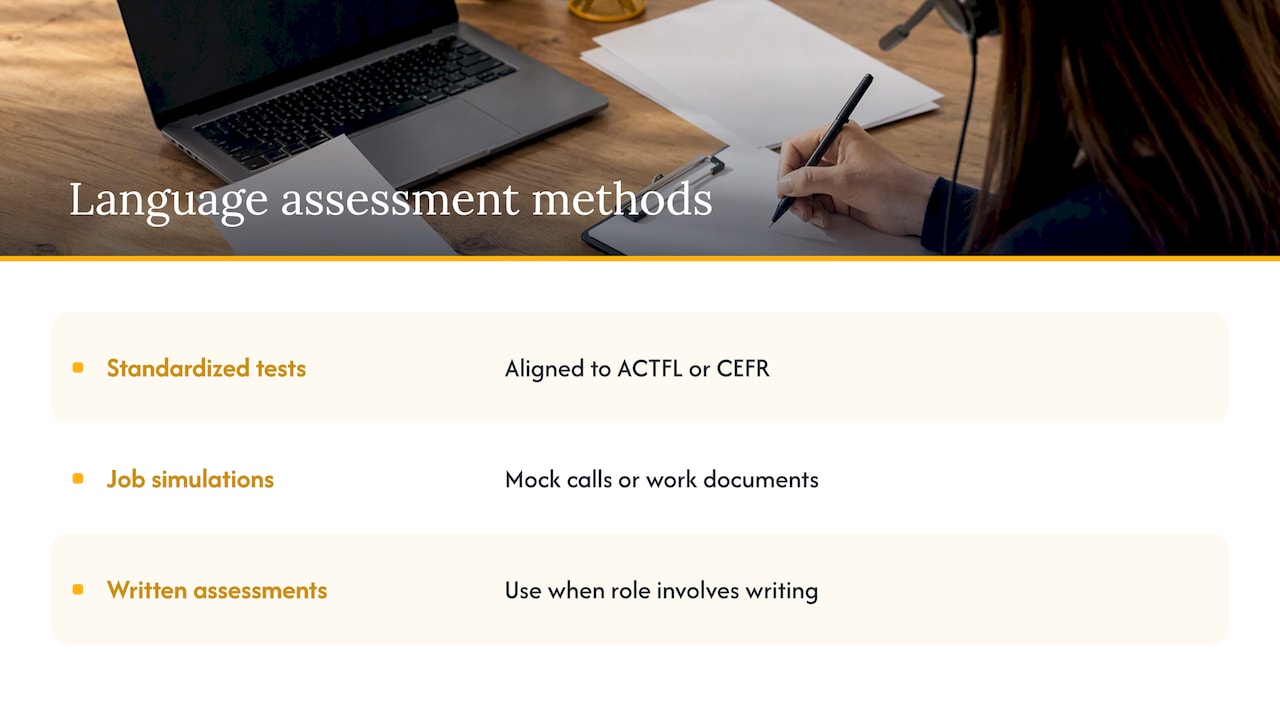
The Department of Justice stresses that independent, structured verification is the most accurate way to assess proficiency. Practical assessment can combine standardized tests aligned to ACTFL or CEFR, job-specific simulations, and written assessments when the role involves writing. Guidance for recruiters also recommends structured assessments that measure the actual tasks, such as mock customer conversations or handling work documents.
There is evidence it pays off. An ACTFL report found that employers who invest in formal language testing are more likely to report satisfaction with employee proficiency.
A four-part screen that works
- Short phone screen (10 minutes). Confirm availability, experience, and basic comfort in both languages.
- Role-play in both languages. Use a real scenario from your queue: a late shipment, a billing dispute, a rescheduled appointment. Score with a rubric covering comprehension, clarity, tone, and accuracy of terms.
- Written task, if the role writes. Have the candidate answer a sample email or summarize a document in the target language.
- English-side check. Bilingual does not mean either-language-adequate. Score the English with the same rubric so you are not hiring a strong Spanish speaker who cannot document the case.
Use the same rubric and the same scenarios for every candidate in the same role. That consistency is what makes the process defensible and fair.
Reassess after hiring
Skills fade when unused. The DOJ guidance recommends periodic reassessment because proficiency can erode if the language is not consistently used professionally. Build a light annual check into quality reviews rather than treating the hiring test as permanent.
What our team has learned about bilingual hiring
We approach this as an operations problem, not a headcount problem. When we staff bilingual seats from our Latin American nearshore locations, three things matter more than any single résumé line.
First, language is only the entry ticket. The agents who improve customer satisfaction pair language with cultural alignment: they understand how a US customer expects to be greeted, how a patient hears reassurance, how a legal client interprets a delay. That is why our hiring and development work, described in our piece on recruiting and nurturing nearshore talent, puts so much weight on communication style, not just test scores.
Second, hiring is half the job. A strong hire without a clear knowledge base and training plan will still stumble. Plan the first weeks deliberately: the framework in our guide to outsourced agent training and the governance advice on multilingual knowledge bases apply equally to in-house teams.
Third, define success before the first offer. Our view is that bilingual coverage should be tied to measurable outcomes such as handle time and satisfaction, which we discuss in how bilingual agents affect Net Promoter Score and handle time. If you cannot name the metric a bilingual seat is meant to move, the role is not defined yet.
— Daniela
Build in-house or extend with a nearshore team
Recruiting directly makes sense when you have a steady, modest number of bilingual seats, a recruiter who can assess both languages, and time to run a full cycle. It gives you direct control over every hire.
It gets harder when:
- You need to add many agents quickly, for a seasonal peak or a new market.
- Your local pool for the language is thin, or the pay needed to win candidates strains your budget.
- Your team cannot evaluate one of the languages itself.
- You need coverage across extended hours.
In those cases, managed team extension moves the sourcing, testing, and training load to a partner while you keep operational direction. If you go that route, read our contract priorities for bilingual customer support and the Spanish and English support checklist first, so that language standards, QA, and scaling terms are written into the agreement. For the broader picture of how proficiency is measured across borders, see our guide to language proficiency in nearshore teams.
How Altiam CX can help
Altiam CX provides nearshore customer experience, managed team extension, technical support, and back-office operations with bilingual agents. Our teams are built for healthcare, legal, ecommerce, and financial services, where terminology and tone carry real stakes. You can see the full range on our services page, the healthcare operations offer, or the legal intake offer. Pricing is scoped to your seats, hours, or managed service, so talk to us about your volumes and languages and we will outline a structure.
A practical 30-day recruiting plan
If you are starting from zero, this sequence keeps the work manageable:
Week 1: Define. Write the skills matrix per role, the required and preferred language levels, and the business reason for each. Have HR or counsel review it against Title VII.
Week 2: Build the assessment. Draft two role-plays from real contacts, one written task if needed, and a scoring rubric. Pilot it on a current bilingual employee to calibrate.
Week 3: Source. Post openly with the language requirement first. In parallel, contact community organizations and college language programs.
Week 4: Screen and decide. Run the phone screen, role-play, and written task. Score independently, compare, and make offers on the rubric, not the gut.
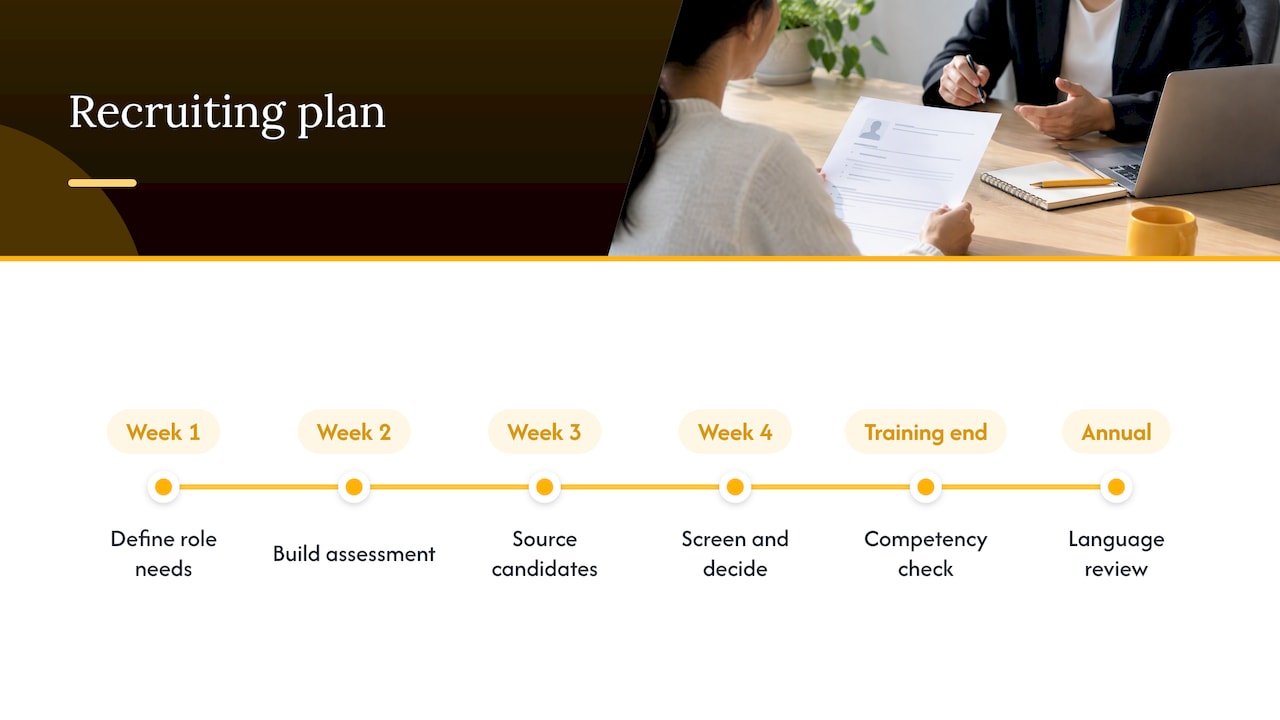
After hire, schedule a competency check at the end of the training period and an annual language review. Track first-contact resolution, handle time, and satisfaction for the bilingual queue separately so you can see whether the seat is working.
Common mistakes to avoid
- Treating native speaker as qualified. Native fluency in conversation does not guarantee professional vocabulary or writing.
- Testing only one language. The agent must document and escalate in English too.
- Using one requirement everywhere. That is both inefficient and a legal exposure under Title VII.
- Skipping the knowledge base. Agents answering in Spanish need Spanish-language resources that match the English ones.
- Hiring one bilingual agent and calling it coverage. One person on one shift is a single point of failure for a whole language queue.
FAQ
How do I verify that a candidate is truly bilingual?
Use a structured assessment instead of asking the candidate. Combine a standardized test aligned to ACTFL or CEFR with a role-play drawn from your real contacts, and score both languages against the same rubric. A written task helps if the job involves emails or documents.
Can I require agents to be bilingual?
Yes, when the requirement is needed to perform the specific job. The EEOC says a fluency requirement must be required for effective performance of the position, so justify it per role and document the reason. Ask your employment counsel to review the wording.
Do I have to pay bilingual agents more?
Title VII does not require extra pay for work in a language other than English, provided you do not require extra uncompensated hours. Competitive markets often pay a premium anyway, so check local pay for comparable bilingual roles before you post.
Where do I find bilingual agents fastest?
Combine open job postings with outreach to local language communities and colleges that have language programs. If you need many agents quickly, a managed nearshore team can shorten the sourcing and training cycle.
When should I use a bilingual recruiter?
Use one when nobody on your hiring team can assess a candidate’s language, for example when applicants cannot be screened without a translator. A bilingual recruiter can run sourcing, screening, and interviews in both languages, though you should still apply your own role-specific test.
Sources
- Language Needs Analysis, ALTA Language Review Services
- Bilingual Candidate Screening Strategies
- EEOC Enforcement Guidance on National Origin Discrimination
- Tips on Building an Effective Staff Language Service Program, U.S. Department of Justice
- Free Bilingual Recruiter Job Description Templates, FirstHR
- Hiring Bilingual Talent: Strategy Guide for US Employers
- How to Recruit Bilingual Employees: Ads, Pay and Testing
- Making Languages Our Business, ACTFL