
Spanish-English support means bilingual nearshore customer and technical support delivered by agents who handle voice, chat, email, and back-office work across both languages. For enterprise buyers, the immediate priority is contracting discipline: require structured language proficiency testing, map security and compliance controls, and lock in enforceable SLAs before signature. We approach every engagement around those three priorities.
TL;DR:
- Write language pass thresholds, channel response and resolution SLAs, staffing guarantees, access limits, subcontractor disclosure, audit rights, and remedies for missed targets into the SOW.
- Combine onboarding tests with live call sampling, role play for regulated workflows, and ongoing scorecards; verify performance rather than relying on vendor pass rates.
- If agents handle electronic protected health information, map access and sign a Business Associate Agreement; payment workflows also require scrutiny of subcontractors and remote connections.
- Use the first 90 days to establish access, validate language skills, pilot limited volume, and make a go or no go decision against agreed metrics.
Table of Contents
- What Bilingual Nearshore Support Covers and Why Buyers Choose It
- Contract Priorities for Spanish-English Support: SOW and SLA Essentials
- How to Measure Language Proficiency and Validate Agents in Practice
- Security, Privacy, and Compliance Checklist for Regulated Workflows
- Practical Implementation Checklist: The First 90 Days After Contract Signature
- How We Approach Bilingual Support Engagements
- We deliver bilingual nearshore teams across customer experience, technical support, and managed team extension, built around the contracting priorities outlined above rather than around generic staffing promises.
- FAQ
- Sources
What Bilingual Nearshore Support Covers and Why Buyers Choose It
Bilingual nearshore support spans more ground than a single call queue. It typically covers inbound and outbound voice, technical troubleshooting, chat and email response, and back-office functions like intake processing, scheduling, and documentation review. For healthcare, legal, and financial services organizations, that back-office layer often carries as much risk and complexity as the live conversation itself.
Nearshore delivery brings practical advantages beyond language coverage. Time-zone alignment with US business hours reduces handoff delays, and bilingual staff availability in Latin America creates a deeper, more sustainable talent pool than many onshore markets can offer. Cultural proximity shortens the learning curve for US consumer expectations, and shorter travel distances make in-person oversight and quality audits far more practical than they would be with offshore teams.
Choosing between nearshore, onshore, and offshore comes down to a few concrete factors:
- Volume and growth trajectory: nearshore scales faster than onshore hiring without the oversight gaps common in distant offshore models.
- Interaction complexity: technical support and regulated intake work benefit from the closer cultural and time-zone fit nearshore provides.
- Compliance exposure: when HIPAA or PCI scope applies, proximity and oversight access become operational requirements, not conveniences.
Bilingual capability is increasingly treated as a baseline expectation rather than a competitive differentiator, according to Frost & Sullivan’s nearshore CX analysis. Buyers now look beyond language fluency to digital enablement and continuity planning as the real differentiators.
Contract Priorities for Spanish-English Support: SOW and SLA Essentials
A well-built statement of work protects language quality, operational continuity, and data security before a single call is taken. We outline these priorities in detail in our contract priorities checklist, and the core elements break down into four categories.
- Language and QA requirements. Require structured proficiency testing with a defined passing threshold, ongoing QA sampling, and acceptance gates before agents go live on your account.
- Service levels. Specify response and resolution SLAs by channel, minimum staffing guarantees, and coverage windows that match your actual demand curve, not a generic average.
- Security and operational terms. Define access rules by role, require disclosure of any subcontractors or nested vendors, and reserve audit rights you can actually exercise.
- Commercial safeguards. Fix the pricing model (per seat, per hour, or managed service), set ramp and exit terms, and attach penalties or remediation clauses to missed SLAs rather than leaving them as goodwill gestures.
Vendor security guidance from the Federal Trade Commission reinforces why these terms belong in the contract itself rather than in a sales conversation: organizations remain accountable for customer data protection even when a breach originates with a vendor, so the written agreement needs to limit access, require monitoring, and spell out breach notification timelines.
Exit and ramp-down terms deserve the same attention as ramp-up terms. A contract that is easy to enter but vague about transition assistance or data return at termination creates risk precisely when you have the least leverage to negotiate.
Pro Tip: Ask any prospective partner to walk through a redacted SOW from a comparable engagement before you negotiate your own, not after.
How to Measure Language Proficiency and Validate Agents in Practice
Marketing claims about “native-level bilingual agents” mean little without a measurable standard behind them. Structured proficiency testing, often using Versant-style assessment methods, gives procurement teams a defined score threshold to require in the contract rather than a subjective impression from a sales call.
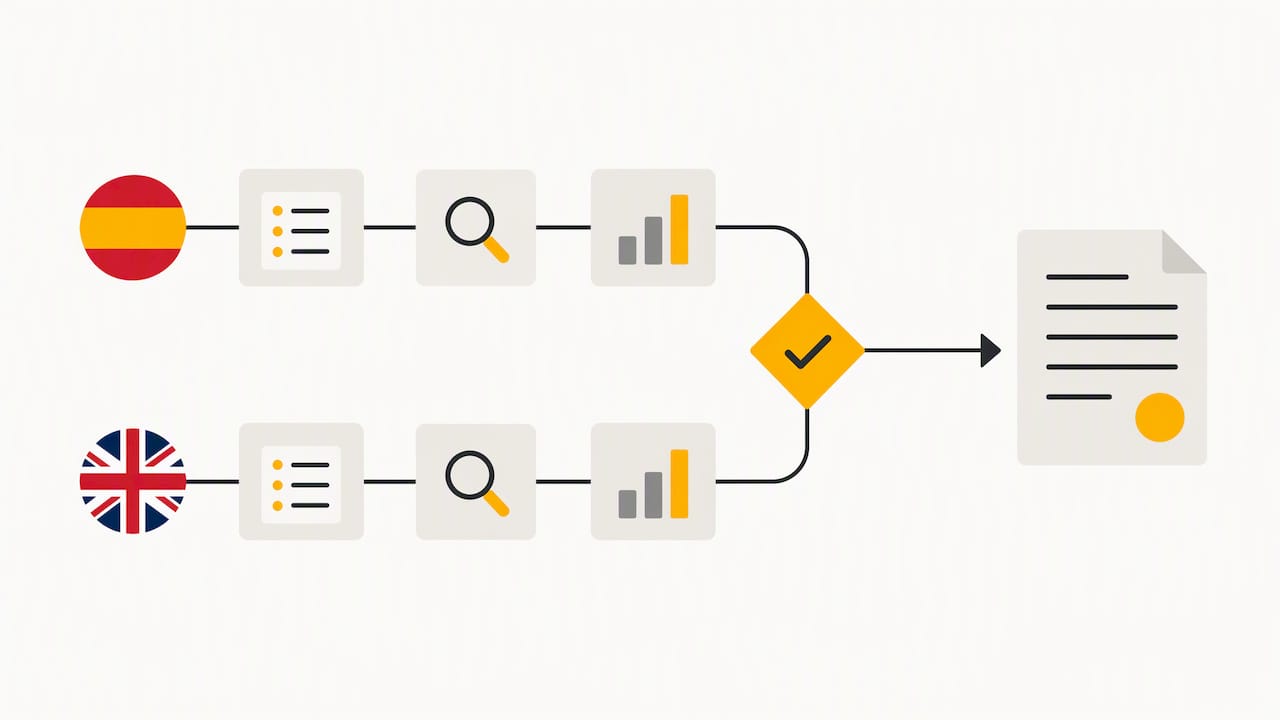
Testing at hire is only the starting point. Frost & Sullivan’s analysis of nearshore CX links structured testing and real-interaction validation to successful delivery outcomes, and recommends buyers treat proficiency measurement as an ongoing practice rather than a one-time gate.
In practice, validation should combine several methods:
- Structured testing at onboarding to set a documented proficiency baseline for every agent before they touch live interactions.
- Live call sampling and recorded QA review to confirm real-world performance matches the test score over time.
- Role-play scenarios for technical or regulated workflows, where precision matters more than conversational fluency alone.
- Ongoing scorecards tracking QA pass rates, escalation handling quality, and sentiment trends across the account.
Requiring these methods in the SOW, rather than accepting a vendor’s self-reported pass rate, is what turns language capability from a claim into something you can audit.
Security, Privacy, and Compliance Checklist for Regulated Workflows
Healthcare and financial services engagements carry regulatory weight that general CX contracts do not. The first step is mapping exactly what agents can access: if a provider creates, receives, maintains, or transmits electronic protected health information on your behalf, it generally qualifies as a HIPAA business associate and needs a signed Business Associate Agreement, according to HHS guidance on cloud computing and HIPAA. Encryption alone does not remove that obligation.
Payment-related workflows carry a parallel exposure. Using a third-party service provider does not eliminate your own PCI responsibilities, and the PCI Security Standards Council’s third-party guidance specifically warns that nested subcontractors and remote connectivity can expand PCI scope beyond what the primary contract anticipated.
A practical compliance checklist includes:
- Access mapping that documents exactly where agents touch ePHI or cardholder data.
- BAAs and encryption requirements written into the contract, not referenced informally.
- Subcontractor disclosure covering any nested vendor who might touch regulated data.
- Audit rights you can exercise on a defined schedule, not only after an incident.
The FTC’s guidance describes this as a “trust but verify” standard: contracts should include security provisions, limit vendor access on a need-to-know basis, and establish ongoing monitoring and breach notification procedures rather than relying on a vendor’s word alone.
Periodic attestation, SOC or ISO reports, and remote-access reviews should recur on a fixed calendar, not only when a renewal is approaching.
Practical Implementation Checklist: The First 90 Days After Contract Signature
The first 90 days determine whether a bilingual nearshore engagement meets its SLAs or spends its first year catching up. A structured ramp plan reduces that risk.
- Weeks 1 to 2: governance and access setup. Finalize account provisioning, security onboarding, and sign-off on the SOW’s operational annexes.
- Weeks 3 to 4: language validation and knowledge transfer. Run proficiency testing against your documented threshold and complete structured knowledge transfer sessions with your clinical, legal, or technical subject matter experts.
- Weeks 5 to 8: pilot volume. Route a limited, representative volume to validate real SLA performance before full-scale handoff.
- Weeks 9 to 12: full ramp and metric review. Track QA pass rate, first-contact resolution, average handle time, and sentiment or NPS trends against the baselines set in your SOW.
Pro Tip: Treat the pilot phase as a contractual checkpoint, not a formality: build a go/no-go decision into the SOW tied to the metrics above.
How We Approach Bilingual Support Engagements
Our contracting approach centers on measurable language validation, documented operational discipline, and compliance mapped to the workflow. Our work with an orthodontic services provider reflects how that discipline plays out inside a regulated, healthcare-adjacent environment.
We would rather walk through the checklist above with you directly than ask you to take language quality on faith.
— Daniela
We deliver bilingual nearshore teams across customer experience, technical support, and managed team extension, built around the contracting priorities outlined above rather than around generic staffing promises.

For regulated workflows, our healthcare CX operations team handles patient support and SOP management with HIPAA considerations built into the engagement, and our legal intake and case communication services cover intake, scheduling, and back-office support for law practices. Visit our services page to request an assessment of your current support model.
FAQ
What does Spanish-English support mean for a business buyer?
It means a nearshore team of bilingual agents handling customer service, technical support, or back-office work in both Spanish and English, under a managed contract rather than individual hires. Buyers typically use it to extend coverage hours, add language capacity, and manage cost without building an in-house bilingual team.
How do I verify an agent’s bilingual proficiency before signing a contract?
Require structured proficiency testing, often following Versant-style methods, with a documented passing threshold written into the SOW, as recommended in Frost & Sullivan’s nearshore CX research. Follow that initial test with live call sampling and recorded QA review to confirm the score holds up in real interactions.
Does a nearshore vendor need a HIPAA Business Associate Agreement?
If agents create, receive, maintain, or transmit electronic protected health information on your behalf, the vendor generally qualifies as a business associate and needs a signed BAA, per HHS guidance. Map every touchpoint where agents could access that data before finalizing scope.
What should a bilingual support contract include to limit risk?
It should specify language testing thresholds, response and resolution SLAs, access and subcontractor disclosure rules, and audit rights, following the “trust but verify” standard described in FTC vendor security guidance. Commercial terms should also define ramp and exit conditions and remediation steps for missed SLAs.
What services does Altiam CX offer for Spanish-English support?
We offer managed customer experience, technical support, and team extension services with bilingual staffing, along with vertical-specific programs for healthcare operations and legal intake. Pricing is available on request based on seat count, hours, or managed service scope.
Sources
- English Proficiency 2.0: The Growth Accelerator for Nearshore CX Management — Frost & Sullivan
- Hhs
- Third-Party Security Assurance — PCI Security Standards Council