
A managed nearshore bilingual customer support team is the right call when you need to scale Spanish and English coverage fast without the six-month hiring cycle of building it onshore. The model pairs cultural alignment with real time-zone overlap, and it typically improves NPS while shortening handle time when the vendor runs disciplined coaching and QA. One option built specifically around this delivery model exists, though the fit ultimately depends on your compliance requirements and volume.
TL;DR:
- Nearshore bilingual support teams can deliver faster scale and cost predictability compared to onshore hiring, especially for high-volume or seasonal demand.
- Successful deployment hinges on strict ramp, quality assurance, and governance practices, including proficiency testing, regular reviews, and clear SLA metrics.
- Vendors must disclose subcontracting, meet security standards, and demonstrate AI governance to avoid governance-related failures within the first few months.
- Language proficiency testing should be role-specific with ongoing assessments, and onboarding typically reaches full capacity within three months.
- AI tools like language routing and real-time knowledge surfacing enhance efficiency and customer experience when integrated with solid vendor management and compliance practices.
Table of Contents
- What Are the Business Benefits of Bilingual Customer Support?
- When Should You Choose a Managed Nearshore Bilingual Team?
- How Do You Evaluate and Contract a Bilingual Support Vendor?
- How Do You Onboard and Govern a Bilingual Team?
- How Do AI and Automation Fit Into Bilingual Support?
- What Should Buyers Watch for Before Signing a Bilingual Vendor?
- How Altiam CX Supports Bilingual Customer Support Programs
- Sources
- FAQ
What Are the Business Benefits of Bilingual Customer Support?
Bilingual agents change the math on three metrics executives actually track: Net Promoter Score, average handle time, and first-contact resolution. When a customer reaches an agent who speaks their language without a transfer or a translation delay, the interaction resolves faster and with less friction. Altiam CX’s internal analysis of bilingual deployments found measurable gains in NPS alongside reduced handle time once agents received targeted language coaching and consistent quality scoring.
The cost logic favors nearshore delivery too. Seat-based or managed-service pricing gives you predictable monthly spend instead of the recruiting, benefits, and turnover costs that come with building a bilingual desk onshore.
Deloitte’s outsourcing survey work found that Many organizations now outsource front-office functions, and buyers increasingly judge partners on combined human and digital capability rather than price alone.
Three operational advantages compound the savings:
- Time-zone overlap that keeps live coverage aligned with US business hours
- Cultural alignment that reduces friction on tone and context, not just vocabulary
- Fewer escalations and transfers, since one agent can handle both languages instead of routing between desks
When Should You Choose a Managed Nearshore Bilingual Team?
This model fits best where volume and repeatability meet a real bilingual demand curve. High-volume voice and chat queues, seasonal spikes around holidays or open enrollment, and regulated intake workflows in legal or healthcare all suit a managed nearshore setup, provided your governance framework accepts a vendor operating outside your building.
It fits poorly in a few specific situations:
- Work requiring physical presence, like in-person patient intake or courier logistics
- Extremely narrow dialect or regional-language needs that a general bilingual pool can’t cover
- Regulatory environments that flatly prohibit offshore or nearshore data handling
Most CX leaders don’t pick one sourcing model exclusively. Managed nearshore teams usually sit alongside insourced specialists and, for larger enterprises, global in-house centers, each handling the workload it’s best suited for.
How Do You Evaluate and Contract a Bilingual Support Vendor?
Vendor selection is where most bilingual programs succeed or fail, and it happens well before the first call gets answered. Build your RFP and contract around five priorities, in this order:
- Security and compliance. Require independent audits, encryption standards, and role-based access controls in writing. The FTC’s guidance on vendor data security is explicit: your organization keeps liability for a vendor’s breach, so contract language on breach notification timelines isn’t optional.
- Subcontracting transparency. Demand disclosure of any foreign-based subcontracting and reserve a right-to-audit clause. FDIC guidance on third-party risk treats undisclosed subcontracting as a supervisory red flag, particularly for financial-services clients.
- Language validation. Insist on role-appropriate proficiency testing, not a generic fluency check, plus ongoing on-the-job assessment. Altiam CX’s approach to language proficiency testing in nearshore hiring is a useful reference point for what rigorous screening looks like.
- SLA metrics. Lock in Average Speed of Answer, AHT, FCR, CSAT, and NPS targets with a defined reporting cadence, monthly at minimum.
- Governance and continuity. Require remediation timelines, a clear escalation path, and a documented service-continuity plan for outages or staffing gaps.
Pro Tip: Ask for a facility walkthrough, virtual or onsite, before signing. Vendors with nothing to hide schedule it within a week; the ones who stall are telling you something.
How Do You Onboard and Govern a Bilingual Team?
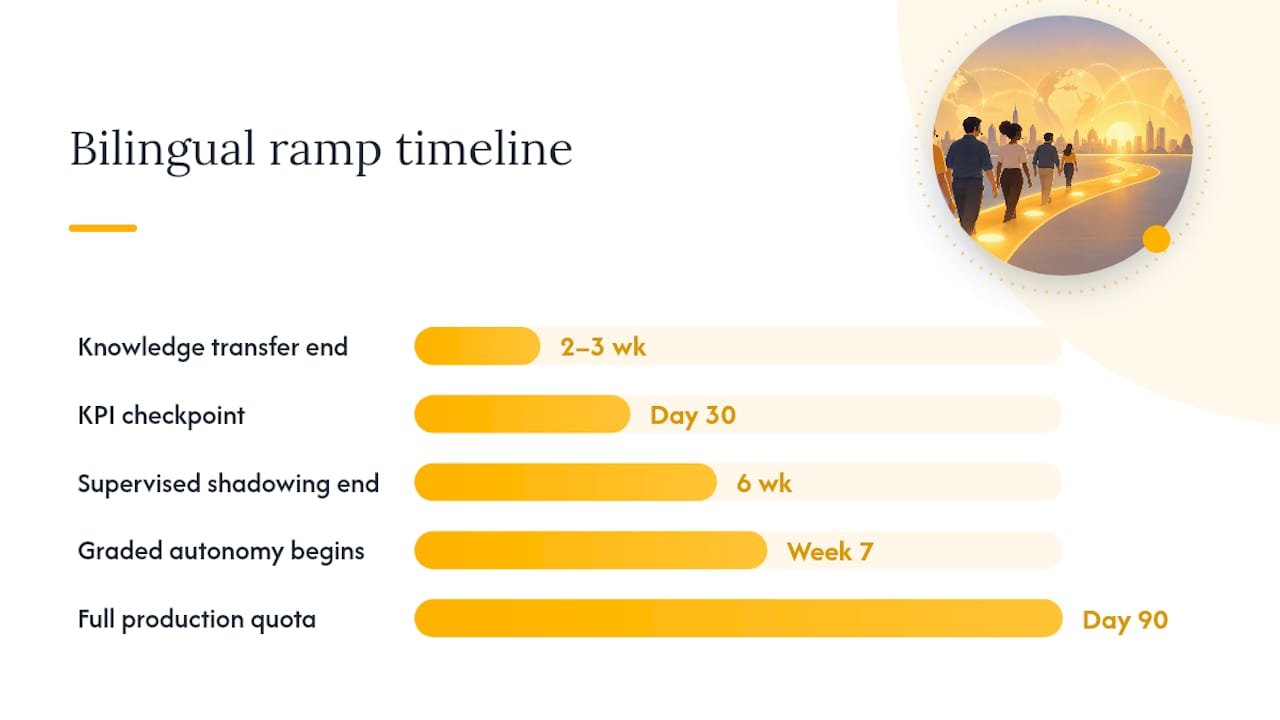
Ramp discipline determines whether your bilingual launch hits its numbers in month one or month four. A workable timeline runs through three phases: knowledge transfer and systems access in the first two to three weeks, supervised shadowing through week six, and graded autonomy from week seven onward, with full production quotas by day 90.
Your quality program needs four fixed components:
- A QA rubric scored against real call and chat transcripts, not sampled scripts
- Regular sampling frequency, weekly at minimum during ramp
- Language coaching tied to specific error patterns, not generic training modules
- Scorecards tracking FCR, AHT, CSAT, and NPS side by side so trends are visible early
Run root-cause reviews biweekly during the first 90 days, then shift to monthly ops reviews once metrics stabilize. Pro Tip: Set your first KPI checkpoint at day 30, not day 90. Catching a coaching gap early costs you a conversation. Catching it late costs you a quarter of missed targets.
How Do AI and Automation Fit Into Bilingual Support?
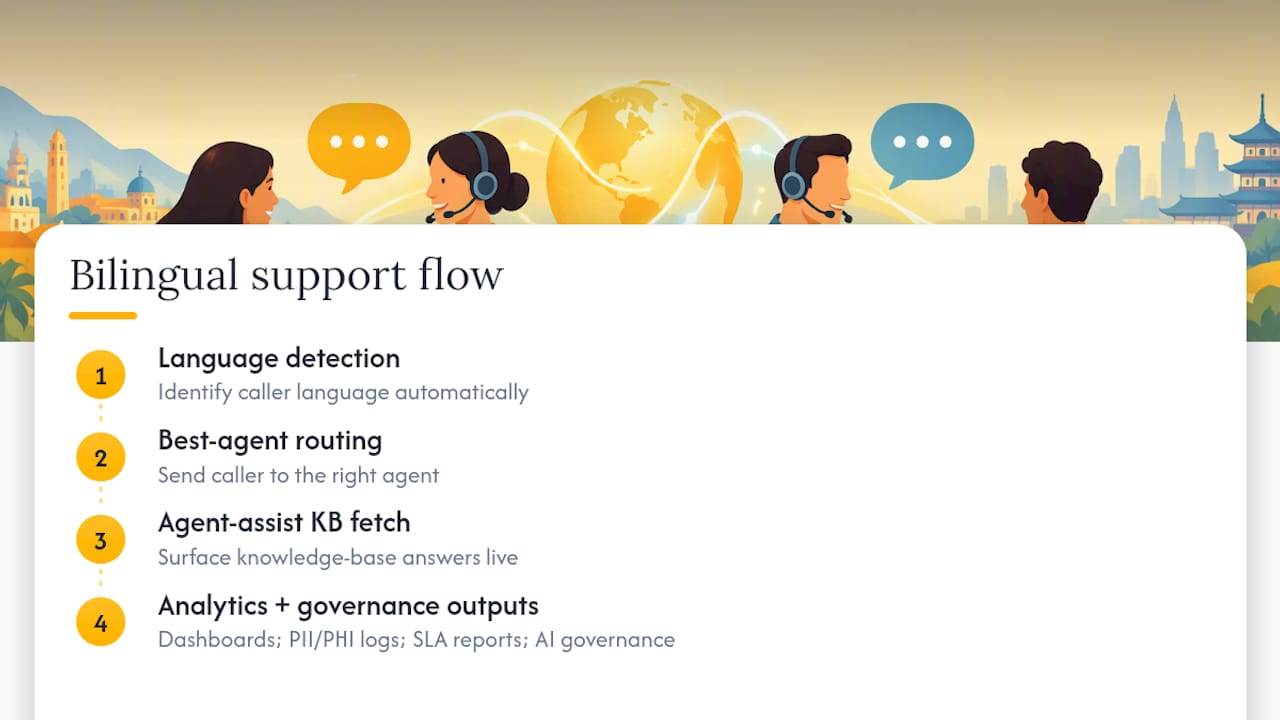
Bilingual coverage and automation aren’t competing investments; the strongest programs run them together, demonstrating how AI for agencies can boost productivity and ROI in agency workflows. Language-detection routing sends callers to the right agent on the first attempt, agent-assist tools surface knowledge-base answers in real time, and conversational analytics flag sentiment shifts before they become complaints. Deloitte’s contact center research found that enterprises increasingly expect vendors to route callers to the most knowledgeable available agent, with analytics baked in rather than bolted on.
Ask any vendor for four concrete outputs: conversation analytics dashboards, compliance logs for PII and PHI handling, SLA reporting, and a documented AI governance model that shows how data actually flows through their systems. Our breakdown of AI integration in customer support covers what a workable model looks like in practice.
What Should Buyers Watch for Before Signing a Bilingual Vendor?
The vendors that disappoint clients almost never fail on language quality. They fail on governance gaps that surface three months in: undisclosed subcontracting, QA that exists on paper but never drives coaching, or SLA reporting that shows up late and incomplete. Altiam CX’s internal data on bilingual agents lifting NPS while cutting handle time only holds up when a partner enforces the ramp and QA discipline behind those numbers, not just the language fluency.
My advice to any CX leader running an RFP: ask for the escalation path and the QA rubric before you ask about pricing. A vendor that can’t produce either on request usually can’t produce the results either.
— Daniela
How Altiam CX Supports Bilingual Customer Support Programs
One provider has built its model specifically around nearshore delivery from Latin America, agents screened for role-appropriate bilingual fluency, and measurable KPI tracking from day one instead of quarter three.
Where a traditional onshore build asks you to recruit, train, and absorb turnover risk yourself, Altiam CX’s managed team extension model puts a bilingual desk into production in weeks, with cultural alignment and cost predictability baked into the seat rate rather than negotiated after the fact. A first engagement typically starts with a discovery call to map your volume and compliance needs, followed by a pilot cohort before scaling to full managed seats. For healthcare organizations handling PHI, the healthcare CX operations page details how patient support and SOP management get structured for regulated intake. Legal practices evaluating intake and case-communication support can review the law-practice intake capabilities for a closer look at what managed legal team extension covers.
If you’re ready to see what a pilot bilingual cohort looks like for your volume, request a scoping conversation with the Altiam CX team.
Sources
- FTC: Safeguards rule and protecting personal information guidance
- FDIC guidance on third-party/foreign-based service provider risk
- Deloitte Global Outsourcing Survey (2024/2025 coverage)
FAQ
What Is Bilingual Customer Support?
Bilingual customer support means outsourced or nearshore agents fluent in two languages, typically English and Spanish, handle voice and chat inquiries without transferring customers between desks. It reduces friction for customers and cuts the handle time that comes from language-based transfers.
How Much Does a Managed Bilingual Support Team Cost?
Pricing for managed nearshore bilingual teams is typically seat-based or structured as a managed service rather than a flat rate, and it varies by volume and complexity. Altiam CX does not publish fixed pricing; current rates are available by contacting the Altiam CX services team directly.
How Long Does It Take to Launch a Bilingual Support Team?
A typical ramp involves knowledge transfer and system access in the first few weeks, supervised shadowing for about a month, and graded autonomy thereafter, reaching full production in around three months. Complex regulated workflows, like legal intake or healthcare, can extend that timeline slightly for compliance training.
What Should Be in a Bilingual Support Vendor Contract?
Contracts should specify security expectations and subcontracting disclosure, since the FTC confirms liability for vendor breaches stays with the hiring organization. They should also lock in SLA metrics like AHT, FCR, CSAT, and NPS with a defined reporting cadence.
Is Nearshore Bilingual Support Better Than Onshore Hiring?
Nearshore bilingual support generally offers faster time-to-capacity and more predictable costs than onshore hiring, along with strong time-zone overlap for US-based operations. Onshore hiring can still make sense for narrow regulatory environments or roles requiring physical presence that a nearshore model can’t cover.