
The build-operate-transfer (BOT) model is a contract in which a service provider sets up an operation for you, runs it for an agreed period, and then hands it over to you. In customer experience and business process outsourcing, that operation is usually a delivery center in another country. Gartner defines BOT as a hybrid of the “build” option (a captive center) and the “buy” option (outsourcing), with the intent to transfer written into the contract from day one.
If you lead customer support, operations or a CX function, the real question is not what BOT means. It is whether owning a delivery center is the right end state for you, and what the handover will cost. This guide covers both.
TL;DR
- BOT has three phases: the provider builds the operation, runs it under a standard service agreement, then transfers it to you as a captive center.
- BOOT differs on ownership: the provider owns the entity and infrastructure until the transfer milestone.
- The money and the risk sit at the handover: transfer trigger, valuation, fee and intellectual property assignment.
- BOT can cost more than pure outsourcing, so it suits companies that truly want to own the center long term.
- If you want capacity, bilingual agents and measurable service without owning an entity, a managed nearshore team is the faster route.
Table of Contents
- What the build-operate-transfer model means in outsourcing
- The three phases: build, operate, transfer
- BOT vs BOOT vs conventional outsourcing
- How ownership can be structured
- What a BOT contract must settle
- What BOT costs
- Benefits and risks side by side
- An illustrative BOT scenario
- When BOT makes sense, and when a managed team fits better
- Our perspective
- Build a nearshore team without the handover
- FAQ
- Sources
What the build-operate-transfer model means in outsourcing
BOT started outside outsourcing. Morgan Lewis notes that businesses have long used it to enter foreign jurisdictions where entry is difficult or expertise is lacking, and that private entities have used it to deliver public projects such as a hospital or a toll road. The same logic was later applied to IT and business process services.
In outsourcing, Legal 500 describes the structure as sitting between a captive and a full outsource. The customer engages a third-party expert to set up the local entity, staff it and run it for a set number of years, then transfer it back. The customer typically pays an operating fee and a buy-out fee at the end. The customer can call for the transfer at the end, or at any time, or walk away.
That last point matters for decision makers. Because the contract includes an exit option, Everest Group says enterprises can test the model without committing fully.

The three phases: build, operate, transfer
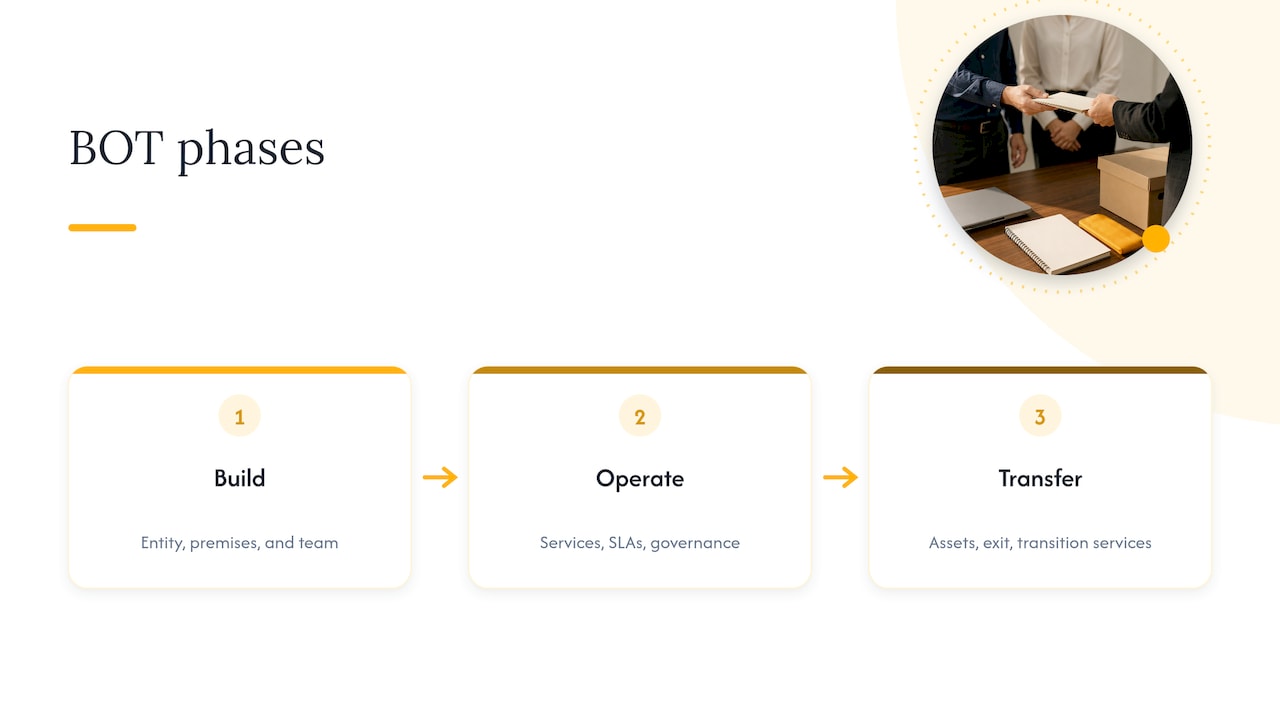
Build
The provider designs and stands up the operation. According to Morgan Lewis, that means setting up a legal entity, obtaining premises, procuring the services the center needs and hiring people, usually after a design phase.
The build phase is where BOT differs most from a normal outsourcing deal on cost. Everest Group notes that the enterprise invests nothing or a limited amount at this stage, while the vendor typically funds most of the upfront investment: the facility, technology infrastructure and hiring mechanism. The provider recovers that money in the next two phases.
Operate
This phase looks like conventional outsourcing. The center is contractually obliged to deliver specified services under standard outsourcing provisions, with service levels, reporting and governance. Everything you would demand of any outsourced CX team applies here, which is why a governance model that measures loyalty rather than handle time is worth setting up before launch, not after.
The operate phase is also your rehearsal for ownership. You see the attrition, quality and cost data the center will produce once it is yours.
Transfer
Morgan Lewis calls the transfer phase particularly complex. It generally includes moving assets or the entity itself, comprehensive exit obligations, and a transitional services agreement to cover any service gaps.
TechTarget points out the upside: the two teams have already worked together before ownership changes hands, and after transfer, issues become an internal matter instead of a contract negotiation with another company.
BOT vs BOOT vs conventional outsourcing
The difference is who owns what, and when.
| Conventional outsourcing | BOT | BOOT | |
|---|---|---|---|
| Who owns the operation | Provider | Client holds beneficial ownership from day one, per RBMSoft | Provider owns entity and infrastructure until transfer |
| What you receive | Deliverables and service levels | Ownership of the operation at the end | Ownership at the transfer milestone |
| Typical duration | Contract term | 18 to 30 months, as RBMSoft describes it | 24 to 48 months, per the same source |
| Upfront capital | Low | Low to limited | Lowest for the client |
| Exit | Renew or re-bid | Transfer, or walk away | Transfer at milestone |
Is BOT the same as a public-private partnership? Not exactly. Infrastructure BOT is a project delivery method for public assets. The outsourcing version borrows the vocabulary but is a commercial contract between two companies, and its risks are different: staffing, data, labor law and intellectual property rather than tolls and concessions.
How ownership can be structured
Morgan Lewis identifies three common structures:
- Asset based. The provider sets up the offshore center and you hold an option to require transfer of all applicable assets.
- Corporate entity, provider owned. You hold an option to buy the full share capital of the entity.
- Corporate entity, joint venture. You hold an option to buy the provider’s share capital in the joint entity.
Each changes your tax, employment and liability exposure at handover. A share purchase brings the whole entity with its history. An asset transfer is cleaner but needs more work to rehire people and move contracts.
What a BOT contract must settle
The biggest risks in BOT are contractual and sit around the handover. Wisemonk lists them as an unclear transfer trigger or valuation, intellectual property never assigned to the client, and in the worst case a partner who holds your shares along with the ability to take control. Renegotiating at handover is common and expensive, which is why price, valuation and timing are negotiated years ahead.
Transfer triggers
Astravise Services describes four mechanisms:
- Fixed date. The window opens on a stated date, typically 24 to 36 months after go-live.
- Steady-state milestone. The window opens when conditions are met: headcount at plan, service levels held for consecutive months, attrition under a threshold, documentation signed off.
- Client call option. You can require transfer any time after a lock-in, at a valuation fixed on exercise.
- Provider put option. The provider can require you to take the center on defined events, such as a change of control or sustained non-payment.
The same source warns that milestone triggers and put options are where deals end up in arbitration, because milestones have to be measurable and independently verifiable. If you write a milestone such as “stable attrition,” you have written a dispute. Write “voluntary attrition below a stated percentage for six consecutive months, verified by a named party.”
Clauses to settle before you sign
- Transfer fee formula and how it is calculated
- Who owns scripts, knowledge bases, process documentation, tooling configurations and recordings
- Employee transfer terms and who carries accrued liabilities
- A transitional services period with defined scope
- Data protection obligations for both phases
- Exit rights if you decide not to take the center
BakerHostetler advises that a sound BOT structure needs careful thought on intellectual property, tax, labor and employment, export compliance, privacy and data security, as well as cultural issues, geopolitical risk and cross-border dispute resolution. Have counsel in each jurisdiction review those areas. Regulated industries such as healthcare, legal and financial services add sector rules on top.
What BOT costs
BOT shifts cost; it does not remove it. Everest Group states that BOT avoids upfront capital investment, reduces operational risk, limits oversight burden and speeds time to market. It also puts numbers on the premium:
- Operate-phase margins are typically 2 to 5% higher than in pure outsourcing.
- The one-time transfer fee can reach 20 to 30% in some cases, usually set as a percentage of the annual fee during the build phase and agreed in the service contract.
- A BOT construct can be roughly 15 to 30% more expensive than a fully owned model built from scratch.
Those figures come from an analysis of global business services in 2020, so treat them as a range to test against current quotes, not a price list. Ask every bidder to model total cost over the full term, including the transfer fee, and compare it with the cost of simply running the same seats as a managed service. For a wider view of the trade-offs, the build versus buy trade-offs in another discipline show the same logic: owning an asset only pays when you will use it long enough to recover the premium.
Benefits and risks side by side
Benefits
- Little or no upfront capital while the provider funds setup
- Faster launch than building alone, since the provider brings hiring and facilities
- A trial period before full ownership
- A team that already knows your processes when it becomes yours
Risks
- Complex contracts. Innowise notes they are more detailed than standard outsourcing, covering scope, KPIs, transfer terms, IP, governance and exit rules.
- Higher total cost than pure outsourcing
- Dependence on the partner’s quality during build and operate
- Cultural and communication gaps
- Local rules on labor, data protection and tax
Every risk on that list is manageable with the right partner and a disciplined contract. The most useful habit is to treat the transfer as a project with its own plan from the first month. Our guide to a four-phase outsourcing transition plan applies equally to a handover.
An illustrative BOT scenario
Picture a U.S. healthcare billing company that needs 40 bilingual support agents in Latin America. It signs a BOT agreement with a 30-month operate period.
- Months 0 to 6, build. The provider recruits, sets up the site and technology, and writes the SOPs. The client pays little upfront.
- Months 6 to 30, operate. The provider runs the team against agreed service levels. The client reviews quality, attrition and cost monthly.
- Month 30, transfer. A milestone trigger fires once service levels hold for six straight months. The client pays the transfer fee, takes over the entity and signs a short transitional services agreement.
This is a hypothetical example, not a client case. It shows why the milestone definition, fee and IP assignment deserve more negotiation time than the build itself.
When BOT makes sense, and when a managed team fits better
BOT suits you if all of these hold:
- You plan to run the center for many years and want to own it.
- You have the management bench to operate a foreign entity after transfer.
- Your volume is large and stable enough to repay the premium.
- You can handle the legal, tax and employment obligations that come with a foreign subsidiary.
If instead your priority is service quality and capacity now, with room to scale seats up or down, a managed team arrangement removes the entity, the transfer fee and the handover risk. You get bilingual agents, defined performance measures and a partner accountable for operations. Our guide to the nearshore operational model explains how that works, and the checklist for outsourcing critical support functions helps you compare either route on the same criteria.
Our perspective
Many leaders who search for BOT are really asking a different question: how do I get a reliable, culturally aligned team without carrying the weight of a new foreign entity?
We start from the operation, not the structure. In our experience, the first goal is a team that answers customers well, in their language, against measurable targets. Ownership is a second decision, and it is easier once you have performance data in hand.
That is why we focus on nearshore delivery from Latin America, with rapid talent sourcing, bilingual staff and team models that scale as your volume does. Our Managed Team Extension is built so that your standards, your SOPs and your quality framework drive the work, which gives you much of what BOT promises: a team that knows your business and a path to deeper integration, without a transfer negotiation.
If you still want ownership at the end, the same discipline applies: document everything, measure what customers feel, and define the handover in writing from the start.
Daniela
Build a nearshore team without the handover
Altiam CX provides nearshore customer experience, technical support, back-office operations and managed team extension. We build industry-specific programs for healthcare, legal, ecommerce and financial services, delivered by bilingual agents from Latin America. Explore our customer experience and team extension services to see how a managed team can start with your processes and grow with your volume.
Healthcare teams can look at our patient support and SOP management program. Law practices can review our legal intake and client communication services.
FAQ
What is a build-operate-transfer agreement?
It is a contract in which a provider builds an operation, runs it for an agreed period, then transfers it to the client. It combines outsourcing’s low upfront burden with insourcing’s eventual ownership. The agreement sets the transfer trigger, fee and exit terms.
What is the difference between BOT and BOOT?
In BOT, the client holds beneficial ownership from the start while the partner operates. In BOOT, the provider owns the entity and infrastructure until the transfer milestone. BOOT typically runs longer, according to RBMSoft.
Is BOT a PPP model?
BOT began as a project delivery method for public infrastructure, often through public-private partnerships. In outsourcing, the same name describes a private contract between two companies for a delivery center. The phases match, but the risks and regulation are different.
How long does a BOT arrangement last?
Providers commonly describe BOT terms of about 18 to 30 months, and fixed-date triggers often fall 24 to 36 months after go-live, as Astravise Services notes. Your own term depends on volume, complexity and the trigger you negotiate.
Is a managed nearshore team an alternative to BOT?
Yes, for companies that want service capacity and quality without owning a foreign entity. A managed team keeps operations with the partner while you keep control of standards and reporting. It avoids a transfer fee entirely.
Sources
- Gartner: Build-operate-transfer
- Legal 500: Alternative Offshore Outsourcing Structures
- Morgan Lewis: Rise of the BOTs
- Everest Group: Commercial construct of a BOT model
- RBMSoft: BOT and BOOT guide
- Wisemonk: Build Operate Transfer guide
- Astravise Services: BOT contract structure and transfer triggers
- BakerHostetler: The BOT model
- Innowise: BOT model guide