
Run a forecast-driven, interval-by-interval staffing cycle: forecast, capacity planning, schedule, monitor, and adjust in real time. Use Erlang C as your baseline for queued voice work, then layer in separate modeling for chat, messaging, and other channels. Success comes down to three numbers: service level, forecast accuracy, and shrinkage. Get those right and everything else in your contact center staffing model tends to follow.
TL;DR:
- Accurate forecast and shrinkage data are crucial, as they directly impact headcount requirements beyond initial Erlang C calculations.
- Modeling each communication channel separately prevents over- or under-staffing caused by blending synchronous and asynchronous queues.
- Incorporating real-time intraday adjustments and recourse actions based on arrival data reduces contact abandonment and improves service levels.
- Building staffing plans around interval-level demand rather than peak daily volume helps avoid common scheduling errors.
- Using a pilot period and defining clear ownership for each staffing step enhances model reliability and compliance.
Table of Contents
- The repeatable staffing cycle from forecast to intraday adjustments
- Baseline calculations: using Erlang C and converting to scheduled headcount
- Modeling omnichannel and multiskill capacity
- Shrinkage: calculating coverage and the workforce levers that move the needle
- What to require from staffing and WFM tools: an evaluation checklist
- Stochastic and two-stage staffing: making plans defensible under uncertainty
- How to choose and operationalize a staffing model: KPIs, cadence, and a checklist
- Impact of agent attrition and turnover on staffing models
- Legal and compliance considerations related to staffing
- Different staffing models compared: centralized versus decentralized
- Impact of remote or hybrid workforce design on staffing models
- Where staffing plans usually break down
- How Altiam CX helps operations implement forecast-driven staffing
- Primary sources and vendor documentation to validate formulas and policies
- Sources
- FAQ
The repeatable staffing cycle from forecast to intraday adjustments
A contact center staffing model is a lifecycle, not a spreadsheet you build once a quarter. Microsoft’s workforce management documentation describes it as a loop: forecast, capacity plan, schedule, publish, monitor adherence, and adjust intraday. Long-term planning runs in daily or weekly buckets for budgeting and hiring; short-term planning drops to 15-minute intervals so staffing actually matches when contacts arrive.
Each step needs specific inputs to work:
- Forecast: interval-level contact volume and average handle time (AHT), split by channel and skill.
- Capacity planning: service-level target, answer-time target, shrinkage rate, and concurrency assumptions for non-voice channels.
- Scheduling: shift patterns that match interval requirements while respecting labor rules and agent preferences.
- Publishing: schedules released with enough lead time for agents to plan around them.
- Adherence monitoring: real-time tracking of whether staffed agents are where the schedule says they should be.
- Intraday adjustment: corrections when actual volume or AHT diverges from forecast.
Decision ownership matters as much as the steps themselves. Workforce planners typically own the forecast and capacity plan, team leads own adherence and local intraday calls, and operations managers own the escalation path when intraday recourse (overtime, schedule changes, skill reassignment) is needed. Without a named owner at each stage, forecasts go stale and intraday drift compounds through the week.
Baseline calculations: using Erlang C and converting to scheduled headcount
Erlang C takes interval contact volume, average handle time, interval length, and a service-level target, then returns the number of agents needed to hit that target for queued voice traffic. Cisco’s sizing guidance treats it as the standard starting point, calculated separately for each interval rather than averaged across a shift.
Say a 30-minute interval gets 120 calls with an average handle time of 4 minutes. That workload, run through Erlang C against an 80/20 service-level target, might return a requirement of 15 agents on the phone during that half hour. That figure is not your schedule. It is the on-phone headcount before shrinkage.
Statistic: Shrinkage is the gap between theoretical staffing from calculators and the practical number of staff available, and the accepted conversion is staff required = demand ÷ (1 - shrinkage). If those 15 agents sit against a shrinkage rate, the scheduled headcount becomes 15 divided by (1 minus the shrinkage rate), increasing the number of people on the roster for that interval accordingly.
Erlang C has real limits worth knowing before you lean on it too hard:
- It assumes a single queue and a single skill, which breaks down the moment multiskill routing enters the picture.
- It assumes patient callers who do not abandon, which can overstate required staffing versus attrition-adjusted models.
- It struggles with volatile, low-volume intervals where small forecast errors swing the required headcount disproportionately.
When any of those conditions apply, stress-test the Erlang output with simulation or a queuing model built for multiskill environments rather than trusting the single-queue number outright.
Modeling omnichannel and multiskill capacity
Voice, chat, messaging, and email do not behave the same way, and treating them as one blended queue is one of the fastest ways to misstaff a contact center. Model each channel and queue separately first, then evaluate whether pooling agents across them actually helps.
- Voice is synchronous and one-to-one: an agent handles one call at a time, and Erlang C applies directly.
- Chat allows concurrency, often two or three sessions per agent, which changes the staffing math entirely since headcount does not scale linearly with volume.
- Messaging and email are asynchronous, so the relevant target shifts from answer speed to response-time windows measured in hours, not seconds.
Research on multiskill routing and staffing under uncertainty shows that once agents work multiple queues, independent per-queue Erlang sizing can miss the benefits of pooling and overstate the headcount you actually need. The fix is an optimization-supported model or simulation that accounts for shared capacity, not a stack of single-queue spreadsheets added together. A common pitfall is applying a voice-style, one-contact-at-a-time assumption to chat: it looks conservative but quietly inflates staffing requests. Getting channel and queue definitions right before you build the schedule, as omnichannel routing guidance for CX leaders lays out, prevents that error from compounding downstream.
Shrinkage: calculating coverage and the workforce levers that move the needle
Shrinkage is the difference between the staff your calculator says you need and the staff actually available to take contacts. The formula, per Call Centre Helper’s guidance, is staff required = demand ÷ (1 - shrinkage). If Erlang indicates 70 agents and shrinkage is taken into account, scheduled staff increases accordingly to cover availability gaps.
Two categories are worth tracking separately:
- External shrinkage: paid time off, sick leave, holidays, absenteeism.
- Internal shrinkage: training, coaching, team meetings, system outages, breaks.
Levers that reduce shrinkage’s drag on headcount include tighter retention practices, a deliberate part-time mix to cover peak intervals without full-shift overstaffing, and a training cadence that avoids stacking coaching hours during known peak windows. Practical guidance on closing coverage gaps tied to shrinkage walks through how operations teams typically close 10 to 15 percentage points of that gap through schedule design alone.
Pro Tip: Audit shrinkage quarterly by category, not just as one blended number. A rising internal-shrinkage line usually points to a training or scheduling problem you can fix directly.
What to require from staffing and WFM tools: an evaluation checklist
Not every workforce management platform handles the full cycle well, and the gap usually shows up first in multiskill environments or during volume spikes. Anaplan’s contact center planning documentation frames a practical evaluation around whether the tool connects forecast scenarios to capacity plans and supports reforecasting mid-shift, not just at day’s end.
Before committing to a platform, check for:
- Interval granularity down to 15 or 30 minutes, matched to your actual contact patterns.
- Multiskill modeling that accounts for pooling rather than treating each queue as isolated.
- Scenario testing so you can compare a baseline forecast against a demand spike before it happens.
- Intraday reforecasting that updates staffing needs as the day’s actual volume comes in.
- Scheduling automation paired with shift-swap and time-off workflows agents can self-serve.
- Adherence reporting with an audit trail you can defend in a compliance review.
| Evaluation area | What to test in a pilot |
|---|---|
| Forecast accuracy | Backtest against historical volume and AHT |
| Integration | Validate the data pipeline from telephony and CRM systems |
| Intraday reforecasting | Run a live scenario using same-day early volume |
| Scheduling automation | Generate a full week’s schedule and check rule compliance |
Usability for schedulers and integration with HR and payroll systems often decide adoption more than any single feature. A tool with strong forecasting but a clunky scheduler interface tends to get worked around within a few months, which defeats the purpose of buying it.
Stochastic and two-stage staffing: making plans defensible under uncertainty
Point forecasts are convenient and often wrong by the time the interval arrives. Two-stage staffing research recommends building an initial schedule from a distributional forecast, one that captures a range of likely volumes, and then correcting it with recourse actions once real data arrives during the day.
Statistic: Staffing to a quantile of the forecast distribution rather than the mean reduces expected total staffing-plus-recourse costs when arrival uncertainty and asymmetric costs are present, a newsvendor-style logic borrowed from inventory planning. In practice, that means intentionally staffing above the average forecast for high-stakes intervals where being short costs more than being slightly over.
When actual volume departs from plan, the useful recourse actions are:
- Approved overtime for the current shift.
- Split shifts or staggered breaks to shift coverage into a peak window.
- Temporary capacity, such as flexing in cross-trained agents from another queue.
- Intraday reallocation of skills based on real-time queue pressure.
Studies on intraday schedule updating support using early-day arrival data to trigger these corrections, showing that guided recourse can reduce abandonment and cost while keeping service levels stable. The practical takeaway: build recourse into the plan from day one instead of treating it as a fire drill.
How to choose and operationalize a staffing model: KPIs, cadence, and a checklist
The right staffing model is only as good as the KPIs you track against it. Cadence matters just as much as the metrics themselves: forecasts typically run on a rolling basis with weekly refreshes, schedules publish with enough lead time for agents to plan, and intraday updates happen in defined windows rather than continuously.
A six-step checklist to implement or review a model in one planning session:
- Data readiness: confirm interval-level volume, AHT, and shrinkage history are clean and accessible.
- Baseline calculation: run Erlang C (or your chosen model) per interval, per channel.
- Shrinkage audit: categorize and quantify external versus internal shrinkage.
- Schedule design: build shifts that match interval requirements, not average daily demand.
- Pilot: test the model against one queue or one week before full rollout.
- Operationalize: assign decision owners for intraday recourse and publish the cadence.
Teams that skip the pilot step tend to discover integration gaps only after full rollout, which is a costlier place to find them.
Impact of agent attrition and turnover on staffing models
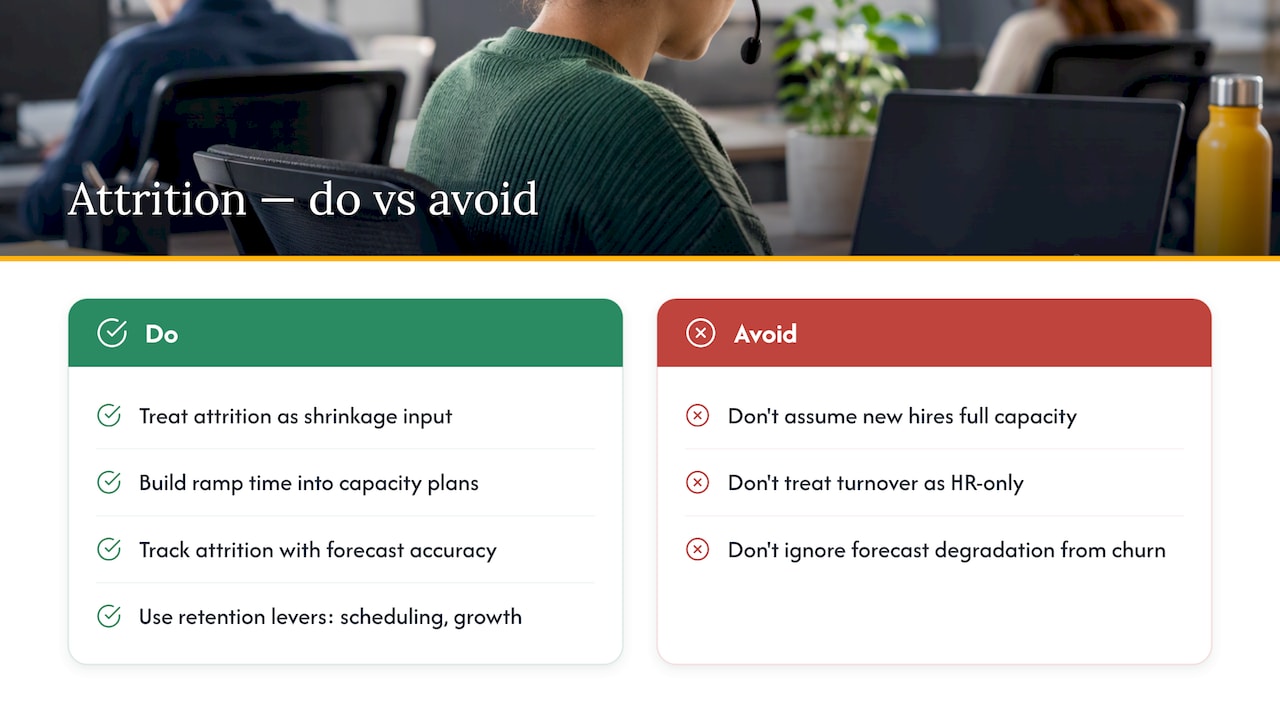
Turnover does more than create open seats. Every departure resets the ramp clock, and a new hire’s early weeks typically run well below the productivity assumed in your Erlang inputs, which means your staffing model is quietly understaffed even when headcount looks correct on paper. High attrition also degrades forecast accuracy, since a workforce in constant flux behaves less predictably than a stable one, especially on AHT.
The practical response is to treat attrition as a shrinkage input rather than a separate HR concern. Build ramp time into capacity planning explicitly: a new agent contributes partial capacity for a defined period, not full capacity from day one. Retention levers that reduce this drag include realistic scheduling that respects agent preferences where possible, clear paths for skill growth into multiskill or higher-tier queues, and manageable occupancy targets that do not burn out tenured staff to cover for gaps left by departures.
Contact centers with chronic high turnover often see this show up first in forecast accuracy before it shows up in attrition reports, since a shifting workforce mix changes handle times before anyone flags a staffing problem. Tracking attrition rate alongside forecast accuracy, rather than in isolation, tends to catch the connection earlier and lets you adjust shrinkage assumptions before a coverage gap opens up.
Legal and compliance considerations related to staffing
Staffing models do not operate in a vacuum: labor law shapes what a schedule can actually require of agents. Break and meal-period rules vary significantly by jurisdiction and by whether staff are classified as employees or contractors, and a schedule that satisfies Erlang math but violates a mandated break window is not a usable schedule. Overtime rules matter just as directly, since intraday recourse that leans on unplanned overtime can trigger premium pay obligations or, in some jurisdictions, require advance notice.
Scheduling predictability laws are an increasingly common wrinkle: several jurisdictions now require advance notice of schedules or compensation for last-minute changes, which directly limits how aggressively you can use same-day intraday adjustments. Adherence tracking systems also need to respect data privacy and monitoring disclosure requirements where they apply to agent activity logs.
None of this replaces legal counsel for your specific jurisdiction and workforce classification. The operational principle is simpler: build compliance checks into the schedule-design step of your staffing cycle, not as an afterthought after the schedule is published, and treat labor rules as a hard constraint on the model rather than a flexible guideline.
Different staffing models compared: centralized versus decentralized
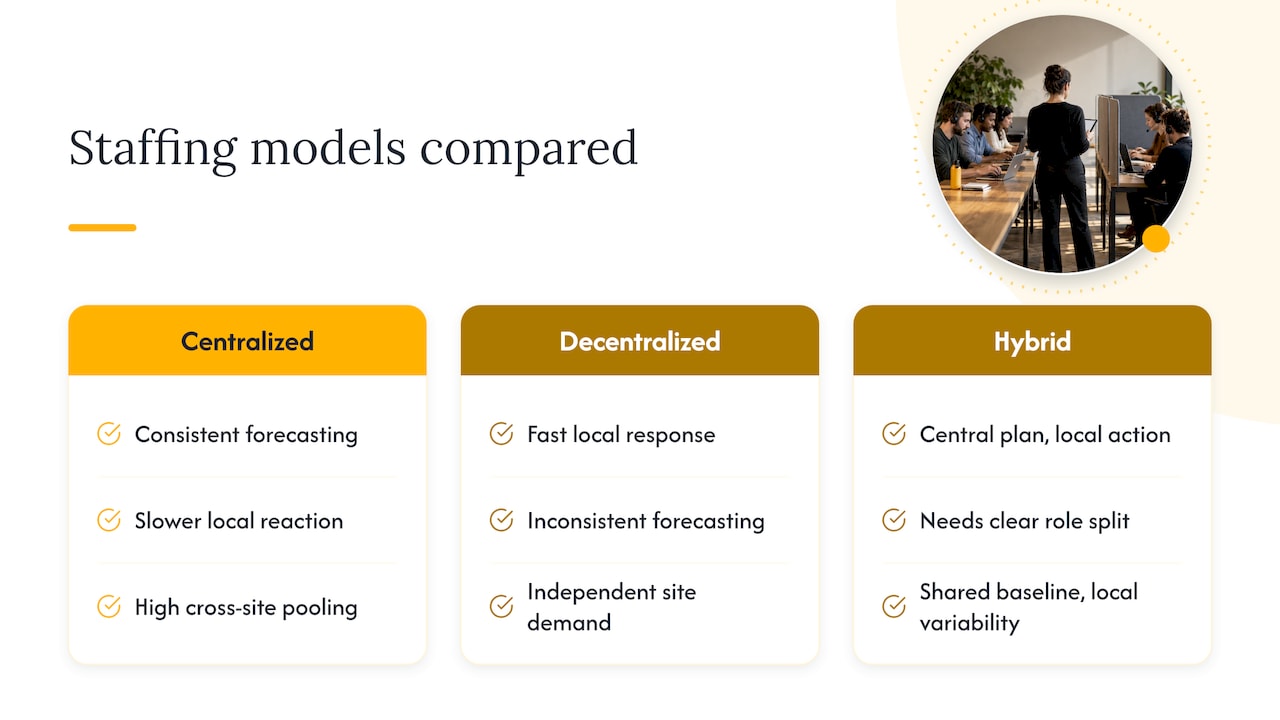
Centralized staffing pools forecasting, scheduling, and intraday decisions into one team or system serving multiple sites or queues. Decentralized staffing pushes those decisions to local site or team leads, closer to the agents being scheduled.
Centralized models tend to produce more consistent forecast methodology and make pooling across sites easier, which helps when multiskill routing spans locations. They can also be slower to react to a single site’s local conditions, since decisions route through a central team that may not see local context in real time.
Decentralized models react faster to local disruptions, a system outage at one site or a sudden local demand spike, because the decision owner is closer to the problem. The tradeoff is inconsistency: without a shared forecasting methodology, sites can end up staffing to different standards, which makes cross-site pooling and benchmarking harder.
A hybrid approach, centralized forecasting and capacity planning with decentralized intraday recourse, captures much of the benefit from both: consistent baseline math with local authority to act when the day departs from plan. The choice depends less on company size and more on how much your queues genuinely share capacity across sites; the more pooling potential exists, the stronger the case for centralizing at least the forecast and capacity-planning steps.
Impact of remote or hybrid workforce design on staffing models
Remote and hybrid work change two inputs that a traditional staffing model assumes are fixed: shrinkage and adherence monitoring. Home-based agents introduce different shrinkage patterns, internet or equipment issues create a new unproductive-time category, while eliminated commute time can reduce tardiness-related shrinkage in other cases.
Scheduling flexibility tends to expand under remote and hybrid models, since split shifts and non-contiguous hours become easier to staff when agents are not tied to a physical site. That flexibility can also fragment coverage if it is not managed against interval-level requirements, since a schedule optimized for agent convenience does not automatically match when contacts actually arrive.
Adherence monitoring has to adapt as well. Presence in a building is no longer a proxy for availability, so system-based adherence tracking, tied to login status, ready state, and queue activity, becomes the primary signal rather than a supplementary one. Time zone spread across a remote workforce can also be an asset: it extends coverage windows without requiring overnight shifts staffed entirely at one site, which is worth factoring into capacity planning if your workforce is geographically distributed.
Where staffing plans usually break down
The most common mistake is not a bad formula, it is treating a single daily peak as the staffing target instead of building interval by interval. Ignoring shrinkage until the schedule is already published is the second, and weak intraday policy (no named owner, no defined recourse actions) is the third. Interval-based forecasting paired with staged recourse fixes all three at once, and it is the practical alternative worth defaulting to.
— Daniela
How Altiam CX helps operations implement forecast-driven staffing
Building a forecast-driven contact center staffing model in-house takes time most operations teams do not have alongside daily queue management. Altiam CX supports this through Managed Team Extension, giving you scaled, bilingual staff who plug into your existing forecasting and scheduling cadence rather than requiring a separate management layer.

Operations teams working with Altiam CX have used forecast-driven methods to improve forecast accuracy while reducing agent burnout and to close 10 to 15 percentage points of coverage gaps tied to shrinkage.
A practical starting point:
- Review current forecast accuracy and shrinkage categorization against your historical data.
- Run a 4 to 6 week pilot on one queue with defined service-level and forecast-accuracy targets.
- Extend the model across channels once the pilot hits its targets.
Visit Altiam CX’s services page to scope a pilot for your operation.
Primary sources and vendor documentation to validate formulas and policies
For formula-level detail, Microsoft’s capacity planning documentation and Cisco’s sizing guide cover Erlang C and lifecycle mechanics directly.
- For two-stage and stochastic staffing foundations, consult the Cambridge Probability in the Engineering and Informational Sciences article.
- For applied shrinkage math, see Call Centre Helper’s shrinkage guide.
- For integration checklists when connecting scheduling tools to CRM or ticketing data, this CRM implementation checklist covers the data pipeline steps worth testing during a pilot.
Sources
- Workforce management capacity planning (Microsoft)
- Cisco Packaged Contact Center Enterprise — sizing and operating conditions
- Anaplan contact center planning application (datasheet)
- Optimal call-center forecasting and staffing (Cambridge / Prob Eng Inf Sci)
- How to calculate contact centre shrinkage (Call Centre Helper)
FAQ
What are the five staffing models?
Definitions vary across sources, but contact centers commonly compare centralized, decentralized, hybrid, outsourced, and blended (in-house plus outsourced) staffing approaches. Each trades off consistency, local responsiveness, and cost differently, and the right choice depends on how much your queues share capacity across sites or teams.
What is the 80/20 rule in call centers?
It is one of the most common benchmarks used in Erlang C calculations to size required staffing per interval, alongside AHT and shrinkage.
What are the four most common KPIs used in call centers?
The most widely tracked KPIs are service level, average handle time (AHT), occupancy, and shrinkage. Forecast accuracy and intraday adherence are also tracked closely in forecast-driven staffing models, since they directly affect whether the other four hit target.
What are the seven steps of the staffing process?
A typical contact center staffing cycle covers forecasting, capacity planning, scheduling, publishing, adherence monitoring, intraday adjustment, and post-interval review. Microsoft’s workforce management documentation frames this as a repeatable loop rather than a linear one-time process.
How does Altiam CX support contact center staffing models?
Altiam CX provides Managed Team Extension services that plug bilingual, nearshore agents into an existing forecast-driven staffing cycle. Details on scope and services are available on the Altiam CX services page.