
A chargeback dispute is a forced reversal of a card payment, initiated by a cardholder’s bank rather than the merchant, and it demands immediate action. The moment you receive a notice, preserve every order record, confirm your acquirer’s response deadline, and never issue a direct refund on top of a pending chargeback. Outcomes split between merchant wins, merchant losses, and escalation to arbitration. Each path carries a real, short-term cash impact.
TL;DR:
- Most internal deadlines for dispute response are shorter than the network’s published windows, so prioritizing the acquirer’s cutoff is crucial to avoid automatic losses.
- Evidence must be directly aligned with the reason code and clearly labeled; generic documentation and poor formatting significantly reduce chances of winning.
- Building centralized, ready-to-use evidence templates and enforcing strict SLAs for reply times can prevent lost disputes and improve win rates.
- Crossed thresholds in chargeback ratio can lead to fines and account termination, making proactive prevention and fast remediation essential.
- Properly responding to inquiries and documenting issues before a chargeback escalates to full dispute can save funds and reduce unnecessary losses.
Table of Contents
- Who does what: cardholder, issuer, acquirer, network, and merchant
- Mapping the chargeback dispute process from notice to resolution
- Building a representment that maps evidence to the reason code
- How much time you actually have before the window closes
- What to include in an issuer-ready evidence packet
- Payment and operational controls that cut chargebacks before they start
- When disputes escalate to arbitration and what network monitoring means
- Running dispute operations like a program, not a fire drill
- Dispute, inquiry, chargeback, refund, and representment are not the same thing
- What cardholders should know before filing a dispute
- Two dispute outcomes that show what actually moves the needle
- A short checklist for operations leaders
- How Altiam CX supports merchants managing dispute volume
- Primary sources every merchant should bookmark
- Sources
- FAQ
Who does what: cardholder, issuer, acquirer, network, and merchant
A chargeback moves through five distinct parties, and knowing which one holds authority at each stage saves you from chasing the wrong contact.
- Cardholder: initiates the dispute with their bank, citing a reason such as fraud, non-receipt, or billing error.
- Issuer: the cardholder’s bank; investigates the claim, issues a temporary reversal, and later decides the outcome.
- Card network: Visa or Mastercard; sets the reason codes, timelines, and evidence rules that govern the whole process.
- Acquirer: your bank or payment processor; relays the notice to you and enforces its own, often shorter, internal deadline.
- Merchant: you; responsible for evidence and representment within the acquirer’s stated window.
Merchants often receive limited detail from the issuer because the network passes along only a reason code and a short description, not the cardholder’s full account. Your practical first move is contacting your acquirer or gateway support line to confirm the exact deadline and required submission format, then looping in whoever owns dispute response internally so nothing sits unanswered.
Mapping the chargeback dispute process from notice to resolution
The chargeback dispute process follows a fixed sequence, though the clock varies by network and acquirer.
- Cardholder disputes a charge with their issuing bank, either through an app, a call, or a written claim.
- Issuer investigates the claim internally and assigns a reason code before proceeding.
- Temporary reversal often happens at this point. The funds leave your account before you have had a chance to respond.
- Acquirer notifies the merchant, typically through your payment gateway or processor dashboard, starting your response clock.
- Evidence window opens. You gather documentation mapped to the reason code.
- Representment. You submit a rebuttal packet arguing the charge was valid.
- Issuer decision. The issuer reviews your evidence against the cardholder’s claim.
- Pre-arbitration or arbitration follows if either side contests the decision, adding weeks to the timeline.
An inquiry is not a chargeback. It is an issuer’s request for information before a formal dispute is filed, and it carries no funds movement, so responding well at the inquiry stage can prevent the cash-flow hit of a full chargeback later. A subscription business might see an inquiry resolved with a quick clarification, while a physical goods retailer more often jumps straight to a chargeback when a package shows as undelivered. Both paths end the same way if evidence is thin: a loss that also counts against your dispute ratio.
Building a representment that maps evidence to the reason code
Your chargeback notice contains a reason code, and that code tells you exactly what the issuer needs to see. Reading it correctly is the first task, because a rebuttal built around the wrong justification gets rejected regardless of how strong the underlying proof is.
A rebuttal letter should open with a concise summary of the transaction and the dispute claim, then walk through evidence item by item, explicitly tying each document to a field the issuer’s form requests. Shopify’s guidance on the chargeback process recommends ordering evidence with the strongest, most direct proof first, since reviewers often stop reading once they are convinced.
- Fraud claims: AVS and CVV match results, device fingerprint, IP address, and prior order history from the same account.
- Non-receipt claims: signed delivery confirmation, tracking history, and carrier proof of delivery.
- Subscription or recurring disputes: cancellation timestamps, consent logs from your customer portal, and signed webhook event history showing the billing terms the customer accepted.
- Product-not-as-described claims: order confirmation, product listing at time of sale, and any support ticket showing the customer’s own description of the issue.
Pro Tip: Build a one-page cover sheet listing each attached file, the reason-code field it answers, and a one-line explanation, so the reviewer never has to guess why a document is there.
The acquirer deadline governs everything here. Even flawless evidence submitted after that window closes results in an automatic loss, so confirm the date the moment you receive the notice, not after you have finished gathering documents.
How much time you actually have before the window closes
Deadlines are the single most common reason merchants lose disputes they could have won on the merits. Networks typically publish evidence windows, but your acquirer or payment processor often sets a shorter internal cutoff to leave room for its own review and submission to the network, and QuickBooks’ guidance on responding to chargebacks stresses treating that acquirer date as final.
Practitioner and platform guidance emphasizes prioritizing the acquirer’s stated deadline over the network’s published window, because missing it almost always means an automatic, unrecoverable loss, according to Mastercard’s guidance for merchants. That single rule should govern your internal triage: when a notice arrives, treat the acquirer’s date as the true deadline regardless of what the reason code’s typical network timeline suggests.
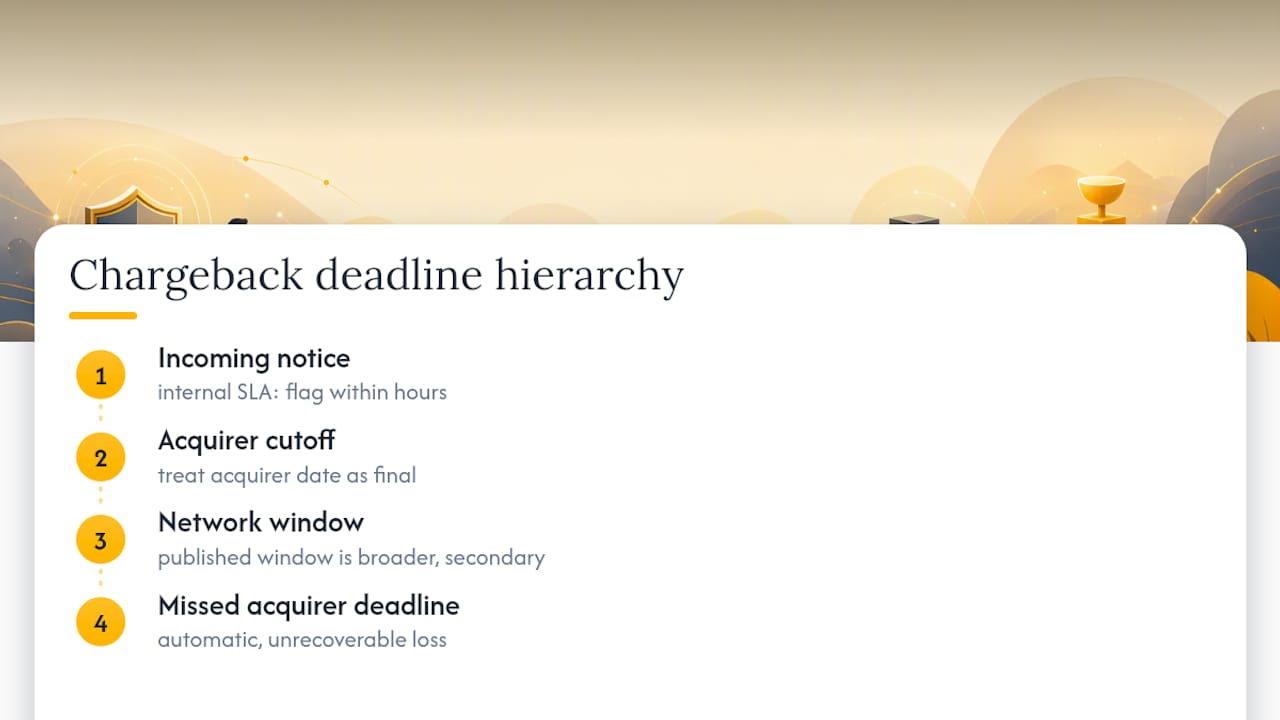
Miss it, and there is no second submission. The chargeback closes against you with no further recourse, which is why an internal SLA that flags every incoming notice within hours, not days, matters more than almost any other operational fix. For related timelines specific to bank-error disputes, our guide on the Reg E dispute process breaks down comparable investigation windows.
What to include in an issuer-ready evidence packet
Issuers reward clarity. A packet that is easy to scan and directly answers the reason code wins more often than one that is merely thorough.
Start with direct evidence: proof of delivery or usage, signed receipts, and activation or login logs that show the product or service was accessed. Add technical evidence next, including AVS and CVV match results, 3-D Secure authentication data, fraud-screening (FR) logs, and the IP address and device details tied to the transaction. Finally, include customer communication: the original order confirmation, any support tickets, documentation of a refund you offered before the dispute, and, where relevant, a retraction letter from the cardholder.
- Scans must be legible. A blurry receipt undermines an otherwise strong case.
- Translate anything not in English so the reviewer is not left guessing at context.
- Lead with a cover sheet that lists every attachment and the claim it supports.
- Label files by order ID and evidence type so nothing gets lost in a multi-document submission.
Visa’s Dispute Management Guidelines describe evidence requirements by dispute category and stress that timely, legible, well-labeled evidence materially improves a merchant’s odds. Treating formatting as part of the argument, not an afterthought, is one of the more underrated levers merchants have.
Pro Tip: Keep a standing evidence template per product line so your team fills in order-specific details instead of building a packet from scratch every time a notice lands.
Payment and operational controls that cut chargebacks before they start
Prevention is cheaper than representment, and most of the fixes are structural rather than reactive.
- Clear billing descriptors that match your brand name reduce “I don’t recognize this charge” disputes.
- Automated post-sale confirmations by email or text give customers a record before they think to call their bank.
- Transparent refund policies posted at checkout reduce disputes filed simply because a customer did not know how to get a refund directly.
- AVS, CVV, and 3-D Secure checks at checkout screen out a meaningful share of fraudulent transactions before they settle.
- Clear subscription cancellation flows prevent the recurring-billing disputes that dominate reason-code volume for subscription merchants.
- A written dispute intake SOP with a named owner and a response SLA keeps notices from sitting unanswered.
Pairing payment-level controls with a monitored evidence repository, and reviewing your chargeback rate against network thresholds on a set schedule, turns prevention from a one-time project into an ongoing discipline. Retailers managing physical goods should also review proof-of-return practices in our ecommerce returns management guide, since return-related disputes often trace back to gaps in that workflow. Merchants evaluating checkout-level protections may also want to review external guidance such as this rundown of security plugins for BigCommerce stores.
When disputes escalate to arbitration and what network monitoring means
Pre-arbitration begins when either the merchant or the cardholder contests the issuer’s decision after representment, and it typically adds several weeks before a network-level ruling closes the case. Arbitration is the final stage, where the card network itself decides, and its ruling is binding.
- Network thresholds trigger monitoring programs. Enforcement filings cited by the FTC describe Visa’s chargeback ratio thresholds at 0.9% of transactions or 100 chargebacks in a month, with Mastercard applying comparable limits.
- Consequences escalate quickly. Fines, rolling reserves, and, in persistent cases, account termination follow merchants who stay above threshold.
Crossing a network’s monitoring threshold does not just cost fines. It puts your ability to accept card payments at risk, based on the enforcement patterns described in Visa’s threshold filings. Responding means fixing the root cause fast and documenting the remediation, since networks look for a credible improvement plan, not just a lower number the following month.
Running dispute operations like a program, not a fire drill
Three outcomes separate merchants who handle disputes well from those who scramble: a centralized evidence library keyed by order ID and reason code, an SLA that guarantees a response within a fixed number of hours of notice, and regular reporting that tracks remediation over time rather than treating each chargeback as an isolated event.
- Centralize evidence collection so no team member is searching five systems when a notice lands.
- Enforce a retrieval and rebuttal SLA internally, ahead of the acquirer’s own deadline, to build in a buffer.
- Report on outcomes monthly, not just chargeback volume, so representment win rate becomes a tracked metric.
Team-extension models built around these three practices reduce time-to-evidence because a dedicated, trained team owns the intake-to-submission workflow full-time rather than fitting it between other duties. Deciding whether to build this in-house or extend your team with outsourced support usually comes down to volume: once dispute notices arrive weekly rather than monthly, a dedicated queue with enforced SLAs tends to outperform an ad hoc response owned by whoever is free. Our overview of data security controls in outsourced evidence handling covers what to look for when evaluating a managed partner for this work.
Dispute, inquiry, chargeback, refund, and representment are not the same thing
These five terms get used interchangeably, and that confusion costs merchants time during the window that matters most.
A dispute is the broad, informal term for a cardholder questioning a charge, which can resolve through a simple refund or escalate further. An inquiry is a formal, pre-chargeback request from the issuer for information, with no funds movement yet, giving you a chance to head off a full chargeback. A chargeback is the forced reversal itself: funds leave your account, and a reason code is attached. A refund is a voluntary return of funds you initiate directly with the customer, and issuing one after a chargeback notice is separate from the dispute process, something QuickBooks explicitly warns against since it can result in losing the funds twice. Representment is your formal rebuttal, submitted with evidence, asking the issuer to reverse the chargeback and return the funds to you.
Knowing which stage you are in changes your options. An inquiry still lets you resolve things quietly with a refund if the claim looks valid. A chargeback that has already moved to representment does not.
What cardholders should know before filing a dispute
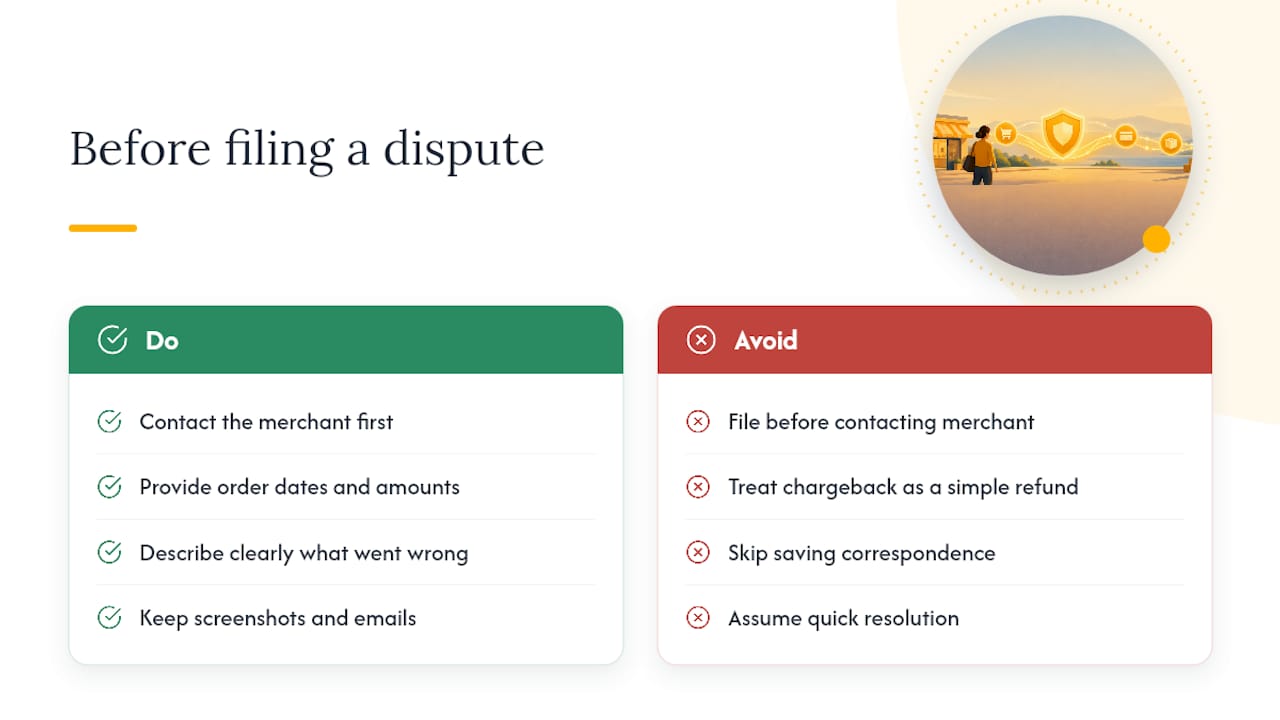
Cardholders filing a legitimate dispute get better, faster outcomes when they follow a few basic habits, and merchants benefit from understanding this side of the process too, since it shapes what evidence issuers expect to see.
Contacting the merchant directly first, before filing with the issuing bank, often resolves billing errors or delivery issues faster than a formal dispute, and it avoids tying up funds for weeks while an investigation runs. When a cardholder does file, providing specific details, order dates, amounts, and a clear description of what went wrong, speeds up the issuer’s reason-code assignment and reduces back-and-forth. Keeping personal records, including screenshots of listings, confirmation emails, and any correspondence with the merchant, strengthens the cardholder’s position if the merchant disputes the claim through representment. Cardholders should also know that a chargeback is not the same as a simple refund request. It triggers a formal investigation that can take weeks to resolve and, if the issuer sides with the merchant, the disputed amount is charged back to the cardholder.
Two dispute outcomes that show what actually moves the needle
A subscription merchant facing a recurring-billing dispute submitted webhook logs showing the customer’s own consent timestamp, alongside the cancellation flow the customer had not completed, mapped directly to the reason code’s authorization field. The issuer reversed the chargeback in the merchant’s favor, because the evidence answered the exact question the reason code asked rather than simply asserting the charge was valid.
A physical-goods retailer facing a non-receipt claim submitted only an order confirmation and a general shipping policy statement, with no tracking number or signed delivery proof. The issuer ruled against the merchant, since the evidence never actually proved the item arrived, and general shipping policy language answers a different question than the reason code raised.
The pattern holds across both outcomes: winning representments answer the specific field the issuer’s form requests, while losing ones submit real but generic documentation that never quite proves the claim.
A short checklist for operations leaders
Run a 72-hour triage on every incoming notice: confirm the acquirer deadline, pull the order record, and assign an owner. Set 30-day and 90-day goals around three metrics: chargeback rate, representment win rate, and average time-to-evidence, since tracking all three together shows whether prevention or response is the weaker link.
If your chargeback rate approaches a network threshold, or representment win rates stay low despite strong evidence, that is the point to consult payments counsel or reconsider your processor relationship rather than absorbing repeated losses quietly.
— Daniela
How Altiam CX supports merchants managing dispute volume

Chasing evidence across five systems on a deadline is not a sustainable process once dispute volume grows, and that is where a managed team extension changes the math. Certain managed team extension providers build centralized evidence workflows and enforce internal response SLAs ahead of acquirer deadlines, so notices get triaged within hours rather than sitting in an inbox.
- Managed customer support teams can handle intake, documentation requests, and follow-up communication with customers before a dispute escalates.
- Back-office operations support can build and maintain the evidence repository a representment team pulls from.
- SLA-driven workflows can help keep every notice inside its acquirer window, with reporting that tracks win rate over time.
If dispute handling is pulling your team away from growth work, see how Altiam CX’s customer experience and managed team extension services can take on the operational load.
Primary sources every merchant should bookmark
- Visa’s Dispute Management Guidelines for reason codes and evidence standards.
- FTC enforcement materials on processor screening for chargeback-related risk.
- Shopify’s chargeback process guide and QuickBooks’ chargeback response guidance for step-by-step platform workflows.
Sources
- Dispute Management Guidelines for Visa Merchants
- Payment Processor Nuvei Must Implement Robust Merchant Screening Practices and Pay $4.85 Million to Settle FTC Charges
- Responding to chargebacks and inquiries (Shopify Help Center)
- Respond to a chargeback (QuickBooks)
FAQ
Do merchants ever win chargeback disputes?
Yes, merchants win representments regularly when their evidence directly answers the reason code’s required fields, such as delivery proof for non-receipt claims or consent logs for subscription disputes. Wins are far more likely when evidence is submitted before the acquirer’s deadline and formatted clearly, according to Visa’s Dispute Management Guidelines.
Can a chargeback get you in trouble?
A single chargeback rarely causes serious trouble, but a pattern that pushes your ratio above network monitoring thresholds can trigger fines, rolling reserves, or account termination. Enforcement filings tied to Visa’s chargeback ratio thresholds show these consequences apply once a merchant crosses the 0.9% or 100-chargeback monthly mark.
Who loses money during a chargeback?
The merchant typically loses the disputed funds first, since issuers reverse the charge temporarily while investigating, and that money only returns if representment succeeds. If the merchant already shipped goods or delivered a service and loses the dispute, they absorb both the refunded amount and the cost of what was provided.
Are chargebacks usually successful for the cardholder?
Outcomes depend heavily on the evidence the merchant submits rather than the claim alone, since a well-documented representment can reverse a chargeback back in the merchant’s favor. Practitioner guidance from Mastercard notes that merchants who meet acquirer deadlines with evidence mapped to the reason code have a real chance at reversing the initial ruling.