
Follow up on medical claims by checking status only after the CMS processing floor passes, routing any denials immediately to a specialized worklist, and filing Medicare appeals within statutory deadlines. For electronic claims, wait at least 14 days before checking payment status; for paper claims, wait 29 days. Use ASC X12 276/277 transactions and MAC portals as your primary status channels, monitor 277CA and 999 acknowledgements for rejections, and track Medicare redetermination deadlines of 120 days from the moment triage begins.
TL;DR:
- Checking claim status before the 14-day CMS processing floor is unlikely to yield useful information and can clog payer systems.
- Medicare deadlines for redetermination are strict, requiring filing within 120 days of the initial notice, or the appeal rights are lost unless good cause is documented.
- Private payers often require appeals within 60 or 90 days of denial, making payer-specific follow-up calendars essential for timely recovery.
- Use batch ASC X12 276/277 transactions and review 277CA and 999 acknowledgements weekly to efficiently monitor claim status and avoid duplicate resubmissions.
- Routing denials to specialized worklists and building payer-specific denial crosswalks prevent repeated errors and enhance root-cause resolution.
Table of Contents
- When to follow up: timelines and priority windows for Medicare and private payers
- How to check claim status without creating duplicate work
- Denial triage and workflow: routing, root cause, and prevention
- Appeals and overpayment handling: staying inside Medicare’s deadlines and payer rules
- Operational KPIs, tools, and staffing models for follow-up at scale
- Why disciplined follow-up protects both revenue and compliance
- How Altiam CX supports managed claims follow-up
- Sources
- FAQ
When to follow up: timelines and priority windows for Medicare and private payers
Timing separates a clean recovery process from a backlog of aging claims. CMS builds in a processing floor precisely so providers do not flood the system with premature status checks: electronic claims need 14 days to clear, paper claims need 29 days. Checking earlier wastes staff time and clutters payer call queues without producing useful information, since the claim likely has not finished initial edits yet.
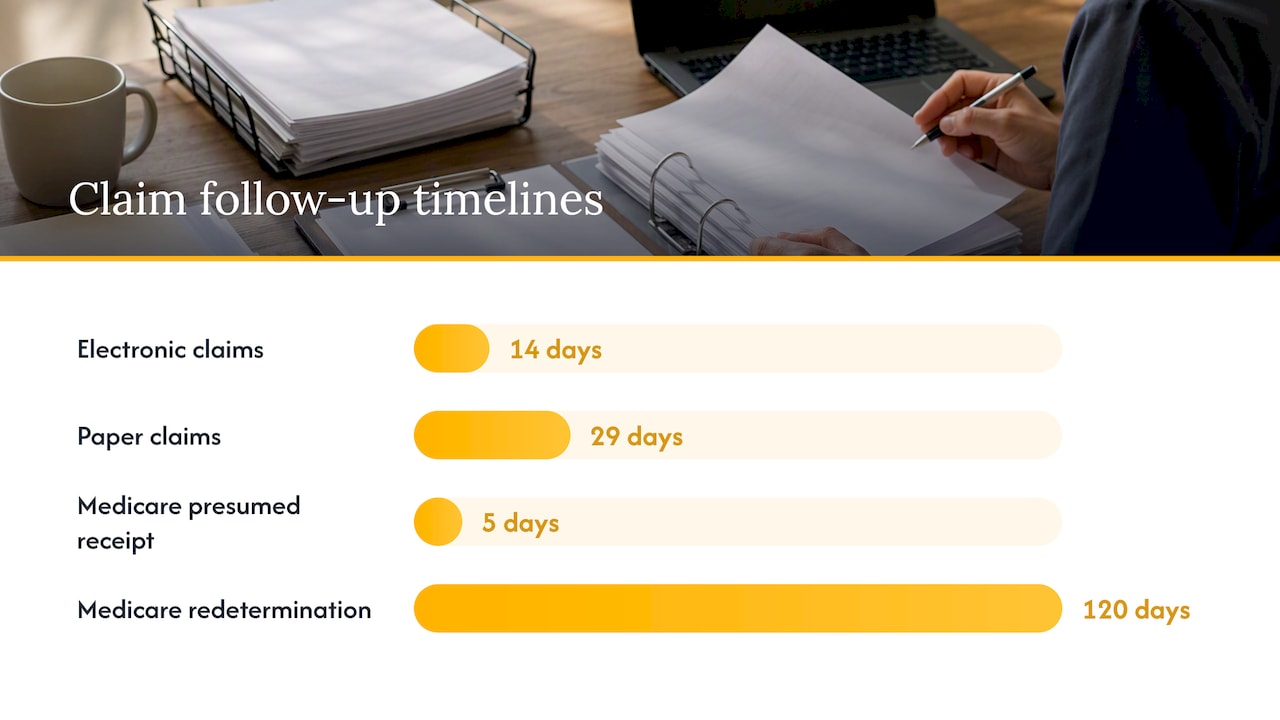
Medicare adds a second layer of urgency once a determination is issued. The clock for filing a redetermination request starts at receipt of the initial determination notice, and Medicare presumes the provider received that notice 5 days after the date on the notice unless proven otherwise. Miss the 120-day redetermination window and the appeal right can be lost unless good cause is documented.
Private payers set their own contractual deadlines for appeals and corrected claims, often shorter than Medicare’s, so your team needs a payer-specific calendar rather than a single rule of thumb. Some commercial plans require appeals within 60 or 90 days of the denial date, and missing that window typically closes the door on recovery regardless of the claim’s merit.
Certain events call for immediate action rather than waiting out a standard cycle:
- Outright claim rejections at the clearinghouse or payer level, since these never entered adjudication and need correction and resubmission right away.
- 277CA rejections flagging front-end errors like invalid member IDs or missing modifiers.
- Recoupment notices, which carry their own short response windows and can escalate into interest charges if ignored.
- Timely filing warnings from a payer, indicating the original submission deadline is close.
Building these triggers into your team’s daily routine keeps the follow-up queue moving instead of letting claims stall past their most workable window.
How to check claim status without creating duplicate work
The ASC X12 276/277 transaction set is the backbone of efficient status checking. A 276 is your inquiry, a 277 is the payer’s response, and CMS notes that a 277 typically returns within 24 hours of submission. Running these in batches instead of one claim at a time is what turns status checking from a manual chore into a repeatable process.
Acknowledgement files matter as much as the 277 itself. A 999 confirms your file passed basic syntax checks. A 277CA (Claim Acknowledgement) tells you whether the claim passed the payer’s front-end edits before it ever reaches adjudication. When an ICN or DCN is missing from the response, the claim did not pass initial edits and needs correction, not a resend of the same data.
A practical weekly checklist keeps this process disciplined:
- Run batch 276 status requests for every claim past its processing floor.
- Review 277CA and 999 reports first, before touching any 277 responses, to catch front-end rejections early.
- Flag any claim missing an ICN or DCN for correction rather than automatic resubmission.
- Contact EDI support for claims stuck with no acknowledgement after 48 hours.
- Log every status outcome in the practice management system so the next follow-up cycle starts from accurate data.
CMS guidance is direct on one point: do not resubmit within the first 72 hours after submission, and always check the 277CA before any corrective resubmission to avoid creating duplicate claims that further delay payment.
Pro Tip: Assign one team member to own EDI acknowledgement review each morning so rejected claims get corrected same-day instead of sitting until the next batch cycle.
Denial triage and workflow: routing, root cause, and prevention
A denial that lands in a generic inbox is a denial that ages. Optum’s denial management guidance recommends automated routing of denials into specialty worklists, whether coding, eligibility, or clinical, so the right person sees the right problem immediately instead of a generalist trying to triage everything.

Routing alone is not enough without a shared understanding of what each denial code actually means for your organization. The same Claim Adjustment Reason Code can require different fixes depending on the payer, which is why experienced billing teams build payer-specific denial crosswalks instead of applying one blanket correction to every claim carrying that code.
A repeatable triage workflow typically includes:
- Route by category into coding, eligibility, authorization, or clinical documentation worklists the moment the denial posts.
- Cross-reference the CARC against your payer-specific crosswalk before deciding on a correction.
- Use standardized checklists and template appeal letters for the most common denial reasons to cut drafting time.
- Loop in clinicians when clinical documentation integrity is the root cause, since coders cannot fabricate missing clinical detail.
- Engage the patient when eligibility or coordination-of-benefits issues require information only they can provide.
Root-cause analysis is what separates a team that fixes denials from one that prevents them. Analysis that targets upstream failures, like eligibility verification gaps or incomplete documentation at the point of service, stops the same denial from recurring across dozens of future claims. Fixing only the symptom on today’s claim guarantees tomorrow’s version of the same problem.
Optum also warns against a habit that looks efficient but rarely is: automatic re-billing without root-cause review. Resubmitting a claim with the same underlying error simply produces a second denial and burns more staff time than the first pass.
Some denials fall outside what internal correction can resolve. When a payer applies a policy in a way that appears inconsistent with the member’s plan documents or state regulation, and internal appeals have been exhausted, escalating to the state insurance commissioner becomes the appropriate next step, particularly for fully insured commercial plans where state oversight applies.
Pro Tip: Keep a living crosswalk document per payer, updated whenever a denial reason resolves differently than expected, so new team members inherit institutional knowledge instead of relearning it claim by claim.
Appeals and overpayment handling: staying inside Medicare’s deadlines and payer rules
Medicare’s appeals process runs through five defined levels, and knowing the sequence prevents a valid claim from dying at the wrong stage. The path runs:
- Redetermination, filed with the MAC within 120 days of receiving the initial determination notice, with receipt presumed 5 days after the notice date.
- Reconsideration, filed with a Qualified Independent Contractor (QIC) within 180 days of the redetermination decision notice.
- Administrative Law Judge (ALJ) hearing, available once the amount in controversy meets the required threshold.
- Medicare Appeals Council review, the next level after an unfavorable ALJ decision.
- Federal district court review, the final level for claims meeting the jurisdictional amount.
When a redetermination request arrives late, providers have two documented remedies. The Medicare Claims Processing Manual allows a request to vacate a dismissal within six months if good cause is shown, or a provider can file directly with the QIC within 60 days of the dismissal notice. Good cause typically means documenting circumstances like a mailing error or a serious illness that genuinely prevented timely filing, not simply an internal backlog.
Overpayment notices demand a different kind of discipline. The AMA’s guidance on resolving overpayment recovery requests lays out a six-step approach: review the payer’s notice carefully, request clarifying information when the basis is unclear, confirm the claim details against your own records, determine whether the recovery is valid, then either refund or appeal according to the payer’s own procedures, and track every timeline against a follow-up calendar. Appealing an invalid overpayment demand without first confirming the claim details risks wasting an appeal on a request that was actually correct, while refunding a demand without review risks giving back money the practice was owed.
Operational KPIs, tools, and staffing models for follow-up at scale
Measuring the follow-up process is what turns a checklist into a management system. Five metrics matter most for most billing operations:
- Days to first follow-up, tracking how quickly a claim gets checked once it clears the processing floor.
- Denial rate by root cause, not just by dollar volume, to identify which upstream process needs fixing.
- Appeals success rate, measured separately by payer since outcomes vary widely by plan type.
- First call resolution (FCR) for payer phone contacts, reducing repeat calls on the same claim.
- Days in accounts receivable (A/R), the summary metric that reflects how well every other KPI is performing.
Operational leaders increasingly treat metrics like Average Speed of Answer and First Call Resolution as core call center benchmarks, though these figures only carry weight when measured against a practice’s own internal standards rather than compared blindly across organizations.
Automation tools support these KPIs directly: batch 276/277 processing, automated 277CA monitoring that flags rejections without manual review, and worklists integrated into the practice management or EHR system so every status update logs automatically. Our customer care workflow guidance covers how automation reduces handling time across support operations, a principle that applies directly to claims follow-up queues.
Staffing structure matters as much as tooling. A dedicated denials specialist paired with cross-trained billers who can absorb overflow volume creates resilience that a single generalist queue cannot match. Clear escalation paths, so a stalled claim reaches a supervisor before it ages past a filing deadline, close the gap that causes most missed appeals. For practices where in-house staffing cannot keep pace with claim volume, managed team extension models offer a way to add trained follow-up capacity without a full internal hiring cycle.
Why disciplined follow-up protects both revenue and compliance
Claims follow-up often gets treated as clerical work, but the deadlines involved are legal ones, and the dollars involved compound quickly when a practice lets claims age past their workable window. The fix is not complicated in concept: check status only after the processing floor, route denials the same day they post, and calendar every appeal deadline the moment a determination arrives.
The barrier is rarely knowledge. It is capacity. A practice with a lean billing staff and rising claim volume will eventually miss a redetermination window, not because the rule was unclear, but because there was no one available to track it. That is the point where bringing in outside operational support to run the process alongside internal staff becomes a reasonable business decision rather than an admission of failure.
— Daniela
How Altiam CX supports managed claims follow-up
Practices juggling growing claim volumes rarely need more advice. They need staffing capacity that already understands payer workflows, denial codes, and the discipline that CMS deadlines require. Nearshore teams can provide operational support to help practices add trained follow-up capacity without the delay of a full internal hiring cycle.

Relevant services for claims-heavy practices may include managed team extension to add dedicated staff integrating into existing systems and processes, patient support and SOP management to align documentation and communication with payer requirements, and managed customer support for handling payer contact and status-check volume.
Outsourcing tends to make sense once denial backlogs grow faster than internal staff can clear them, or when appeal deadlines start slipping because no single person owns the tracking calendar. If that describes your billing operation, explore Altiam CX’s healthcare CX operations services to see how a managed team could fit into your existing follow-up process.
Sources
The timelines and procedures above come directly from federal guidance and industry associations rather than secondhand summaries. For appeals deadlines and the five-level appeals sequence, refer to the CMS Medicare Parts A & B Appeals Process MLN article. For claim status timing and the processing floor, see MLN3171902 on checking Medicare claim status and the ASC X12 276/277 guidance from CMS. For overpayment recovery procedures, consult the AMA’s guidance on resolving overpayment requests.
- MLN006562 – Medicare Parts A & B Appeals Process
- MLN3171902 – Checking Medicare Claim Status
- AMA: Address and resolve overpayment recovery requests
- Optum: Denial management — manage
FAQ
What is follow-up in medical billing?
Follow-up in medical billing is the process of checking a submitted claim’s status, resolving any denials or rejections, and pursuing appeals or corrections within payer and Medicare deadlines. It typically begins after the CMS processing floor of 14 days for electronic claims and 29 days for paper claims and continues until the claim is paid or fully resolved.
How do I follow up on an insurance claim?
Check claim status using ASC X12 276/277 transactions or the payer’s MAC portal, reviewing 277CA and 999 acknowledgements first to confirm the claim passed initial edits. If a denial appears, route it to the appropriate specialist worklist immediately and calendar any appeal deadline, since Medicare redeterminations must be filed within 120 days of the determination notice.
What are the stages of claim processing?
Claim processing generally moves through submission, front-end edit checks (reflected in the 999 and 277CA acknowledgements), adjudication by the payer, and final determination as paid, denied, or pended for more information. A claim missing an ICN or DCN in its status response has not passed initial edits and needs correction rather than a duplicate resubmission, according to CMS guidance.
What is the process of medical billing in the United States?
Medical billing in the United States starts with patient registration and eligibility verification, followed by coding, claim submission through EDI channels, payer adjudication, and post-adjudication follow-up for any denials or underpayments. Throughout the process, providers track claims using ASC X12276/277 transactions and follow CMS-defined timelines for both initial status checks and any subsequent appeals.
How long do I have to appeal a denied Medicare claim?
A Medicare redetermination request must be filed within 120 days of receiving the initial determination notice, with receipt presumed five days after the notice date. If the redetermination is unfavorable, a reconsideration request must go to the Qualified Independent Contractor within 180 days of that decision notice.