Nearshore site selection is the process of choosing the country, and then the city, where your outsourced customer experience, support or back-office team will work. The right choice comes down to five tests: can the market supply enough qualified bilingual people at your seat count, do working hours overlap with your customers, can the site keep running through a disruption, does it meet your compliance obligations, and does the total cost still hold once you scale. Proximity on a map is only the starting point.
This guide walks through each test, shows where buyers most often go wrong, and ends with a scorecard you can take into your next vendor conversation. One note on terms: in ecology, “nearshore” means shallow coastal water. EPA’s Great Lakes assessment defines it as water within 5 kilometers of shore or up to 30 meters deep. Here, it means delivering services from a nearby foreign country, usually in Latin America for U.S. companies.
TL;DR
- Treat time zone, bilingual capacity and cultural affinity as the entry ticket, not the decision. Resilience, labor depth and compliance fit separate good sites from risky ones.
- Model hiring capacity at your target seat count. A small, cheap city can run dry as you grow.
- Nearshore does not equal resilient. Verify dual connectivity, power, disaster recovery and a contingency site or work-from-home option.
- For regulated work (healthcare, legal, financial services), build a control map before you shortlist locations, not after.
- Score two or three finalist cities on the same weighted scorecard and pilot before you commit to full scale.
Table of Contents
- Start with the work, not the map
- The baseline factors every nearshore site offers
- Why proximity is a weak proxy for a good site
- Labor depth versus labor saturation
- Cost: look at total cost, not hourly rates
- Resilience: does the site keep running?
- Compliance: build the control map first
- Digital capability is becoming the differentiator
- A scorecard for comparing locations
- Our perspective
- Where Altiam CX fits
- A five-step process you can run this quarter
- FAQ
- Sources
Start with the work, not the map
The best location for one program is a poor fit for another. Site selection guidance for contact centers makes the point directly: a 300-seat healthcare operation should not use the same assumptions as a 1,500-seat general-service program. Program size, interaction complexity and industry change the answer.
Before you compare cities, write down four things:
- Seat count today and in 24 months. Site selection is a growth decision. If you plan to triple volume, the market has to support that.
- Interaction complexity. A password reset and a patient benefits question are not the same job. Complex, high-touch work rewards language depth and management proximity.
- Hours of coverage. Do customers need live help at 7 a.m. Pacific or 9 p.m. Eastern?
- Regulated data. Which systems will agents touch, and what contracts, regulators or auditors govern them?
These answers become your weighting. Without them, every country looks good on a brochure.
The baseline factors every nearshore site offers
For U.S. buyers, a handful of factors are close to universal across the major Latin American hubs: time-zone alignment, English-Spanish bilingual capacity, cultural affinity, accessibility from U.S. cities, cost efficiency, digital capability and crisis management. Research on U.S. buyers treats these as baseline selection factors, not sufficient differentiators by themselves.
That matters because most vendor pitches lead with them. If every shortlisted site clears the bar on time zone and language, those two criteria stop helping you choose. They still deserve verification:
- Time zone. Overlap should cover your full service window, including daylight saving shifts, since not every country observes them. Our guide on nearshore time zone alignment covers what U.S. leaders should check.
- Language. Ask for assessed proficiency, not self-reported fluency, and test on your own call types. We explain how to evaluate this in language proficiency in nearshore.
- Cultural alignment. Familiarity with U.S. norms shows up in tone, empathy and how agents handle frustration. See our piece on nearshore cultural alignment.
Why proximity is a weak proxy for a good site
It is tempting to assume that closer is safer. Independent evidence says to look wider. The U.S. Chamber’s nearshoring research lists logistics, labor, safety and security, macroeconomic and political stability, and rule of law among the major decision factors. It reports that logistics mattered to 99% of small and midsized companies and 93% of large companies when sourcing goods, and labor mattered to 93% of small and midsized companies and 86% of large ones for direct investment.
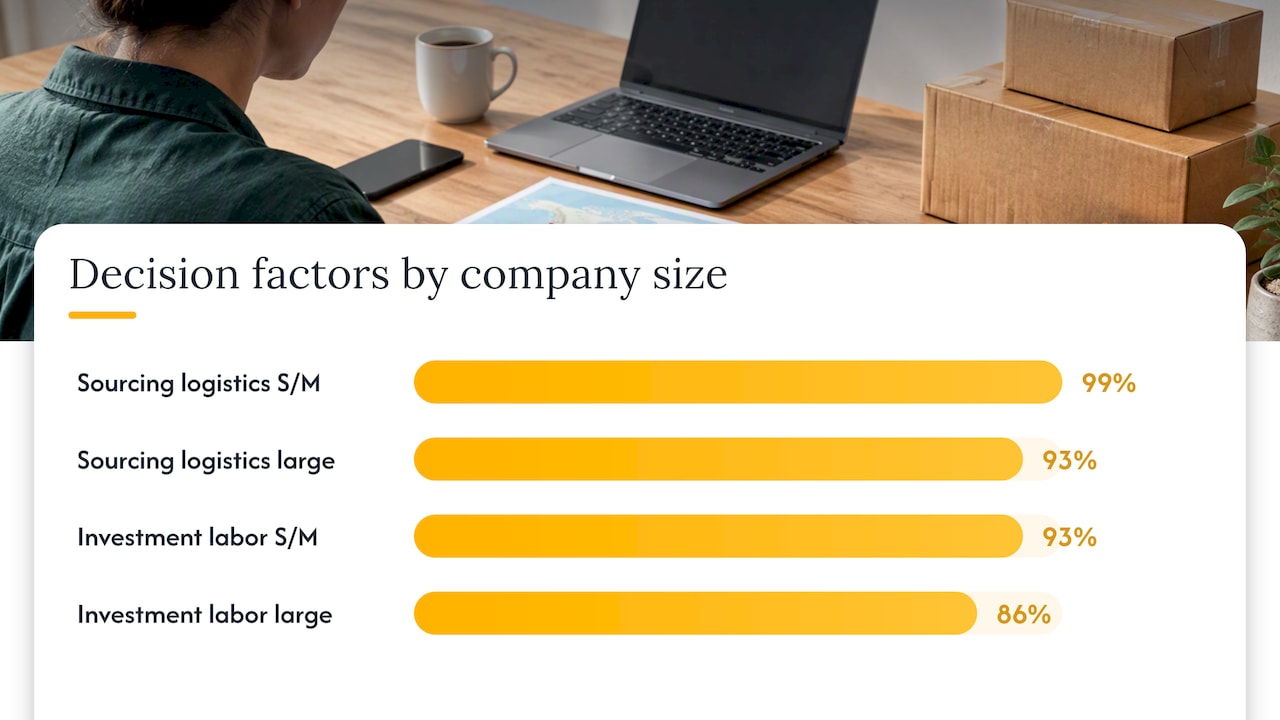
Those figures come from supply-chain decisions, so read them as directional, not as CX benchmarks. The lesson still carries over. For CX, “can this location sustain secure, uninterrupted service at the scale I need?” is a better question than “how far is it from Miami?”
Labor depth versus labor saturation
This is the tradeoff buyers underestimate most. A small, low-cost city can look excellent in the first six months. Then volume grows, competing employers start bidding for the same agents, wages climb and attrition follows.

The contact-center site-selection guidance cited above recommends favoring labor markets with a metro population of roughly 500,000 or more, a diverse employment base, a replenishing university or community-college pipeline, competitive rather than saturated hiring conditions, and manageable wage and real-estate costs. That guidance was written about domestic reshoring, so apply it as a screening logic, not a rule for any single country.
Here is how to apply it to a nearshore shortlist:
- Count the pipeline. How many universities, technical institutes and language programs graduate people each year in the metro area?
- Map the competition. Which other contact centers and shared-service operations hire there? What do they pay?
- Model attrition. If you need 200 trained agents in a year and attrition runs high, how many candidates must you screen?
- Check second-tier cities. Sometimes a secondary city next to a major hub gives you the hub’s talent at lower competition. Test it, don’t assume it.
For a deeper look at how talent markets are defined, read what a nearshore talent pool is.
Cost: look at total cost, not hourly rates
Published benchmarks give a sense of the range. One 2025 site-selection roundup put Colombian agent labor rates at $4 to $6 per hour and billable BPO rates at $15 to $18 per hour. Treat those as a snapshot from a specific year, since wages and exchange rates move.
The lower hourly figure matters less than what surrounds it:
- Recruiting and training cost per productive agent
- Attrition and ramp time
- Management and quality-assurance overhead
- Technology, security and connectivity requirements
- Travel for audits, calibration and leadership visits
A site that is 10% cheaper per hour but loses agents twice as fast is not cheaper. Ask every finalist for fully loaded cost per resolved contact, not just a rate card.
Resilience: does the site keep running?
Nearshore does not automatically mean operational resilience. Infrastructure and logistics performance vary materially by country and city across Latin America, a theme in the Atlantic Council’s analysis of nearshoring in the Americas, which also calls for modernizing telecommunications infrastructure and expanding internet access.
Ask each candidate site for evidence on:
- Dual connectivity. Two independent internet providers and automatic failover.
- Power continuity. Generators, UPS capacity and tested switchover.
- Disaster recovery. Documented plans, tested at least annually, with recovery-time targets.
- Geopolitical and security conditions. Local safety for staff commuting on night shifts, and political stability.
- Travel access. Direct flights from your hub cities, in case you need to visit on short notice.
- Contingency capacity. A second site, or a work-from-home model that can absorb a local outage.
Our article on nearshore’s role in business continuity goes further on building these safeguards into an engagement.
Compliance: build the control map first
For healthcare, legal and financial services, compliance can narrow your shortlist faster than cost. Draft a control map before you talk to vendors. It should cover:
- Contractual restrictions from your payers, health systems or clients
- Data residency and access rules
- Business-associate or subcontractor terms
- PCI and SOC controls where relevant
- Role-based access to systems and records
- Call-recording governance
- Audit rights
- Incident-notification timelines
One nuance is worth knowing. Guidance on HIPAA and SOC 2 in regulated healthcare notes that HIPAA itself does not create a blanket U.S.-location requirement. A payer, health system, client contract or state rule may still impose one. Check your own contracts, and have your compliance officer or counsel confirm the position before you commit to a country.
Digital capability is becoming the differentiator
Bilingual labor arbitrage and time-zone overlap are increasingly table stakes. A 2024 report on Latin American outsourcing points to digital enablement, generative AI integration and crisis-management capability as the emerging differentiators.
That changes what you ask a site. Beyond “how many agents,” ask about technology integration with your CRM and ticketing stack, analytics, automation governance and business-continuity maturity. If you are weighing how much automation to fold into the service model, this overview of customer service AI automation is a helpful way to frame your readiness. If voice or chat agents will sit in front of customers, it is also worth reading how teams load test a voice agent before an enterprise deployment.
A scorecard for comparing locations
Use a weighted scorecard so the decision survives internal debate. Adjust weights to your program. The ones below suit a mid-sized, high-touch, regulated program.
| Criterion | Suggested weight | What to verify |
|---|---|---|
| Labor depth at target seats | 25% | Metro size, graduate pipeline, competing employers, attrition |
| Language and cultural fit | 15% | Assessed proficiency on your call types |
| Resilience | 20% | Dual connectivity, power, DR tests, contingency site |
| Compliance fit | 20% | Control map coverage, audit rights, data rules |
| Total cost | 10% | Fully loaded cost per resolved contact |
| Time zone and travel | 10% | Overlap through daylight saving, flight access |
Score two or three finalist cities from 1 to 5 on each row, multiply by the weight and compare. Then ask a harder question: which score would change if we doubled the seat count?
Our perspective
We have seen the same pattern in site conversations: buyers arrive with a country in mind and a rate they want to hit. We would rather start with the work itself. Altiam CX delivers customer care, technical assistance, back-office operations and managed team extension from Latin America, and our view is that nearshore earns its place when the work is high-touch, specialized or sensitive, and when language, culture and management proximity matter more than the lowest possible labor cost.
That is why we push clients to test for depth rather than headline cost. A city that can hire 20 agents is not the same as a city that can sustain 200. We also encourage a pilot, with real call types and real quality metrics, before full ramp. Performance frameworks that are measurable from day one make the location decision something you can defend with data instead of instinct. For a broader view of how to evaluate providers, see how to select nearshore CX.
— Daniela
Where Altiam CX fits
If your program involves regulated or relationship-heavy work, we offer managed nearshore teams built around specific industries. Healthcare organizations can explore our patient support and SOP management service. Law practices can look at legal intake and inquiry handling, which also covers client follow-ups, scheduling and back-office legal support. For a general overview of customer experience and managed team extension, visit our services page. We don’t publish prices, so the best next step is a conversation about your seat count, hours and compliance needs.
A five-step process you can run this quarter
- Define the work and the growth curve. Seats, hours, complexity, regulated data.
- Set non-negotiables. Compliance requirements, minimum overlap hours, security controls.
- Shortlist two or three cities. Use labor depth and resilience first, cost second.
- Score and visit. Use the scorecard, tour the facility, interview team leads and test connectivity failover.
- Pilot, then scale. Start with a defined team, track quality and attrition for a quarter, then expand against agreed targets.
The communication side of the pilot deserves attention too. Why nearshore reduces communication gaps in CX and our guide to nearshore workforce management cover what to monitor once agents are live.
FAQ
What does nearshore site selection actually involve?
It means choosing the country and city from which an outsourced team will serve your customers. You compare labor depth, language ability, time-zone overlap, resilience, compliance fit and total cost for your specific program. The goal is a location that works at your target scale, not just on day one.
Is the cheapest nearshore city the best choice?
Usually not. Low hourly rates can be offset by higher attrition, longer ramp times and a thin talent pool that struggles as you grow. Compare fully loaded cost per resolved contact across finalists instead.
Does HIPAA require a call center to be in the United States?
HIPAA itself does not set a blanket U.S.-location requirement, according to regulated-healthcare guidance. However, a payer, health system, client contract or state rule may. Confirm your contractual obligations with your compliance officer or counsel.
How many locations should I evaluate?
Two or three finalists is a practical number. Fewer gives you no leverage or comparison, and more tends to slow the decision without improving it. Score each on the same weighted criteria and pilot the leader.
Sources
- EPA National Coastal Condition Assessment 2020 Site Evaluation Guidelines
- 10 Critical Factors in Contact Center Reshoring
- Supply Chain Strategies and Nearshoring Opportunities in the Americas, U.S. Chamber of Commerce
- Top Nearshore & Offshore Call Center Locations to Watch in 2025
- From Rhetoric to Reality: Nearshoring in the Americas, Atlantic Council
- From HIPAA to SOC 2: Operating Cloud Infrastructure in Regulated Healthcare
- American Nearshore 2024