TL;DR:
- Nearshore outsourcing involves placing business functions in nearby countries with aligned time zones and regulatory frameworks. It enhances operational resilience by enabling real-time collaboration, faster incident response, and reducing governance gaps, compared to offshore models. Successful nearshore partnerships require strong governance, cultural alignment, and ongoing relationship management to serve as true continuity assets during disruptions.
Nearshore outsourcing is defined as the practice of placing business functions in geographically adjacent countries that share time zones, cultural norms, and compatible legal frameworks with the client organization. The role of nearshore in business continuity goes well beyond cost reduction. It serves as an operational anchor that keeps critical functions running during disruptions, accelerates issue resolution, and reduces the governance gaps that offshore models routinely create. Business leaders who treat nearshore as a deliberate workforce architecture choice, rather than a reactive cost lever, consistently achieve stronger recovery outcomes and more predictable service delivery.
How nearshore models enhance operational resilience
Operational resilience is the ability to absorb disruption and maintain service delivery without significant degradation. Nearshore delivery directly supports this by eliminating the asynchronous handoffs that slow offshore models to a crawl during a crisis. Nearshore shortens escalation times from days to hours by enabling real-time crisis management between co-located and near-located teams.
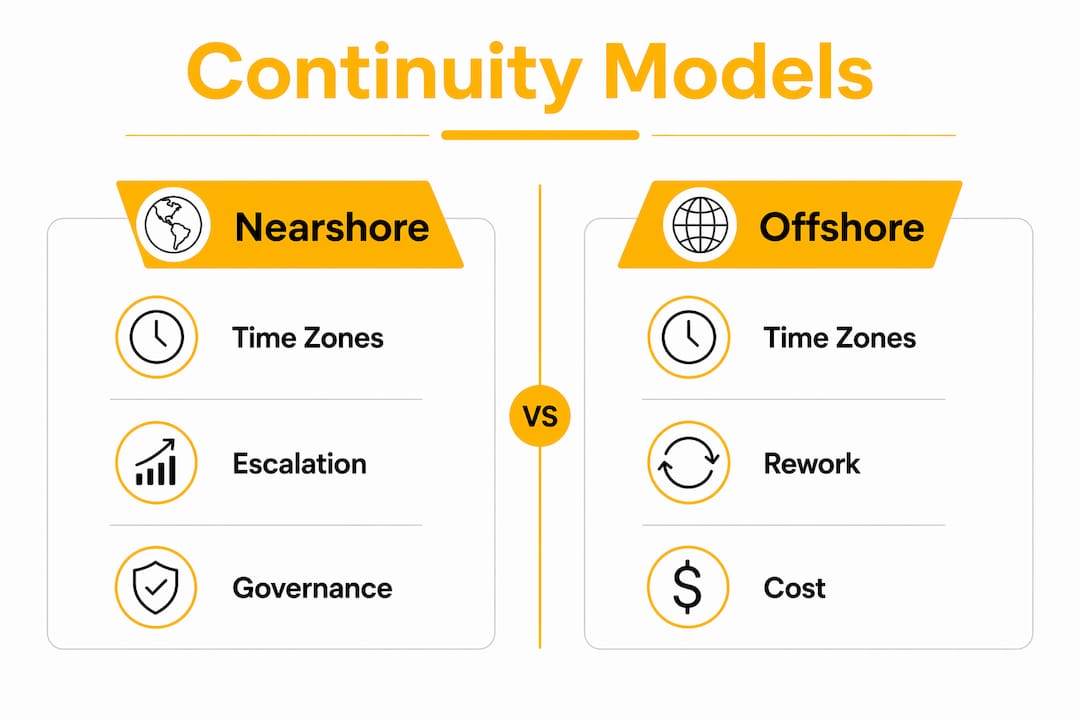
Time zone alignment is the mechanism that makes this possible. Nearshore teams in LATAM, for example, share 6–8 hours of daily overlap with U.S. operations. That overlap means a production incident at 9 a.m. in New York reaches a fully staffed team in Bogotá or San José at the same moment, not the following morning.
“Nearshoring is a fundamental design choice that anchors global execution under uncertainty, not merely a cost-saving stopgap.”
Governance proximity adds another layer of resilience. When a nearshore partner operates under a legal and regulatory framework that is compatible with the client’s jurisdiction, incident response becomes faster and less bureaucratic. Regulatory proximity simplifies compliance and speeds administrative decisions compared to offshore arrangements, where legal differences can stall even routine escalations.
Hybrid leadership models also benefit directly. Nearshore enables hybrid leadership by keeping key architects onsite while build and support teams operate in aligned regions. This preserves oversight without sacrificing scale, a combination that pure offshore models rarely achieve.

The performance data supports this picture. Nearshore projects complete 40% faster than offshore equivalents, with 65% fewer communication misunderstandings and an 80% project success rate compared to 60% for offshore. Those numbers translate directly into fewer service gaps and faster recovery during business disruptions.
Are cost-effective nearshore solutions worth the premium over offshore?
The honest answer is yes, when you account for total cost of ownership rather than hourly rates alone. Nearshore outsourcing delivers 40–60% cost reduction compared to U.S. hiring. That savings is meaningful. But the more important comparison is nearshore versus offshore, where the rate difference is smaller yet the hidden costs of offshore tell a different story.
Nearshore total cost ownership favors continuity-sensitive projects because offshore arrangements frequently incur rework, delayed escalations, and management overhead that erode the apparent savings. A team that costs 20% less per hour but requires two rounds of rework on every deliverable is not cheaper. It is more expensive and slower.
Pro Tip: When evaluating nearshore versus offshore costs, build a rework rate and escalation delay cost into your comparison model. Most organizations that do this find nearshore total cost is lower within 6 months of engagement.
Dual-sourcing models offer a middle path for organizations with complex supply or delivery chains. Dual-sourcing with CAFTA-DR nearshore regions enables 2-week order-to-delivery cycles compared to 8–10 weeks from Asia, with a 5–12% cost premium. For business continuity purposes, that premium buys speed and risk diversification that offshore cannot replicate.
The table below compares the three primary sourcing models across the dimensions that matter most for continuity planning.
| Dimension | Nearshore | Offshore | Onshore |
|---|---|---|---|
| Time zone overlap | 6–8 hours daily | 0–2 hours daily | Full overlap |
| Escalation speed | Hours | Days | Hours |
| Cost vs. U.S. hiring | 40–60% lower | 50–70% lower | Comparable |
| Rework risk | Low | High | Low |
| Regulatory alignment | High | Variable | High |
| Delivery cycle | 2 weeks (CAFTA-DR) | 8–10 weeks | Varies |
What are the key benefits of nearshoring for business continuity in 2026?
The benefits of nearshoring for business continuity strategy are concrete and measurable. They fall into four categories that business leaders should evaluate when building or updating their continuity plans.
- Talent access with real-time availability. LATAM nearshore talent pools share cultural and time zone alignment with U.S. operations, enabling product-focused work at enterprise quality standards. Senior engineers, CX specialists, and back-office operators are available during the same business hours as headquarters, not on a delayed schedule.
- Compliance framework compatibility. Nearshore partners operating in LATAM frequently maintain SOC 2 certification and align with GDPR-adjacent data handling standards. This makes them easier to integrate into existing compliance programs without requiring separate audit tracks. For a deeper look at SOC 2 certified nearshore vendors, the selection criteria matter as much as the certification itself.
- Delivery predictability. Synchronous Agile workflows in nearshore teams produce fewer regressions, more ownership, and faster delivery. Predictability is the foundation of any continuity plan. A partner who delivers on schedule reduces the need for buffer capacity and contingency spending.
- Long-term partnership stability. Nearshore relationships built on shared rituals and governance integration outlast transactional staff augmentation arrangements. Stability in the partner relationship directly translates to stability in service delivery.
Pro Tip: Require any nearshore partner to demonstrate at least 12 months of team retention data before signing a continuity-critical contract. High turnover in a nearshore team creates the same asynchronous knowledge gaps that offshore models produce.
The benefits of nearshore outsourcing for CX extend beyond technology delivery. Customer care, back-office operations, and technical support functions all gain from the same time zone and cultural alignment that makes software delivery more predictable.
How do you implement nearshore partnerships for sustained continuity?
Effective nearshore implementation requires treating the partner as a continuity node, not a vendor. Most nearshore failures come from treating partners as transactional rather than as embedded operational units. The following steps address the most common failure modes.
- Select for stability and compliance first. Evaluate partners on team retention rates, compliance certifications, and financial stability before evaluating cost. A partner who cannot sustain their own operations cannot sustain yours.
- Build shared rituals from day one. Synchronous stand-ups and compliance audits embed nearshore teams as true continuity nodes. Daily check-ins, shared incident response runbooks, and joint quarterly reviews create the operational muscle memory that activates during a real disruption.
- Integrate into your governance structure. Assign a named internal owner for the nearshore relationship. That person attends partner reviews, owns escalation paths, and reports to leadership on continuity metrics. Without internal ownership, the relationship drifts toward transactional.
- Audit AI-augmented workflows. Partners who use AI-assisted quality monitoring, ticket routing, or knowledge management deliver faster and with fewer errors. Verify that these tools are in active use and that the partner can demonstrate their impact on throughput and accuracy.
- Review the nearshore operational model annually. Business conditions change. A continuity plan built on a nearshore model from 2024 may not reflect your current risk profile, team size, or compliance requirements. Annual reviews keep the model current.
Key Takeaways
Nearshore outsourcing is the most effective model for business continuity when time zone alignment, governance proximity, and deep partner integration are treated as non-negotiable requirements.
| Point | Details |
|---|---|
| Escalation speed | Nearshore reduces crisis response from days to hours through real-time time zone overlap. |
| Total cost advantage | Nearshore delivers 40–60% savings vs. U.S. hiring with lower rework risk than offshore. |
| Compliance alignment | SOC 2 and GDPR-compatible partners reduce audit burden and speed incident response. |
| Partnership depth | Shared rituals and governance integration separate continuity-grade partners from transactional vendors. |
| Delivery predictability | Synchronous Agile workflows produce 80% project success rates vs. 60% for offshore models. |
What most business leaders miss about nearshore continuity
I have spent years watching organizations build nearshore relationships and then wonder why they underperform during actual disruptions. The pattern is almost always the same. The organization selected the partner on cost, onboarded them as a vendor, and never built the governance layer that turns a vendor into a continuity node.
The uncomfortable truth is that nearshore proximity is necessary but not sufficient. A team in Mexico City that operates on U.S. hours but reports through a ticketing system with 48-hour SLAs is not a continuity asset. It is an offshore model with a shorter flight. The time zone advantage only activates when you build the communication and governance infrastructure to use it.
What I find most leaders overlook is the cultural alignment dimension. LATAM nearshore teams do not just share time zones with U.S. organizations. They share professional norms, communication styles, and expectations about escalation that make real-time collaboration feel natural rather than forced. That alignment reduces the friction that slows offshore models, and it compounds over time as the relationship matures.
The future of nearshore in business continuity is not just about geography. It is about AI-augmented workflows, shared performance frameworks, and leadership integration that makes the nearshore team indistinguishable from an internal one during a crisis. Organizations that invest in that depth now will have a structural advantage when the next disruption hits.
— Daniela
Altiamcx nearshore solutions for operational continuity
Altiamcx delivers nearshore customer experience and operational services designed to function as genuine continuity assets, not supplemental headcount. Every engagement combines cultural alignment, disciplined execution, and measurable performance frameworks that activate when your organization needs them most.

A software platform migration to Altiamcx produced an 89% improvement in productivity, demonstrating what happens when nearshore integration is done with depth and governance. For organizations ready to build a continuity-grade nearshore team extension, Altiamcx provides the structure, talent, and performance accountability to make it work from day one.
FAQ
What is the role of nearshore in business continuity?
Nearshore outsourcing serves as an operational anchor that keeps critical functions running during disruptions by providing real-time time zone overlap, governance proximity, and faster escalation paths than offshore models.
How does nearshore compare to offshore for continuity planning?
Nearshore projects achieve an 80% success rate versus 60% for offshore, with 40% faster completion and significantly lower rework risk, making nearshore the stronger choice for continuity-sensitive operations.
What compliance frameworks do nearshore partners typically support?
Nearshore partners in LATAM frequently maintain SOC 2 certification and align with GDPR-adjacent data handling standards, reducing the audit burden for U.S. organizations with regulatory obligations.
How quickly can nearshore teams respond during a crisis?
Nearshore teams with 6–8 hours of daily time zone overlap with U.S. operations can respond to incidents in hours rather than the days typical of offshore arrangements with asynchronous handoffs.
What is the biggest mistake organizations make with nearshore partnerships?
The most common failure is treating nearshore partners as transactional vendors rather than embedded continuity nodes. Success requires shared rituals, governance integration, and internal ownership of the relationship from day one.