TL;DR:
- Paralegal process outsourcing involves delegating legal support tasks to external professionals under attorney supervision.
- It helps law firms save 40–60% on costs and enables scalable, efficient support for document review, research, and drafting.
Paralegal process outsourcing is the practice of contracting substantive legal support tasks to external professionals who work under licensed attorney supervision. The industry standard term is legal process outsourcing, or LPO, and paralegal outsourcing sits within that broader category as its most operationally focused segment. Law firms and corporate legal departments use this model to handle document review, legal research, client intake support, and drafting without adding permanent headcount. Cost savings of 40–60% compared to full-time in-house paralegal hires make this model financially compelling. The ethical guardrail is non-negotiable: attorneys retain full legal responsibility and must review all outsourced work before it moves forward.
What is paralegal process outsourcing and how does it work?
Paralegal process outsourcing works by assigning defined, repeatable legal support tasks to an external team while the supervising attorney maintains oversight at every review stage. The external provider receives task instructions, firm templates, and access to case management software. Completed work returns to the attorney for review, correction, and approval before it enters any official record or client communication.
Common tasks handled through outsourced paralegal services include:
- Document review and organization: Sorting, labeling, and summarizing case documents and discovery materials
- Legal research: Pulling case law, statutes, and regulatory references on defined questions
- Drafting support: Preparing demand letters, contract summaries, and pleading templates
- Medical records organization: Chronologizing records for personal injury and workers’ compensation matters
- Client intake support: Gathering initial case information and completing intake forms
Provider models vary. Onshore providers operate within the same country and legal system. Nearshore providers, like the team extension model offered by Altiamcx, work in adjacent time zones with strong cultural alignment. Offshore providers operate in distant time zones and often compete primarily on price. Treating outsourced paralegals as extensions of your internal team, with direct access to templates and structured review loops, produces better compliance and faster turnaround than treating them as isolated vendors.
Pro Tip: Set up a shared folder or case management workspace before your first outsourced task. Providers who can access your templates and checklists from day one deliver faster, more consistent results.

What tasks can be outsourced safely and ethically?
The American Bar Association’s Model Rules of Professional Conduct permit attorneys to delegate substantive legal work to non-lawyers, provided the attorney maintains direct supervision and assumes responsibility for the final work product. That framework defines what paralegal services outsourcing can and cannot include.
The table below clarifies which tasks fall inside and outside ethical boundaries.
| Task category | Safe to outsource | Must stay in-house |
|---|---|---|
| Document review and indexing | Yes | No |
| Legal research and case law summaries | Yes | No |
| Demand letter drafting | Yes (with attorney review) | No |
| Medical records chronologies | Yes | No |
| Client intake data collection | Yes | No |
| Providing legal advice to clients | No | Yes |
| Signing pleadings or court filings | No | Yes |
| Court appearances and hearings | No | Yes |
| Attorney-client privilege decisions | No | Yes |
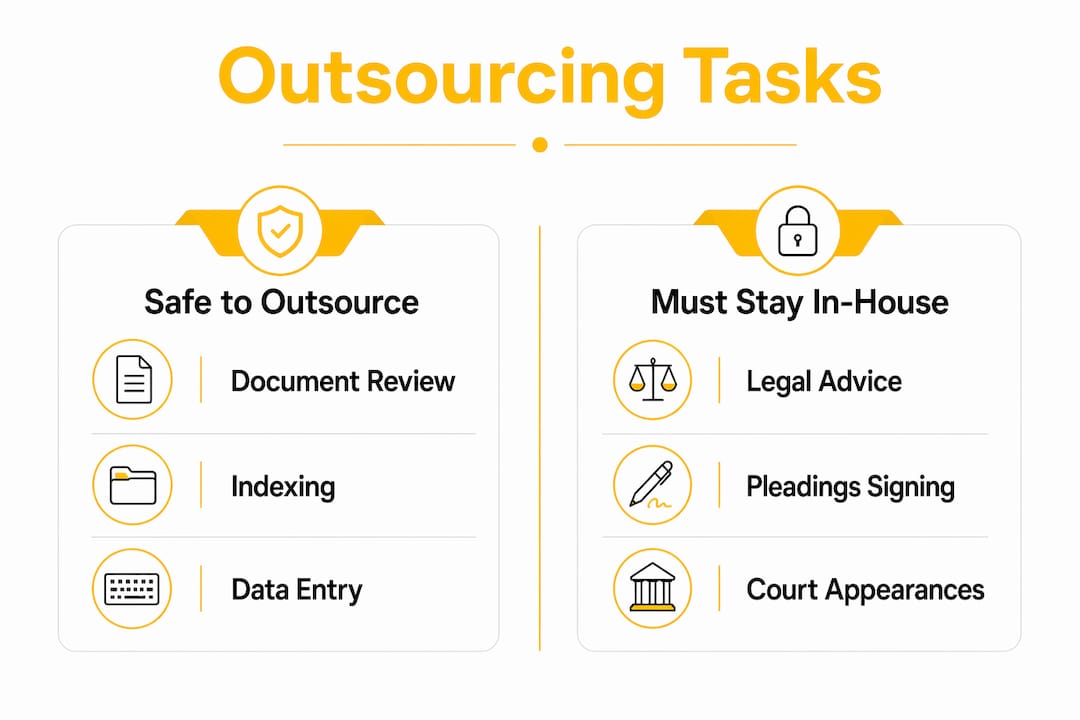
Outsourced paralegals perform substantive legal tasks but cannot deliver legal advice or sign pleadings. Supervising attorneys retain ultimate legal responsibility and must maintain ongoing oversight. That is not a technicality. It is the structural requirement that makes the entire model ethically sound.
One distinction that trips up many firms involves virtual legal assistants versus outsourced paralegals. Virtual legal assistants manage administrative tasks such as scheduling, billing, and correspondence. Outsourced paralegals provide substantive legal support that directly affects case strategy and outcomes. Confusing the two leads to mismatched expectations and gaps in legal support quality.
Pro Tip: Write a one-page role definition document before onboarding any external paralegal. List exactly which tasks they handle, which require attorney sign-off, and which are off-limits. This document protects your firm and sets clear expectations from day one.
What are the benefits and risks of paralegal process outsourcing?
The financial and operational case
The cost argument for outsourcing legal processes is direct. Cost savings of 40–60% compared to full-time in-house hires are typical, and pricing models include per-project, hourly, or retainer arrangements. That flexibility matters for firms whose workloads fluctuate by practice area or season.
Standard paralegal tasks achieve 24-hour turnaround with over 99% accuracy when integrated into attorney-led workflows. That level of reliability, applied to document review or medical records organization, removes a common bottleneck in case preparation.
Paralegal outsourcing enables flexible capacity management during workload fluctuations without permanent staffing costs. Law firms scale support up or down as needed through contract or retainer arrangements. That is a structural advantage over maintaining a fixed in-house team that sits underutilized during slow periods.
The strategic value beyond cost savings
The stronger argument for outsourcing legal processes is not cost reduction. Paralegal outsourcing is primarily a growth strategy that allows attorneys to focus on substantive legal work by offloading time-intensive, non-billable tasks. An attorney who spends three hours organizing medical records is an attorney who is not advising clients, developing business, or preparing for trial.
The benefits of paralegal outsourcing extend to specialized expertise. External providers who focus exclusively on medical records chronologies or e-discovery review develop depth that a generalist in-house paralegal rarely matches.
Risks and how to manage them
The risks in outsourcing legal processes are real but manageable:
- Quality control: Require structured review loops and attorney sign-off before any work product is used
- Data security: Verify that providers use encrypted file transfer, signed confidentiality agreements, and access controls that match your firm’s standards
- Communication gaps: Establish weekly check-ins and a single point of contact on both sides
- Scope creep: Define task boundaries in writing and revisit them quarterly
Firms that treat these risks as checklists rather than ongoing practices tend to encounter problems. Quality and security require active management, not one-time setup.
How to get started with paralegal process outsourcing
Getting started with outsourced paralegal services works best when you begin small and build from a proven foundation. Rushing to outsource ten task types simultaneously creates quality control problems and makes it hard to identify where things go wrong.
-
Pick one repeatable task. Start with a single specific task such as medical records chronologies or demand letter preparation. These tasks have clear inputs, defined outputs, and measurable quality standards.
-
Document your workflow. Write down every step the task requires, including which templates to use, what format the output should follow, and who reviews it before it is used. Providers cannot follow a process you have not defined.
-
Verify provider qualifications. Confirm that the provider’s paralegals hold recognized credentials, such as certification from the National Association of Legal Assistants (NALA) or the National Federation of Paralegal Associations (NFPA). Ask for sample work products and client references in your practice area.
-
Integrate into your technology stack. Give the provider access to the specific case management software, document templates, and communication channels your firm uses. Integrating outsourced paralegals via secure access to firm templates and case management software, with a closed-loop review process, produces the best compliance and quality outcomes.
-
Evaluate and adjust after 30 days. Review turnaround times, accuracy rates, and attorney feedback after the first month. Expand to additional task types only after the first task type runs consistently well.
Pro Tip: Ask your provider for a sample deliverable on a closed case before signing any agreement. A real work product tells you more about quality and format fit than any sales conversation.
Firms that follow this phased approach, as outlined in legal industry outsourcing trends for 2026, report faster adoption and fewer quality issues than those who attempt broad rollouts from the start.
Key takeaways
Paralegal process outsourcing reduces costs, increases attorney capacity for billable work, and scales legal support without permanent staffing, provided attorney supervision and ethical guardrails remain in place throughout.
| Point | Details |
|---|---|
| Core definition | Paralegal outsourcing delegates substantive legal tasks to external professionals under direct attorney supervision. |
| Cost efficiency | Outsourcing typically reduces paralegal costs by 40–60% compared to full-time in-house hires. |
| Ethical boundaries | Outsourced paralegals cannot provide legal advice, sign pleadings, or appear in court. |
| Start small | Begin with one repeatable task, such as medical records chronologies, before expanding to other matter types. |
| Growth strategy | The primary value is freeing attorney time for billable, high-value work, not just cutting overhead. |
What I’ve learned about paralegal outsourcing that most articles get wrong
Most articles frame paralegal outsourcing as a cost-cutting tactic. That framing is accurate but incomplete, and it leads firms to make a critical mistake: they outsource the cheapest tasks first instead of the most time-consuming ones.
The attorneys I have seen get the most value from outsourcing are not the ones who saved money on document organization. They are the ones who reclaimed 10 to 15 hours per week of attorney time that was previously consumed by non-billable preparation work. That time went back into client development, complex legal strategy, and trial preparation. The financial return on that shift far exceeds any direct cost comparison.
The ethical guardrails are also misunderstood. Attorneys sometimes treat the supervision requirement as a formality, a quick glance before signing off. That approach creates real liability exposure. Effective supervision means reading the work product, understanding it, and being prepared to defend it. If you would not put your name on it without reading it, do not put your name on it after outsourcing it either.
The other lesson I would share is about provider selection. Credentials matter, but workflow fit matters more. A provider with strong NALA-certified paralegals who cannot integrate with your case management system will cost you more in coordination time than you save in labor costs. Test the workflow before you commit to the relationship.
Outsourcing paralegal work is not a shortcut. It is a structural decision about how your firm allocates its most limited resource: attorney time. Firms that treat it that way build real capacity. Firms that treat it as a vendor transaction tend to cycle through providers without seeing lasting results.
— Daniela
How Altiamcx supports legal teams through outsourced paralegal operations
Legal professionals who want to expand capacity without adding permanent headcount have a direct path forward with Altiamcx. As a nearshore team extension partner, Altiamcx supports law firms and legal departments with back-office operations, client intake support, and document processing workflows that integrate directly into existing firm systems.

Altiamcx combines cultural alignment with measurable performance frameworks, which means your outsourced team operates on your schedule, in your language, and within your quality standards. The nearshore team extension model gives legal teams the flexibility to scale support up or down without the overhead of full-time hiring. For firms ready to move from concept to execution, Altiamcx’s outsourcing solutions provide a proven operational foundation. You can also review how business process outsourcing drives growth in professional services to see how the model applies to your practice.
FAQ
What is paralegal process outsourcing?
Paralegal process outsourcing is the practice of delegating substantive legal support tasks, such as document review, legal research, and drafting, to external professionals who work under licensed attorney supervision.
How much can a law firm save by outsourcing paralegal work?
Law firms typically save 40–60% compared to the cost of full-time in-house paralegal hires, with pricing available on a per-project, hourly, or retainer basis.
What tasks cannot be outsourced to a paralegal?
Providing legal advice, signing pleadings, and making court appearances cannot be outsourced. These activities require a licensed attorney and cannot be delegated under ABA professional conduct rules.
What is the difference between a virtual legal assistant and an outsourced paralegal?
Virtual legal assistants handle administrative tasks such as scheduling and billing. Outsourced paralegals provide substantive legal support that directly affects case preparation and outcomes.
How does a law firm get started with paralegal outsourcing?
Start by outsourcing one repeatable task, such as medical records chronologies or demand letter drafting, document the workflow clearly, verify provider credentials, and evaluate quality after 30 days before expanding further.