Nearshore time zone alignment means contracting teams located within 0 to 3 hours of your U.S. offices, primarily across Latin America, so both sides share 6 to 8 hours of genuine working-hour overlap every day. That overlap is not a scheduling convenience. It is the operational foundation that determines whether your distributed team can run live standups, resolve blockers the same morning they surface, and iterate on product decisions without waiting until the next business day. For U.S. companies running Agile workflows or managing customer experience operations, the difference between a 2-hour offshore window and a 6-hour nearshore window compounds across every sprint, every escalation, and every client interaction.
The core benefits of nearshore time zone alignment include:
- Real-time standups and sprint ceremonies without anyone joining at an unreasonable hour
- Same-day code reviews and pull request feedback, eliminating the overnight lag common in offshore models
- Live incident response with the engineers who built the system
- Faster decision-making on evolving requirements, since questions get answered within the hour rather than the next morning
- Lower coordination overhead for U.S. team leads, who spend less time managing status updates and more time on product direction
What does nearshore time zone alignment look like with U.S. and Latin American teams?
The overlap math is straightforward once you map specific countries against U.S. time zones. Colombia and Peru operate on Eastern Standard Time year-round, with no daylight saving adjustment, giving East Coast teams zero to one hour of difference and a full eight-hour working-day overlap. Costa Rica runs on Central Standard Time with no daylight saving either, making it an ideal match for U.S. Pacific and Mountain teams who gain six to eight hours of synchronous availability. Mexico spans Central and Mountain Time, overlapping fully with U.S. Central hours and providing six or more hours for both coasts.

| Country | UTC Offset | Difference from U.S. Eastern | Overlap with U.S. Eastern |
|---|---|---|---|
| Colombia | UTC-5 | 0 hours | 8 hours |
| Costa Rica | UTC-6 | 1 hour | 6 to 8 hours |
| Mexico City | UTC-6 | 1 hour | 6 to 8 hours |
| Brazil (São Paulo) | UTC-3 | 2 hours ahead | 6 hours |
| Argentina (Buenos Aires) | UTC-3 | 2 hours ahead | 6 hours |
Brazil and Argentina sit two hours ahead of U.S. Eastern, which provides six hours of shared availability. That is enough runway for a full sprint planning session, a design review, and uninterrupted focus time on both sides. Compare those figures to India, where the gap reaches 10.5 hours from U.S. Eastern and zero natural business-day overlap exists.
One scheduling detail worth building into your calendar: daylight saving transitions in the U.S. can temporarily shift overlap by one hour when your Latin American partner does not observe DST. Colombia and Costa Rica never adjust their clocks, so your overlap window with those teams narrows by one hour during U.S. summer months. Proactive schedule management, confirmed in writing at the start of each quarter, prevents the confusion that catches teams off guard.
Pro Tip: When onboarding a new nearshore partner, confirm the exact UTC offset for their city, not just their country. Brazil spans four time zones, and Argentina does not observe daylight saving, so city-level precision protects your scheduling from the start.
How does time zone overlap actually affect productivity and communication?
The research on this is specific and worth citing directly. A 2024 study published in Organization Science, led by researchers at Harvard Business School, Georgetown, and Rice University, analyzed communication patterns across a large global firm and found that synchronous communication, including phone calls and video meetings, declined substantially for every additional hour of time zone separation. That is not a rounding error. On a team operating across a 10-hour gap, the cumulative drop in real-time interaction is severe enough to change how work fundamentally gets done.
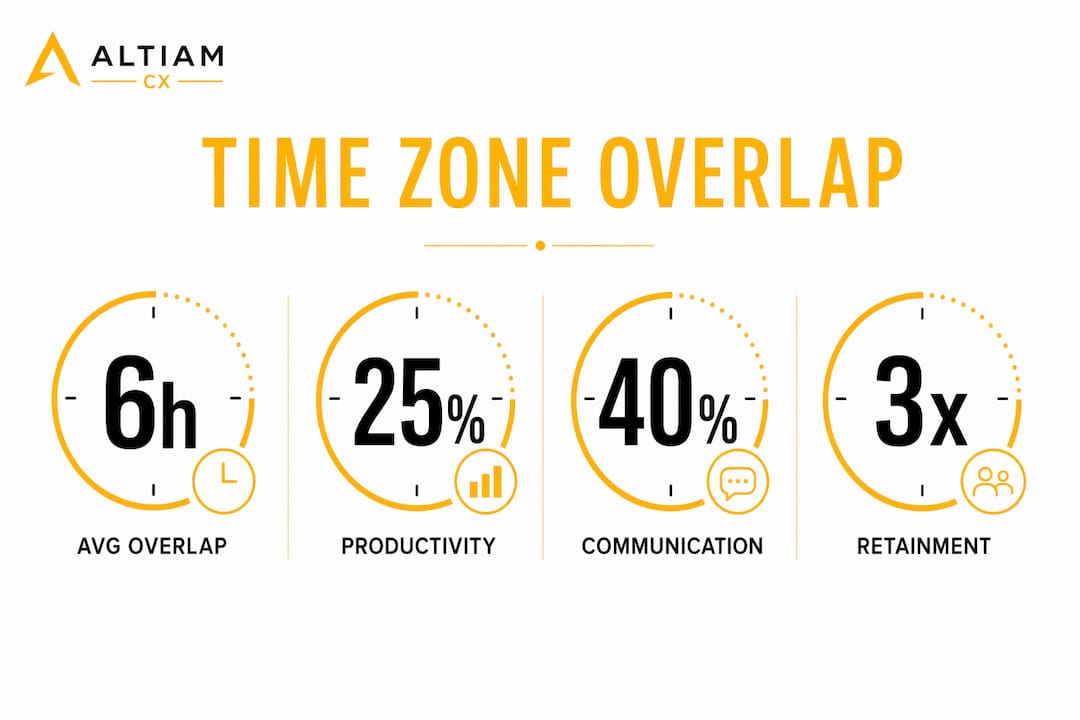
The productivity consequences follow directly from that communication decline. Teams with LATAM time zone alignment report up to 25% higher project efficiency compared to teams operating across large time gaps, and nearshore teams achieve 20–30% faster sprint velocity than offshore teams. The hidden cost in offshore models is not the rate card. It is the compounding delay: a code review submitted late in the day sits untouched for a long period, a scope question raised Monday gets reflected in code by Wednesday at the earliest, and a production incident at 3 PM waits until the next morning for a response.
U.S. team leads also absorb a coordination tax when overlap is thin. When nearshore teams are managed as external vendors rather than integrated colleagues, leads can spend over 20% of their time on status updates and communication management rather than product strategy. Genuine time zone alignment, combined with treating nearshore members as first-class team participants, cuts that overhead by more than 20%.
Why Agile teams depend on time zone overlap to function
Agile methodology is built on daily synchronous ceremonies. The Scrum Guide requires the Daily Scrum to happen at the same time every working day of the sprint. Sprint planning, retrospectives, and sprint reviews all assume the full team can meet live. When half the team is asleep during those ceremonies, Agile becomes a document you update asynchronously rather than a practice that actually drives iteration.
Nearshore time zone alignment restores what Agile ceremonies are designed to produce:
- Daily standups where blockers surface and get resolved before they stall a sprint
- Live pair programming when a complex problem benefits from two engineers thinking together in real time
- Same-day pull request reviews that keep code moving rather than queuing overnight
- Sprint planning sessions where the full team shapes scope together, not in asynchronous comment threads
- Retrospectives that capture honest feedback while the sprint is still fresh
The distinction between fixed-scope and evolving-scope work matters here. If your project has tight specifications, mature acceptance criteria, and an internal product organization that resolves questions before they reach the partner, an offshore model can work. But for the iterative, partly-discovered work that most growing companies actually need to ship, six or more hours of daily overlap is worth more than the offshore rate discount. A team at a lower hourly rate that takes three days to ship what a nearshore team ships in one day is more expensive in real terms.
Time zone alignment is foundational for rapid iteration in digital product development. It enables a continuous flow state through real-time interactions that async-only models simply cannot replicate.
How time zone alignment shapes retention and team morale
Burnout in distributed teams often traces back to scheduling friction, not workload. Engineers and CX professionals who consistently join meetings outside their normal working hours, or who wait hours for answers to simple questions, disengage faster than those working in genuine overlap. Nearshore teams operating within shared business hours avoid that structural frustration from day one.
The management practices that reinforce retention are specific. Treating nearshore developers as integrated team members, with regular weekly one-on-ones, shared team rituals, and inclusion in planning conversations, reduces attrition and builds the sense of belonging that keeps tenure long. Teams that are onboarded with dedicated integration leadership, not just a written runbook, ramp up faster and churn less. The difference shows up in multi-year engagement stability.
Pro Tip: Assign a named integration lead on the U.S. side for every new nearshore team. That person owns the first 90 days of onboarding, runs the weekly one-on-ones, and serves as the cultural bridge. Teams with a dedicated integration lead reach full productivity faster and report higher satisfaction scores.
Cultural proximity also plays a role that pure time zone math does not capture. Latin American professionals working with U.S. companies share many of the same professional norms, communication expectations, and business rhythms that make collaboration feel natural rather than effortful. That alignment reduces the low-level friction that accumulates in offshore relationships and contributes to longer tenure across nearshore support teams.
Common misconceptions about offshore vs. nearshore timing
The most persistent misconception is that offshore and nearshore are interchangeable options differentiated only by cost. They are not. The operational model is fundamentally different. Offshore arrangements with 10 to 13-hour gaps force every meaningful interaction into an asynchronous format. That works for projects with stable, fully documented requirements and minimal need for real-time judgment. It does not work for Agile product development, customer experience operations, or any workflow where scope evolves and decisions need to be made jointly.
A second misconception is that Eastern European locations marketed as “nearshore” from the U.S. deliver comparable overlap. Warsaw sits six hours ahead of U.S. Eastern Time. The morning overlap window is two to three hours on a good day, which is closer to offshore than to the six-plus hours that Latin American teams provide. The label “nearshore” is a function of where you are sitting, not a universal standard.
Third, many leaders assume that strong async tooling can fully compensate for a large time gap. Disciplined teams do use async well, but the 11% drop in synchronous communication per hour of separation and the resulting 20–30% loss in sprint velocity are not recoverable through better Slack hygiene. The compounding effect on performance is structural, not a process problem you can write your way out of.
Finally, cost is often treated as the primary reason to choose nearshore over onshore. The real reason is time zone overlap. Cost is a tiebreaker. A nearshore team that iterates with you in real time delivers more value than an offshore team at a lower rate that iterates without you.
Which tools help nearshore teams collaborate across time zones?
The right communication stack does not replace overlap, but it does make the overlap hours count. The tools that work best for nearshore teams are those scheduled and used deliberately within the confirmed overlap window, not spread across the full day in ways that create async backlogs.
Slack or Microsoft Teams handles fast async updates and quick questions during overlap hours, with dedicated channels per team or project keeping visibility high. Zoom or Google Meet covers standups, sprint ceremonies, and one-on-ones, all scheduled during the confirmed overlap window with time zones confirmed explicitly in the calendar invite. Jira or Linear manages sprint tasks, bug tracking, and epic planning, with shared boards updated daily so both sides see the same picture without a status call.

The scheduling principle that ties these tools together: always book recurring meetings within your confirmed overlap window. For Colombia and Peru, that window is typically 9 AM to 1 PM Eastern. For Mexico, 9 AM to 5 PM Central. Never ask a LATAM team member to consistently attend meetings outside their normal working hours. The same principle applies in reverse. When the overlap window is respected, the tools work. When it is ignored, even the best communication stack creates resentment.
Pro Tip: Build a shared team calendar that marks the confirmed overlap window in green. Any recurring meeting outside that window requires explicit approval from both sides. This single practice prevents the scheduling drift that erodes morale over time.
For teams managing customer experience operations across nearshore locations, reducing communication gaps requires both the right tools and the right cultural norms. Tools without norms produce noise. Norms without tools produce friction. Both together produce the real-time responsiveness that nearshore alignment is designed to deliver.
How Altiamcx approaches nearshore time zone alignment in practice
Altiamcx builds its nearshore model around the principle that time zone overlap is operational infrastructure, not a feature. Every engagement starts with a precise mapping of overlap hours between the client’s U.S. team and the Altiamcx delivery team, with scheduling architecture designed around that window rather than retrofitted to it. The result is a collaboration structure where standups, escalations, and client-facing decisions happen in real time, not in the next-day message queue.
Altiamcx’s productivity improvement case studies demonstrate what disciplined execution within a nearshore model produces. One software platform that migrated its technical support operations to Altiamcx achieved an 89% improvement in productivity, driven by the combination of time zone alignment, structured onboarding, and measurable performance frameworks. That outcome reflects what happens when overlap hours are treated as a managed resource rather than a background assumption.
The Altiamcx framework for nearshore workforce management integrates three disciplines: cultural alignment that reduces the low-level friction of cross-border collaboration, disciplined execution through shared Agile rituals and communication norms, and performance measurement that makes productivity visible to both sides. Cultural alignment is not a soft benefit in this model. It is the mechanism that makes the overlap hours productive rather than merely available.
For business leaders evaluating nearshore partners, the evaluation criteria that matter most are time zone overlap with your core hours, communication infrastructure, and the partner’s track record of treating distributed teams as integrated colleagues. Any partner scoring below a minimum threshold on time zone overlap should be eliminated from consideration regardless of their rate card. The overlap is the product.
Key Takeaways
Nearshore time zone alignment delivers its full value only when overlap hours are actively managed, not passively assumed.
| Point | Details |
|---|---|
| Overlap defines the model | Latin American nearshore teams provide 6–8 hours of daily overlap with U.S. teams, enabling live Agile ceremonies and same-day decisions. |
| Communication drops 11% per hour | Each additional hour of time zone separation reduces synchronous communication by 11%, compounding across every sprint and escalation. |
| Agile depends on real-time overlap | Daily standups, sprint planning, and retrospectives lose their value when half the team cannot join live during normal business hours. |
| Integration beats vendor management | Treating nearshore teams as first-class colleagues, with weekly one-on-ones and shared rituals, reduces attrition and cuts coordination overhead. |
| Cost is the tiebreaker, not the case | The primary reason to choose nearshore over offshore is time zone overlap; cost savings are a secondary benefit, not the core argument. |