
Follow-the-sun support means routing customer issues between teams in different time zones so someone is always working during daylight hours, without forcing any single team into permanent night shifts. It fits organizations juggling global customers, tight SLAs, and a workforce that refuses to burn out on overnight rotations. The model only works effectively when standardized handoff protocols, a unified CRM or ticketing system, and clear regional ownership are in place.
TL;DR:
- Effective follow-the-sun support requires standardized handoff protocols and a unified ticketing system to reduce delays caused by coordination issues.
- A two-region pilot with a five to six-hour gap and a short overlap window is the recommended starting point for implementation.
- Clear regional ownership, mandatory handoff templates, and training across locations are crucial for maintaining reliability and consistency.
- AI tools can assist with ticket summaries, response suggestions, and routing but must be used with human oversight to prevent errors.
- Tracking metrics like handoff count, SLA compliance, and ticket reopening rates helps identify and address breakdowns in cross-timezone support.
Table of Contents
- What Follow-the-Sun Support Actually Covers
- Why Leaders Adopt This Model: Real Benefits and Real Limits
- The Non-Negotiable Components of a Working Model
- Building Your Pilot: A Step-by-Step Rollout Plan
- The Technology Stack Follow-the-Sun Support Actually Needs
- Metrics and Governance That Keep Handoffs Honest
- Where This Model Breaks, and How to Fix It
- What Most Teams Get Wrong About This Model
- Getting Follow-the-Sun Support Right Without the Guesswork
- Sources
- FAQ
What Follow-the-Sun Support Actually Covers
Follow-the-sun support is a global workflow where tickets move across time zones so work continues without anyone clocking in at 2 a.m. That distinguishes it sharply from on-call rotations or night shifts, where one team simply absorbs the after-hours burden. Under follow-the-sun, ownership of a ticket transfers to a team that is already awake and working normal daytime hours, and it keeps transferring as the sun moves.
There isn’t one fixed shape to this model. Most organizations run one of a few common patterns:
- Two-region coverage, typically pairing a nearshore or North American team with a European or Asia-Pacific team to cover many overlapping hours of live coverage.
- Three-region coverage, adding a third team to close the remaining gap and provide near-continuous 24/7 support.
- Partial follow-the-sun, where only high-priority queues (major incidents, VIP accounts) get the full handoff treatment while lower-tier tickets wait for business hours.
The model shows up most often in IT service management, SaaS incident response, and account support for high-value customers, where a delayed response has a real financial or reputational cost. Academic research on the model notes that handoff efficiency is the make-or-break variable determining whether the approach actually shortens resolution time or just adds coordination overhead.
Why Leaders Adopt This Model: Real Benefits and Real Limits
The case for follow-the-sun support rests on three measurable outcomes: faster response times, stronger SLA adherence, and better agent retention. When a ticket doesn’t sit idle for eight hours waiting for a team to wake up, resolution clocks stop ticking against you instead of running against you overnight.
What tends to improve:
- First response time, because a live team is always working the queue.
- SLA compliance, especially for time-sensitive severity-one and severity-two tickets.
- Agent well-being, since no team is locked into a permanent overnight schedule.
- Operational resilience, because a regional outage or staffing gap in one location doesn’t stall the whole queue.
Quick Take: The efficiency payoff isn’t automatic. Academic work on global software workflows found that few organizations see real gains without disciplined, standardized handoff protocols in place first. Poor handoffs simply move the delay from “waiting overnight” to “waiting for someone to understand the ticket.”
Benefits shrink for low-volume queues, single-region customer bases, or teams where ticket complexity is high enough that context loss during handoff outweighs any speed gain. If your daily ticket volume can’t justify staffing two or three regions, you’re paying for coordination overhead with no upside.
The Non-Negotiable Components of a Working Model
Follow-the-sun support fails or succeeds on a handful of structural decisions made before the first ticket ever crosses a time zone.
- Geographic team design with clear ownership rules. Each region needs defined hours of primary responsibility and an explicit answer to “who owns this ticket right now.”
- A mandatory handoff template. Every transition note needs required fields, not optional ones: current status, next action, ticket owner, and an escalation flag if anything is at risk. Salesforce’s guidance on the model stresses documenting status and flagging urgent matters as a baseline, not a nice-to-have.
- Short overlap windows. A brief overlap between outgoing and incoming shifts, even 30 to 60 minutes, lets agents verify notes and ask questions before the previous team logs off.
- One unified ticketing and knowledge system. Every region works from the same CRM or help desk, the same macros, and the same knowledge base, never a patchwork of local tools.
- Shared severity and priority language. “P1” has to mean the same thing in Manila and Bogotá, or your escalation flags become noise.
Pro Tip: Build your handoff fields into the ticketing platform itself, not into a shared doc. If “next action” and “owner” are required fields an agent can’t submit without filling in, you remove the temptation to skip documentation when a shift is ending in five minutes.
Regional training matters just as much as the tooling. Agents in every location need to be trained on the same product knowledge, the same escalation matrix, and the same customer tone, so a customer can’t tell their ticket just crossed an ocean.
Building Your Pilot: A Step-by-Step Rollout Plan
Skip the temptation to launch three-region, 24/7 coverage on day one. Practitioner guidance consistently points to a two-region pilot with a manageable overlap window as the fastest way to find real handoff problems before they scale into a global mess.
- Choose your pilot regions. Pick two teams with meaningful ticket volume and at least a five to six hour time zone gap, enough to matter but not so much that overlap windows disappear entirely.
- Set your overlap window. Thirty to sixty minutes is usually enough for a live handoff review without eating into productive hours.
- Build your handoff template and automate it. Configure macros that auto-populate mandatory fields (status, next action, owner, escalation flag) so agents aren’t typing the same boilerplate every shift change.
- Define routing rules and fallback groups. Zendesk’s configuration guidance recommends building triage views that surface tickets waiting on a cross-region handoff, plus a fallback group that catches anything left unclaimed when a shift ends.
- Assign staffing roles clearly. Every shift needs a designated escalation owner, not just a rotating cast of available agents.
- Measure the pilot for four to six weeks. Track handoff success rate, SLA compliance by region, and run sampled quality checks on a handful of cross-timezone tickets each week.
Once the pilot clears its handoff success and SLA targets consistently, scale one region at a time rather than flipping the switch to full 24/7 coverage. If you’re already stretching a support team thin, scaling without sacrificing quality demands the same staged discipline as the pilot itself.
The Technology Stack Follow-the-Sun Support Actually Needs
None of this works on disconnected tools. Every region needs to operate inside one cloud-based CRM or ticketing platform with shared views and role-based access, so a ticket looks the same whether it’s touched in Austin or Manila.
Knowledge management deserves equal attention. Search analytics reveal which articles customers actually rely on, dynamic content adapts answers by region or language, and built-in translation support keeps a knowledge base usable across markets rather than fluent in just one.
Generative AI has become one of the more practical fixes for the oldest follow-the-sun problem: lost context, as explained in AI for Agencies: Scale Client Work Without Burnout | AmmarAI. Salesforce notes that generative AI can summarize ticket history and suggest responses, acting as a context aggregator that shortens how long an incoming agent needs to get up to speed. Useful AI applications here include:
- Automated ticket summaries at shift change, replacing a wall of notes with a two-line brief.
- Suggested response drafts based on similar past tickets.
- Routing signals that flag which region or specialist should own a ticket next.
- AI-driven virtual agents that handle routine queries around the clock, regardless of which human team is live.
None of that replaces judgment. Every AI-generated summary or suggested response needs a human-in-the-loop check before it reaches a customer, with clear escalation paths when the AI’s confidence is low or the ticket touches anything sensitive.
Metrics and Governance That Keep Handoffs Honest
Follow-the-sun support without measurement is just guessing across time zones. Track these five metrics at minimum:
- First response time, broken out by region.
- End-to-end resolution time across the full ticket lifecycle.
- Handoff count per ticket, since more handoffs usually mean more room for error.
- Rate of tickets reopened shortly after a handoff, a strong signal of incomplete notes.
- SLA compliance by region and by severity tier.
Run a weekly QA routine that samples a small batch of cross-timezone tickets and traces the root cause of any handoff failure, rather than relying on broad customer satisfaction scores that hide where the breakdown actually happened. Assign the routine to named regional leads and escalation owners, and write the whole thing down in an operations playbook, not a series of Slack messages that evaporate after the next shift change.
Where This Model Breaks, and How to Fix It
Most follow-the-sun failures trace back to the same handful of causes.
- Information gaps at handoff. Fix it with mandatory template fields and internal macros that force documentation before a ticket can transfer.
- Inconsistent regional processes. Standardize training curricula and run shared QA reviews across every region, not separate reviews per site.
- Cultural friction between teams. Build asynchronous-first habits, clear written updates, generous context, no assumptions and pair them with regular overlap rituals so teams build trust as people, not just handoff partners.
- Local outages or incident spikes. A pre-defined fallback routing group with elevated privileges prevents a single region’s bad day from backing up the entire queue.
Pro Tip: Treat culture as an operational risk, not a soft-skills afterthought. A regional team that doesn’t trust the notes left by the previous shift will quietly redo work instead of trusting the handoff, and that redundancy is invisible in your ticket metrics until resolution times start creeping up for no obvious reason.
What Most Teams Get Wrong About This Model
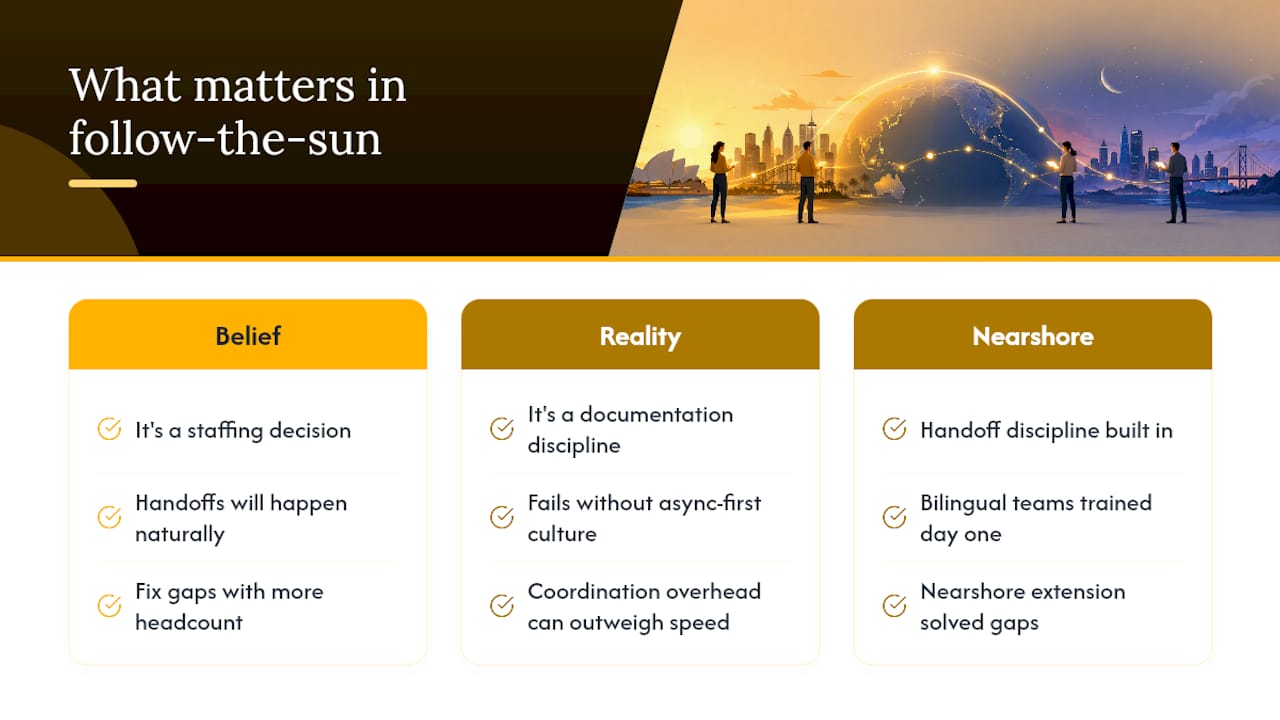
The biggest misconception about follow-the-sun support is that it’s a staffing decision. It isn’t. It’s a documentation discipline wearing a staffing model’s clothes. Teams that fail at this usually hired the right regional coverage and then assumed good handoffs would happen naturally. They don’t. Research on global software workflows backs this up directly: coordination overhead can quietly outweigh the speed benefits when an asynchronous-first culture isn’t already part of how teams operate.
Some nearshore, managed-team models work because handoff discipline is built into how bilingual teams are trained and deployed from day one, not bolted on after a rollout stalls. In one case, an orthodontic services provider needed continuous patient scheduling and follow-up support without gaps between shifts. Extending the client’s team with a nearshore group solved the handoff problem structurally instead of patching it with more headcount.
— Daniela
Getting Follow-the-Sun Support Right Without the Guesswork
Most organizations trying to build follow-the-sun coverage from scratch hit the same wall: hiring across three time zones, writing handoff SOPs, and training regional teams to a single standard takes months you don’t have. Some providers shorten that path by extending your existing support team with bilingual nearshore staff already trained to a shared handoff discipline, not a separate outsourced team learning your product from zero.

That matters most in industries where a dropped handoff has real consequences. Altiam CX’s managed customer support and SOP management work covers healthcare operations where patient scheduling can’t afford a gap between shifts, and similar structured intake and follow-up support extends into legal practices through legal intake and client communication services. If your organization is weighing whether to build follow-the-sun coverage in-house or bring in a nearshore partner who already runs this model daily, start by reviewing Altiam CX’s customer experience and managed team extension services and request a scoped assessment of your current handoff gaps.
Sources
- What Is the Follow the Sun Model? Key Benefits and More | Salesforce
- Configuring a follow-the-sun global support model – Zendesk help
- Follow-the-sun - Wikipedia
FAQ
What does “follow the sun support” mean?
It means routing customer support tickets between teams in different time zones so a live team is always working during daylight hours, rather than any single team covering overnight shifts.
What does “follow the sun” mean outside of customer support?
Outside support operations, it describes any global workflow, especially in software development, where work is handed off between time zones to keep a project moving continuously without an around-the-clock team in one location.
What is follow-the-sun coverage?
It’s the operational result of the model: continuous or near-continuous service hours built by chaining together two or three regional teams, each covering the daytime hours in their own time zone.
How fast do you need to go to follow the sun?
There’s no fixed speed requirement. The model depends on your regions’ time zone gaps and ticket volume, and most organizations start with a two-region pilot before scaling to full 24/7 coverage.
Does Altiam CX offer follow-the-sun support staffing?
Altiam CX provides managed team extension and bilingual nearshore staffing that organizations use to build follow-the-sun coverage, with pricing available directly through its services page.