
Bilingual agent training is the structured program that turns a person who speaks two languages into an agent who can resolve a customer’s problem in either one, accurately, with the right tone and inside your compliance rules. Fluency is the entry ticket. The program has to add product knowledge, systems skills, cultural fluency, realistic practice and measurable quality standards. This guide walks through each layer so operations and CX leaders can build a program that holds up, whether the team sits in-house or with a nearshore partner.
TL;DR
- Set a minimum proficiency level for each role and channel before you hire, and test it with real-world tasks rather than résumé claims.
- Train the same core curriculum you would give any agent (products, policies, systems, escalation), then add language-specific layers: terminology, dialect, tone and cultural context.
- Practice with role-plays and recorded calls, not slide decks, and debrief with specific feedback on empathy, accuracy, policy and tone.
- In healthcare, legal and financial services, add privacy, confidentiality and language-access rules to the curriculum from day one.
- Measure bilingual quality with calibrated audits in both languages, and keep coaching after onboarding.
Table of Contents
- Start with the role, not the résumé
- The core curriculum every agent needs
- Language-specific layers: terminology, dialect and culture
- Practice that looks like the real job
- Regulated industries: privacy, confidentiality and language access
- Measuring whether training worked
- Keep coaching after onboarding
- Our perspective: train for outcomes, not for fluency
- How Altiam CX supports bilingual teams
- FAQ
- Sources
Start with the role, not the résumé
Most bilingual training failures begin before day one. A candidate says they are fluent, the hiring team agrees after a friendly chat, and three weeks later the agent struggles with a billing dispute in their second language. The fix is to define what the job actually demands.
A language needs analysis identifies the speaking, listening, reading and writing capabilities each job requires, sets minimum levels, and then uses language tests to select people. Not every seat needs the same profile:
- Voice support leans on speaking and listening, including comprehension of fast, accented or emotional speech.
- Chat and email support leans on writing accuracy, spelling, grammar and the ability to adapt register quickly.
- Back-office roles such as document review or case notes may need strong reading and writing but little speaking.
Language Testing International advises setting a minimum proficiency level for each role and matching the assessment to the channel: speaking tests for voice, writing tests for chat or written support. Its corporate guidance adds that workplace proficiency should be shown through spontaneous, unrehearsed real-world tasks, not inferred from years of study or grammar knowledge.
Language is only half the screen. Assessment guidance for customer-service hiring points out that readiness also means testing listening, empathy, clear explanation and adaptability along with job-specific behavior. A candidate who scores well on grammar but interrupts upset callers will need a very different training plan from one who is warm and precise but needs terminology work.
If you are still building your pipeline, our guide to recruiting bilingual agents covers sourcing and screening in more detail, and our piece on language proficiency in nearshore explains how to set the bar for US-facing teams.
The core curriculum every agent needs
A bilingual agent is first a customer service agent. Skip the fundamentals and you get someone who can say “I understand your frustration” in two languages but cannot fix the problem in either.
Curriculum guidance from TechClass says a program should cover products and services, company policies and standard operating procedures, support tools such as CRM, ticketing, chat and call-center software, communication and conflict-resolution skills, brand voice, and scenario-based problem solving. Use that as your skeleton and build these modules.
Systems and access readiness
Before training content matters, the basics must work. NiCE’s onboarding checklist lists working computers and headsets, network access, contact-center and CRM or ticketing systems, knowledge-base access, authentication with multifactor security, and tested voice and browser peripherals. Nothing wastes a training week like agents who cannot log in. Treat access provisioning as a gate: no one starts classroom time until every tool is verified.
Product knowledge that mirrors real contacts
Product training should not be a tour of features. The same NiCE guidance says it should teach the common customer intents, the authoritative sources of information, realistic customer language, troubleshooting or resolution paths, and the situations that require escalation. For a bilingual team, the “realistic customer language” part is critical. Customers do not say “initiate a return merchandise authorization.” They say what they say, in the words of their own community.
Policies, SOPs and escalation
Teach each procedure in both languages, with the same decision logic. The agent serving a Spanish-speaking customer must have exactly the same refund authority, verification steps and escalation triggers as the one serving an English speaker. Inconsistency here is a customer-experience and compliance risk, not a translation problem.
Language-specific layers: terminology, dialect and culture
This is where bilingual training differs from standard onboarding.
Build a bilingual glossary
Agents need approved terms for your products, fees, forms and processes in both languages. USAGov’s outreach team describes using transcreation that accounts for culture and regional differences in Spanish instead of literal translation, supported by glossaries, dictionaries and style guides. Adopt the same discipline: one glossary, one style guide, owned by someone, updated when products change. Our article on multilingual knowledge base management explains how to govern that content so agents and any AI tools draw from the same approved answers.
Train for dialect and regional nuance
Spanish spoken by customers in Texas, Florida, New York and Puerto Rico is not identical, and a word that is neutral in one region can be awkward or offensive in another. The Multilanguage Customer Support Research Report recommends hiring genuinely fluent agents, testing dialect nuance, avoiding regionally offensive slang and having recruiting interviews conducted in both languages. It also recommends cultural training covering vocabulary, geographic familiarity, tone and etiquette, with continuing updates about regional differences and events affecting customers.
For teams working from Latin America and serving US customers, add two things: exposure to the range of American English accents and idioms, and familiarity with the US context behind the call (insurance deductibles, state-by-state rules, retail return norms). Academic work on this topic points to practical communication skills, including listening, accent comprehension, idiom awareness and clarity, along with exposure to varied accents and an emphasis on cultural awareness.
Soft skills in both languages
Empathy, active listening and clear explanation do not transfer automatically between languages. An agent may be reassuring in one and stiff in the other. Build client communication skills such as listening, plain-language explanation and adaptability into modules that are practiced in both languages, and coach to the weaker one.
Be careful with translated training
If you translate your training materials, do not rely on automation alone. Articulate’s localization guidance recommends combining automation with expert review, with native-speaker or in-market reviewers checking translated training for clarity, accuracy and brand fit. A machine-translated SOP that sounds slightly off teaches agents slightly off phrasing.
Practice that looks like the real job
Knowledge does not become skill until agents use it under pressure. Role-play is the most reliable bridge, and it works best when it is designed rather than improvised.
TechClass’s guidance on role-playing for support training suggests practicing angry customers, technical problems, refunds outside policy and outages. Give participants roles and context, allow natural language and curveballs, observe or record the session, and debrief with specific feedback on empathy, accuracy, policy and tone. Then repeat the scenarios and raise the difficulty.
For bilingual teams, adapt the format:
- Run scenarios in both languages. Use the same scenario in English and Spanish and compare performance. Gaps show quickly.
- Switch mid-call. Real customers often move between languages. Train agents to follow gracefully without making the customer feel corrected.
- Use native-speaking role-play partners. A peer from the same linguistic background can flag unnatural phrasing that a monolingual trainer would miss.
- Record and review. Listening back is the fastest way to hear a stiff phrase or a missed empathy cue.
- Add sensitive scenarios. Bereavement, medical worry, a missed court date, a declined payment. These are the moments when language precision matters most.
A simple progression works well: guided practice in week one, unscripted role-play with curveballs in the middle of the program, then nesting (supervised live contacts with a coach listening in) before the agent handles the queue alone. Our article on outsourced agent training for managers shows how that ramp can be structured, and our customer service training tips cover coaching habits that keep it effective.
Regulated industries: privacy, confidentiality and language access
In healthcare, legal and financial services, the cost of a language error is not just a bad survey score. It can be a misunderstood instruction, a breached confidentiality rule or a missed deadline. Add these elements to the curriculum.
Healthcare
The U.S. Department of Health and Human Services’ Office of Minority Health revised the National CLAS Standards in June 2025. They say organizations should ensure competent language assistance through training and certification when available, and avoid using untrained individuals or minors as interpreters. The framework treats language assistance as a quality function that needs competent staff and regular training, not just a conversational advantage. HHS also states that health organizations should provide language assistance at no cost to people who need it so they can reach care and services in a timely way.
For patient-facing teams, that means training on confidentiality, medical and scheduling terminology in both languages, and clear rules on when an agent should hand off to a qualified interpreter instead of improvising. A state Medicaid transportation call-center manual, for example, covers diversity and cultural sensitivity, difficult callers, healthcare protocols, confidentiality, practice in sample-account software, documentation, interpreter and relay procedures and post-training call monitoring. It is a useful model of how much a regulated program includes beyond language.
Legal and financial services
Legal intake and financial support share a theme: agents hear sensitive facts and must neither give advice they are not qualified to give nor lose critical details. Training should cover what an agent may and may not say, how to capture facts accurately, how to verify identity, and how to document in the system of record. Specialized assessments exist for these fields: LanguageLine’s US brochure says its tests can evaluate bilingual staff in medical, insurance, finance, legal, 9-1-1 and public-service fields, covering language proficiency, interpreting skills, terminology and industry knowledge.
Whatever the sector, have your compliance or legal counsel sign off on the privacy and regulatory module. The specific obligations depend on your industry, your state and your contracts.
Measuring whether training worked
A program you cannot measure is a program you cannot improve. Build quality assurance into the design.
USAGov’s contact center describes a quality blueprint that includes calibrated audits of English and Spanish calls and chats, live monitoring and recorded-interaction analysis, scoring for completeness and accuracy, customer feedback, monthly performance reports and a defined quality threshold (its example is a score of 94). Borrow the structure:
| What to measure | How | Why it matters for bilingual teams |
|---|---|---|
| Quality score | Calibrated QA audits of calls and chats in each language | Confirms one standard across both languages |
| Accuracy and completeness | Scorecard items tied to SOPs and the glossary | Catches terminology drift |
| Customer feedback | Post-contact surveys, segmented by language | Shows whether tone lands naturally |
| Handle time and first-contact resolution | Segmented by language and agent cohort | Reveals whether second-language contacts are slowed by gaps |
| Escalation rate | By reason code | Flags missing product or policy knowledge |
Two practices make the numbers trustworthy. First, calibrate: have QA analysts and supervisors score the same interactions and reconcile differences, and make sure at least one evaluator is fluent in each language. Second, segment everything by language. An overall CSAT of 88 can hide a Spanish-language score that is much lower. For the business case, see how bilingual agents affect Net Promoter Score and handle time.
Set a graduation standard too. Agents move from training to production when they meet the quality threshold in both languages on supervised contacts, not when the calendar says so.
Keep coaching after onboarding
Onboarding gets an agent to a baseline. It does not keep them there. Qiscus’s 2026 guide distinguishes the two: onboarding prepares agents for initial query categories, tools, escalation boundaries, tone, language and channel standards, while ongoing training responds to observed performance gaps.
A workable cadence looks like this:
- Weekly: short one-to-one coaching based on two or three reviewed interactions in each language.
- Monthly: a refresher on whatever the QA data shows is slipping, plus glossary updates for new products or policy changes.
- When something changes: a product launch, a new regulation, a seasonal surge or a service outage should trigger a brief, targeted briefing in both languages before the first customer call.
- Quarterly: cultural and regional updates, plus re-certification for roles in regulated workflows.
The principle is simple: let the data decide what to train next, and do not let one language’s training fall behind the other’s. Our look at workforce optimization examples shows how this fits into broader capacity planning.
Our perspective: train for outcomes, not for fluency
We see the same pattern across the organizations we support: leaders treat language as the whole requirement, then wonder why quality varies. In our experience, the programs that perform best treat bilingual ability as one capability inside a disciplined operation.
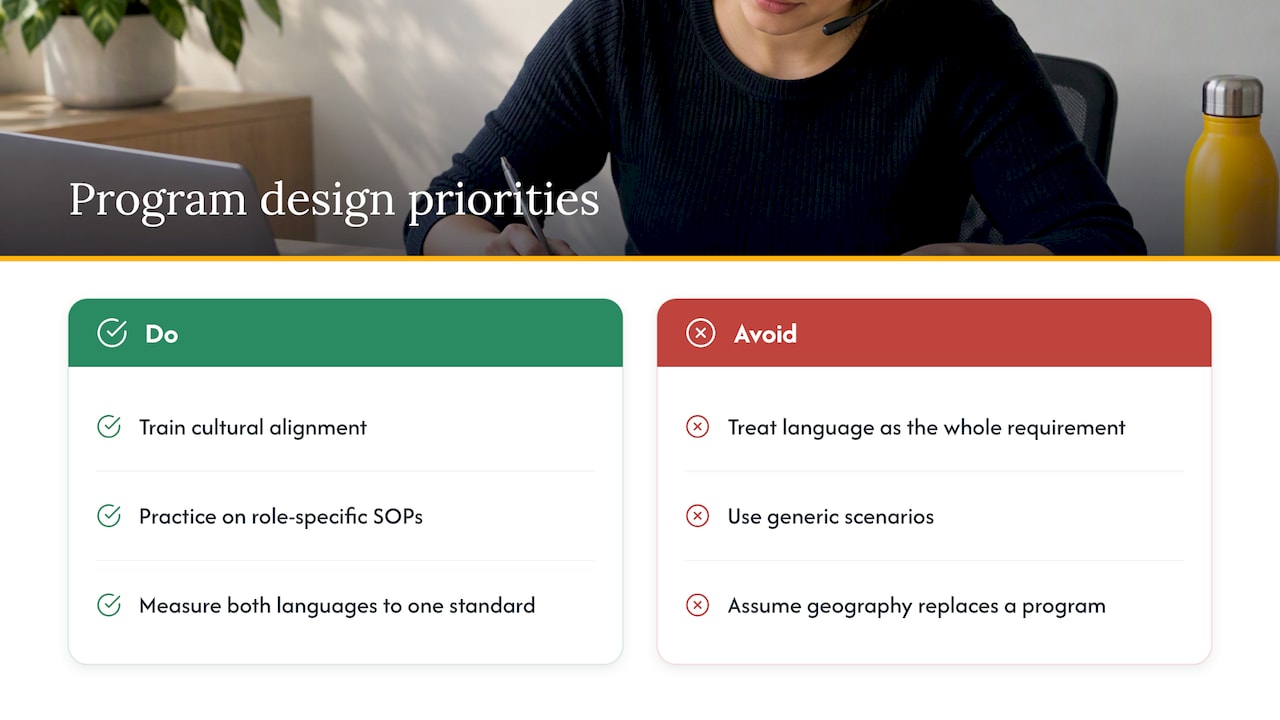
That means three things. First, cultural alignment is a training topic, not a hiring slogan. Agents who understand the expectations of US customers, and who share enough context to sound natural, make interactions feel authentic instead of scripted. Second, the training has to be tied to the operation’s real workflows, so a patient-support agent practices on the patient-support SOPs and a legal-intake agent practices on intake forms, not on generic scenarios. Third, measurement has to be built in before launch, with both languages held to one standard.
Nearshore delivery helps because teams in Latin America share working hours and cultural proximity with US customers, which makes live coaching, joint QA calibration and quick feedback loops easier to run. But geography does not replace a program. If you are weighing outsourced options, be clear about who owns the glossary, who calibrates QA and how fast the team can ramp. Our contract guides on bilingual customer support priorities and Spanish and English support list what to settle before you sign.
— Daniela
How Altiam CX supports bilingual teams
If you would rather not build the whole program yourself, we deliver managed nearshore teams with bilingual agents trained on your processes, systems and quality standards. Our Managed Team Extension and Customer Experience services let you scale capacity while keeping direct visibility into performance.
We also build industry-specific operations. Healthcare organizations can explore our patient support and SOP management services, and law practices can see how we handle intake, follow-ups and scheduling. Tell us the languages, channels and compliance requirements you need, and we will show you how we would train and measure the team.
FAQ
How long should bilingual agent training take?
It depends on the complexity of your products, systems and compliance requirements. A simple chat queue ramps faster than a regulated healthcare or legal workflow. Plan for classroom training, supervised practice and a coached nesting period, and move agents to production only after they meet your quality threshold in both languages.
Do bilingual agents need different training than monolingual agents?
They need the same core curriculum, plus extra layers: an approved bilingual glossary, dialect and cultural training, language-specific soft-skill practice and QA in both languages. The goal is one service standard regardless of the language the customer chooses.
How do you test bilingual proficiency before training starts?
Use a structured assessment matched to the channel: speaking and listening tests for voice roles, writing tests for chat and email. Proficiency testing organizations recommend demonstrating ability through unrehearsed real-world tasks, and a bilingual interview adds a practical check. Add behavioral screening for empathy and listening.
Can AI translation replace bilingual agent training?
No. Machine-assisted translation can help scale training content and support agents, but native-speaker review is still needed to keep communication accurate and natural. Agents also need judgment, empathy and policy knowledge that a translation tool does not provide.
What metrics show that bilingual training is working?
Track calibrated quality scores, accuracy, customer satisfaction, handle time, first-contact resolution and escalation rate, each segmented by language. Compare the two languages regularly. A gap between them usually points to a specific training need.
Sources
- Language Needs Analysis, ALTA Language Review Services
- Language Testing for Commercial Organizations, LTI
- The Importance of Language Assessment in Recruitment, LTI
- The 5 Things You Should Test Before Hiring, Hallo
- Call Center Requirements Checklist, NiCE
- How to Build an Effective Customer Support Training Program, TechClass
- Role-Playing in Support Training, TechClass
- Speaking your language: USAGov outreach’s approach to bilingual content
- The Growing Need for Multilanguage Customer Support
- LABEL: Law, Accounting, Business, Economics, and Language
- From 0 to 100: Translating Global Customer Service Training, Articulate
- National CLAS Standards, HHS Office of Minority Health
- Cultural and Linguistic Competence, HHS Office of Minority Health
- Call Center Manual, Louisiana Department of Health
- Ensure Your Bilingual and Interpreter Staff Are Prepared, LanguageLine
- Creating a blueprint for quality, USAGov
- How to Build Customer Service Training Programs, Qiscus
- Client Communication Skills