
The recommended path for most operations leaders and CX directors is to outsource multilingual agent-facing knowledge base and SOP governance to a nearshore BPO partner running a structured 90-day governance sprint. This approach delivers consistent agent guidance, faster content updates, bilingual accuracy, and a knowledge base ready for AI retrieval. The practical next step is simple: start the 90-day governance sprint now, before adding any AI agent assist layer on top of ungoverned content.
TL;DR:
- Require each article to solve one problem, include role specific variants, and carry language, locale, owner, update date, escalation, and channel metadata; verify clean export.
- Set same day updates for policy or compliance changes and weekly batches for routine edits; require expert approval, version control, and rollback before publishing.
- Transcript extraction can identify information seeking question and answer pairs with above 90% accuracy, but representative samples still need human review before production use.
- Require ownership, export, audit, human review, metadata, and update terms in contracts; track five KPIs monthly, including accuracy and agent adoption.
- Launch role specific SOP variants in both languages together, with the same subject matter expert reviewing each pair so one language does not lag.
Table of Contents
- What Multilingual Knowledge Base Management Means Here
- Authoring, Metadata, and Storage Standards to Require from a Vendor
- Governance Model: Roles, Workflows, and Update SLAs
- Preparing Knowledge Bases for RAG and AI Agent Assist
- The 90-Day Roadmap for an MVP Knowledge Base and SOP Set
- Contract Priorities and KPIs Procurement Should Require
- SOP Integration and Persona-Aware Variants for Bilingual Agents
- Keeping Multilingual Content Current Beyond Basic Bilingual Variants
- Translation Workflow and Quality Assurance Best Practices
- Technology Stack Choices for Multilingual Knowledge Management
- Connecting the Knowledge Base to Support Platforms and CRM Systems
- Training Bilingual Teams on a New Knowledge Base System
- Why Governance Matters More Than the Platform You Choose
- Getting Started with Altiam CX on Knowledge Base Governance
- FAQ
- Sources
What Multilingual Knowledge Base Management Means Here
When we talk about multilingual knowledge base management in this guide, we mean something specific: the ongoing creation, localization, governance, and maintenance of agent-facing knowledge bases and standard operating procedures for bilingual contact center teams. We are not talking about public-facing help centers or the configuration of translation software, that’s a different discipline aimed at a different audience.
The content we manage under this scope typically includes:
- Structured knowledge base articles written for agent consumption during live calls or chats
- SOP decision trees that guide agents through regulated or multi-step processes
- QA pairs extracted from past interactions and validated for reuse
- Metadata layers that make every article findable by language, channel, and topic
This content supports agent desktops, live chat assist tools, phone agent prompts, and back-office SOP libraries, anywhere a bilingual agent needs a fast, accurate answer mid-interaction.
Authoring, Metadata, and Storage Standards to Require from a Vendor
Before signing a statement of work, operations leaders should require a documented content standard, not a vague promise of “organized knowledge.” Research into knowledge management for customer support AI agents identifies a formal set of requirements spanning authoring, metadata, structure, and storage that lets a single knowledge article serve as one source of truth for human agents, customers, and AI retrieval systems alike.
On the authoring side, every article should cover one problem only, written as clear step-by-step agent actions, with role-aware variants distinguishing a billing scenario from a technical support scenario. Mixing both into a single sprawling article is a common failure mode that slows agents down and confuses retrieval systems.
Metadata is where most KBs fall apart. At minimum, require:
- Language and locale tags for every article
- Domain, product, or service category
- Content owner and last-updated date
- Escalation level and channel applicability (phone, chat, back office)
Formatting should include QA pairs for quick lookup, SOP decision graphs for multi-step processes, consistent templates, and variable placeholders for things like product IDs or region codes so one article can serve multiple markets without duplication.
Finally, evaluate whether your existing customer support platform can actually export this metadata cleanly. A platform that stores everything as unstructured text will block any future move toward retrieval-augmented generation, no matter how good the content underneath looks.
Pro Tip: Ask any prospective BPO partner to show you a sample article with full metadata fields populated, not just a clean-looking paragraph.
Governance Model: Roles, Workflows, and Update SLAs
Content quality erodes fast without clear ownership. A working governance model assigns distinct roles and enforces a publishing workflow with human checkpoints before anything reaches agents or an AI layer.
- Capture: Bilingual frontline agents flag gaps, outdated steps, or recurring questions as they work, the earliest and cheapest signal of what needs updating.
- Author and edit: Dedicated knowledge managers turn raw input into structured articles that follow your authoring and metadata standards.
- Approve: Subject matter experts or operations leads sign off before anything goes live, especially for regulated or compliance-sensitive SOPs.
- Publish with QA gates: No article or QA pair reaches an agent desktop or an AI retrieval index without passing this review chain.
- Maintain: Version control, deduplication checks, and rollback policies keep the knowledge base from accumulating conflicting or stale versions of the same answer.
Review cadence should differentiate urgency: policy changes or compliance updates need same-day turnaround, while routine clarifications can follow a weekly batch cycle. Our governance playbook for operations leaders lays out a version of this workflow built specifically around reducing AI retrieval risk over a 90-day window.
Preparing Knowledge Bases for RAG and AI Agent Assist
Feeding an AI retrieval system a messy knowledge base just produces confident, wrong answers faster. The fix starts with how you extract and structure content, not with the AI model itself.
Recent research on automated knowledge base creation for conversational AI agents demonstrates that transcript extraction and clustering can produce high-accuracy QA pairs and directly address the cold-start problem that RAG-based contact center agents face when no structured knowledge base exists yet. In practice, this means:
- Running transcripts through extraction pipelines to surface candidate QA pairs
- Clustering similar questions and selecting representative examples for human review rather than reviewing every raw transcript line
- Maintaining a bilingual terminology dictionary so embeddings stay aligned across language pairs instead of drifting
- Setting conservative similarity thresholds to flag stale or duplicate entries for review rather than auto-publishing them
One finding worth internalizing: the same research reports above 90% accuracy in extracting information-seeking QA pairs from conversation logs, but it still recommends human review of representative samples before anything is trusted for production use. Full automation remains risky around multimedia content and incomplete transcripts, human-in-the-loop validation isn’t optional, it’s the safeguard that keeps retrieval accurate.
The 90-Day Roadmap for an MVP Knowledge Base and SOP Set
A well-scoped 90-day sprint turns a scattered knowledge base into a governed, AI-ready asset without stalling your contact center for a quarter.
- Weeks 1-3, discovery and data collection: inventory existing articles, pull sample transcripts, and identify top recurring issues by volume.
- Weeks 4-6, templates and metadata rollout: finalize authoring standards and metadata schema, then migrate priority content into the new structure.
- Weeks 7-9, transcript extraction and pilot QA population: run extraction pipelines on historical transcripts and populate a pilot set of QA pairs.
- Weeks 10-11, human review and pilot deployment: subject matter experts validate pilot content before it reaches a live agent group.
- Week 12, go-live and KPI baseline: launch to the full bilingual team and capture baseline metrics for ongoing measurement.
Early quick wins typically come from targeting the top handful of recurring issues, standardizing SOP decision trees for the highest-volume escalation path, and giving bilingual agents a single searchable terminology reference instead of scattered notes.
Pro Tip: Request deliverables at the 30, 60, and 90-day marks in writing, a populated template library, a pilot QA set, and a live KPI baseline, so there’s no ambiguity about what “done” looks like.
Contract Priorities and KPIs Procurement Should Require
A governance process is only as strong as the contract behind it. Procurement teams should treat the following as non-negotiable clauses rather than nice-to-haves:
- Clear content ownership and export rights so your knowledge base isn’t locked into a vendor’s platform
- Defined update SLAs separating urgent fixes from routine edits
- Mandatory human QA before any content reaches agents or an AI layer
- Audit access so your team can review article history and approval trails
- Documented metadata standards the vendor commits to maintaining
| KPI | What it measures |
|---|---|
| Time-to-publish | Days from flagged gap to live article |
| Article accuracy rate | Share of articles passing QA review without rework |
| SLA compliance | Percentage of updates completed within agreed timeframes |
| KB-assisted resolution rate | Share of contacts resolved using KB content |
| Agent adoption | Percentage of agents actively using the KB during live interactions |
Pair these KPIs with a regular reporting cadence, monthly at minimum, and tie renewal or bonus terms to sustained SLA compliance rather than one-time delivery. Our contract priorities guide for bilingual support walks through how to translate these into actual SOW language.
SOP Integration and Persona-Aware Variants for Bilingual Agents
A knowledge base that treats a billing agent and a technical support agent the same way creates friction for both. Persona-aware tailoring, delivering role-specific article variants rather than one generic version, reduces the cognitive load on agents who are already switching between English and a second language mid-call.
SOPs deserve special treatment here. Research on SOP-guided agent frameworks shows that representing procedures as decision graphs rather than long-form prose improves outcomes for decision-intensive customer service tasks, both for human agents following the steps and for AI agents guided by the same structure. A billing dispute SOP and an account security SOP shouldn’t live in the same generic “process” bucket, each needs its own decision path, escalation triggers, and language-specific phrasing.
Mapping this taxonomy to agent roles is work best owned by whoever governs your knowledge base day to day. Practitioner guidance on localization and knowledge management confirms that high-performing organizations map content to specific agent roles instead of publishing one-size-fits-all articles, with outsourcing partners typically responsible for maintaining that taxonomy over time.
For bilingual teams specifically, this means every persona variant exists in both languages from day one, not as an afterthought translated weeks later. A technical support variant and its bilingual counterpart should launch together, reviewed by the same SME, so neither language lags in accuracy.

Keeping Multilingual Content Current Beyond Basic Bilingual Variants
Bilingual coverage is the floor, not the ceiling. Contact centers serving diverse customer bases often need cultural adaptation that goes beyond a direct translation, phrasing that respects regional norms, examples that make sense locally, and tone calibrated to what feels natural rather than literal.
Treating localization as a one-time project guarantees drift. Product changes, policy updates, and seasonal shifts all touch content continuously, so a sustainable approach builds localization into the same review cadence as the rest of your knowledge base governance, not as a separate annual cleanup.
Practical habits that keep multilingual content from going stale include:
- Reviewing culturally specific examples and phrasing whenever source-language content changes, not just translating word-for-word
- Assigning a bilingual reviewer, not just a translator, who understands both the language and the customer context
- Flagging idioms or region-specific references during authoring so they don’t require rework after translation
- Tracking which articles serve which markets so updates propagate consistently across every variant
A knowledge base governed this way treats localization as a continuous discipline tied to the same SLAs and approval gates as everything else, rather than a separate workstream that falls behind.
Translation Workflow and Quality Assurance Best Practices
Translation quality directly determines whether agents trust the knowledge base at all. A workflow without a dedicated QA step tends to produce content that reads correctly but misses nuance, especially around technical terminology or compliance language.
A disciplined workflow separates three steps clearly: initial translation, bilingual QA review, and final approval by someone with subject matter authority. Skipping the middle step is the most common shortcut, and it’s the one that lets inconsistent terminology slip through.
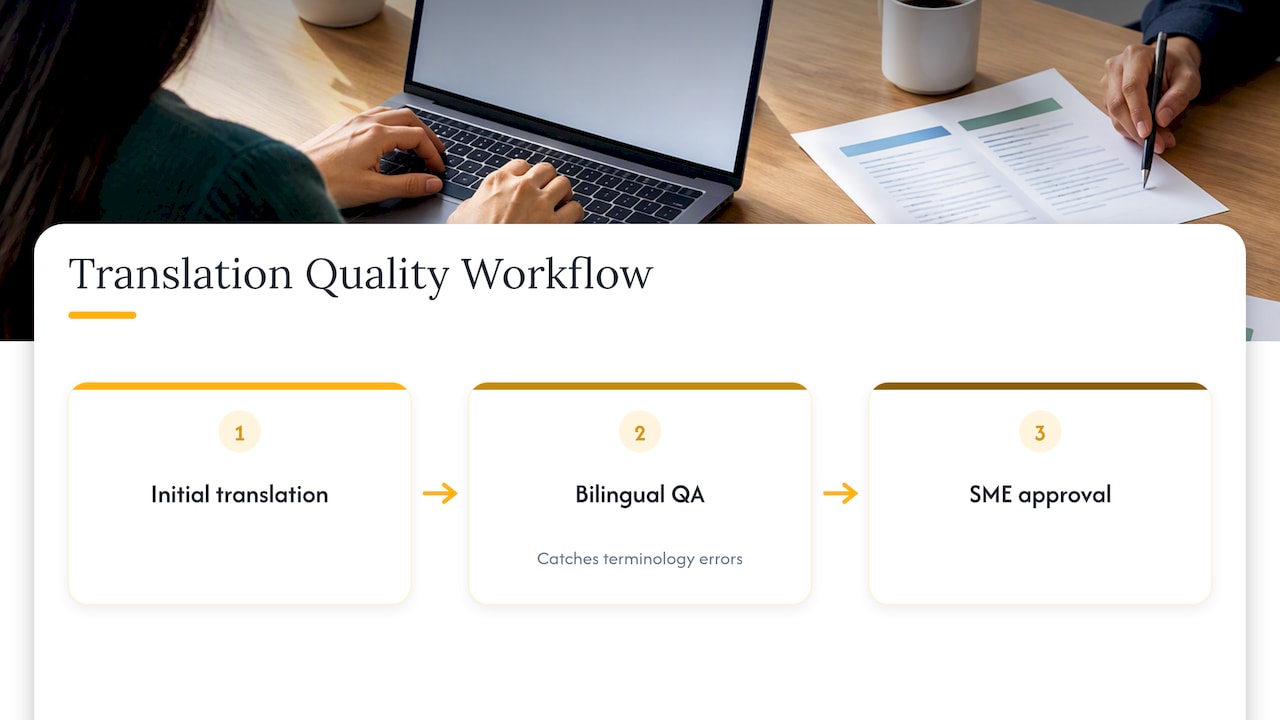
Industry findings on multilingual support back up why this matters operationally. Multilingual support improves customer satisfaction and other quality metrics, but implementation is genuinely difficult, and many organizations lean on bilingual staff or machine translation as interim solutions rather than fully resourced localization programs. That gap is exactly where a dedicated QA step pays off: it catches the errors that interim solutions tend to let through.
A shared bilingual terminology dictionary, maintained alongside your knowledge base rather than as a separate document, keeps translators and reviewers aligned on how specific terms should render every time. Combine that with periodic sampling audits, pulling a percentage of recently translated articles for spot review, to catch drift before it compounds across the knowledge base.
Technology Stack Choices for Multilingual Knowledge Management
The right stack for multilingual knowledge base management balances three needs: structured storage, multilingual search capability, and compatibility with whatever AI retrieval layer you plan to add later.
At the storage layer, look for a platform that supports rich metadata fields natively, language, locale, domain, owner, rather than forcing you to bolt metadata on as unstructured tags. This single decision determines whether retrieval-augmented generation is even feasible down the line without a costly migration.
Search and retrieval components should support multilingual indexing, meaning the system can match a query in one language against content tagged for that locale without relying on machine translation at query time. Embedding-based search, paired with the terminology dictionary mentioned earlier, tends to outperform keyword-only search for multilingual content because it captures intent rather than exact phrasing.
Finally, confirm export capability before committing. A stack that locks your knowledge base content into a proprietary format makes it difficult to switch vendors or bring governance in-house later, undermining the content ownership clause your contract should already require.
Connecting the Knowledge Base to Support Platforms and CRM Systems
A knowledge base that lives apart from the tools agents already use adds friction instead of removing it. Integration with your core customer support platform and CRM should surface relevant articles automatically based on ticket type, customer language, and product context, rather than requiring agents to search manually mid-call.
Practical integration points to confirm with any vendor or internal IT team include whether the knowledge base can push suggested articles directly into the agent’s active ticket view, whether customer language preference stored in the CRM can auto-filter which language variant displays, and whether resolution data flows back into the knowledge base to flag articles that aren’t actually solving the problem they claim to.
This connective layer also supports the KPI tracking covered earlier. Without integration, measuring KB-assisted resolution rate or time-to-publish against live ticket data becomes a manual, error-prone exercise. With it, those numbers populate automatically as part of normal support operations, giving operations leaders a real-time view rather than a quarterly guess.
Training Bilingual Teams on a New Knowledge Base System
Rolling out a governed knowledge base changes daily habits for agents who have likely built their own workarounds, personal notes, sticky notes, informal chat threads, over time. Change management here matters as much as the content itself.
Effective rollouts start with a short, role-specific onboarding session rather than a single all-hands training that tries to cover every persona variant at once. Technical support agents need to see their decision trees and terminology references; billing agents need theirs, in both languages they work in daily.
Ongoing reinforcement works better than a one-time launch event. Short refreshers tied to major content updates, paired with a visible feedback channel where agents can flag gaps directly from the article they’re viewing, keep adoption from fading after the initial rollout excitement wears off. Tracking agent adoption as a KPI, not just publishing it as a one-time number, keeps this visible to operations leaders over time rather than assumed.
Why Governance Matters More Than the Platform You Choose
Most organizations evaluating multilingual knowledge base management focus their energy on picking the right software. That’s the wrong starting point. The platform matters far less than whether a disciplined governance process, clear ownership, enforced QA gates, and a real update cadence, sits behind it.
We’d argue the biggest blind spot for operations leaders right now is treating AI readiness as a technology purchase rather than a content discipline. A perfectly configured RAG system fed by an ungoverned, duplicate-riddled knowledge base will produce confident wrong answers faster than a human agent ever could. The fix isn’t a better model, it’s the unglamorous work of metadata standards, human review gates, and terminology consistency that most teams skip because it doesn’t feel like progress.
As a nearshore customer experience and operational services partner, we support organizations through customer care, technical assistance, back-office operations, and scalable team-extension work built on cultural alignment, disciplined execution, and measurable performance frameworks. Our view on knowledge governance comes directly from that operational seat, not from theory.
— Daniela
Getting Started with Altiam CX on Knowledge Base Governance
We run a structured 90-day knowledge base and SOP governance engagement built for bilingual contact centers, combining our Managed Customer Support capabilities with the authoring, metadata, and AI-readiness standards covered in this guide.

- A discovery call to review your current knowledge base and top agent pain points
- A pilot statement of work scoped to your highest-volume SOP or escalation path
- A 90-day rollout following the governance model outlined above, with KPI baselines delivered at go-live
Explore our services page to see how a pilot engagement fits your contact center.
FAQ
What is multilingual knowledge base management for contact centers?
It refers to creating, localizing, and governing agent-facing knowledge base articles and SOPs so bilingual support teams have consistent, accurate guidance across languages. This is distinct from public-facing help center content, which follows a different workflow and audience.
How long does it take to build an AI-ready multilingual knowledge base?
A structured rollout typically runs on a 90-day cycle, covering discovery, template and metadata rollout, transcript-based QA extraction, and a pilot go-live with KPI baselines. Timelines can extend for larger content libraries or highly regulated SOP sets.
Can transcripts really be turned into usable knowledge base content?
Yes, research on automated knowledge base creation for conversational AI shows transcript extraction and clustering can produce QA pairs with above 90% accuracy in identifying information-seeking exchanges. Human review of representative samples remains necessary before publishing any extracted content.
What KPIs should we require from a BPO managing our knowledge base?
Prioritize time-to-publish, article accuracy rate, SLA compliance, KB-assisted resolution rate, and agent adoption as core metrics. These should be tied to contract terms with a regular reporting cadence, not reported only at renewal time.
Does outsourcing knowledge base governance work for regulated industries?
Yes, when the contract specifies human QA gates, audit access, and documented metadata standards before any content reaches agents or an AI layer. Our managed support and SOP governance work for healthcare clients follows this same structure for regulated environments.
Sources
- Toward a knowledge management method for training customer support AI agents
- AI Knowledge Assist: An Automated Approach for the Creation of Knowledge Bases for Conversational AI Agents
- Multilingual service in the support center (HDI & Lionbridge)