
Knowledge base governance is the set of rules, roles, and review cycles that keep organizational content accurate, owned, and safe to use. Done right, it produces four outcomes: every article has a named owner, freshness is verified on a schedule, content is findable through consistent structure, and access respects compliance boundaries. The sections below break each piece into something you can build this quarter.
TL;DR:
- Ownership at the category level ensures accountability for hundreds of articles and prevents knowledge decay caused by staff turnover.
- Regular review cadences should be tailored to the volatility of content, with event triggers for urgent updates and automated tracking of review status.
- Five mandatory metadata fields—owner, last-reviewed date, content type, status, and target audience—are critical for automating governance and access control.
- Behavioral metrics such as search failure rate, ticket deflection, and agent flags provide actionable insights into knowledge base health, not just content quantity.
- Implementing governance with a focus on habits, ownership, and feedback loops is more effective than relying solely on tools or policies, especially in AI-driven environments.
Table of Contents
- What Is Knowledge Base Governance, and What Framework Supports It?
- Who Should Own What: Roles and Stewardship Patterns
- How Often Should You Review Knowledge Base Content?
- Taxonomy and Metadata: The Fields That Make Governance Work
- Which Metrics Actually Show Knowledge Base Health?
- Centralized, Federated, or Hybrid: Choosing a Stewardship Model
- Rolling Out Governance: The First 90 Days
- How Altiam CX Approaches Governance in Practice
- Risk Management and Legal Considerations in Knowledge Base Content
- The Real Priority Isn’t the Tool, It’s the Habit
- Need Help Running Governance Day to Day?
- Sources
- FAQ
What Is Knowledge Base Governance, and What Framework Supports It?
A governance framework works because it forces decisions that would otherwise get made ad hoc, article by article, by whoever touched the content last. That inconsistency is exactly what generative AI exposes fastest. When a support bot or internal copilot pulls from your knowledge base as its source of truth, a stale article does not just confuse one reader. It gets repeated at scale, instantly, across every conversation the AI touches. IBM’s analysis of generative AI’s effect on data governance makes the case plainly: weak governance amplifies errors and operational risk the moment AI enters the workflow.
The practitioner consensus, laid out in the KMHelpDesk governance guide, organizes effective knowledge governance around five pillars. Ownership comes first because everything else depends on it.
- Ownership and decision rights. Someone must be accountable for every article, and that person needs the authority to approve, retire, or escalate changes.
- Quality standards and publishing gates. Style, structure, and fact-checking rules applied before content goes live, not after complaints roll in.
- Compliance and scoped access. Legal, HIPAA, or financial-services content needs access rules baked into the taxonomy, not bolted on later.
- Measurement and review. Scheduled audits plus event triggers that catch decay before customers do.
- Taxonomy and metadata. The connective tissue that makes the other four pillars automatable rather than manual.
Skip ownership and the rest collapses. Nobody reviews content nobody owns.
Who Should Own What: Roles and Stewardship Patterns
Governance fails most often at the handoff between “someone should fix this” and an actual name attached to a deadline. The fix is a role map, not a wish list.
- Category owners, not article owners, at scale. Assigning ownership to individual articles works for a hundred pages. Past that, category-level ownership (billing, onboarding, returns) survives staff turnover and keeps accountability intact even as headcount shifts.
- Content stewards handle day-to-day edits, formatting, and metadata hygiene within their assigned categories. They are the people who actually open the editor.
- Platform stewards manage the tooling: search relevance, tagging schemas, integration with the support or CRM stack.
- A governance council, usually four to eight people spanning support, product, legal, and IT, meets on a fixed cadence to resolve cross-category disputes and approve policy changes.
- Delegation rules let stewards approve minor edits (typos, broken links) without council sign-off, reserving escalation for anything that changes a policy statement or compliance claim.
Pro Tip: Give every category owner a backup owner on day one. The single most common governance failure isn’t bad content, it’s an owner who left the company six months ago and nobody noticed.
How Often Should You Review Knowledge Base Content?
Cadence should match volatility, not a calendar default. A pricing page that changes with every product release needs a different rhythm than a company history page that hasn’t moved in years.
A workable split includes frequent reviews for rapidly changing content, regular check-ins for moderately changing content, and event-triggered reviews for urgent updates.
Scheduled reviews catch slow decay. Event triggers catch the fast kind. HelpDocs recommends attaching an owner and a last-reviewed date to every article specifically so cadence can be enforced automatically rather than tracked in a spreadsheet nobody opens.
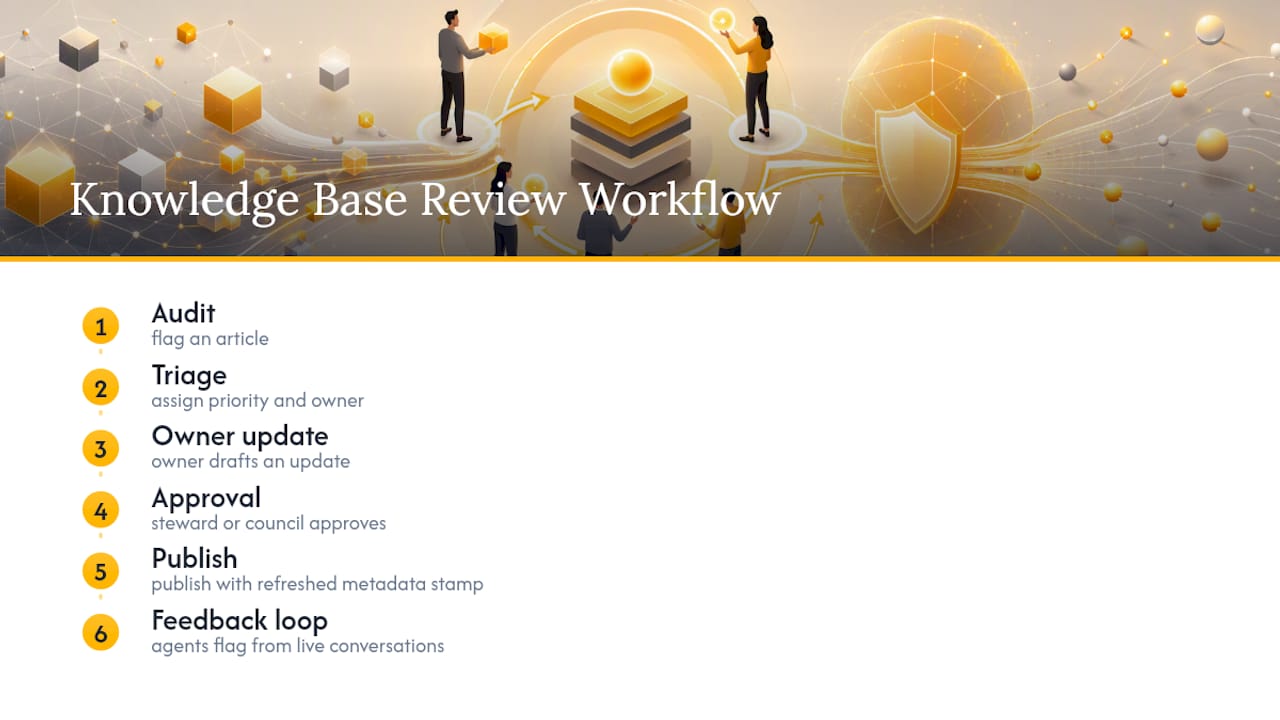
The workflow itself runs in five steps: audit flags an article, triage assigns priority and owner, the owner drafts an update, a steward or council member approves it, and it publishes with a refreshed metadata stamp. Feedback loops close the circle. When agents can flag an article with one click from inside a live conversation, teams see faster trust rebuilding because contributors watch their input get acted on instead of vanishing into a queue.
Statistic to watch: low-confidence AI answers are themselves a review trigger. If your AI assistant surfaces an answer with a confidence score below your threshold, that article should route straight to triage, not wait for the next quarterly cycle.
Taxonomy and Metadata: The Fields That Make Governance Work
Metadata is what turns governance from a policy document into something a dashboard can enforce. Enterprise Knowledge’s guidance on metadata governance states it directly: you cannot manage what you cannot filter.
Five fields should be mandatory on every article before it publishes:
- Owner — the named person or category owner accountable for accuracy.
- Last-reviewed date — a required publication field, not an optional nice-to-have.
- Content type — policy, procedure, FAQ, troubleshooting, so search and routing logic can treat each differently.
- Status — draft, approved, under review, retired.
- Audience and product — who the content applies to and which product line it covers, critical for multi-product organizations.
Category and tag design matters just as much as the fields themselves. A flat tag list turns into noise past a few hundred articles; a hierarchical taxonomy tied to your actual product and support structure keeps search relevant and lets automation route flagged content to the right steward without a human reading every ticket first.
Access control follows the same logic. Regulated content, patient data references, legal case details, financial disclosures, needs scoped visibility built into the taxonomy itself, not a separate system layered on top. A board-level review of data security controls is worth running before you finalize access tiers for sensitive categories.
Which Metrics Actually Show Knowledge Base Health?
Article count is a vanity metric. It tells you nothing about whether the content works. The metrics worth a dashboard slot are the behavioral ones: they show what happens when a real person or AI system tries to use the content, not how much of it exists.
| Metric | What It Reveals | Review Cadence |
|---|---|---|
| Search-to-no-result rate | Content gaps readers can’t find an answer for | Weekly |
| Ticket deflection rate | Whether self-service content is actually resolving issues | Monthly |
| Percent of articles with a named owner | Governance coverage gaps | Monthly |
| Article age since last substantive edit | Decay risk, independent of traffic | Quarterly |
| Agent-flag counts per article | Frontline signal that content is wrong or confusing | Weekly |
HelpScout’s maintenance framework makes the case for prioritizing exactly this kind of behavioral data over raw publishing volume. A red flag on ticket deflection or a spike in agent flags should trigger a defined action within the week: update, merge with a related article, or retire and redirect. Whoever owns the category acts; whoever sits on the council reviews trends across categories monthly. Set the targets before you launch the dashboard, not after the first report confuses everyone in the room.
Centralized, Federated, or Hybrid: Choosing a Stewardship Model
Three patterns cover most organizations, and each trades consistency against speed differently.
- Centralized puts a single team in charge of every article. Consistency and quality control are strong, but throughput suffers the moment content volume outpaces the team’s capacity, which happens faster than most leaders expect.
- Federated distributes ownership to subject-matter experts across departments. Content stays closer to the people who actually know it, but drift risk climbs without a strong council enforcing shared standards.
- Hybrid pairs a thin central steward team, usually two or three people, with distributed category owners across the business. This is the pattern most mid-size and large organizations land on because it balances speed with enough oversight to catch drift early.
Use this checklist before committing to a model:
- How many articles and categories do you manage today, and what’s the growth trajectory over the next year?
- How specialized is the content? Highly technical or regulated content leans federated or hybrid.
- Does a governance council already exist, or would you be building one from scratch?
- Can you staff platform stewardship separately from content stewardship?
Most organizations that start centralized outgrow it within a year and shift to hybrid once category ownership proves it can hold.
Rolling Out Governance: The First 90 Days
Governance dies when it launches as a 40-page policy document nobody reads. It survives when it launches as five visible actions in sequence.
- Weeks 1 to 3: Audit and assign. Inventory existing content, tag every article by category, and assign an owner to each category. Start with your highest-traffic articles first.
- Weeks 4 to 6: Build the flagging workflow. Stand up the one-click agent-flag mechanism and define your event triggers.
- Weeks 7 to 10: Baseline your metrics and run a cleanup. Pull your search-to-no-result and ticket-deflection numbers, then fix the top ten flagged or stalest articles as a visible win.
- Weeks 11 to 13: Review, form the council, and scale. Evaluate what worked, formalize the governance council, and layer in AI-assisted drafting, with humans retaining final approval on every published change.
This sequencing follows the pattern GB Advisors documents for organizations rebuilding trust in decayed knowledge bases: assign owners and clean up top-traffic content first, before touching anything else.
Pro Tip: Resist the urge to automate before you’ve assigned owners. AI-assisted drafting without a human approval gate is how governance frameworks quietly fail six months in, once the novelty wears off and nobody’s checking the output.
The most common risk in this rollout is council fatigue: too many disputes routed upward because delegation rules weren’t set early enough. Fix it by giving stewards clear authority to approve minor edits from week one.
How Altiam CX Approaches Governance in Practice
Governance frameworks read cleanly on paper. Running one day to day, across hundreds of articles and multiple product lines, is a different discipline entirely. Daniela, who leads operational strategy at Altiamcx, has watched the same failure pattern repeat across client engagements: teams write the policy, skip the staffing, and wonder six months later why nothing got reviewed.
A managed team treats governance as an ongoing operation, not a project with an end date. That means:
- A dedicated owner map maintained and updated as staff change, not written once and forgotten.
- Metadata hygiene checked on a fixed cadence, not left to whoever remembers.
- Feedback loops monitored daily, so a flagged article gets triaged within days, not months.
Readers can copy this structure directly: an owner map, five mandatory metadata fields, and a defined trigger list. The discipline is in maintaining it after the launch excitement fades. Altiamcx supports organizations through exactly this kind of managed team extension when internal bandwidth runs short.
Risk Management and Legal Considerations in Knowledge Base Content
Every published article carries some legal exposure, whether it names a policy, a price, a medical guideline, or a compliance claim. Governance frameworks that skip legal review of high-risk categories are building a liability, not a knowledge base.
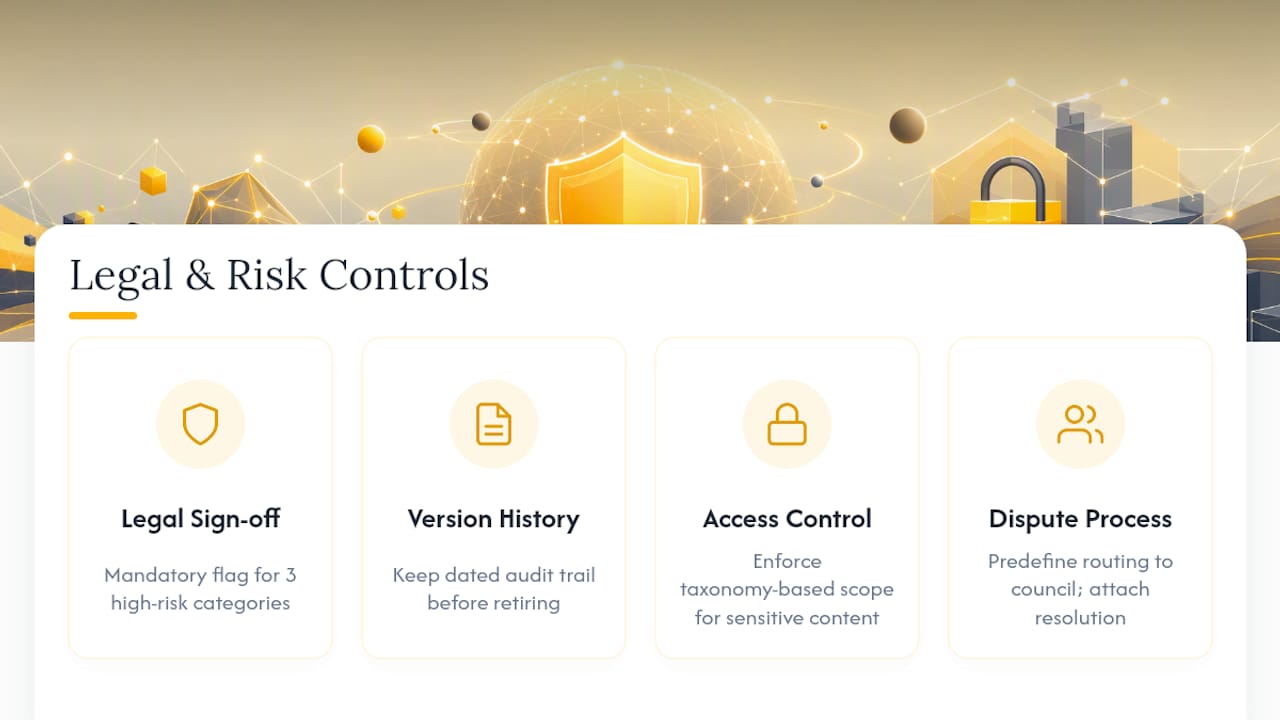
Three categories deserve explicit legal sign-off before publication: anything referencing regulatory compliance (HIPAA, financial disclosure rules, data privacy statutes), anything stating a guarantee or warranty, and anything describing a legal process or client rights. These categories should carry a mandatory “legal reviewed” metadata flag, separate from the standard “last reviewed” date, because a content steward’s approval and a legal team’s approval answer different questions.
Version history matters more than most teams treat it. If a policy article changes, you need a record of what it said on any given date, particularly in legal and healthcare contexts where a customer or regulator might ask what guidance was published when. Retiring an article without an audit trail creates a gap that’s hard to explain later.
Access control ties directly into risk. Content referencing patient information, case details, or financial account specifics should never be visible to a broader audience than necessary, and your taxonomy should enforce that scoping automatically rather than relying on someone remembering to restrict it manually. Organizations working in legal document management already treat classification and retention as first-class steps for exactly this reason.
Finally, build a defined process for disputed content, disagreements between departments about what a policy actually says, before the dispute happens. Route it to the governance council with a documented resolution, and keep that resolution attached to the article’s metadata so the reasoning survives the next reorg.
The Real Priority Isn’t the Tool, It’s the Habit
Most governance rollouts fail for a boring reason: leadership buys a platform before assigning a single owner. The tool never fixes an accountability gap. Ownership, metadata discipline, and a working feedback loop matter more than any dashboard, because those three things determine whether the dashboard’s data means anything six months from now.
The urgency is real. AI systems treat your knowledge base as ground truth, and a badly governed one doesn’t just mislead a customer once. It repeats the mistake at scale, instantly, every time the AI answers a related question. Build the flag-and-approve loop before you build the automation, and let culture and small, visible wins carry the rollout further than a big-bang tool launch ever will.
— Daniela
Need Help Running Governance Day to Day?
Managed team extension offers an alternative to hiring an in-house governance team from scratch. Building owner maps, running review cycles, and staffing a content steward function internally can take months and considerable budget. Managed team extension services can get that operational structure running in weeks, staffed by people trained on relevant content, compliance requirements, and review cadence.

This maps directly to the phased rollout above. Instead of pulling internal staff off their core roles to audit, triage, and maintain articles, a managed team runs that operation as its core function, whether that’s general managed customer support or SOP management for regulated healthcare content. For legal teams facing the same governance load on case documentation and client communication, our legal intake and back-office support covers the same ground.
If your knowledge base has outgrown what your current team can review on schedule, consider discussing managed governance engagement options suited to your content volume.
Sources
- Impact on data governance with generative AI (IBM)
- Create a knowledge base and use it in an agentic workflow (Azure docs)
- KM governance guide — five pillars (KMHelpDesk)
- Best practices for metadata governance (Enterprise Knowledge)
FAQ
What Are the Five Pillars of Knowledge Management Governance?
The five pillars are ownership, decision rights, quality standards, compliance, and measurement, with ownership acting as the foundation everything else depends on, according to KMHelpDesk’s governance framework. Skip ownership and quality standards, review cadence, and compliance checks all lose the accountability that makes them enforceable.
What Are the Four P’s of Governance?
Definitions vary across industries, and there’s no single canonical “four P’s” framework specific to knowledge base governance in the sources referenced here. If you encounter this term elsewhere, treat it as organization-specific terminology rather than an industry standard, and confirm the source’s exact definitions before applying it.
What Is an Example of a Knowledge Management System?
Azure’s Knowledge Base-as-a-Service is a concrete example: it automates ingestion, chunking, summarization, and vectorization for content used in AI-driven agentic workflows. A traditional customer support help center, paired with defined owners and metadata, is a simpler but equally valid example of a knowledge management system in practice.
How Often Should a Knowledge Base Be Reviewed?
Cadence should match content volatility rather than following one fixed schedule. Pricing and compliance content typically needs monthly review, standard documentation quarterly, and anything tied to a product release should trigger review immediately after that release ships.
Can Altiamcx Help Manage an Existing Knowledge Base?
Yes. Altiamcx offers managed team extension and customer support services that can run ongoing governance tasks, including review workflows, metadata upkeep, and content triage, as an operational extension of your existing team.