
The most effective agent retention strategies combine three levers: structured growth and coaching, active friction removal through better tools and processes, and measurable rewards tied to career pathways. Managers who treat retention as an operational system, not a perk contest, see faster results across call center, customer service, and real estate teams alike. The tactics below apply that framework, starting with a prioritized checklist you can act on this week.
TL;DR:
- Running stay interviews with top performers and fixing their main friction points can lead to rapid retention improvements within 30 days.
- Building a competency-based onboarding process and tracking “time to first solo success” effectively reduces early attrition during the first 90 days.
- Implementing ongoing coaching with measurable KPIs, career pathways, and tailored retention tactics addresses long-term engagement and prevents burnout.
- Structured communication, leadership involvement, and personalized strategies for different agent profiles significantly strengthen agent loyalty and decrease turnover.
- Technology investments such as AI tools for admin work and friction removal, combined with flexible scheduling, can quickly lower attrition rates by reducing daily frustrations.
Table of Contents
- What Are the Best Agent Retention Strategies to Start With?
- How Do You Build an Onboarding Program That Reduces Early Attrition?
- Why Does Ongoing Coaching Matter More Than Onboarding Alone?
- How Should You Structure Compensation to Retain Agents, Not Just Recruit Them?
- Can AI and Better Tools Actually Reduce Agent Attrition?
- How Do Career Pathways Improve Agent Retention?
- What Cultural and Workload Changes Reduce Everyday Friction?
- Does Schedule Flexibility Actually Prevent Burnout and Turnover?
- How Do You Measure and Diagnose Agent Attrition?
- What Does a 30/60/90-Day Retention Action Plan Look Like?
- Altiam CX’s Take on Implementing These Tactics
- What Communication Habits Keep Agents Engaged?
- How Involved Should Leadership Be in Retention Efforts?
- How Do You Personalize Retention Strategies for Different Agent Profiles?
- What Can Exit Interviews Reveal That Other Data Misses?
- What Employee Engagement Efforts Work Beyond Free Snacks and Swag?
- A Final Word on Retention as a Discipline, Not a Fix
- When It Makes Sense to Bring in a Managed Team
- Sources
- FAQ
What Are the Best Agent Retention Strategies to Start With?
Not every fix deserves equal attention right away. Some tactics pay off in weeks; others take a quarter or more to show results. The list below ranks interventions by speed of impact and effort required, so you can build momentum with quick wins while longer plays mature in the background.
- Run stay interviews with your top 20% of performers (0 to 30 days). Ask them directly what would make them leave. This week: schedule five 20 minute conversations.
- Fix the worst friction point agents complain about most (0 to 30 days). Usually it is a clunky tool or a slow approval chain. This week: ask your team to name the single most annoying part of their day.
- Launch a peer buddy system for new hires (0 to 30 days). Pairing reduces early confusion and builds belonging fast. This week: match every hire from the last 60 days with a tenured peer.
- Introduce a weekly recognition ritual (0 to 30 days). Public wins cost nothing and build visibility. This week: add a two minute “wins” segment to your standup.
- Audit your onboarding for competency gates, not just calendar days (1 to 3 months). Readiness scoring beats a fixed two week schedule. This week: list the five skills a new agent must demonstrate before handling live cases alone.
- Pilot one AI or automation tool that removes repetitive admin work (1 to 3 months). This week: identify the task agents mention most as tedious and research a tool for it.
- Build a documented internal mobility path with milestones (1 to 3 months). This week: draft a one page career map showing what promotion or transfer requires.
- Redesign compensation to reward tenure and performance together (1 to 3 months). This week: model what a small vesting bonus at 12 and 24 months would cost.
- Establish a formal coaching cadence with measurable KPIs (1 to 3 months). This week: block 30 minutes weekly per agent on your calendar.
- Pilot flexible scheduling for a subset of the team (3 to 12 months). This week: identify which shifts have the most flexibility to test with.
- Build a full stay interview and exit interview analysis loop (3 to 12 months). This week: standardize your exit interview questions.
- Formalize sponsored continuing education or centralized compliance handling for real estate teams (3 to 12 months). This week: price out what centralizing CE tracking would save agents in time.
Reducing agent attrition rarely comes down to one dramatic gesture. It comes down to stacking these tactics so agents feel supported at every stage, from their first week to their third year.
How Do You Build an Onboarding Program That Reduces Early Attrition?
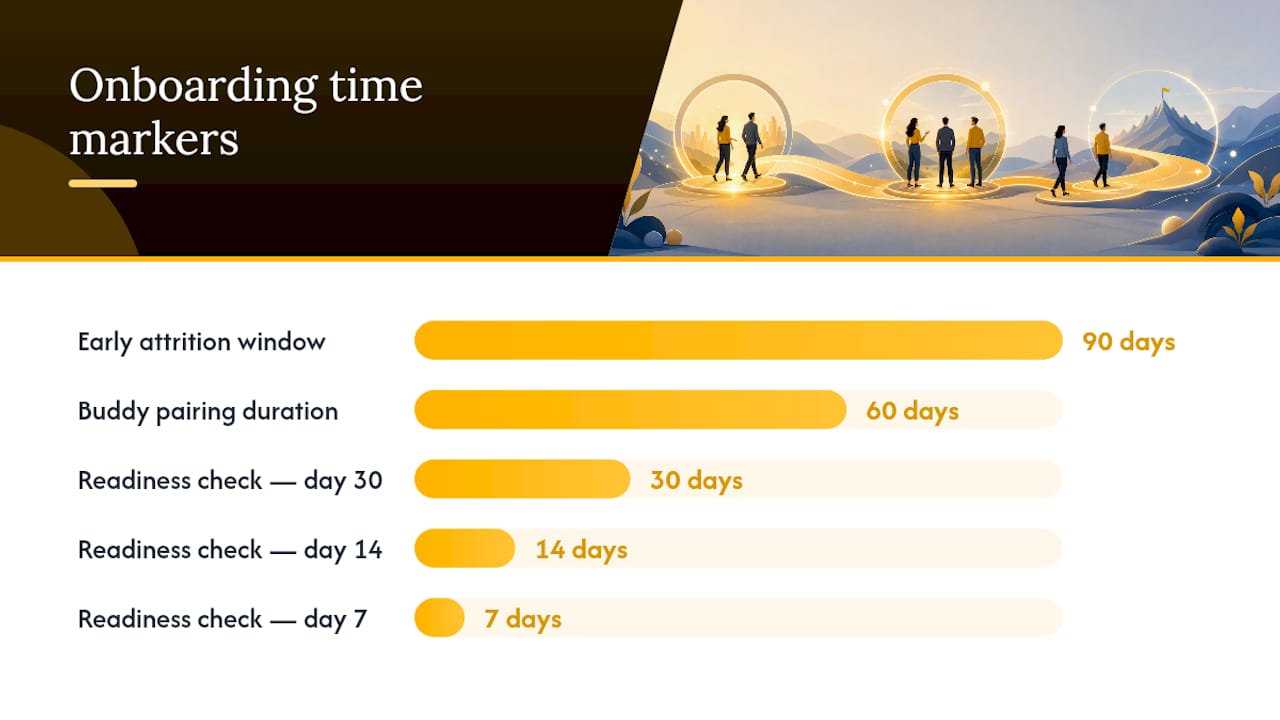
First year attrition concentrates hardest in the first 90 days, and contact center benchmarking ties that early churn directly to ramp time and hiring fit. That means onboarding is not a formality. It is your single highest leverage retention investment.
Structure onboarding as competency gates rather than a fixed calendar. A modular onboarding design lets managers score readiness and route tasks based on demonstrated skill, not days on the job. An agent who masters call handling in eight days should not wait two weeks to take live cases. One who needs three weeks should not be pushed early.
For real estate teams, the training question extends past ramp time into ongoing licensing. Brokerages that sponsor pre-licensing and centralize continuing education report retention rates 10 to 25 percentage points higher than brokerages that leave agents to handle CE on their own, according to Aceable Partners. Agents who engage in even one learning experience show notably higher retention compared to agents with none, per data cited by Inman.
A working onboarding blueprint typically includes:
- Role-based modules split by function (inbound support, outbound sales, licensing compliance) rather than one generic track for everyone.
- A readiness score checked at days 7, 14, and 30, with clear pass thresholds before advancing to live work.
- A buddy program pairing every new hire with a tenured agent for the first 60 days.
- QA sampling at a higher frequency for new hires (weekly, not monthly) to catch friction before it becomes frustration.
- Sponsored CE or centralized compliance administration for real estate teams, removing a task that otherwise eats agent time and goodwill.
Pro Tip: Track “time to first solo success,” not just “days since hire.” An agent who closes their first deal or resolves their first ticket without help crosses a confidence threshold that calendar time alone doesn’t capture.
If you manage a nearshore or distributed team, onboarding gets a layer more complex. A dedicated look at nearshore agent training walks through what changes when your training program has to work across time zones and cultural context.
Why Does Ongoing Coaching Matter More Than Onboarding Alone?
Onboarding gets an agent to competent. Coaching is what keeps them improving, and improvement is what keeps them engaged. Retention responds strongly to the sense that a manager is still paying attention after the first 90 days, not just during them.
A weekly or biweekly coaching cadence, tracked with real KPIs, turns vague “check in with your team” advice into something measurable. Good coaching KPIs include call quality trend over time, resolution rate on complex cases, and self-reported confidence scores gathered during one-on-ones. None of these require expensive software. They require consistency.
Peer mentoring extends the coaching model without adding to a manager’s calendar. Agents who mentor newer hires often report higher engagement themselves, and the mentee benefits from a perspective closer to their own daily reality than a manager’s view from above.
A short list of coaching practices that consistently move retention:
- Weekly one-on-ones of 20 to 30 minutes, protected from cancellation.
- A running coaching log per agent, so progress is visible and specific, not anecdotal.
- Monthly internal masterclasses where top performers teach a skill to the wider team.
- Recognition tied directly to coaching milestones, not just sales or resolution numbers, so agents see growth itself rewarded.
Recruitment gets intense attention: interviews, offer negotiation, first-week welcome. Retention often gets a fraction of that effort once the agent is actually hired. Flipping that imbalance, sustaining the same level of attention past day one, is one of the more underused levers in this list.
How Should You Structure Compensation to Retain Agents, Not Just Recruit Them?
Recruiting pay and retention pay solve different problems, and treating them as the same line item is a common mistake. Recruiting pay gets someone to say yes. Retention pay gives them a reason to still be there in eighteen months.
The most effective retention-focused compensation design vests over time rather than paying out entirely upfront. A signing bonus disappears from memory within a quarter. A bonus that vests at 12 and 24 months keeps working in the background, quietly raising the cost of leaving. Performance tiers that unlock at tenure milestones, not just production milestones, do something similar. They reward the agent for staying and improving, together.
Some concrete examples of compensation structures that reward loyalty without ballooning payroll:
- A referral bonus paid in two installments: half at hire, half at the referred agent’s 90 day mark.
- A tenure-based benefits upgrade (added PTO, higher 401k match, or expanded health coverage) at the 1 and 2 year marks.
- Performance tiers that require both a production threshold and a minimum tenure to unlock the top rate.
- A small quarterly “stability bonus” for agents who hit both attendance and quality benchmarks, separate from commission or incentive pay.
On ROI: Aceable Partners found that small, recurring investments like sponsored CE and centralized compliance often outperform one-time signing bonuses on retention ROI. The math tracks. Replacing one contact center agent costs roughly $10,000 to $20,000 fully loaded, according to Posh AI, so even a modest recurring investment that shaves a few points off attrition pays for itself many times over.
Can AI and Better Tools Actually Reduce Agent Attrition?
Contact center attrition commonly runs 30% to 45% annually, per Posh AI, and a meaningful share of that churn traces back to friction: clunky systems, repetitive admin work, and slow answers to simple questions. Technology that removes that friction is one of the fastest-acting retention levers available.
AI adoption itself is not what drives agents away. The absence of practical automation that reduces administrative burden is the actual retention risk, according to evaluagent.
The highest-impact categories to prioritize:
- Unified knowledge tools that surface answers in one search instead of five tabs and a call to a supervisor.
- Automation for admin tasks like call logging, case tagging, and after-call summaries, which eat far more agent time than most managers realize.
- Simulation and training platforms that let new hires practice difficult scenarios before facing them live.
Pilot any new tool with a narrow scope: one team, one quarter, three success metrics. Track ramp time reduction, QA score movement, and average handle time before and after. A pilot with unclear success criteria tends to stall regardless of how good the tool is.
How Do Career Pathways Improve Agent Retention?
Agents leave when staying feels like a dead end. They stay when the next step is visible, specific, and reachable within a realistic timeframe. That distinction shows up clearly in the data: internal office-to-office transfers rose 38% year over year in one market sample cited by Inman, suggesting many agents are looking for a better fit inside the organization rather than an exit from the industry entirely.
That is a retention opportunity most managers underuse. A multi-year pathway with explicit production milestones does more than any single conversation about “growth potential.” Show an agent that hitting a specific volume or quality benchmark for two consecutive quarters unlocks a senior role, a specialty team, or a transfer option, and staying becomes a strategy rather than a default.
Practical steps to enable this:
- Document a two or three tier career map with specific, measurable milestones at each level.
- Build an internal transfer process with a clear application window, rather than leaving transfers to informal manager-to-manager conversations.
- Track how many agents request internal moves versus how many simply leave. That ratio tells you whether your internal mobility structure is actually working.
- Revisit the map annually. A pathway that made sense two years ago may not match your current team structure.
Retaining top agents often comes down to giving them a reason to build a career inside your organization instead of starting over somewhere else.
What Cultural and Workload Changes Reduce Everyday Friction?
Culture is not a mission statement. It is the accumulation of small daily experiences: whether wins get noticed, whether schedules feel fair, whether approvals move fast or drag for days.
A few rituals consistently build belonging without requiring a budget:
- A weekly standup that includes one specific win from someone on the team, named out loud.
- A shared channel or board where agents can post good outcomes without waiting for a manager to notice.
- Predictable, published schedules at least two weeks out, so agents can plan their lives around work rather than around uncertainty.
- Fair call or case routing, monitored so the same agents are not consistently handed the hardest cases without acknowledgment.
Pro Tip: Audit your approval turnaround time for common requests, like time-off or expense reimbursement. Slow approvals read as disrespect even when that is not the intent, and they quietly erode trust faster than almost any other daily friction point.
Building agent loyalty rarely requires a grand gesture. It requires removing the small annoyances that stack up until an agent decides the job is not worth the hassle.
Does Schedule Flexibility Actually Prevent Burnout and Turnover?
Flexible scheduling models, staggered shifts, self-selected blocks, or compressed workweeks, give agents a sense of control that fixed nine-to-five structures often remove. That sense of control correlates strongly with lower burnout, particularly among younger agents who weigh schedule flexibility heavily when deciding whether to stay.
Practical wellness supports worth pairing with flexibility:
- Access to an Employee Assistance Program (EAP), clearly communicated, not buried in an onboarding packet nobody rereads.
- One or two paid mental health days per year, separate from standard PTO.
- A pilot of flexible shift blocks with a small group before rolling it out company-wide.
Test flexibility changes in a contained way first. Pick one team, one quarter, and track service coverage alongside satisfaction. If coverage holds and satisfaction rises, expand it. If coverage slips, you have caught the problem before it became company-wide.
How Do You Measure and Diagnose Agent Attrition?
You cannot fix what you are not measuring, and vague impressions about “morale” rarely point to a specific fix. A compact measurement framework turns retention from a feeling into a diagnosis.
| Metric | What it tells you | Suggested check-in cadence |
|---|---|---|
| 12 and 24 month retention by cohort | Whether specific hire groups or training cohorts underperform | Quarterly |
| Ramp time to full productivity | Whether onboarding gaps are driving early exits | Monthly during pilots |
| Friction incidents per agent | Recurring pain points surfaced in QA or stay interviews | Monthly |
| Net producer or team movement | Whether agents are transferring internally or leaving entirely | Quarterly |
Stay interviews close the gap that exit interviews cannot, because they happen while an agent is still there and still able to act on what they say. Useful questions include: “What would make you consider leaving in the next six months?” and “What’s the one thing that would make this week easier?” A pattern of the same answer across multiple agents is your signal threshold, treat it as a priority the moment three or more people independently name the same friction point.
Report these metrics on the same cadence as your coaching reviews, and tie every experiment, a new tool pilot, a schedule change, a coaching cadence shift, back to movement in these numbers. Retention improves fastest when managers treat it as an operational system rather than episodic perks, and metrics are what make that system visible.
What Does a 30/60/90-Day Retention Action Plan Look Like?
- Days 1 to 30: Run stay interviews with your top performers, fix the most-cited friction point, and start a weekly recognition ritual. Owner: team lead. Success metric: friction point resolved, five stay interviews completed.
- Days 30 to 60: Launch one AI or automation pilot on a narrow task, begin a formal coaching cadence, and draft your internal career map. Owner: manager plus one operations partner. Success metric: measurable ramp time or handle time change.
- Days 60 to 90: Review pilot results, expand what worked, and formalize sponsored CE or compensation vesting changes. Owner: manager plus HR or brokerage lead. Success metric: retention metrics trending up versus baseline.
Budget a pilot modestly: one team, one manager’s time, and whatever a single tool license or vesting bonus costs. The goal is proof, not scale, in the first 90 days.
Altiam CX’s Take on Implementing These Tactics
[brand_signal] These tactics work whether your team sits in-house or with a partner. What changes with a nearshore managed model is speed and scale: Altiam CX can stand up trained, coached, culturally aligned agent teams faster than most in-house hiring pipelines, while still applying the same coaching cadence, career pathway, and friction-reduction discipline outlined above.
[author_bio]
A managed nearshore model makes sense when:
- You need to scale a team quickly without rebuilding your entire hiring and onboarding pipeline from scratch.
- You want bilingual coverage or extended hours without the overhead of a second internal team.
- You are testing a new service line and need flexible headcount before committing to permanent hires.
What Communication Habits Keep Agents Engaged?
Improving agent retention depends heavily on whether agents feel heard between formal reviews, not just during them. A once-a-year survey does not catch a problem that started building in week three.
Effective communication channels combine structured and informal touchpoints. Weekly one-on-ones remain the backbone, but they work best paired with a lightweight, always-open channel, a shared chat thread, a suggestion form, or a rotating “open office hour”, where agents can flag something without waiting for a scheduled meeting.
Feedback loops fail most often when they are one-directional. An agent who submits feedback and never hears what happened to it stops submitting feedback. Close the loop explicitly: “You mentioned the escalation process was slow. We changed X. Here’s what to expect now.” That single habit, acknowledging feedback and reporting back, does more for perceived trust than almost any survey tool.
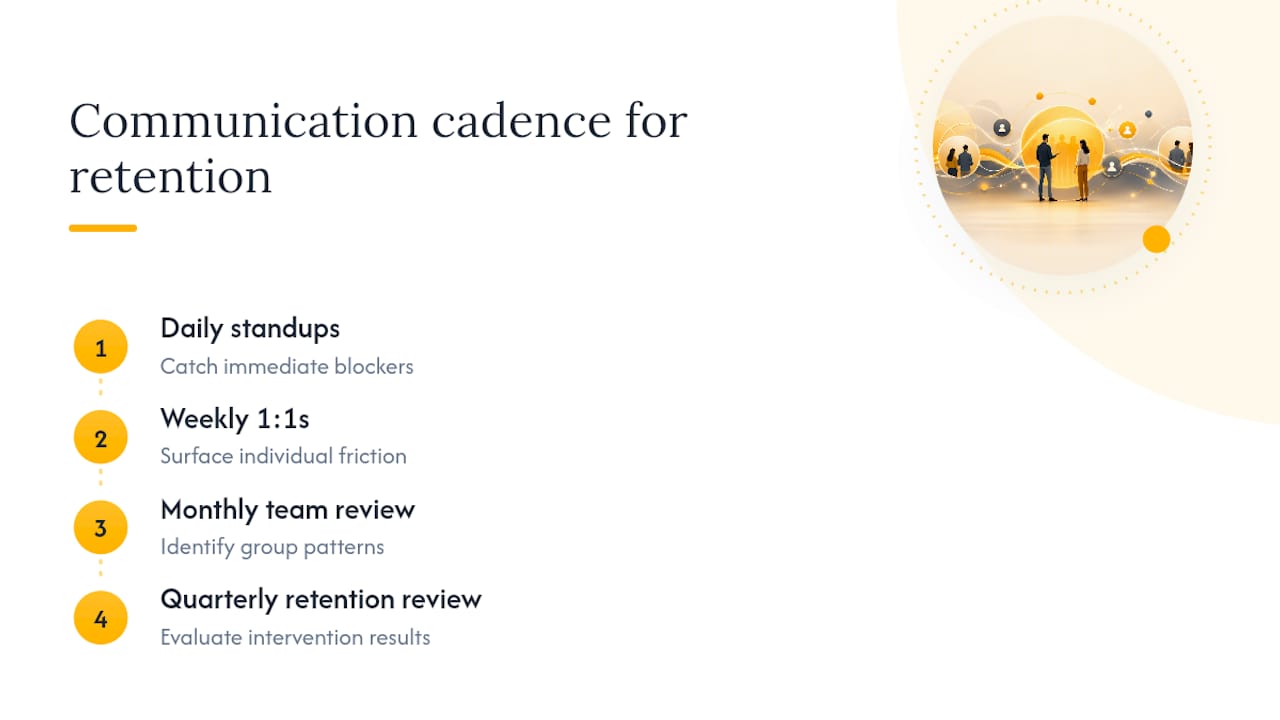
Cadence matters too. Daily standups catch immediate blockers. Weekly one-on-ones catch individual friction. Monthly team reviews catch patterns across the group. Quarterly retention reviews catch whether your interventions are actually working. Skipping any one layer creates a blind spot somewhere in that chain.
How Involved Should Leadership Be in Retention Efforts?
Retention initiatives that live only at the team-lead level tend to stall the moment budget or priorities shift elsewhere. Leadership involvement is not about senior executives micromanaging coaching sessions. It is about visible, consistent support for the managers doing that work.
That support looks like leadership protecting coaching time on the calendar instead of letting it get bumped for “more urgent” tasks. It looks like senior leaders showing up occasionally in team recognition moments, not just quarterly all-hands meetings. It looks like budget approval for a modest retention pilot without months of committee review.
Leaders who ask about retention metrics in the same breath as revenue metrics send a clear signal about what the organization actually values. Leaders who only ask about retention after a bad quarter send a different signal entirely, and agents notice the difference.
How Do You Personalize Retention Strategies for Different Agent Profiles?
Not every agent leaves for the same reason, and a single retention program applied uniformly across an entire team will always underperform a personalized approach. A new hire six weeks into the job worries about competence. A three-year veteran worries about whether there is still a next step. A high performer nearing burnout worries about sustainability, not opportunity.
Segmenting your retention approach by profile means matching the intervention to the actual risk:
- New hires (0 to 6 months): Focus on buddy support, competency-gated onboarding, and frequent, low-stakes feedback.
- Mid-tenure agents (6 months to 2 years): Focus on coaching progression, visible recognition, and early exposure to internal mobility options.
- Veteran or top-tier agents (2+ years): Focus on career pathway milestones, mentorship roles, and compensation tiers that reward sustained performance.
- High performers showing burnout signals: Focus on workload review, schedule flexibility, and a direct conversation about sustainability before performance drops.
Stay interview answers are the fastest way to sort agents into these profiles accurately, since self-reported concerns rarely match assumptions based on tenure alone.
What Can Exit Interviews Reveal That Other Data Misses?
Exit interviews get treated as a formality in too many organizations, a box checked on the way out the door. Done properly, they surface patterns that stay interviews and QA scores miss entirely, because a departing agent has less incentive to soften their answer.
The value comes from aggregation, not individual anecdotes. One exit interview citing “poor scheduling” is a data point. Five exit interviews across three months citing the same issue is a diagnosis. Track exit interview themes in the same structured way you track any other retention metric, tagged by category (compensation, workload, management, growth opportunity) so patterns become visible over a quarter rather than getting lost in individual HR files.
The deeper issues exit interviews often reveal sit beneath the stated reason. An agent who cites “better opportunity elsewhere” may actually be describing a career pathway that felt invisible at your organization. Ask a follow-up question: “What did that opportunity offer that we didn’t?” The answer usually points to something fixable, a communication gap, a missed promotion window, a coaching relationship that never developed.
What Employee Engagement Efforts Work Beyond Free Snacks and Swag?
Traditional perks (snacks, casual Fridays, an occasional team lunch) rarely move retention numbers on their own, because they do not address why agents actually leave: lack of growth, unresolved friction, or feeling unseen. Real engagement initiatives target those root causes directly.
Some approaches with a track record of moving the needle beyond standard perks:
- Cross-training opportunities that let agents build skills outside their core role, increasing both engagement and internal mobility options.
- Agent-led initiatives, letting a tenured agent design and run a training module or process improvement, which builds ownership perks cannot replicate.
- Transparent goal-setting where agents help define their own quarterly targets rather than receiving them top-down.
- Structured peer recognition programs where agents nominate each other for specific behaviors, not just top sales numbers.
Related client retention practices from the customer experience side echo the same principle: engagement that lasts comes from feeling genuinely involved in outcomes, not from occasional rewards handed down after the fact.
A Final Word on Retention as a Discipline, Not a Fix
Retention fails when managers treat it as a single initiative instead of an ongoing system. The three levers that matter, coaching and growth, friction removal, and measurable rewards tied to real pathways, only work together and only work when revisited quarter after quarter. This week, do two things: run one stay interview with a flight-risk agent, and fix the single friction point your team complains about most.
— Daniela
When It Makes Sense to Bring in a Managed Team
Building every one of these systems in-house, coaching cadences, onboarding gates, career pathways, takes time most managers do not have alongside daily operations. A nearshore team extension that arrives already trained, coached, and culturally aligned can help you get the retention discipline outlined above without building the entire infrastructure from zero.

That matters most when you are scaling fast, testing a new service line, or watching your current team stretch thin under growing volume. Instead of a six-month hiring and training cycle, a managed extension model gets bilingual, coached agents into your operation on a timeline measured in weeks. Whether you need general customer experience and team extension support, or something more specialized like healthcare CX operations or legal intake and back-office support, the same coaching and career-pathway framework applies underneath. If you are weighing whether to build this in-house or bring in a partner, request a consult through the Altiam CX services page and walk through what a pilot team would look like for your specific volume.
Sources
- Why Agents Leave, And What Brokerages Must Do To Keep Them | Inman Real Estate News
- Real Estate Agent Retention Strategies That Actually Work in 2026 — Aceable Partners
- The 2025 US contact center HR & operational benchmarking report (excerpt)
- How to use AI to reduce contact center attrition - evaluagent
- Why Contact Center Agents Quit and How AI Improves Retention | Posh AI
FAQ
What Are the Top Five Employee Retention Strategies?
The five with the strongest track record are structured onboarding with competency gates, a regular coaching cadence with measurable KPIs, compensation that vests over time rather than paying out upfront, documented career pathways with real milestones, and technology that removes repetitive administrative friction. Together, these address the root causes behind why agents leave rather than masking them with one-time perks.
What Are the “5 C’s” People Refer to in Retention Discussions?
Definitions vary across sources, and there is no single industry-standard version tied to agent retention specifically. Rather than force-fitting a framework, focus on the proven levers this article covers: coaching, compensation design, career pathways, communication, and culture consistently show up across the retention research.
What Is a Good Benchmark for Call Center Attrition?
Contact center attrition commonly runs 30% to 45% annually across the industry, according to Posh AI. If your team sits meaningfully above that range, treat it as a signal to audit onboarding, ramp time, and daily friction points before assuming it is a compensation problem alone.
How Quickly Can a Manager Expect to See Retention Improve?
Quick wins like fixing a top friction point or launching stay interviews can shift agent sentiment within 30 days, but measurable retention movement in your 12-month cohort numbers typically takes one to two quarters. Structural changes like career pathways and vested compensation take longer to show up but tend to produce more durable results.
Does Altiam CX Help With Agent Retention Directly?
Altiam CX’s managed team extension model builds coaching cadences, structured onboarding, and career visibility into how nearshore teams are staffed and trained from day one, rather than leaving retention to chance after placement. Pricing and program scope are available on request through the services page.