
Secure remote agents require enforced multi-factor authentication, company-approved and hardened endpoints, strict call and recording controls for payment data, network segmentation, continuous logging and vendor visibility, and ongoing security training. These controls track directly to guidance from the PCI Security Standards Council and NIST SP 800-46, and a managed nearshore partner builds them into daily operations rather than leaving them as optional policy.
TL;DR:
- Require MFA on every system and telephone environment that touches cardholder data, not only the primary application, and block unapproved remote access tools.
- Issue encrypted, company managed devices with non removable endpoint protection, enforced patches, and health checks before access; personal laptops should not handle sensitive work.
- Mask payment card numbers in call and screen recordings, encrypt files in transit and at rest, and restrict playback to authorized quality reviewers.
- Require client visible logs, one to four hour incident notice, and contract audit rights covering device inventories, patch records, background checks, and training.
- Train agents at onboarding and quarterly, run phishing simulations, and require daily policy acknowledgments; verify completion through records rather than relying on annual refreshers.
Table of Contents
- 1. How a managed nearshore partner should deliver these controls
- 2. Concrete technical defenses that close the common gaps
- 3. What PCI, NIST, and CISA actually require for audit readiness
- 4. Agent lifecycle practices that make the technical controls work
- 5. Contract language and SLAs to require from your provider
- 6. A quick checklist to paste into your next vendor audit
- 7. Why security belongs on the operations scorecard, not just IT’s
- 8. How Altiam CX builds security into nearshore agent programs
- FAQ
- Sources
1. How a managed nearshore partner should deliver these controls
When staffing a nearshore team, security cannot be a side agreement. It has to be built into how agents are hired, equipped, and supervised every day. Operations leaders should expect a provider to supply and manage the full security stack, not just the headcount.
A credible delivery model includes:
- Company-issued, pre-hardened devices rather than agent-owned laptops
- Centrally managed patching and endpoint detection, not opt-in updates
- Role-based access tied to job function, reviewed on a set cadence
- Encrypted call and screen recordings with restricted playback rights
- Logging and reporting that the client can review, not just the provider
Pro Tip: Ask any prospective provider to show you their device inventory and patch compliance report before you sign, not after your first incident.
The gap between a managed arrangement and a bring-your-own-device setup is not cosmetic. With unmanaged remote agents, enforcement depends on individual compliance and spot checks. With a managed nearshore team, enforcement is built into the device image, the network path, and the supervision model, so the control exists whether or not an individual agent remembers the policy that day.
2. Concrete technical defenses that close the common gaps
Security for remote agents starts with identity and the device, then extends to the network and the recording chain.
Multi-factor authentication is not optional for any system or telephone environment that touches cardholder data. PCI SSC guidance mandates MFA for remote access to these environments, and that requirement should extend to every login an agent uses during a shift, not just the primary application.
Company-approved hardware matters just as much as the login. NIST SP 800-46 treats external telework environments as potentially hostile by default, recommending device health checks, network access control, and enforced patch management before a device ever reaches a corporate system. In practice, that means:
- Full-disk encryption on every agent device, no exceptions
- Endpoint detection and antivirus that agents cannot disable
- Enforced patch windows rather than agent-initiated updates
- Network access control that checks device health before granting entry
Statistic Callout: CISA’s guide to securing remote access software recommends allowlisting approved remote access and RMM tools while actively monitoring for in-memory execution and mass scripting activity. Unauthorized remote access tools are a known entry point for attackers, which is why limiting which tools can run, and watching how they run, matters as much as the login credentials themselves.
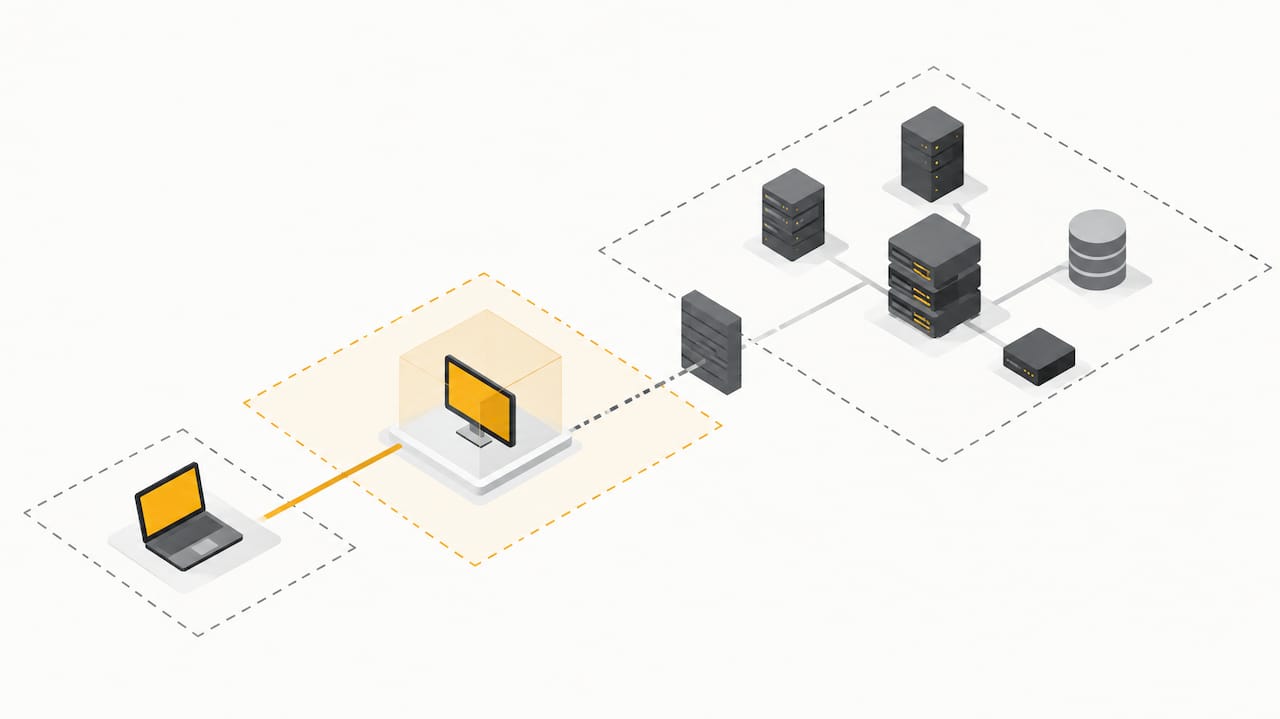
Segmentation reduces how far a single compromised endpoint can reach, demonstrating the importance of robust enterprise-grade security controls for document handling and secure human-in-the-loop workflows. Virtual desktop infrastructure or zero trust architectures keep an agent’s session isolated from the broader network, so one bad login does not become a full breach.
Call and screen recordings need the same discipline. PCI guidance on telephone-based payment data requires masking primary account numbers, encrypting recordings at rest and in transit, and restricting who can play them back.
3. What PCI, NIST, and CISA actually require for audit readiness
Translating standards into a checklist makes vendor audits faster and far less contentious.
PCI requirements that touch remote agents directly include MFA for any telephone environment handling cardholder data, company-approved devices only, and a flat prohibition on unencrypted channels, meaning SMS or email can never carry cardholder data. NIST SP 800-46 adds device health checks and network access control as baseline expectations for any telework setup, because the standard assumes the home network is not trustworthy by default. CISA’s telework essentials guidance rounds this out with segmentation, continuous logging, and a maintained inventory of approved hardware and software.
For an audit, operations leaders should be able to produce:
- A written remote work security policy, signed and dated
- A current inventory of approved devices and software
- Training completion logs, including phishing simulation results
- Patch and update schedules with compliance rates
- Logging access records showing who reviewed what, and when
Keeping these artifacts current, rather than reconstructing them when a client asks, is the difference between a routine audit and a stressful one.
4. Agent lifecycle practices that make the technical controls work
Technology enforces policy, but daily habits are what keep that policy alive between audits.
- Run background checks before onboarding, with role-based access assigned on day one rather than expanded later by request.
- Require a daily sign-in acknowledgement of security policy, particularly for agents handling cardholder or health data.
- Confirm each agent’s home workspace meets physical security requirements, including a dedicated, private space with no shared household access to the screen.
- Prohibit recording or copying sensitive data to personal devices, with the rule stated explicitly rather than assumed.
- Run onboarding training, then quarterly micro-learning and phishing simulations, tracking completion against performance reviews.
- Use masked playback and limited recording access for QA, paired with periodic spot audits to catch policy drift early.
Pro Tip: A structured 30/60/90 day retention plan reinforces security habits the same way it reinforces service quality, because agents who stay longer internalize policy instead of repeating it from a script.
PCI SSC guidance frames security awareness as a shared responsibility between IT and operations leadership, not something that lives in a policy document nobody rereads after week one.
5. Contract language and SLAs to require from your provider
Security that lives only in a sales deck is not security. It needs to be written into the statement of work.
- Require explicit MFA and least-privilege clauses for every provider staff member with system access
- Specify logging and SIEM visibility, including export frequency, client-side access, and alerting response times
- Define incident notification windows, commonly one to four hours, along with forensic access and joint tabletop exercises
- Build in right-to-audit language covering training records, device inventories, patch schedules, and background-screening evidence
These clauses are the operational backbone behind the kind of board-level governance controls that separate a genuine security program from a checkbox exercise. Recording-specific obligations should also account for state-level call recording laws, since consent and retention rules vary by jurisdiction.
6. A quick checklist to paste into your next vendor audit
Some of these are quick to verify, others require an ongoing program.
- MFA enforced on every system and telephone environment touching sensitive data
- Company-approved, encrypted endpoints, no personal devices
- EDR and antivirus active and non-removable by agents
- Masked, encrypted call and screen recordings with restricted playback
- Network segmentation or VDI isolating agent sessions
- Client-visible logging and access review cadence
- Daily sign-in acknowledgement of security policy
- Background checks completed before systems access is granted
- Documented incident response SLA, typically one to four hours
- Quarterly phishing simulations with tracked completion
- Secure, verified home workspace for agents handling cardholder or health data
- Right-to-audit clause covering training, patching, and device inventories
| Checklist item | Type |
|---|---|
| MFA, approved endpoints, EDR | Quick win |
| Masked recordings, segmentation | Program-level |
| Logging visibility, incident SLA | Contractual |
| Background checks, training cadence | Program-level |
7. Why security belongs on the operations scorecard, not just IT’s
Security failures in a remote agent program are operational failures first. A compromised endpoint or a mishandled recording disrupts service continuity, damages client trust, and often costs more in remediation than the program saved in labor rate. We see security and retention as linked, since agents who work inside a disciplined, well-equipped program tend to stay longer and perform more consistently.
For leadership reporting, track incidents per seat, mean time to detect, training completion rates, and audit pass rate. These four numbers tell you whether the program is actually working, not just whether a policy exists on paper.
— Daniela
8. How Altiam CX builds security into nearshore agent programs
We operationalize the controls in this article as a standard part of how we staff and manage nearshore teams, including HIPAA-capable healthcare operations and secure legal intake and back-office support where client data sensitivity is highest.

If you want to see how this looks in practice, request a security evidence pack or schedule a short workshop through our services page and we will walk through device inventories, training logs, and access controls specific to your use case.
FAQ
What is the single most important control for remote agent security?
Multi-factor authentication for any system or telephone environment touching sensitive data is the baseline requirement, per PCI SSC guidance. Without it, every other control becomes harder to trust during an audit.
Can remote agents use personal devices for customer support work?
PCI guidance requires company-approved hardware and prohibits unencrypted channels like SMS or email for cardholder data, which effectively rules out personal, unmanaged devices for sensitive work. A managed provider issues and controls the endpoint instead.
How often should remote agents complete security training?
Security awareness training should happen at onboarding and continue on a regular cadence, with PCI SSC recommending ongoing reinforcement rather than a single annual session. Many programs pair quarterly micro-learning with phishing simulations and a daily policy acknowledgement at sign-in.
Does Altiam CX provide HIPAA-capable remote agent support?
Yes, we support HIPAA-capable healthcare CX operations including patient support and SOP management for organizations that need compliant handling of protected health information.
What should a vendor contract require for remote agent security?
A contract should specify MFA and least-privilege access for provider staff, client-visible logging, an incident notification window, and a right-to-audit clause covering training and device records. These clauses turn security promises into enforceable obligations rather than informal assurances.
Sources
- How the PCI DSS can help remote workers — PCI SSC blog
- Protecting telephone-based payment card data — PCI SSC information supplement
- Guide to securing remote access software — CISA (2023)
- Security for enterprise telework, remote access, and BYOD solutions — NIST SP 800-46r2