
A nearshore site visit exists to confirm one thing above all else: that the people, processes, and security controls a provider describes on paper actually perform that way on the floor. Whether conducted in person or virtually, the visit is due diligence, not a courtesy tour. The agenda, checklist, and decision framework below turn that diligence into a repeatable procurement process.
TL;DR:
- Live staffing and coaching sessions, along with real-time call and chat monitoring, are essential to verify actual operational performance on the floor.
- Prepare by reviewing key documents such as SLA drafts, organizational charts, and recent incident logs before the visit to focus on verification rather than data collection.
- In virtual visits, insist on live dashboards, recent training recordings, and timestamped recordings while requesting independent verification to prevent staged footage.
- SOC 2 Type II reports, covering control effectiveness over months, provide significantly stronger assurance than Type I reports, which only attest to control design at a single point.
- Post-visit, expect documented next steps, evidence requests, and clear pilot or remediation plans scheduled within a multi-week timeframe to ensure ongoing compliance and performance.
Table of Contents
- Building a One-Day Visit Agenda and Checklist
- Preparing Your Team Before You Arrive
- What to Look for on the Floor
- Getting Equivalent Assurance in a Virtual Visit
- Turning Visit Findings Into a Decision
- What Happens After the Visit
- What We’ve Learned From Running These Visits
- How Altiam CX Supports Your Next Site Visit
- FAQ
- Sources
Building a One-Day Visit Agenda and Checklist
A well-run visit follows a tight schedule that moves from documents to people to live operations, in that order. We recommend structuring the day so evidence gets harder to fake as it progresses.
Sample time-blocked agenda:
- Security and compliance briefing (45 minutes)
- Facilities and floor tour (60 minutes)
- Staff and management interviews (90 minutes)
- Live call or chat monitoring (60 minutes)
- Coaching session observation (30 minutes)
- Wrap-up and findings debrief (45 minutes)
Some items must be seen on-site; others are acceptable as follow-up evidence.
- Must-see live: staffing roster against actual floor headcount, a real coaching session, live QA calibration, and current dashboard metrics.
- Acceptable afterward: signed SLA drafts, full org charts, historical turnover data, and formal compliance reports.
- Always verify: data handling procedures, badge and network access controls, and incident escalation paths.
Treat anything promised “we’ll send it later” as a flag worth tracking, not dismissing.
Preparing Your Team Before You Arrive
The quality of a visit depends more on preparation than on the day itself. Assemble a buyer-side team that includes operations leadership, a security or compliance reviewer, and whoever will own the account day to day. On the provider side, request time with the site director, a QA lead, a training manager, and at least two frontline supervisors, not just sales staff.
Request documents well before arrival so you spend floor time verifying rather than reading:
- Draft SLA terms and staffing plans
- Organizational chart with tenure data
- Recent turnover and attrition metrics
- SOC 2 report (Type I or Type II)
- Network and data flow diagrams
- Recent incident logs and QA scorecards
Logistics matter too; following biotech outsourcing best practices ensures your on-site evaluation checklist aligns with critical industry-specific controls. Sign NDAs ahead of time, confirm visitor access and photo policies, and agree on how any recordings or notes taken during the visit will be stored and shared. Our guide to nearshore workforce management walks through the interview questions that get past rehearsed answers.
Pro Tip: Ask for the training manager’s calendar, not just a training manual. Live sessions on the schedule tell you more than a binder ever will.
What to Look for on the Floor
Documentation tells you what a provider intends to do. The floor tells you what actually happens. Compare the staffing roster against live headcount, and ask why any gap exists. Watch agent occupancy rates in real time rather than relying on a monthly average pulled from a slide deck.
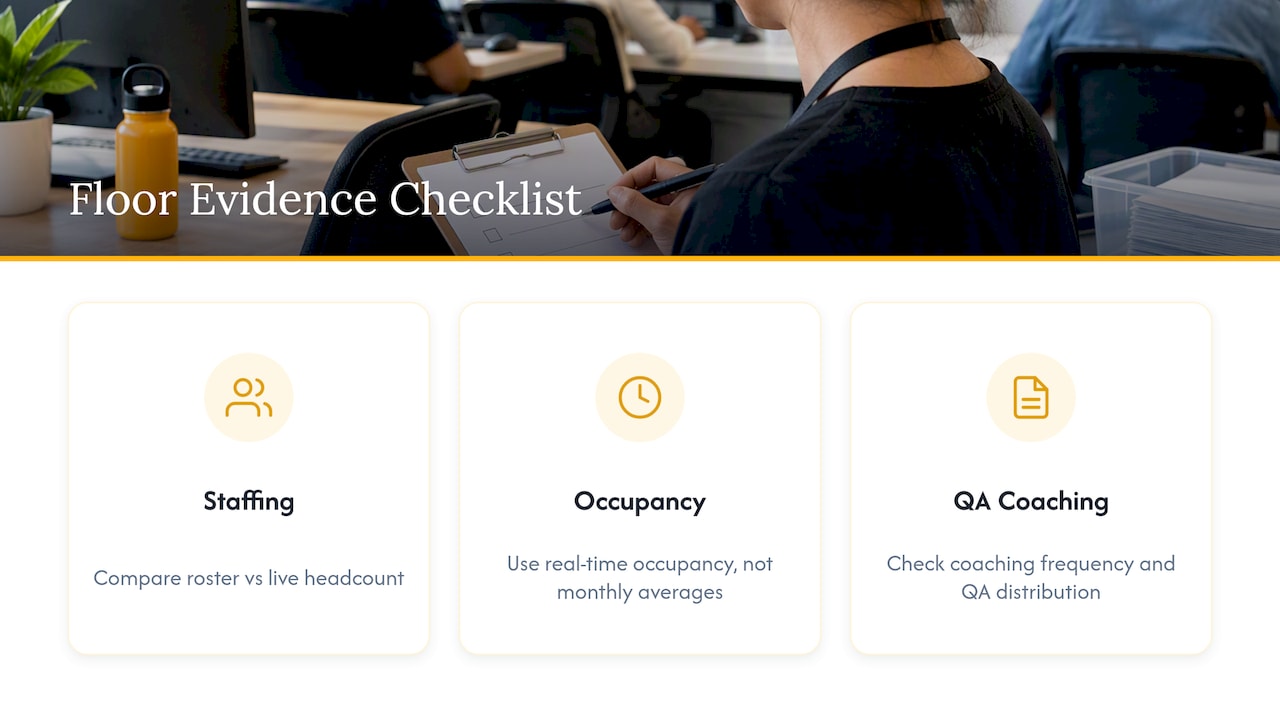
Coaching frequency and QA calibration reveal more than almost any other floor signal. Ask to see how often agents receive documented coaching, how QA scores are distributed across the team, and whether calibration sessions between QA reviewers happen on a set cadence or only when something breaks.
When sampling recorded or live interactions, insist on a method you control rather than one curated by the provider. A reasonable sample pulls calls or chats at random across shifts and agents, not a handful pre-selected as highlights. Look for accuracy against the script, compliance with required disclosures, and genuine empathy in tone, not just adherence to a checklist.
Technology and security cues worth a close look include screen lock timeouts, clean-desk practices, visible access to unauthorized personal devices, and how quickly a supervisor can pull up a specific call recording on request. Red flags that warrant pausing or follow-up include unexplained staffing gaps between roster and floor, QA scores clustered suspiciously near perfect, coaching records that stop abruptly months ago, or reluctance to let you choose your own call samples.
SOC 2 Type II reports verify operating effectiveness of controls over a period of time, commonly several months, which gives far stronger assurance than a Type I report that only attests to control design at a single point in time. A provider offering only Type I should prompt a direct question about Type II timing, since that distinction often predicts how operational claims hold up under scrutiny.
Getting Equivalent Assurance in a Virtual Visit
Travel is not always practical, and a virtual visit can deliver comparable assurance when it is structured with the same rigor as an in-person one. The goal is to replace physical presence with verifiable, time-stamped evidence rather than a scripted video call.
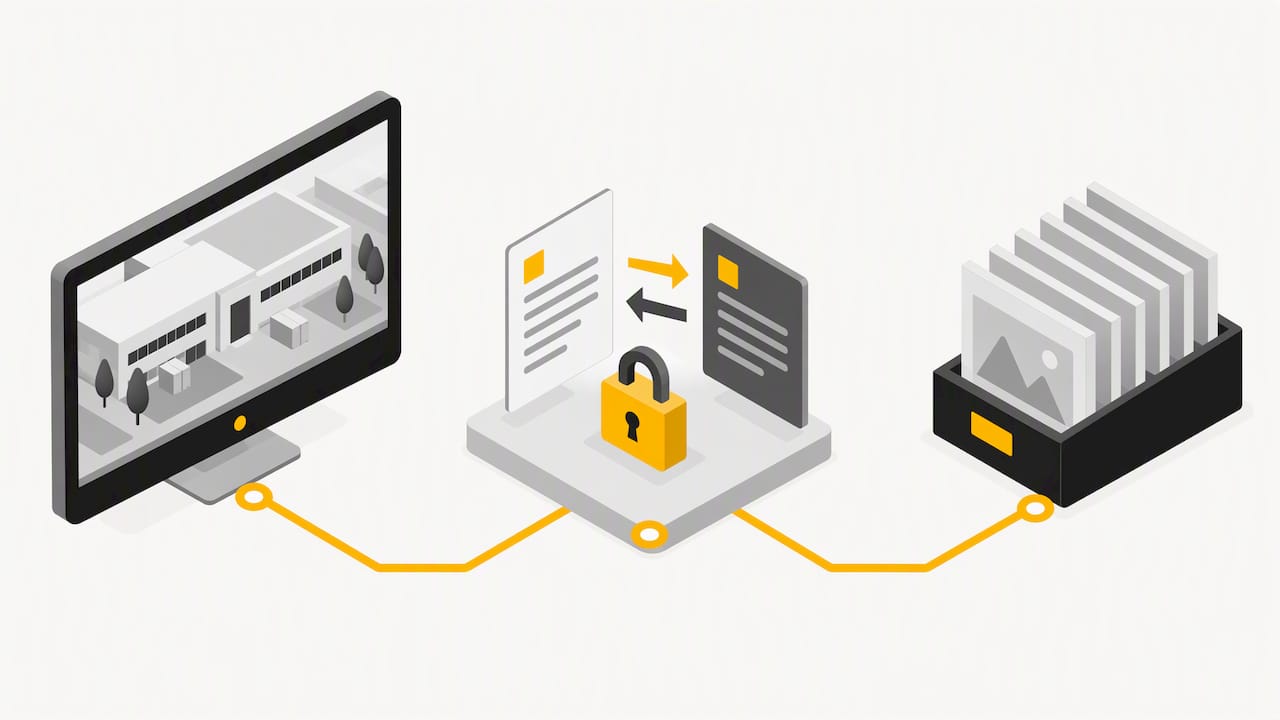
A solid virtual agenda includes a live video walk-through of the floor (not a pre-recorded tour), a screen share of real-time QA and staffing dashboards, a review of recorded calls you select on the spot, and private interviews with frontline staff without a supervisor in the room.
Insist on specific evidence types:
- SOC 2 Type II report, not just a summary letter
- Live QA dashboard access during the call
- Recent training session recordings with dates visible
- Audit logs showing access and system activity
To guard against staged footage, ask for independent verification such as a second camera angle on request, time stamps visible in every recording, and the ability to request a spot check on a specific shift with no advance notice.
Turning Visit Findings Into a Decision
A visit generates a lot of impressions; a weighted framework turns those impressions into a decision. Adjust weights to match your industry’s risk profile, but keep security and QA carrying the most weight.
SOC 2 Type II reports verify operating effectiveness over time, while Type I reports cover design only at a single point in time, so a Type II should score meaningfully higher in your matrix than a Type I alone. Treat references, recent audit findings, and documented case studies as supporting signals that confirm or contradict what you saw on the floor.
- Move to pilot when security and QA scores clear your threshold and no unresolved red flags remain.
- Postpone when evidence gaps exist but the provider commits to a documented remediation timeline.
- Walk away when staffing or QA data contradicts what was presented live, or compliance reports are unavailable on request.
What Happens After the Visit
The visit itself has limited value unless it leads to documented next steps within days, not weeks.
- Send a formal evidence request covering any item flagged during the visit, with a specific deadline.
- Circulate minutes of the visit to both teams, including agreed remediation timelines for anything unresolved.
- Design a pilot with clear acceptance criteria, a defined number of seats or hours, a set duration, and a reporting cadence, typically weekly during the early weeks.
- Confirm exit conditions for the pilot before it starts, not after a problem appears.
- Review the contract for SLA metrics and remedies, audit rights, data protection terms, and termination clauses tied to performance.
A realistic calendar runs the evaluation and pilot together within a multi-week window for most mid-size programs, from initial scheduling through pilot completion.
What We’ve Learned From Running These Visits
The providers that pass scrutiny are rarely the ones with the glossiest training materials. They are the ones willing to let a buyer pick the call sample, interview an agent without a supervisor present, and show a QA scorecard with a bad month on it.
In one engagement, an orthodontic services provider needed a nearshore partner that could demonstrate both cultural fit and measurable performance before expanding scope. The visit-to-pilot sequence worked because pilot metrics were agreed upon before day one, which removed ambiguity once live data started coming in. For readers building their own evaluation criteria, our guide to selecting nearshore CX partners covers the cultural and operational signals worth weighing alongside security.
— Daniela
How Altiam CX Supports Your Next Site Visit
We host site visits, both in-person and virtual, structured around evidence buyers need: live floor access, QA dashboards, staffing data, and direct staff interviews. Our team extension and managed support programs are designed to move from visit to pilot efficiently.

- Request an NDA and schedule a discovery call through our services page.
- Evaluating healthcare CX? Review our healthcare operations programs.
- Assessing legal intake or back-office support? See our legal services and intake solutions.
If you are ready to see how a visit converts into a scoped pilot, reach out and we will walk you through staffing options, timelines, and reporting before you commit to anything.
FAQ
What is the main goal of a nearshore site visit?
The main goal is confirming that staffing, quality processes, and security controls work as described, not just reviewing documentation. A visit that only checks paperwork misses the operational risks that surface on the floor.
How is a virtual nearshore site visit different from an in-person one?
A virtual visit replaces physical presence with live video walk-throughs, real-time dashboard access, and staff interviews conducted without supervisors present. The key is insisting on time-stamped, verifiable evidence rather than pre-recorded or curated footage.
Why does SOC 2 Type II matter more than Type I during due diligence?
SOC 2 Type II verifies that security and operational controls worked effectively over a period, commonly several months, while Type I only attests to control design at one point in time. A Type II report gives stronger assurance that a provider’s controls hold up under real operating conditions.
How long should a nearshore evaluation and pilot take?
A focused site visit combined with a defined pilot typically fits within a multi-week window from scheduling through pilot completion for mid-size programs. That timeline covers evidence requests, the visit itself, and early pilot reporting cycles.
What services does Altiam CX offer for buyers evaluating a nearshore partner?
We offer managed team extension, customer experience support, and industry-specific programs for healthcare and legal operations, detailed on our services page. Pricing is available on request based on scope, seats, and program duration.