A HIPAA business associate agreement (BAA) is the written contract that lets a covered entity, such as a provider, health plan or clearinghouse, share protected health information (PHI) with a vendor that handles it on its behalf. If a vendor creates, receives, maintains or transmits PHI for you, you need a BAA before any data moves. That includes the outsourced support, scheduling and back-office teams that operations leaders hire to run patient and client communication.
This guide covers who needs a BAA, what the contract must say, where subcontractors fit, what a violation costs, and how to build the agreement into an outsourcing decision.
TL;DR
- A BAA is required before a covered entity discloses PHI to a vendor that performs a function or service for it. The same applies between a business associate and its own subcontractors.
- The required terms come from 45 CFR 164.504(e): permitted uses, safeguards, breach reporting, access and amendment support, record availability to HHS, return or destruction of PHI, and subcontractor flow-down.
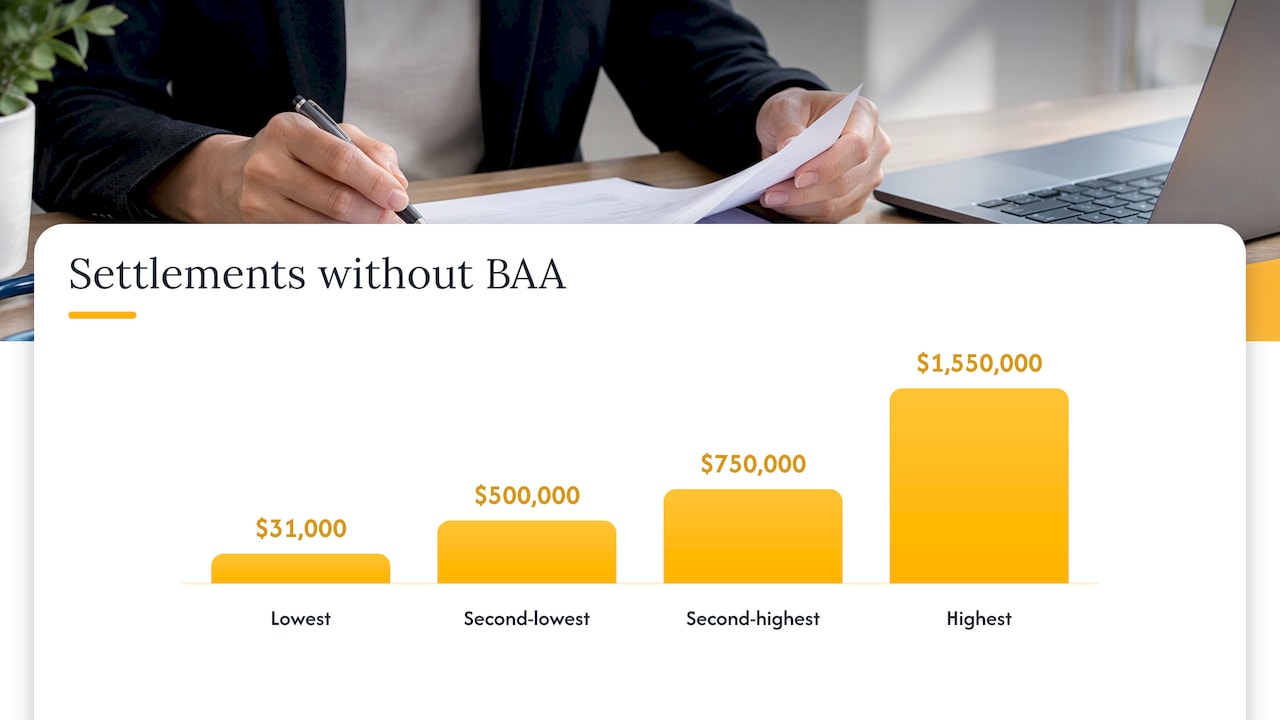
- Business associates are directly liable under HIPAA, and a missing or weak BAA has produced settlements from $31,000 to $1,550,000.
- Outsourcing patient support, intake or scheduling puts the vendor and every downstream provider in the BAA chain, so settle the paper before the first call is handled.
Table of Contents
- What a business associate agreement is
- Who needs a BAA
- When a BAA is not required
- What a BAA must contain
- The subcontractor flow-down
- Who is liable, and what a failure costs
- Adding a BAA to an outsourcing decision
- The Security Rule proposal and your BAAs
- Where we fit
- Our perspective
- FAQ
- Sources
What a business associate agreement is
HHS describes a BAA as a contract or other written arrangement that gives a covered entity satisfactory assurances that the business associate will appropriately safeguard PHI. According to HHS’s Business Associates FAQs, the HIPAA Rules permit a covered entity to disclose PHI to a business associate only if it obtains that assurance in writing.
PHI is individually identifiable health information held or transmitted by a covered entity or its business associate: a name tied to an appointment, a claim number, a diagnosis mentioned on a support call. If your vendor sees or hears any of that while doing your work, the BAA question is already live.
The agreement does three jobs. It limits what the vendor may do with the data. It obliges the vendor to protect it and report problems. It gives you the contractual hooks to end the relationship if the vendor breaks the terms.
Who needs a BAA
The test is functional, not about job title. HHS says a business associate is a person or organization that performs regulated functions on behalf of a covered entity involving PHI, or provides certain services that involve disclosure of PHI. HHS’s Privacy Rule summary lists functions such as claims processing, data analysis, utilization review and billing. It lists services such as legal, actuarial, accounting, consulting, data aggregation, management, administrative, accreditation and financial work.
HHS also gives practical examples, including:
- Cloud service providers that store or transmit electronic PHI
- EHR vendors and managed IT service providers that support systems holding PHI
- Health information exchanges and e-prescribing gateways
- Technicians who service devices storing PHI, where the work involves disclosure of PHI to them
If you are unsure whether a given software, hosting or contractor relationship qualifies, this overview of which vendors count as business associates walks through the categories.
Contact center, intake and back-office vendors
For operations leaders, the relevant cases are outsourced functions that touch patient or client records: patient support lines, eligibility checks, appointment scheduling, claims follow-up, and legal teams handling intake for matters that involve health information. Each of these is a service performed on your behalf with access to PHI. Treat each as a business associate relationship unless a documented analysis shows otherwise.
Law firms and other professional advisers sit in the same category. HHS names legal services among the covered business associate services, so a firm that receives PHI from a covered entity needs a BAA with it.
Subcontractors are business associates too
HHS states that any subcontractor that creates, receives, maintains or transmits PHI on behalf of a business associate is itself a business associate. A covered entity can even be the business associate of another covered entity. The result is a chain: your vendor needs a BAA with its hosting provider, its telephony or software platform and any staffing partner that touches PHI, and each of those needs one with its own downstream providers.
When a BAA is not required
Not every relationship needs one. A few common cases:
- Treatment disclosures between providers. HHS FAQs explain that HIPAA does not require a BAA for disclosures to another health care provider for treatment.
- Incidental access only. HHS’s Privacy Rule summary says an organization is not a business associate when its functions do not involve use or disclosure of PHI and any access would be incidental, if at all.
- Your own workforce. Employees are not business associates, though they must be trained on HIPAA.
The cleaner your data map, the easier these calls are. If you cannot say which vendors touch PHI and how, start there.
What a BAA must contain
The required content is set out in 45 CFR 164.504(e). A summary published by Holland & Knight attorneys lists the core terms. A compliant BAA:
- Establishes the permitted and required uses and disclosures of PHI.
- Prohibits use or further disclosure beyond the contract or the law.
- Requires appropriate safeguards, including Security Rule safeguards for electronic PHI.
- Requires reporting of unauthorized uses or disclosures, including breaches of unsecured PHI.
- Requires the vendor to make PHI available so you can meet individual access, amendment and accounting-of-disclosures duties.
- Requires compliance with Privacy Rule obligations the vendor carries out for you.
- Makes the vendor’s books and records available to HHS.
- Requires return or destruction of PHI at termination, where feasible.
- Ensures subcontractors agree to the same restrictions and conditions.
HHS adds a limit on what the contract may authorize. A BAA cannot permit a use or disclosure that would violate the Privacy Rule if the covered entity did it, except for the vendor’s proper management and administration or data aggregation for health care operations.
The HIPAA Journal’s 2026 update also lists workforce training and termination rights: all members of the vendor’s workforce should receive HIPAA training, and either party should be able to terminate for a violation of any term. HHS publishes a model business associate agreement you can use as a baseline for structure.
Terms operations teams should push on
The required clauses are the floor. For a vendor running live customer interactions, the negotiation usually turns on operational detail:
- Breach notice window. The law gives the vendor up to 60 calendar days from discovery. North Privacy Advisors points out that the clock starts when the vendor discovers the breach, not when it tells you. A vendor that waits 45 days leaves you 15 days to notify individuals, so many covered entities write a much shorter contractual window.
- Who counts as a subcontractor. Name the categories (telephony, CRM, quality tools, staffing partners) and require notice before new ones are added. The HHS model agreement asks for notice of subcontracts within 30 calendar days of execution.
- Training evidence. Specify how new agents are trained before touching PHI and how refreshers are tracked.
- Exit. Define how PHI is returned or destroyed, and how quickly, when the engagement ends.
Our guide to BPO due diligence and the one on data security controls in BPO partnerships turn these into procurement questions.
The subcontractor flow-down
The most common weak spot is the chain below the vendor. Under 45 CFR 164.504(e)(2)(ii)(D), the agreement between a business associate and its subcontractor must carry the same restrictions and conditions that apply to the business associate. Holland & Hart explains that restrictions in your BAA must flow down, and the subcontractor may not use PHI in a way the business associate could not.
BASG, a compliance consultancy, reports that OCR, the HHS office that enforces HIPAA, most frequently finds flow-down language inadequate. Its practical advice: put explicit flow-down wording in every BAA, ask about subcontractor practices during diligence for significant vendors, and document that diligence.
In a nearshore arrangement the chain is short when the model is a managed team working inside your approved systems. Ask every candidate to list each company that will handle PHI for you, and make sure the contract mirrors that list.
Who is liable, and what a failure costs
A vendor’s duty does not end at the contract. HHS’s direct liability fact sheet says business associates are directly liable for Security Rule noncompliance, failure to give breach notification, impermissible uses and disclosures, failure to limit PHI to the minimum necessary, failure to sign BAAs with their own subcontractors, and failure to act on a subcontractor’s material breach.
The covered entity carries exposure too. Holland & Hart reports that OCR has used the absence of a BAA to obtain settlements of $31,000, $500,000, $750,000 and $1,550,000 from covered entities after their business associates suffered data breaches. Civil penalties are set in tiers by culpability and adjusted for inflation, so check the current HHS schedule rather than relying on any single published figure.
The lesson is practical: the agreement, the risk analysis and the diligence record together are what you show OCR after an incident.
Adding a BAA to an outsourcing decision
If you are moving patient support, intake or back-office work to an outside team, the BAA is a step in the sequence, not a closing formality. A workable order:
- Map the PHI. List the call types, forms and systems the team will touch. Eligibility questions, scheduling and claims status all involve PHI.
- Define the function. Write down what the vendor may do with PHI. This becomes the permitted-uses clause.
- Run diligence. Review the vendor’s safeguards, training and subcontractor list before the contract is final. Our HIPAA compliant outsourcing guide for healthcare administrators covers what to ask.
- Sign the BAA first. Execute it before any PHI is shared, including during pilots and training with live records.
- Tie the BAA to the service agreement. Align service levels, escalation and incident response. See our note on negotiating BPO SLA penalties.
- Monitor. Review call quality, access and training on a schedule, and keep records. A call center compliance monitoring playbook shows how.
- Plan the exit. Confirm return or destruction of PHI when the contract ends.
The Security Rule proposal and your BAAs
On January 6, 2025, HHS published a proposed rule to strengthen the HIPAA Security Rule. North Privacy Advisors summarizes it as eliminating the required versus addressable distinction, requiring business associates to notify covered entities within 24 hours of activating a contingency plan, and requiring covered entities to verify business associate safeguards at least annually. BASG reported in October 2026 that no final rule had been issued, that the regulatory agenda projected July 2027, and that compliance would come 180 to 240 days after publication.
Until a final rule exists, 45 CFR 164.504(e) and 164.314 continue to apply. A sensible step is to draft new BAAs and renewals with room for the proposed changes, such as shorter incident notice and annual verification, so you are not renegotiating every contract later.
Where we fit
We run managed nearshore teams for healthcare and legal organizations. For healthcare, our Managed Customer Support and Patient Support & SOP Management services cover patient-facing communication run to your documented procedures. For law practices, our legal intake and client communication services cover Legal Intake & Inquiry Handling, Client Follow-Ups & Case Communication, Appointment Scheduling & Coordination, Ongoing Client Support, Managed Legal Team Extension and Back-Office Legal Support.
If you are scoping a team that will handle patient or client information, talk to us about your support operation and bring your PHI map.

Our perspective
Most BAA problems we see discussed are operational, not legal. The contract says the right things, and then the team on the phones works from a different script, a different tool or a different subcontractor than the one on paper.
That is why we think of the BAA as the start of the operating model. Our nearshore teams are built around your SOPs, your systems and a defined scope of work, so the agreement, the procedures and the people doing the work describe the same thing. Cultural alignment and bilingual staff matter here too: agents who understand your patients or clients make fewer mistakes with sensitive information.
Our view is simple. Choose a partner whose team structure is small enough to document and stable enough to audit, put the permitted uses, breach window and subcontractor list in writing, and review them as the engagement grows. A managed team extension gives you that clarity: one accountable team, scaled up or down as volume changes.
Daniela
FAQ
Does HIPAA require a business associate agreement?
Yes, whenever a covered entity discloses PHI to a business associate, or a business associate discloses PHI to a subcontractor for work done for the covered entity. HHS says the HIPAA Rules permit the disclosure only with satisfactory written assurances. Disclosures between providers for treatment are an exception.
Who needs a BAA?
Any vendor that creates, receives, maintains or transmits PHI for a covered entity, from billing and claims processors to IT, cloud, legal, consulting and outsourced support providers. Their subcontractors that handle PHI need one with them as well.
Is a vendor’s own HIPAA policy enough?
No. A policy does not replace the contract. The agreement must contain the terms in 45 CFR 164.504(e), and the vendor must still sign BAAs with its own subcontractors that handle PHI.
How fast must a vendor report a breach?
By law, without unreasonable delay and no later than 60 calendar days after discovery. Your BAA can set a shorter window, and for time-sensitive operations it usually should.
Is the BAA rule changing?
HHS proposed Security Rule changes in January 2025, including new business associate notice and verification duties. As of BASG’s October 2026 report no final rule had been published, so current requirements apply.
Sources
- HHS: Business Associates Frequently Asked Questions
- HHS: Summary of the HIPAA Privacy Rule
- HHS: Direct Liability of Business Associates
- HHS: Model Business Associate Agreement
- Holland & Hart: Business Associate Agreements, Requirements and Suggestions
- Holland & Knight: Business Associate Agreements Matter
- HIPAA Journal: HIPAA Business Associate Agreement 2026 Update
- North Privacy Advisors: HIPAA Vendor Contracts
- BASG: HIPAA BAA Requirements 2026 Vendor Checklist
- Adverbum: HIPAA compliant translation and business associates