
A call center is in scope for PCI DSS the moment an agent hears, keys or records a card number. The fastest route to compliance is to keep card data out of agents’ ears, screens and recordings, and to hold any outsourced team to written security responsibilities, because outsourcing never transfers your obligation to the card brands. This guide explains what the standard covers, what it asks of your operation, and how to run a compliant phone payment program without stalling service quality.
It is written for CX directors, VPs of support and operations leaders in healthcare, legal, ecommerce, retail and financial services who take payments by phone, or who plan to hand those calls to a partner.
TL;DR
- PCI DSS is the payment card industry’s security standard. Any call center that accepts, transmits or stores cardholder data by phone is in scope, along with the people, technology and facilities involved.
- Phone payments have no lighter rulebook. The same requirements apply, but card data travels through call recordings, agent desktops and telephony systems that were built for voice, not security.
- Sensitive authentication data, such as the card security code, must never be kept after authorization, and that includes call recordings.
- The most effective move is scope reduction: design the call flow so card numbers never touch agents or recordings.
- If you outsource, you still own compliance. Responsibilities, due diligence and monitoring need to be written down and reviewed.
Table of Contents
- What PCI DSS means for a call center
- Why phone payments are harder than web payments
- What PCI DSS asks of agents, operations and facilities
- Call recording: the rule that trips up most teams
- Reduce scope before you add controls
- Outsourcing your phone team does not outsource PCI
- A working checklist for your call center
- Our perspective
- Where Altiam CX fits
- FAQ
- Sources
What PCI DSS means for a call center
The Payment Card Industry Data Security Standard (PCI DSS) is a security framework set by the PCI Security Standards Council, the body formed by the major card brands. It governs how organizations protect payment card data. Your acquiring bank and card brands enforce it through your merchant or service provider agreement, which is why it matters even though it is not a statute.
The PCI Council’s guidance on telephone-based payment card data is clear on the scope question. PCI DSS applies to all system components in or connected to the cardholder data environment (CDE), the people, processes and technology that store, process or transmit card data. Accepting spoken account data over the telephone brings personnel, technology and infrastructure into that environment. An environment where no card data is collected has no components in scope.
Two terms are worth fixing in mind:
- PAN: the primary account number, the long number on the front of the card.
- SAD: sensitive authentication data, such as the card verification code. The standard does not allow it to be stored after authorization, even if it is encrypted.
For a healthcare billing line, a law firm collecting retainers, an ecommerce support desk processing replacement orders or a financial services team taking a payment, the question is identical: does a card number pass through our people or our systems?
Why phone payments are harder than web payments
Online checkout can send card data straight from the customer’s browser to a payment processor. A phone call does not. The number is spoken to an agent, typed into a screen, and often captured by the recording platform running in the background. Each of those steps pulls another system into scope.
Typical places card data ends up in a call center:
- The agent’s head and handwriting, if they jot it down.
- The agent desktop and any payment terminal or CRM field they type into.
- Call recordings and the quality assurance tools that review them.
- Chat, email, tickets and spreadsheets, when a customer reads a number out or an agent copies it for convenience.
- Telephony and network equipment that carries the audio and keypad tones.
The broader the footprint, the bigger the assessment, the more controls you must prove, and the greater the exposure after a breach. Our guide to shrinking your cardholder data environment walks through the design choices that narrow this footprint.
What PCI DSS asks of agents, operations and facilities
You will not find a separate telephone chapter in the standard. The same twelve requirement areas apply. The Council’s telephone guidance highlights several that hit call centers hardest.
Access control and authentication
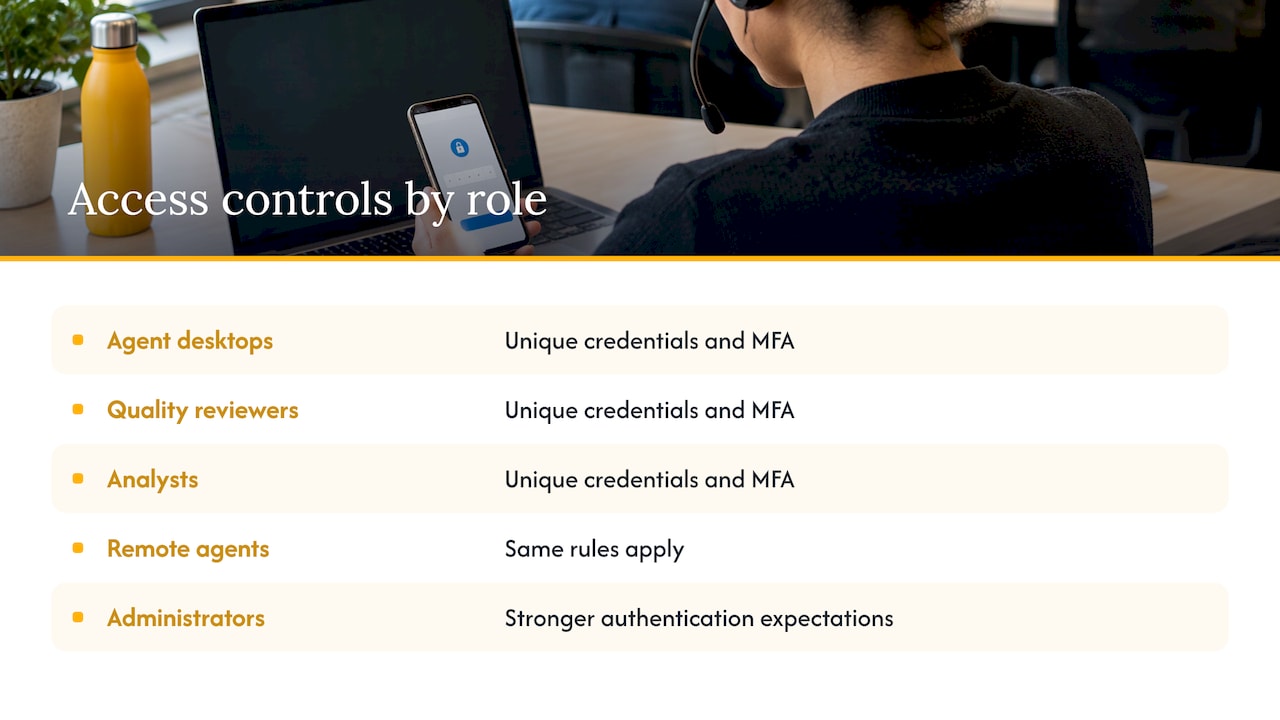
Everyone who can reach the CDE needs unique credentials and multi-factor authentication (MFA), meaning a second proof of identity beyond a password. According to the PCI Council’s telephone guidance, that covers agent desktops, quality reviewers and analysts, not just administrators. Administrative access is held to a higher bar still. Remote and work-from-home agents fall under the same rules, which is why we publish remote agent security controls for leaders who run distributed teams.
Physical security
The PCI Council’s FAQ explains that call-center areas count as sensitive areas under Requirement 9.1.1 because they contain systems that process, transmit or store cardholder data. Entry and exit points must be controlled and monitored, for example with cameras or access controls, so that only authorized personnel are verified as entering.
Agent behavior
Policy has to be specific, trained and enforced. Examples that belong in every call-center handbook:
- Never write card details on paper, in notes or in personal devices.
- Never accept card numbers through email, chat or tickets.
- Never repeat a card number aloud back to the customer in a way that others can overhear.
- Report any exposed card data immediately, so it can be removed.
Monitoring and logging
Access to anything touching card data must be logged and reviewed. Log review is one of the controls assessors check first, and a weak routine here is a common reason for findings. Our compliance monitoring playbook covers how to build an audit rhythm that stands up to scrutiny.
Call recording: the rule that trips up most teams
Recording is where many call centers discover they are holding data they never meant to keep. The Council flagged this back in 2011, when it issued supplemental guidance noting that PCI standards apply to call center operations where card information spoken over the phone may be recorded and stored.
The current telephone guidance sets out what that means in practice:
- Sensitive authentication data may not survive authorization. If SAD is received and recorded, it must be rendered unrecoverable once authorization is complete.
- Pause-and-resume has limits. If the technology that pauses recording during payment cannot reliably block the audio from being stored, the SAD must be deleted from the recording as soon as the transaction is processed. Where agents trigger the pause themselves, the guidance recommends verifying it, preferably weekly.
- PAN in recordings must be unreadable. Where a card number is stored, it has to be rendered unreadable.
- Recordings that hold card data are restricted. Access must be limited, logged under the logging requirement, and stored on segregated networks.
The practical goal is simpler than the list: build the call flow so a recording never contains the card number or code in the first place. A deletion process is a safety net, not a design.
Recording consent is a separate question
PCI DSS says nothing about whether you may record a call. That is governed by federal and state law, and requirements vary, with some states requiring every party to consent. Check your announcement and consent practice against the state rules before you decide what to record. Our overview of U.S. call recording laws by state is a good starting point, and your counsel should confirm how it applies to you.
Reduce scope before you add controls
Most compliance programs get easier when the number of systems that touch card data falls. The common approaches work on the same principle: card digits go to a payment provider and never reach your agents, desktops or recordings.
- Customer keys the card on their own phone keypad while the agent stays on the line, and the tones are masked from the agent and the recording.
- Transfer to an automated payment line, then return the customer to the agent once payment completes.
- Send a secure payment link by a method that keeps the number out of your environment.
Whichever you choose, three questions decide whether it really cuts scope:
- Do keypad tones appear in any recording or log? Raw audio that captures them can hold card data.
- Does the number touch any agent screen, ticket or chat transcript?
- Is your boundary documented, and is it re-validated when systems, vendors or workflows change?
The last question matters most over time. Scope drifts: a new CRM integration, a new recording tool, a new remote-work setup. Map the data flows across every channel, not only voice, before you decide what is in or out. Your qualified security assessor or acquiring bank decides which self-assessment questionnaire applies to you, so confirm that with them before you assume a reduced scope.
Outsourcing your phone team does not outsource PCI
If you use a BPO, nearshore partner or any third party to take calls, PCI DSS Requirement 12.8 still applies to you. According to the PCI Council’s telephone guidance, you must manage service providers through a maintained list, written agreements, due diligence before engagement and ongoing monitoring of their compliance status. Outsourcing does not relieve you of ultimate responsibility.
That shapes how you should evaluate and contract a partner:
- Define who owns what. Write down which requirements the provider meets, which you meet, and which are shared. Do not assume the provider covers everything.
- Limit third-party access. Give the partner access only to the systems needed, for as long as needed, with activity monitored.
- Ask for current evidence. Request the provider’s compliance documentation and its independent assurance reports, and diarize the renewal.
- Set measurable obligations. Tie security duties, incident notification and audit rights into the contract and the service-level agreement.
Our pieces on contract terms to demand from a cloud contact center, board-level controls in BPO partnerships and what SOC 2 Type II tests in a BPO give you the questions to bring to procurement. Penalties for missed obligations are worth negotiating up front, and the SLA penalty guide explains the typical structure.
A working checklist for your call center
Use this as an internal review before an audit or a vendor change.
| Area | What to confirm |
|---|---|
| Scope | A documented map of every system, channel and vendor that can touch card data, reviewed on a schedule |
| Payment flow | Card capture designed so agents and recordings never see the digits |
| Recordings | No SAD retained after authorization; PAN unreadable; access restricted and logged |
| Access | Unique IDs and MFA for every user who can reach the CDE |
| Facilities | Call floor treated as a sensitive area, with monitored entry and exit |
| People | Training on what agents must never write, type or repeat; quick escalation path |
| Vendors | Written responsibilities, due diligence and monitoring for every provider |
| Consent | Recording announcements aligned to the state laws where your callers are |
PCI DSS has moved through version 4.0 into 4.0.1, and its newer requirements are now mandatory, so check the PCI Council’s document library for the version in force when you plan an assessment.
Our perspective
Compliance conversations usually start with the audit. We think they should start with the call flow. The cleanest PCI posture belongs to the teams who decided early that agents should not need to see a card number to resolve a payment.
When a company brings in a nearshore partner, the question we hear most is who is responsible for what. Our answer is that it has to be written down before the first call is taken. Security duties, access limits, escalation paths and reporting all belong in the engagement, alongside service levels.
That is how we approach managed customer support and team extension: disciplined execution, measurable performance frameworks and cultural alignment, with bilingual agents working as a true extension of your operation. Compliance is easier to sustain when the team handling your customers is built around process and accountability, not improvisation.
If payments are part of your customer conversations, start by narrowing what your agents touch. Everything else gets simpler from there.
Daniela
Where Altiam CX fits
If your phone team spends its day on payment-adjacent work, such as patient billing questions, legal client follow-ups, appointment scheduling or order support, a managed team can take that load while you keep the card-capture design under your control. Altiam CX delivers managed customer support and patient support operations for healthcare organizations, and legal intake, client communication and back-office support for law practices, all from nearshore Latin America locations with bilingual agents and scalable team models.

To discuss a team for your own operation, see our customer experience and managed team extension services.
FAQ
Does PCI DSS apply to a small call center?
Yes. The standard applies to any organization that accepts, transmits or stores card data, whatever its size or transaction volume. What changes with size is how your acquirer asks you to validate compliance. Reducing the systems that touch card data is the most reliable way to keep that validation manageable.
Can we record calls that include card payments?
You can record the call, but you cannot keep sensitive authentication data after authorization, and any card number retained must be unreadable and tightly controlled. The simplest approach is to stop card details reaching the recording at all. Separately, check state consent laws on call recording with your counsel.
If we outsource our call center, are we still responsible for PCI compliance?
Yes. Under Requirement 12.8, you must keep a list of service providers, hold written agreements, perform due diligence and monitor their compliance. The provider can carry specific duties, but ultimate responsibility stays with you, so assign each requirement in the contract.
What is the quickest way to reduce PCI scope in a call center?
Keep card numbers away from agents and recordings, for example by having customers enter digits on their phone keypad through a payment provider while the agent stays on the call. Then document the new boundary and revalidate it whenever your systems change. Confirm the resulting validation requirements with your acquiring bank or assessor.
Sources
- Protecting Telephone-Based Payment Card Data, PCI Security Standards Council
- Are call center environments considered sensitive areas for PCI DSS Requirement 9.1.1?, PCI Security Standards Council
- PCI Security Standards Council releases supplemental call recording guidance, March 18, 2011