

Content moderation outsourcing means handing the day-to-day review of user content (text, images, video, profiles, reviews, messages) to a trained external team that works from your written policy. It pays off when volume is steady, coverage has to run beyond one shift, and your own staff should spend their time on policy and hard calls. For U.S. teams, a nearshore partner in Latin America adds same-time-zone coverage and bilingual reviewers, which matters when your community writes in English and Spanish. Below: what to outsource, which contract model fits, how to vet a vendor, how to protect moderators, and what drives the price.
TL;DR
- Outsource the sustained, high-volume review queues. Keep policy ownership, appeals decisions and legal escalations in-house.
- Match the contract to the workflow: a long-term outsourcing model for stable queues, a time-limited managed service for new or changing ones.
- Vet vendors on three things: contracts and security, quality assurance, and moderator wellbeing. Ask for evidence, not promises.
- Moderator wellbeing is an operating requirement. Research shows harm builds over time, so rotation, training and support belong in the contract.
- Price follows delivery location, language, content risk and engagement model (per seat, per hour or managed service).
Table of Contents
- What content moderation outsourcing covers
- When outsourcing makes sense, and where automation fits
- Choose the engagement model first
- Benefits and risks to weigh
- Moderator wellbeing is a buying criterion
- How to evaluate a moderation vendor
- Setting up and running the program
- What drives the cost
- U.S. legal context
- Where Altiam CX fits
- Perspective
- FAQ
- Sources
What content moderation outsourcing covers
Moderation is more than deleting bad posts. A typical outsourced scope has four layers:
- Review and classification. Agents read or watch each item and label it against your policy: allowed, removed, escalated.
- Enforcement. Removing content, warning users, suspending accounts, following your action matrix.
- Escalation. Passing edge cases, legal threats, self-harm signals or abuse involving minors to your trust and safety lead or counsel.
- Feedback and reporting. Flagging policy gaps, trend shifts and new abuse tactics so your rules improve.
Content types range from product reviews and marketplace listings to community forums, patient or client portals, chat, and comments on social channels. Ecommerce brands moderate reviews and seller listings. Healthcare organizations watch patient community spaces. Legal and financial firms screen inbound messages and forms. The work differs by industry, but the discipline is the same: a clear policy, trained people, measured quality.
When outsourcing makes sense, and where automation fits
The Trust & Safety Professional Association (TSPA) notes that outsourcing manual review can be more efficient when enforcement is sustained and scaled across very large volumes of content. Outsourcing is easiest to justify when:
- Queues are predictable enough to staff for, but too large for your core team.
- You need evening, weekend or overnight coverage without building a second site.
- Volume spikes with launches, promotions or seasonal peaks.
- Your trust and safety staff are stuck on routine tickets instead of policy work.
Automation is part of the picture, not a rival to it. The Digital Trust & Safety Partnership (2024) says it is common to let automated systems act without human review when the system is highly confident that content breaks policy. The practical split: automation handles the clear-cut volume, and trained people handle context, nuance, appeals and anything where a wrong call is costly. Human review is also what keeps community trust intact, a point we develop in our piece on why human moderation matters.
If you are a small team trying to scale support without adding headcount, the same logic applies: automate what is repeatable, and put people where judgment is needed.
Choose the engagement model first
TSPA describes two models that fit different stages.
| Outsourcing model | Managed service provider model | |
|---|---|---|
| Best for | Long-term, scaled review | Temporary or evolving workflows |
| Typical use | Stable queues with well-defined procedures | Piloting a new process before scaling |
| Control and visibility | Structured communication channels for performance and improvement | Medium control and visibility on review |
| Contract length | Ongoing | Time-limited, for example 6 or 12 months |
| Hiring | Vendor hires and manages its people | Platform staff may take part in hiring |
Source for both columns: TSPA, Setting Up Content Moderation Teams. Two consequences follow. First, you will not pick the vendor’s individual employees, so the quality of their selection, training and management is the thing you are buying. Second, if you are launching a new policy area, start with a time-boxed managed engagement, learn what the queue really looks like, then convert it into a steady program.
Benefits and risks to weigh
What you gain. TSPA says outsourced moderation is easy to scale because experienced operators run day-to-day operations, facilities and people. You add capacity through a contract change instead of a hiring drive. Costs become variable, coverage extends across time zones, and your leaders are freed for policy and escalation.
What you must manage. Outsourcing moves the work, not the accountability. Your policy, your brand and your users remain yours. That makes three disciplines non-negotiable:
- Structured communication. Because you do not hire the vendor’s team, you need a regular channel for policy updates, calibration and quality feedback.
- Data protection. Moderators see user data, sometimes sensitive data. Our guide to board-level controls that secure data in BPO partnerships covers the contractual and oversight layer.
- Moderator wellbeing. This one deserves its own section.
Moderator wellbeing is a buying criterion
Reviewing disturbing content takes a toll. A 2023 qualitative study in Cyberpsychology of 11 commercial moderators exposed to child sexual abuse material found symptoms consistent with repeated trauma, including intrusive thoughts and emotional detachment, and concluded that companies should provide psychoeducation and trauma-informed care. A 2022 study of more than 300 experienced moderators found that stress and emotional distress are cumulative: the longer people stay in the role, the worse the effects appear. The same study found that adding pleasant images to breaks did not reduce those effects.
What this means for a buyer:
- Write wellbeing into the contract: training before exposure, access to mental health support, rotation off the most severe queues, and limits on exposure time.
- Ask how long moderators stay on high-severity queues and what happens when they step off.
- Do not treat a break-room amenity as a wellbeing program.
- Route the most graphic categories through automation first, so humans see less of it.
A well-run team is also a better-quality team. Tired, unsupported reviewers make inconsistent decisions, and inconsistency is what users and regulators notice.
How to evaluate a moderation vendor
A useful audit framework, published by a 2026 vendor audit checklist, organizes diligence into three pillars. We adapt it here.
1. Compliance and contractual controls
Look for signed data processing agreements, enforceable service levels with penalty schedules, and security certifications such as SOC 2 Type II or ISO 27001. If your content touches health or financial data, add the sector rules that apply to you. For regulated financial work, see how U.S. compliance officers handle GLBA outsourcing and its 30-day deadline.
2. Operational standards and quality assurance
Ask for moderation rules in writing, how decision consistency is measured, how appeals are handled and which KPIs are reported. The same checklist suggests measuring inter-rater reliability (how often two reviewers reach the same decision, expressed as percent agreement or Cohen’s kappa) across 500 or more items. Low agreement points to inconsistent training or ambiguous policy. It also suggests shadow sessions, where you watch moderators work, to verify speed, judgment and use of escalation paths.
3. People and wellbeing
Request training curricula, rosters, incident logs, rotation schedules and the support offered to moderators. These documents show whether wellbeing is a practice or a slide.
Questions worth asking in every vendor meeting
- Who writes and updates the work instructions, and how fast do policy changes reach the floor?
- How are language and cultural nuance handled for each market you serve?
- What is the escalation path for imminent harm, and who is reachable out of hours?
- How are reviewers trained, certified and re-certified?
- Which metrics are reported weekly, and which trigger a corrective plan?
A vendor that answers these with documents is one you can govern. One that answers with adjectives is not.
Setting up and running the program
A moderation program works when the first 90 days are treated as calibration, not launch.
- Write the policy and the action matrix. Define each violation type, severity, and the action taken. Include examples of borderline cases.
- Define escalation tiers. Frontline reviewers decide the clear cases. A senior reviewer or your team handles gray areas. Legal, safety and law-enforcement matters go to named owners with response times.
- Run a pilot. Start with one queue and a small team. Compare their decisions to your own gold-standard set.
- Calibrate weekly. Review disagreements, update guidance, and record decisions so the same case is not argued twice.
- Scale in steps. Add queues and languages only after quality holds.
- Govern continuously. Hold a weekly operations review and a monthly business review with trend data.
Track accuracy against your gold set, inter-rater agreement, turnaround time against the service level, escalation rate, appeal overturn rate and backlog age. Overturned appeals are a particularly honest signal: a rising rate usually means unclear policy or drifting training. For the broader set of operational measures that keep a support-style operation honest, this overview of call center performance metrics is a helpful companion, and our own view of measuring loyalty instead of handle time explains why speed alone misleads.
One caution on speed: if turnaround is the only number a vendor is paid on, accuracy will suffer. Pair every speed target with a quality target.
What drives the cost
Pricing varies by vendor, so treat any published figure as an indicator and request written quotes for your own scope. The common structures are:
- Per seat: a dedicated full-time reviewer, billed monthly.
- Per hour: flexible capacity, useful for spikes and pilots.
- Managed service: a defined scope and service level for a set fee, with the vendor responsible for staffing to meet it.
The main cost drivers are the same in every quote:
- Delivery location. Offshore, nearshore and onshore teams price differently, and time-zone overlap changes how much management you need.
- Language and specialization. Bilingual reviewers, or reviewers with healthcare, legal or financial knowledge, cost more than generalists.
- Content severity. Graphic or high-risk queues call for more support, rotation and supervision.
- Coverage hours. Overnight and weekend shifts add cost.
- Security requirements. Certifications, secure workstations and audit rights shape the price.
- Contract length and volume. Larger, longer commitments usually earn better terms.
Compare quotes on total cost per correct decision, not cost per hour. A cheaper hour that produces more reversals and rework is rarely cheaper.
U.S. legal context
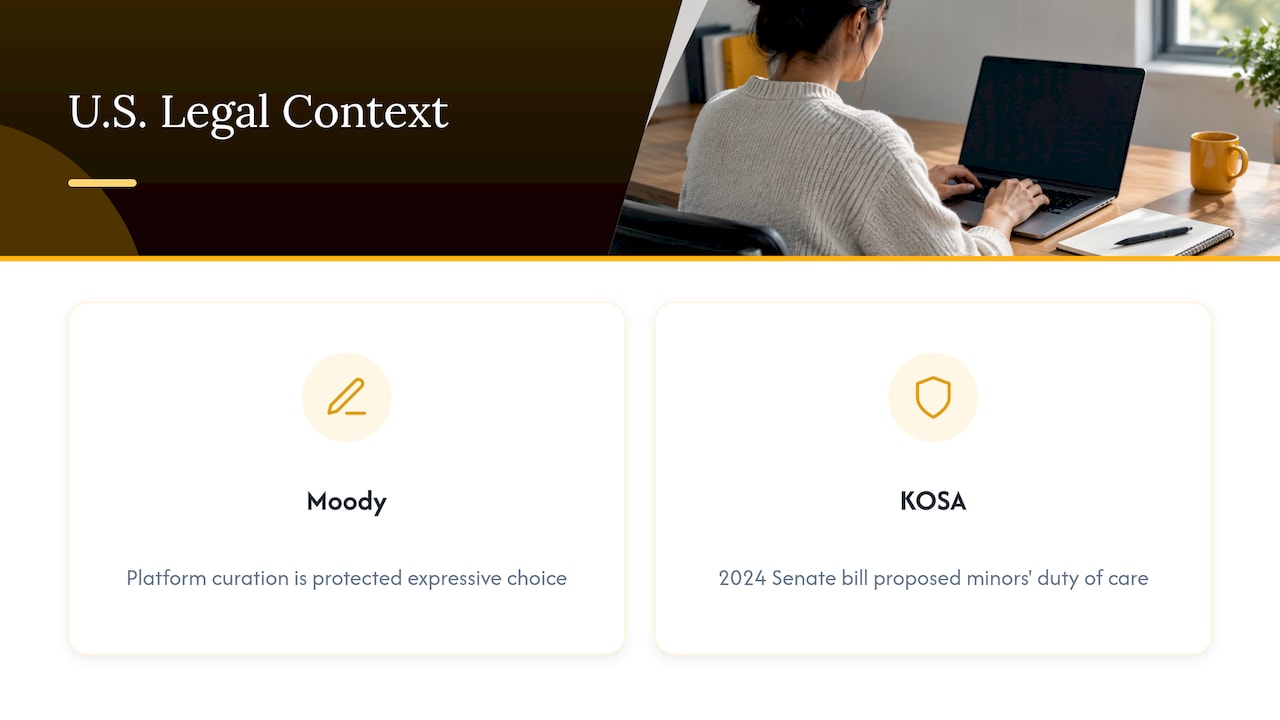
In the United States, the First Amendment shapes what government can require of moderation. In Moody v. NetChoice (2024), the Supreme Court held that when platforms decide which third-party content to display and how to organize it, they are making protected expressive choices. The EFF reads that decision as confirming that government cannot mandate neutral moderation policies. In practice, your policy is your own to write, which is why your documented rules and consistent enforcement matter.
Child safety proposals continue to move. The Kids Online Safety Act, which passed the Senate in July 2024 as part of a larger bill, would have imposed a duty of care on certain platforms likely to be used by minors. Check with counsel for the status of any bill that affects your platform, and make sure your vendor’s escalation path for minor-safety content is already tight.
Where Altiam CX fits
If your moderation, community support or customer-facing review work needs trained bilingual teams working in U.S.-friendly hours, our managed team extension and customer experience services deliver dedicated nearshore teams from Latin America. Engagements are billed per seat, per hour or as a managed service, so you can start with a defined scope and grow.

Healthcare organizations can look at our patient support and SOP management work, and legal teams at our intake and case communication services. Both are built around documented procedures, which is the same foundation good moderation needs.
Perspective
We have spent our time building managed teams for organizations where an error is expensive: patient communication, legal intake, financial services, ecommerce support. The lesson carries straight into moderation. The quality of a team comes from the procedure it follows, the training behind it and the way it is governed.
That is why we argue for nearshore delivery. Cultural alignment is not a slogan when your reviewers must read tone, slang and context in the same language your customers use. Working in hours that overlap with yours means a policy change on Monday morning reaches the floor on Monday, not on Tuesday.
Our model is designed around flexible, scalable teams, rapid talent sourcing and bilingual staff, with performance frameworks that make results measurable. We believe the best outsourcing relationships are run like a shared operation: common metrics, regular calibration and clear escalation owners. If you build it that way, the vendor becomes an extension of your team instead of a black box.
Daniela
FAQ
What is content moderation outsourcing?
It is the practice of contracting an external team to review, classify and act on user-generated content according to your policy. The vendor manages hiring, training, facilities and day-to-day operations. You keep ownership of the policy and the final say on difficult cases.
Should I outsource all moderation or only part of it?
Most organizations outsource the sustained, high-volume queues and keep policy, appeals and legal escalations in-house. Automation takes the clear-cut items, and trained reviewers take what needs context. Start with one queue, measure quality, then expand.
How do I know a vendor protects its moderators?
Ask for training curricula, rotation schedules, access to mental health support and incident logs, and write those commitments into the contract. Research shows the effects of exposure build up over time, so ongoing support matters more than a one-time briefing.
Which metrics should the contract include?
Use accuracy against a gold-standard set, inter-rater agreement, turnaround time, escalation rate, appeal overturn rate and backlog age. Pair every speed target with a quality target so one does not undermine the other.
How is outsourced moderation priced?
Common structures are per seat, per hour and managed service with a defined scope. Location, language, content severity, coverage hours and security requirements move the price most. Compare vendors on cost per correct decision, not hourly rate alone.
Sources
- TSPA: Setting Up Content Moderation Teams
- Digital Trust & Safety Partnership: Best Practices for AI and Automation in Trust & Safety (2024)
- Cyberpsychology: The psychological impacts of content moderation on content moderators (2023)
- arXiv: study of experienced content moderators (2022)
- Moderation Vendor Audit Checklist (2026)
- CRS: Social Media, Regulatory, Legal, and Policy Considerations (2025)
- EFF Transition Memo to the Incoming Administration (2025)


