A CX maturity assessment tells you how well your organization is set up to deliver good customer experiences, not how customers feel this quarter. You score your capabilities (strategy, customer insight, design, delivery, measurement, culture) against defined stages, find the weakest links, and build a roadmap. This guide shows how the main models work, how to run an assessment in your own organization, and how to turn the score into decisions.
TL;DR
- CX maturity measures organizational capability. Satisfaction and NPS measure sentiment. You need both, but they answer different questions.
- Most published models use five stages and 6 to 15 capability areas. The right choice is the one your leadership team will actually complete and repeat.
- Score against observable evidence (documents, decisions, data), not opinion. An independent second view catches blind spots.
- Fix the lowest-scoring capability that blocks the others first, then reassess every six to twelve months.
- Gaps in delivery capacity are often the fastest to close, and a managed nearshore team can add that capacity while your internal team works on strategy and measurement.
Table of Contents
- What CX maturity actually measures
- The main CX maturity models compared
- How scoring works: the XM Institute example
- How to run a CX maturity assessment in six steps
- Interpreting results and deciding what to fix first
- Our perspective
- Where Altiam CX fits in your roadmap
- Tracking progress after the assessment
- FAQ
- Sources
What CX maturity actually measures
Customer experience maturity is whether an organization has the leadership, insight, design discipline and delivery consistency that produce good experiences year after year. ICXI’s CX framework frames it as capability, not how customers feel in a given quarter.
That distinction matters in practice. A strong NPS can come from a great product, a few heroic agents or a quiet quarter. A mature program is one where results do not depend on heroics: owners are named, insight reaches decisions, and fixes ship.
Maturity research points the same way. A Quirks article on CX maturity reports that the choice of metric (NPS, CES or overall satisfaction) has little to no impact on whether a program drives business outcomes. What matters is how customer-centric the organization is across a set of core competencies.
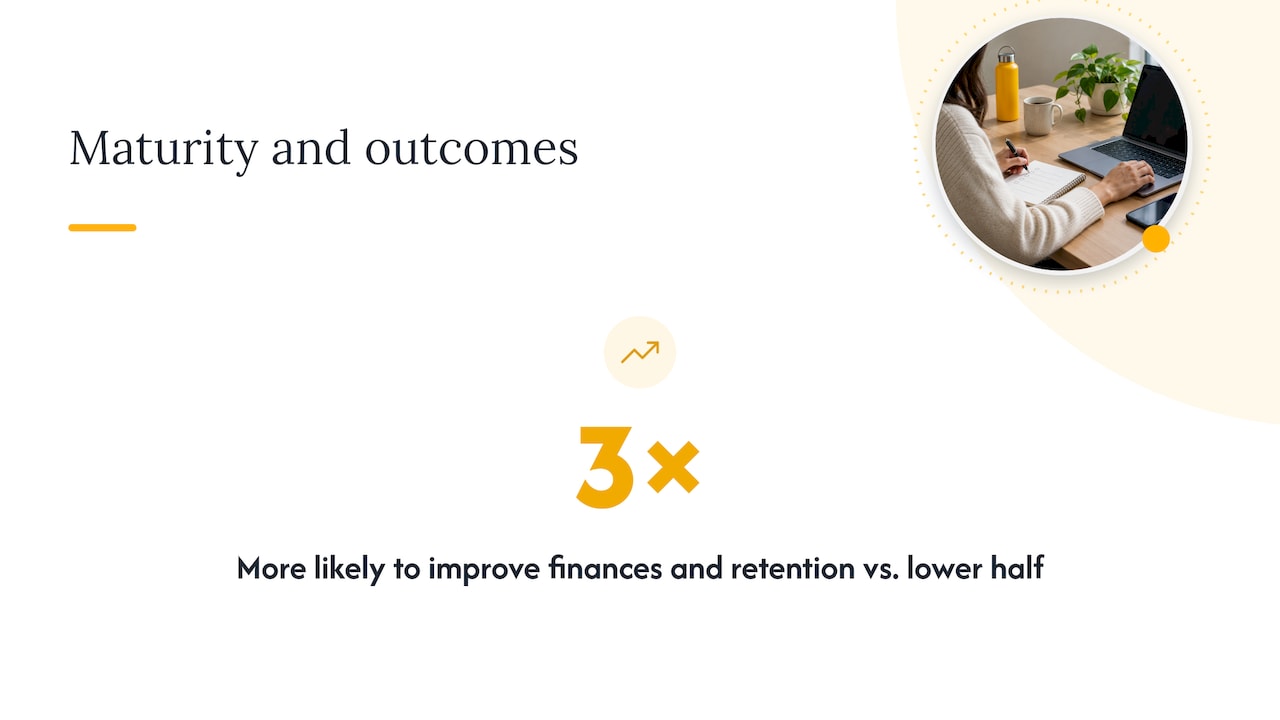
The same article cites MaritzCX validation research finding that companies at the highest maturity level are three times more likely to have improved financial results and retention than companies in the lower half of the curve. It also cites 2015 Temkin Group research showing that fewer than one-third of companies rate themselves good or very good at changing the business based on insights. Collecting feedback is the easy part. Acting on it is where maturity shows.
If you are still defining your overall approach, our guide to what customer experience management involves is a useful starting point before you score anything.
The main CX maturity models compared
There is no single standard. Each model groups capabilities differently, but they overlap more than they differ. Here is how the best-documented ones compare.
| Model | What it assesses | Levels |
|---|---|---|
| XM Institute CX Maturity Assessment | 6 competencies and 20 skills | 5 stages |
| ICXI 12 CX Pillars | 12 dimensions of CX capability | 5 levels: Emerging, Developing, Structured, Proactive, Exemplary |
| XLA Institute Maturity Model | 15 aspects under Strategy, Culture, Design, Technology and Value | 5 levels |
| TM Forum CEMM v2.0.0 | Experience, Strategy, Technology, Operations, Culture and Data | Staged maturity levels |
| Gartner CX Maturity Model | Voice of the Customer, Metrics, Strategy, Research, Personas and Journeys, Technology, Culture, Roles and Governance | 3 phases |
Two more references are worth knowing. The Forrester Customer Experience Maturity Model, published in January 2018, supports objective self-assessment on each topic, and its level definitions help you set improvement goals. Forrester also estimates that more than 60% of B2B companies have a customer experience function, but responsibilities vary widely, which is why a maturity model helps you see where you actually sit.
Academic work lands in the same place. A 2024 peer-reviewed study in ESIC Market built a CXM maturity model from CXPA, Forrester and Qualtrics models plus expert input via the Delphi method. It settled on six categories: strategy, culture, customer understanding, design, implementation and innovation, and measurement and return.
How to choose a model
Pick on three criteria:
- Fit with your scope. An enterprise-wide program may suit a 12-pillar framework. A single support function may only need a lighter self-assessment.
- Evidence requirements. Some models are a questionnaire you can finish in an hour. Others require documentation reviews and interviews.
- Repeatability. A model your team can rerun twice a year beats a thorough one you run once.
If you want a wider look at how these frameworks differ in philosophy, see our overview of types of customer experience models.
How scoring works: the XM Institute example
The XM Institute assessment is one of the most transparent public examples, so it is a good way to see the mechanics. According to the assessment worksheet, you rate each of 20 CX skills from 1 (Never) to 5 (Always). Competency scores are the averages of their skills. The overall stage comes from the total score:
| Total score | Stage |
|---|---|
| 6 to 14 | Investigate |
| 15 to 18 | Initiate |
| 19 to 22 | Mobilize |
| 23 to 26 | Scale |
| 27 to 30 | Embed |
The total is the sum of the six competency scores, which is why the range runs from 6 to 30.
The worksheet suggests four uses: individual self-assessment, group discussion, action planning and progress tracking. The group discussion matters most. When a CX director scores a skill 4 and a support manager scores it 2, that gap is the finding.
What scores usually look like
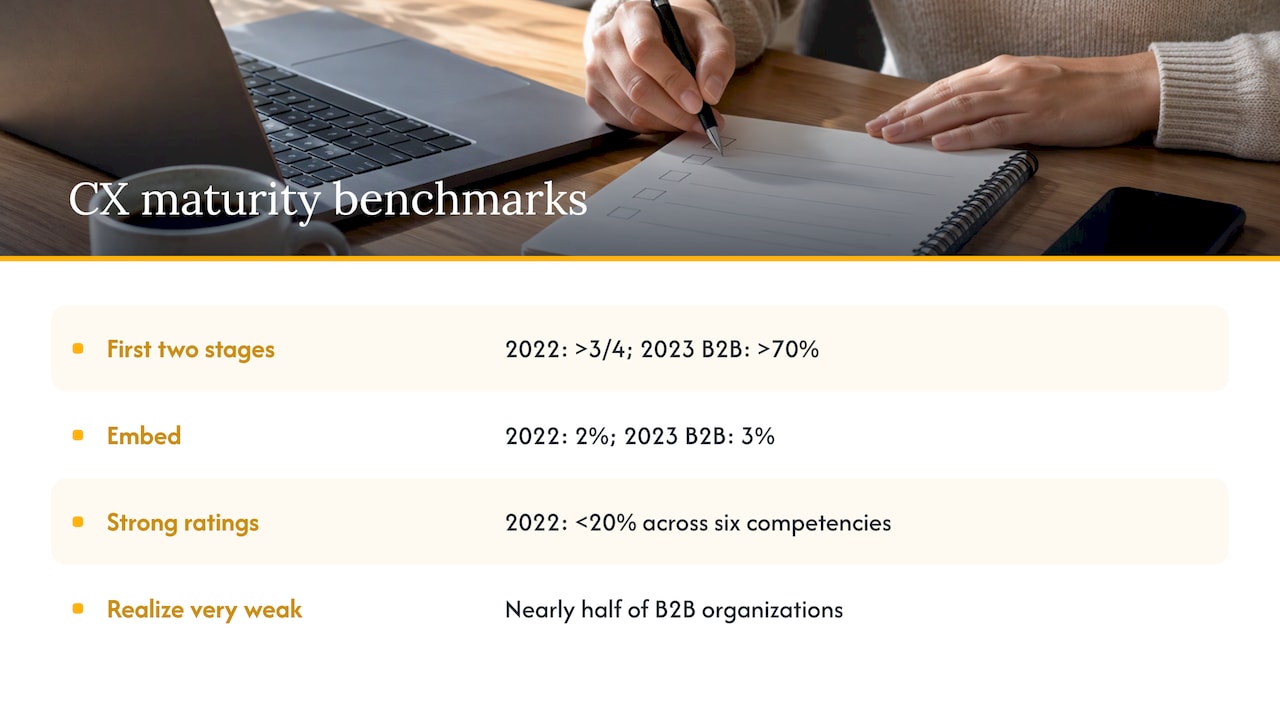
The benchmarks are humbling. XM Institute’s 2022 State of CX Management study found more than three-quarters of respondents in the first two stages, just 2% at the top Embed stage, and fewer than 20% with strong ratings across all six competencies. Its 2023 B2B study found more than 70% in the first two stages and 3% at Embed. B2B organizations were weakest in the Realize competency, with nearly half rating their capabilities as very weak.
If your first score is low, you are in the majority. The point is to know where you stand and move.
How to run a CX maturity assessment in six steps
The formal methods differ in detail but follow a similar arc. The XLA Institute process runs from framing the need and defining scope to building evidence, assessing the current state, prioritizing, and improving and reassessing. Here is a practical version.
1. Define the scope and the sponsor
Decide whether you are assessing the whole company, one business unit or one channel. Name an executive sponsor. Without one, results become a slide deck nobody owns.
2. Assemble the right people
Bring together people who can contribute different perspectives and evidence across your scope: CX, support operations, product, marketing, IT or data, and finance. For regulated industries such as healthcare, legal and financial services, add compliance. Their view of how experiences are governed is often the missing piece.
3. Gather observable evidence
The XLA Institute recommends collecting practices, artifacts, decisions and measures that show how experience capability operates today. Its logic is simple: if leadership sponsors improving experience, an email or presentation would exist to show it. Evidence makes the result more consistent and actionable than perception alone.
Useful evidence includes:
- Journey maps and the last time they changed a decision
- Voice of the customer reports and who receives them
- Support quality scorecards and SOPs
- Roadmap items traced back to customer insight
- Executive meeting agendas that include CX metrics
4. Score, then calibrate
Have each participant score independently, then compare. ICXI’s assessment process shows a rigorous version: documentary evidence, structured interviews and customer data review, then 120 evidence-based judgements checked by a second independent assessor.
An outside view helps even if you use a simpler model. GovCX notes that independent assessors help validate a maturity level, identify blind spots and challenge assumptions, not just confirm a self-assessment.
5. Prioritize
Turn scores into a short list. We cover how below.
6. Reassess
Put the next assessment on the calendar before you close this one.
Interpreting results and deciding what to fix first
A stage label is a headline. The useful content is the pattern underneath it.
Look for the lowest competency, then ask what it blocks. Weak measurement hides every other problem. Weak delivery means insight never reaches customers. Weak culture means good plans stall.
Compare self-scores with evidence. A skill scored 4 with no documents behind it is probably a 2.
Separate strategic gaps from capacity gaps. A strategy gap needs leadership decisions. A capacity gap, such as slow response times, inconsistent follow-up or no after-hours coverage, needs people and process. The two have different timelines, and mixing them stalls both.
Limit the roadmap. Pick three to five initiatives. ICXI’s report includes a sequenced 12 to 24 month roadmap, which is a sensible planning horizon. A longer list rarely gets finished.
For the step after scoring, turning results into prioritized improvement goals is where a loyalty-focused plan helps. Our own CX improvement guide for senior leaders and guide to CX program design go deeper on structuring the initiatives.
Pick metrics that prove the move
Every roadmap item needs a measure you can check at the next assessment. Our piece on measuring customer experience success covers which operational and outcome metrics pair well with maturity scores.
Our perspective
We see the same pattern in assessments across industries. Strategy and measurement get the attention. Delivery, the daily work of answering patients, clients and customers well, gets treated as a given.
That is a mistake. A maturity score rises when customers feel consistent service, and consistency is an operations problem as much as a design one. Documented SOPs, trained bilingual agents, clear escalation paths and reliable coverage are things you can build in weeks, not years.
This is why we believe nearshore teams belong in a maturity roadmap. Working from Latin America, in time zones aligned with U.S. business hours and with cultural alignment to U.S. customers, a managed team can take on customer care, technical assistance and back-office work while your leaders focus on insight, governance and design. You keep the strategy. We help carry the delivery.
Our advice: do not wait for a perfect assessment before acting on delivery gaps. Score honestly, fix the capacity constraint that is hurting customers today, and let the next assessment show the lift.
Daniela
Where Altiam CX fits in your roadmap
When an assessment points to delivery capacity, response consistency or specialized support as the weak spot, Altiam CX provides managed nearshore customer experience, technical support, back-office operations and team extension, with bilingual agents and scalable team deployment. Explore the Customer Experience and Managed Team Extension services to see how engagements are structured.

We also build industry-specific programs. For providers, see our healthcare CX operations offer covering managed support and patient support with SOP management. For firms, see legal intake and client communication, or read the legal services case study. If you outsource any part of CX, our outsourcing governance checklist helps you keep that work inside your maturity framework.
Tracking progress after the assessment
The XM Institute recommends repeating the assessment every six to twelve months to track progress. Keep conditions identical: same model, same scope, same evidence standard, ideally the same participants.
Between assessments, track the leading indicators tied to your roadmap items, such as time to resolution, follow-up completion, or how many customer insights became roadmap changes. Review them in a regular leadership meeting. Maturity moves when someone is accountable for it every month, not once a year.
FAQ
What is the difference between a CX maturity model and a CX maturity assessment?
The model is the framework: its capability areas, levels and definitions. The assessment is the act of scoring your organization against it using evidence. You choose a model first, then run the assessment to learn your current level and gaps.
How long does a CX maturity assessment take?
It depends on the model and scope. A self-assessment questionnaire such as the 20-skill XM Institute worksheet can be completed in a sitting, followed by a group discussion. Evidence-based assessments with interviews and documentation review take longer, and ICXI’s process includes scoping, evidence gathering, scoring and a report with a roadmap.
Should we assess ourselves or hire an outside assessor?
Start with a self-assessment if you want a quick baseline and team alignment. Add an independent view when results will drive major investment or when internal scores seem inflated. External assessors can surface blind spots and challenge assumptions that insiders miss.
How often should we reassess?
Every six to twelve months, according to XM Institute guidance. Choose the shorter interval while you are making fast changes, and the longer one once the program is stable.
What should we do first after getting a low score?
Identify the lowest-scoring capability that limits the others, then choose three to five initiatives with measurable outcomes. Close delivery and capacity gaps early, since they affect customers directly, while you work on longer-term strategy and measurement.
Sources
- ICXI: The 12 CX Pillars
- ICXI: CX Assessment and maturity rating
- Quirks: Why maturity matters for customer experience management
- XM Institute: Customer Experience Maturity Assessment
- XM Institute: CX Maturity Assessment worksheet
- XM Institute: The State of CX Management, 2022
- XM Institute: State of B2B CX Management, 2023
- XLA Institute Maturity Model
- TM Forum Customer Experience Maturity Model v2.0.0
- Forrester Customer Experience Maturity Model
- Gartner Customer Experience Maturity Model
- ESIC Market: Creation of a maturity model to measure customer experience
- GovCX: The Assessment Process