
Data entry outsourcing means handing the repetitive capture, keying, validation and updating of records to an external team that works to agreed accuracy and turnaround targets. It works best when the volume is steady or seasonal, the rules for each field can be written down, and the provider is held to measurable quality. For U.S. organizations in healthcare, legal, ecommerce and financial services, the decision rests less on hourly rate than on three questions: what exactly is in scope, how errors are caught, and how the data is protected.
This guide covers what the work includes, how a managed workflow runs from intake to delivery, what drives cost and turnaround, which security controls to confirm, and how to launch without disrupting your operation.
TL;DR
- Outsourced data entry, data processing, data input and data capture describe the same family of work: turning documents, forms, emails and system records into clean, structured data.
- The best candidates are rule-based, high-volume tasks with a clear definition of “correct”. Judgment-heavy exceptions stay with your own staff or a specialist escalation path.
- Price and speed depend on volume, document quality, field complexity, validation depth and security requirements, so define these before you ask for a quote.
- Regulated data (patient, client, financial) calls for documented safeguards, contract terms and ongoing monitoring, not just a promise of confidentiality.
- Start with a scoped pilot, written standard operating procedures (SOPs) and weekly quality reviews, then scale.
Table of Contents
- What data entry outsourcing includes
- Which work suits an outside team
- How an outsourced data entry workflow runs
- Benefits and trade-offs to plan for
- What drives cost and turnaround
- Security and compliance checks before you share data
- Setting scope, accuracy and service levels
- A practical launch plan
- Our perspective
- How Altiam CX can help
- FAQ
- Sources
What data entry outsourcing includes
Searchers use several phrases for this work: outsourced data processing, data input outsourcing, data capture outsourcing. In practice they overlap. The tasks fall into a few groups:
- Keying and transcription. Typing information from paper forms, PDFs, scans, handwritten notes or voicemail into a system of record.
- Data capture from documents. Pulling fields from invoices, claims, intake forms, contracts or shipping documents, often with software doing the first pass and a person verifying it.
- Record updates and maintenance. Changing addresses, statuses, account details and contact data in a CRM, practice management system, ERP or order system.
- Cleansing and validation. Deduplicating records, standardizing formats, checking values against reference lists, and flagging mismatches for review.
- Catalog and listing work. Entering product attributes, pricing updates, descriptions and inventory data for ecommerce and retail.
- Back-office processing. Matching documents to accounts, logging case information, scheduling data, and preparing records for the next team in the chain.
What separates data entry from broader back-office operations is how narrow the task is. Data entry follows a defined rule set. Back-office operations add queues, follow-ups, exceptions and communication. Many organizations start with data entry and extend into the wider process once the first workflow runs smoothly.
Which work suits an outside team
Yes, companies can and routinely do outsource data entry jobs. The question is which work to send. A task is a strong candidate when it meets most of these conditions:
- Volume is steady or spikes predictably. Month-end, open enrollment, holiday catalog loads and case-intake surges all strain an internal team.
- The rules can be written. If an experienced employee can explain in a checklist what a correct record looks like, a trained external team can reproduce it.
- The source material is accessible. Scans, exports, shared inboxes and portal downloads can be routed securely to the team.
- Errors are measurable. You can sample records and score them against the standard.
- The work distracts skilled staff. Nurses, paralegals, analysts and support leads lose hours to keying that someone else could own.
Keep in-house, or build a defined escalation path for, anything that needs legal judgment, clinical decisions or discretionary approvals. A good arrangement lets the outsourced team handle the 90-plus percent that is routine and send the rest back with clear notes.
How an outsourced data entry workflow runs
A managed workflow has the same stages whether the team is five people or fifty. Knowing them helps you ask the right questions of any provider.
1. Intake and capture
Source material arrives through a secure channel: an SFTP folder, a portal, an integration with your system, or a controlled shared mailbox. The team logs each batch, checks it is complete and legible, and returns unusable items. Define here what counts as a batch and how fast it must be acknowledged.
2. Entry or extraction
Agents key data or verify what software has extracted, following the written SOP for each field: format, allowed values, required versus optional, and what to do when information is missing. Ambiguity at this stage is the main source of downstream errors, so SOPs should include examples of both correct and incorrect entries.
3. Validation
Records pass through automated checks (format, range, duplicate detection, cross-reference to a master list) and, for higher-risk fields, a second person’s review. Double-keying and independent verification catch errors a single pass misses, at the cost of extra time. Match the depth of validation to the consequence of a mistake: a wrong phone digit is not the same as a wrong medication code or settlement amount.
4. Quality review
A quality lead samples completed work against the standard and records an accuracy score. Errors are categorized by cause (unclear source, SOP gap, agent error, system issue) so the fix targets the real problem rather than just correcting the record.
5. Delivery and feedback
Cleaned data is delivered back to your system on the agreed schedule, with a report on volumes, turnaround, accuracy and open exceptions. A weekly review between your process owner and the provider’s team lead keeps SOPs current as your business changes.
Benefits and trade-offs to plan for
The advantages are practical. You convert a fixed internal workload into a flexible one, free skilled staff for higher-value work, and gain coverage when volume rises. Nearshore teams in Latin America also work in time zones that overlap with U.S. business hours, which makes same-day questions and corrections realistic. Bilingual agents help when source documents or customer records arrive in both English and Spanish.
The points to manage are equally concrete, and each one has a clear answer:
- Knowledge transfer takes effort up front. Budget time to document how your best employee actually does the task. This documentation becomes an asset in its own right.
- Quality depends on the SOP. A vague procedure produces inconsistent output with any team. Write it tightly.
- Data protection needs structure. This is covered in detail below.
- Systems access must be scoped. Give accounts only the permissions the role requires.
Organizations that treat the engagement as a managed service, with named leads, targets and reviews, avoid most problems. Those that treat it as a one-time handoff tend to discover gaps later.
What drives cost and turnaround
Providers price data entry per seat, per hour or as a managed service, and there is no single market rate that applies to your work. These factors move the number more than anything else:
| Factor | Why it matters |
|---|---|
| Volume and consistency | Steady, high volume supports a dedicated team and lower unit effort. Irregular spikes need flexible capacity. |
| Source quality | Clean digital files are fast. Poor scans, handwriting and mixed formats slow every record. |
| Field complexity | Ten simple fields per record differ greatly from sixty fields with conditional rules. |
| Validation depth | Double entry and second-person review improve accuracy but add time. |
| Language needs | Bilingual work requires agents with verified skills in both languages. |
| Security and compliance | Regulated data requires controlled environments, access restrictions, logging and audit support. |
| Systems | Entry into your own platform needs training, credentials and sometimes a sandbox. |
| Turnaround target | Same-day delivery needs more capacity than a three-day window. |
To get a comparable quote, give every provider the same package: a sample of real (de-identified) documents, expected monthly volume, field list, accuracy target, turnaround window and security requirements. Quotes based on vague descriptions are not comparable.
Security and compliance checks before you share data
Data entry means someone outside your walls sees your records. For regulated sectors, this is where due diligence matters most. A service-provider paper from a major law firm identifies three controls for any organization that shares personal information with a vendor: initial diligence, specific privacy and security contract terms, and continued monitoring. That framework applies to every sector below.
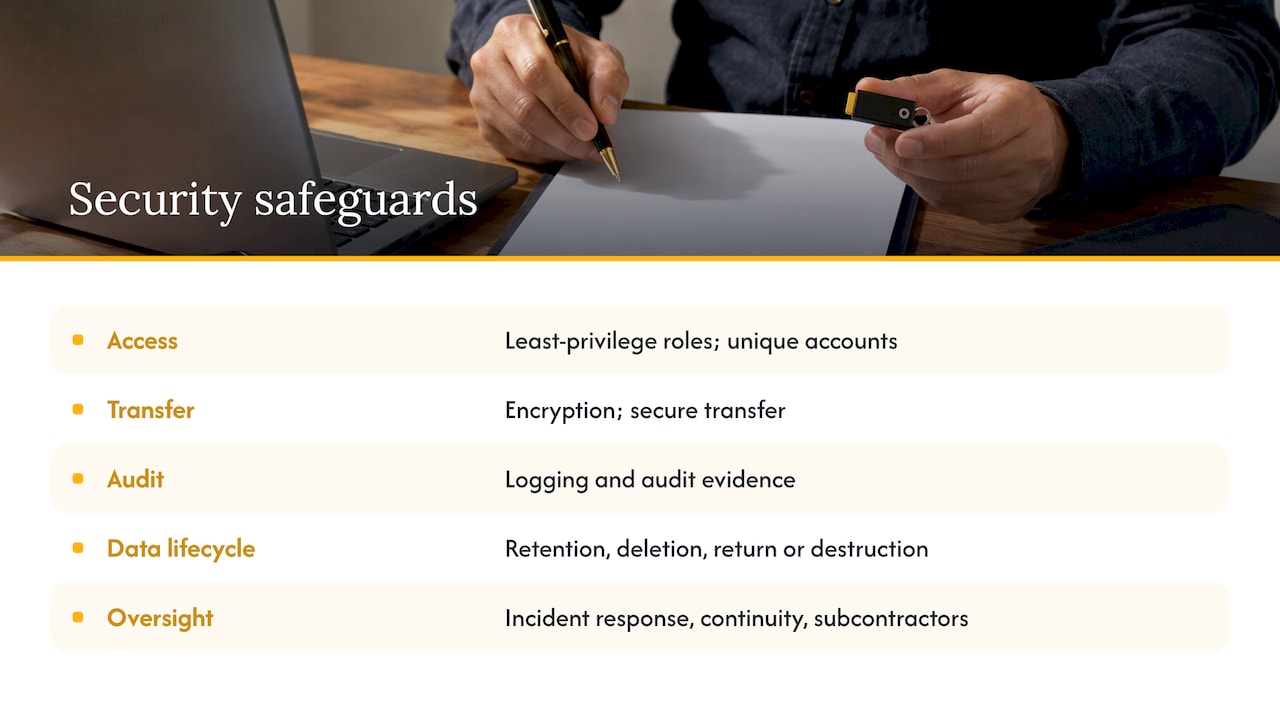
The same source points to a practical checklist: role-based, least-privilege access and unique accounts, encryption, logging, secure transfer, retention and deletion rules, incident response, subcontractor restrictions, audit evidence, continuity planning, and return or destruction of data at the end of the contract.
Healthcare
If the data includes protected health information, the provider is a business associate. Under the HIPAA/HITECH Omnibus Rule, business associates must comply with the Security Rule, make sure subcontractors protect electronic PHI, and report breaches of unsecured PHI. A business associate agreement clarifies and limits permitted uses and disclosures. For a deeper walk-through, see our HIPAA compliant outsourcing guide for healthcare administrators.
Financial services
A June 2026 client alert on third-party data sharing lists what vendor diligence should examine: information security, privacy compliance, financial stability, regulatory history, SOC 2 Type II reporting, penetration-test results, GLBA and FTC Safeguards Rule compliance, prior breaches, retention, access controls and workforce training. The same alert says contracts should define permitted uses, security standards, breach-notification timelines, audit rights, indemnification, subcontractor restrictions and secure return or destruction of data at termination. Our articles on GLBA work and the 30-day deadline and SOC 2 for BPOs explain how those pieces fit together.
Legal
Law firms and legal departments should tailor restrictions to client confidentiality: who may see matter data, how documents are transferred, and what happens to copies when the engagement ends. Our guides on eDiscovery outsourcing risks and paralegal outsourcing service examples cover the controls counsel should keep.
Ecommerce and retail
Customer, catalog and transaction data each carry different risks. Restrict access to payment-related fields, separate pricing and supplier information from general catalog work, and confirm how files are transferred and deleted.
For a procurement-ready list that applies across sectors, use our BPO due diligence checklist, and for governance at leadership level, see four board-level controls for data security in BPO partnerships.
Setting scope, accuracy and service levels
A clear statement of work does more for quality than any tool. Cover these items before the first record moves:
- Scope in writing. List each document type, each field, and each system. State what is explicitly out of scope.
- Definition of an error. Decide whether accuracy is measured per field or per record. A record with one wrong field out of forty is 97.5 percent right by field and wrong by record. Pick the measure that matches the business risk.
- Accuracy target by risk tier. Set stricter targets and deeper validation for high-consequence fields, and lighter checks for low-consequence ones.
- Turnaround. Define the clock: from receipt of a complete batch to delivery of validated data.
- Escalation rules. Specify who answers questions, how quickly, and what the team does with records it cannot complete.
- Reporting. Agree on weekly volume, turnaround, accuracy and error-cause reports.
- Security and exit terms. Put access, logging, breach notification, subcontractor limits and data return or destruction in the contract.
- Change control. Decide how new fields, new document types and volume changes are requested and priced.
A practical launch plan
Most transitions work best in phases.
Weeks one and two: define and document
Choose one workflow. Collect a sample set, interview the people who do the work today, and write the SOP with screenshots and examples. Agree on accuracy and turnaround targets and set up access with least-privilege accounts.
Weeks three to six: pilot
Run a limited volume in parallel with your internal process or with 100 percent review. Track errors by cause and update the SOP each week. The pilot is finished when the team consistently meets the agreed targets, not when a calendar date arrives.
After the pilot: scale and monitor
Increase volume in steps, move from full review to risk-based sampling, and hold a regular service review. Add the next workflow only when the first is stable. Our critical support function outsourcing checklist offers a broader readiness list.
Our perspective
We see data entry as the quiet foundation of customer experience. When a patient record, a legal intake form or an order update is wrong, the customer feels it first, in a missed appointment, a repeated question or a delayed shipment. That is why we treat data work as part of a managed operation, not as a stand-alone task.
Our nearshore model is built around cultural alignment, disciplined execution and measurable performance frameworks. Teams in Latin America work in time zones that overlap with U.S. operations, and our bilingual agents can handle English and Spanish material without hand-offs. We aim to make the team an extension of yours: documented SOPs, named leads, regular reviews and targets you can see.
We recommend starting with one well-defined workflow, proving quality, then widening scope. In our experience, that sequence builds trust faster than a large launch and gives your own staff time to move toward higher-value work.
Daniela
How Altiam CX can help
Altiam CX is a nearshore partner for customer care, technical assistance, back-office operations and managed team extension. If your data entry sits inside a larger process, such as patient support, legal intake or customer service, we can staff and manage the whole workflow rather than one slice of it.

Healthcare teams can look at our managed customer support and patient support SOP management. Law practices can see how we handle legal intake, scheduling and back-office legal support. For other functions, our services page describes customer experience and managed team extension. Tell us about your volume, document types and compliance needs, and we will scope a pilot with you.
FAQ
Can you outsource data entry jobs?
Yes. Many U.S. organizations outsource data entry, usually the rule-based, high-volume portion of the work. You define the fields, accuracy targets and turnaround, and the provider trains a team to follow your SOPs. Work needing judgment is typically escalated back to your staff.
What is the difference between data entry, data processing and data capture outsourcing?
The terms overlap. Data capture focuses on pulling information from documents or forms, data entry on keying it into a system, and data processing on the wider cleaning, validating and organizing of records. Many providers bundle them, so define the specific tasks in your scope instead of relying on the label.
How do I keep outsourced data secure?
Confirm least-privilege access, unique accounts, encryption, logging, secure transfer, subcontractor limits and data return or destruction terms. Then monitor continuously. Healthcare teams should add HIPAA business associate terms, and financial institutions should review GLBA and Safeguards Rule obligations with counsel.
How do I measure the quality of outsourced data entry?
Sample completed records against your written standard, and score accuracy by field or by record, whichever matches your risk. Categorize each error by cause and review the results weekly with the provider. Stricter checks belong on high-consequence fields.
How long does it take to start?
A scoped pilot on one workflow typically needs time for documentation, access setup and parallel review before it reaches steady state. The timeline depends on your SOP quality, systems access and security approvals, so agree on pilot exit criteria rather than a fixed date.
Sources
- Privacy and Data Security in Service Provider Arrangements (Mayer Brown)
- Overview of HIPAA/HITECH Act Omnibus Final Rule (Alston & Bird)
- 10 Tips for Managing Third-Party Data Sharing in Financial Services (Shumaker)