A power dialer places one call for each agent who is ready, so every answered call reaches a person. A predictive dialer dials more numbers than you have free agents, betting that some calls will go unanswered. The first protects conversation quality and compliance. The second maximizes talk time, but only when you have a large floor and a low-answer list. For most teams that sell, support or follow up on high-value relationships, the power dialer is the safer default. Either mode performs only as well as the people on the line, which is where staffing decisions matter more than software settings.
TL;DR
- Power dialer: one call per available agent, no abandoned calls by design, best for small to mid-sized teams and calls worth preparing for.
- Predictive dialer: an algorithm over-dials to keep agents busy. It suits large floors and big, lower-quality lists, and it needs active compliance monitoring.
- Team size is the first filter. Genesys recommends at least 15 agents for predictive mode and 10 to 15 for power mode.
- U.S. rules cap abandoned calls at 3% of live-answered calls per campaign over 30 days, with extra safe harbor conditions.
- Agent readiness decides results. Prepared, well-trained agents turn connected calls into outcomes in either mode.
Table of Contents
- How each dialer places calls
- Side-by-side comparison
- Agent utilization and customer experience
- When a predictive dialer fits
- When a power dialer fits
- U.S. compliance: what changes between the modes
- Metrics to track whichever mode you pick
- The staffing question most comparisons skip
- A simple decision framework
- Where Altiam CX fits
- Our perspective
- FAQ
- Sources
How each dialer places calls
The difference comes down to one question: when does the system dial?
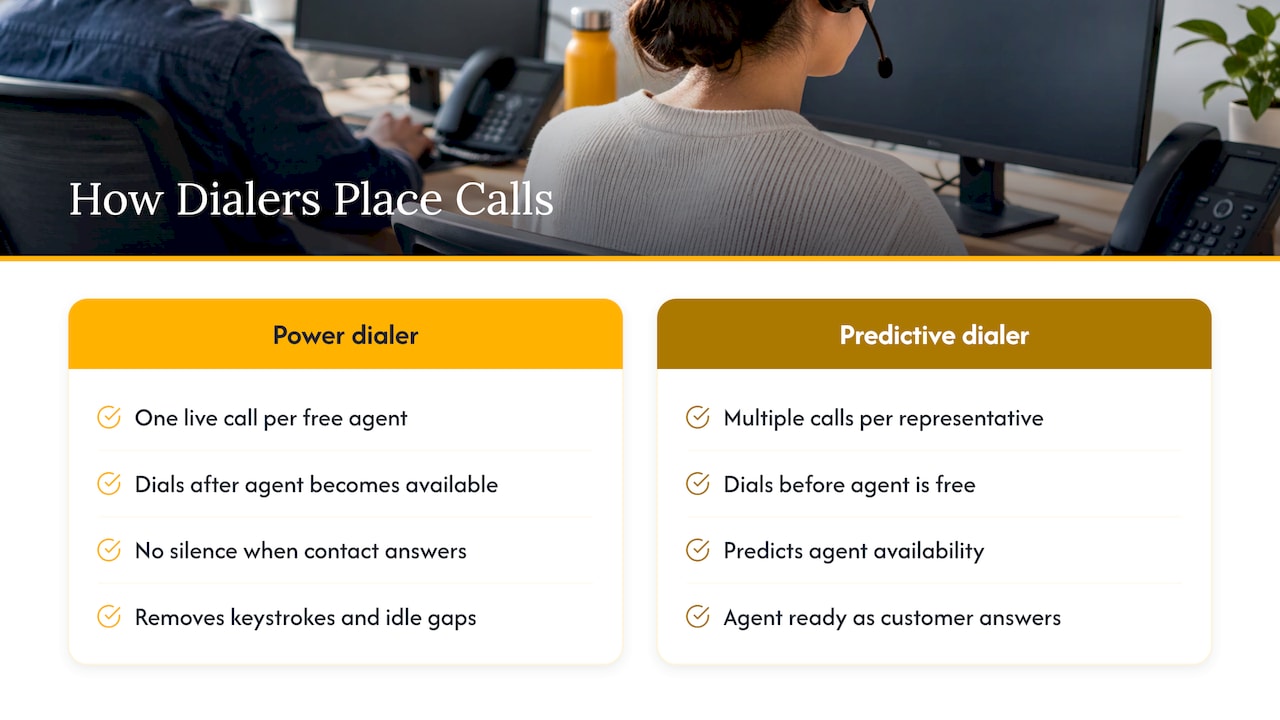
A power dialer dials the next number automatically as soon as an agent finishes the previous call and becomes available. There is one live call per free agent. Because the agent is already on the line when the contact picks up, nobody answers into silence. Power dialing sits between manual dialing and full prediction: it removes the keystrokes, the lookups and the idle gaps, but it never gets ahead of the agent.
A predictive dialer dials ahead. Genesys documents that in predictive mode the dialer uses an algorithm to predict agent availability. It draws on inputs such as average handle time, after-call time, idle time and historical contact rate, and it can launch a call before the agent is free. The goal is that by the time the customer answers, an agent is just becoming available.
The FTC describes the result in plain terms: predictive dialers call multiple consumers for every available sales representative. That is efficient when most dials go unanswered. It is a problem when too many are answered at once.
The math behind over-dialing
Imagine a list where only 5% of dials reach a person. A one-line-at-a-time dialer wastes about 19 dials per conversation, and agents spend much of the shift waiting. Over-dialing fixes that. Now imagine 40% of dials are answered. Extra lines mean more people answering when no agent is free. The algorithm has to guess, and every wrong guess is a customer who hears nothing or a hang-up.
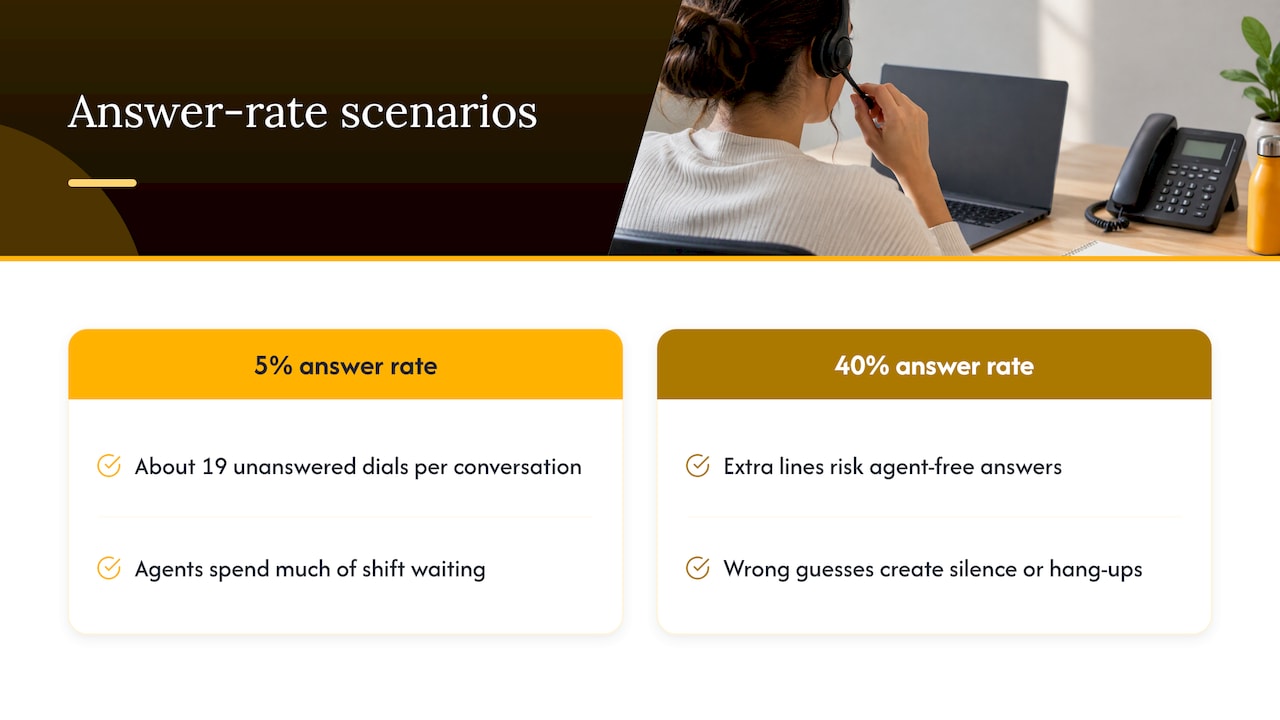
That is the whole trade. Predictive dialing buys agent utilization with risk. Power dialing gives up some raw dial volume for certainty.
Side-by-side comparison
| Factor | Power dialer | Predictive dialer |
|---|---|---|
| Calls placed | One per available agent | Several per available agent, driven by an algorithm |
| Abandoned calls | Not a built-in risk, since an agent is already free | Expected; must be held under the legal cap |
| Best list type | Warm, high-quality, smaller lists | Large, lower-quality lists with low answer rates |
| Team size | Small to mid-sized teams | Larger floors with enough agents to absorb simultaneous answers |
| Call character | Steady, prepared, conversational | Fast, high volume, similar conversations |
| Compliance load | Lower | Higher, with ongoing monitoring and records |
| Agent experience | Time to review context between calls | Back-to-back calls with little pause |
Agent utilization and customer experience
Predictive dialing wins on pure throughput. Vendors and operators publish different ranges, and the figures vary widely by list quality, so treat any single number as an estimate. The pattern is consistent, though: predictive modes produce more dials per hour and more talk time per agent, and power modes produce fewer dials with a more controlled pace.
The customer side is where the gap shows. When a predictive dialer connects someone with no agent free, the FTC notes in its proposed rulemaking on call abandonment that the dialer will either disconnect the call, creating a hang-up, or keep the person on the line with no one there, creating dead air. The FTC called abandonment an unavoidable consequence of predictive dialing. For a collections team, a hospital scheduling desk or a law practice returning inquiries, a silent call is more than a lost dial. It is a damaged first impression.
Agents feel the difference too. A pace with no breathing room leaves no time to read the account, check the last interaction or think about the opening line. A power dialer gives that time back. When an agent can see who the person is, what happened last time and what the call is for, the first sentence sounds like it came from someone who knows them. That preparation is also the core of effective lead nurturing strategies: relevant, personal outreach beats volume.
When a predictive dialer fits
Choose predictive when all of these are true:
- You have a big floor. More agents smooth out answers that arrive together. With few agents, a second answer often has nobody to take it.
- Your lists are large and answer rates are low. Over-dialing pays off when many calls end in voicemail, busy signals or no answer.
- Conversations are similar and transactional. Mass reminders, voter outreach and high-volume campaigns with a standard script are the classic cases.
- You can monitor compliance continuously. Predictive dialing requires closer oversight because it dials before agents are available.
Genesys also advises that a small sample makes the prediction unreliable. Its documentation recommends at least 15 agents for predictive campaigns, because average handle time, after-call time, idle time and contact rate are hard to calculate from a handful of people.
When a power dialer fits
Choose power when the reality of your operation looks like this:
- Your team is small or mid-sized. Genesys suggests 10 to 15 agents or more for power mode, and teams smaller than that often run it successfully because one call per agent does not depend on prediction.
- Your lists are warm or high-value. Existing customers, inbound inquiries that need a callback, patients, clients and qualified leads all deserve a prepared conversation.
- You work in a regulated corner. Healthcare, legal and financial services teams have good reason to avoid abandoned calls entirely.
- Your list is small enough to exhaust. If you will run through your contacts quickly, speed is not your constraint. Quality is.
As a rule of thumb from TechRepublic’s comparison, power dialers are a good fit for small to mid-sized teams with fewer than 1,000 fairly high-quality contacts per day. They get less effective when connection rates fall below 30%, because the one-to-one ratio leaves agents waiting. That is the honest boundary between the two modes: it is set by your connection rate and list size, not by which label sounds more advanced.
U.S. compliance: what changes between the modes
The legal exposure is the strongest argument for thinking carefully before choosing predictive. These rules are U.S. federal rules, and states add their own.
Abandoned calls
Under the FTC’s Telemarketing Sales Rule, a call is abandoned when a person answers and the telemarketer does not connect them to a sales representative within two seconds of the person’s completed greeting. The FCC aligned its own rule with the FTC’s in its 2012 TCPA order, which states that no more than 3% of calls answered by a person may be abandoned per calling campaign, measured over a 30-day period. For campaigns longer than 30 days, the rate is measured over each successive 30-day period, so you cannot average a bad campaign against a good one.
The safe harbor
Predictive dialers that want the safe harbor must meet four conditions at once, as summarized by Lexology’s review of the TSR amendments:
- No more than 3% of calls answered by a person are abandoned.
- The phone rings for at least 15 seconds or four rings.
- A recorded message states the seller’s name and phone number whenever no representative is available within two seconds.
- Records documenting compliance are kept.
A power dialer does not eliminate your other obligations. Consent rules, do-not-call requirements and calling-hour limits apply to every outbound call, whichever mode places it. Have your compliance counsel confirm which rules apply to your campaigns, especially where state laws differ. Our call center compliance monitoring playbook covers the monitoring routines, and our guide to U.S. call recording laws by state covers a related exposure that catches many outbound teams.
Metrics to track whichever mode you pick
A dialer is a means. Measure the result:
- Connect rate: the share of dials that reach a live person. It is the number that tells you which mode fits.
- Right-party contact rate: reaching the person you meant to reach, not just anyone.
- Talk time per hour: the share of the shift agents spend in conversation.
- Abandoned call rate: essential for predictive, worth watching in any mode. Set an internal alert well under the 3% legal ceiling.
- Agent occupancy: how much of the shift is productive versus waiting.
- Outcomes per connected call: appointments set, issues resolved, payments arranged. This is the metric that stops you from optimizing dials at the expense of results.
If you run the metrics weekly, the pattern will tell you when to change modes. A connect rate that climbs while your team shrinks points to power. A growing floor and a falling connect rate point toward predictive.
The staffing question most comparisons skip
Most dialer comparisons treat staffing as a given. It is the variable that decides everything above. Predictive dialing needs enough agents for the algorithm to work. Power dialing needs agents who can pick up a call cold and sound prepared. Neither works when volume spikes and you are short of trained people, or when the floor is overstaffed on quiet days.
Three practical points follow.
Forecast before you configure. Dialing mode, pacing and headcount move together. If you cannot say how many agents you will have on the phones in each interval, you cannot set pacing sensibly. Our guides to contact center forecasting and the interval-based staffing model walk through how to do that.
Match language to the list. A connected call only helps if the agent can hold the conversation. For U.S. teams calling bilingual populations, language coverage affects both handle time and customer satisfaction. See how bilingual CX agents affect NPS and handle time.
Give agents context. Whether the call is placed by a power dialer or a predictive one, the agent needs the account history, the reason for the call and the script on the screen. Preparation is what makes high-touch calls feel high-touch. Our tips for high-touch customer service apply directly.
A simple decision framework
Work through these in order:
- Count your agents on the phones. Under 10 to 15, choose power. At 15 or more, both are possible.
- Check your connect rate. Above roughly 30%, power keeps agents busy. Well below that, on a large list, predictive starts to earn its risk.
- Judge the call value. If each conversation is worth preparing for, choose power. If the script is standard and volume is the goal, predictive is viable.
- Test your compliance capacity. If you cannot monitor abandonment per campaign over 30 days and keep records, do not run predictive.
- Review monthly. Lists age, teams change and connect rates drift.
The most common mistake in this category is picking predictive because it sounds more advanced. For most outbound programs that build relationships, power dialing is the better choice.
Where Altiam CX fits
The dialer decides who gets called and when. The team decides whether the call works. Altiam CX provides managed nearshore customer experience and team extension services, including bilingual agents and scalable team deployment, so you can staff outbound programs to the volume your dialing mode needs. For healthcare organizations, we offer Managed Customer Support and Patient Support and SOP Management. For law practices, we offer Legal Intake and Inquiry Handling, Client Follow-Ups and Appointment Scheduling.
If you are deciding between modes because your team is the constraint, start by describing your call volumes and language needs to us.
Our perspective
We see the dialer debate framed as a software choice. We think it is a staffing and quality choice with a software setting attached.
Predictive dialing is a legitimate tool for large floors working big lists. But it asks a lot: a deep bench of agents, close monitoring and tolerance for the occasional silent call. Many of the teams that reach for it do so because they want more output from the people they already have.
Our view is that the better lever is usually the team around the dialer. A team of trained, bilingual agents who know the account, understand the reason for the call and follow clear procedures will convert more connected calls than a faster dialer with unprepared agents. That is why we build managed teams with defined SOPs and measurable performance frameworks, and why we extend client teams in the same nearshore time zones instead of adding more dials to the same few people.
If you run power dialing with prepared agents, you protect your number’s reputation, stay clear of abandonment rules and keep every conversation human. When volume grows, you add capacity through team extension rather than pacing risk.
Daniela
FAQ
Is a predictive dialer better than a power dialer?
Not by default. Predictive dialers generate more dials per agent hour, which helps on large floors working big, low-answer lists. Power dialers connect every answered call to a ready agent, which suits smaller teams and higher-value conversations. The right choice depends on team size, connect rate and compliance capacity.
How many agents do I need for a predictive dialer?
Genesys recommends at least 15 agents for predictive campaigns and 10 to 15 for power campaigns. The reason is statistical: with fewer agents, average handle time, idle time and contact rate are hard to estimate, so predictions become unreliable.
What is the legal limit on abandoned calls?
In the U.S., a telemarketer may abandon no more than 3% of calls answered by a person, measured per campaign over a 30-day period, according to the FCC’s 2012 order. Safe harbor also requires a minimum ring time, a recorded message with the seller’s name and number, and compliance records.
Does a power dialer remove my compliance obligations?
No. It removes the abandoned-call risk that comes from over-dialing, but consent, do-not-call and calling-time rules still apply to each call. Confirm the requirements for your campaign type with legal counsel.
Sources
- Dialing modes, Genesys Cloud Resource Center
- FTC proposed rules on call abandonment, Federal Register (2004)
- FCC 2012 TCPA Order (FCC-12-21A1)
- Telemarketing Sales Rule amendments affect call abandonment, Lexology
- How to Decide Between a Power Dialer vs Predictive Dialer, TechRepublic