

Selecting the right nearshore CX partner can feel like navigating a minefield. CX leaders in healthcare, legal, and ecommerce face unique compliance demands, cultural alignment challenges, and scalability pressures that make vendor selection critical. This guide walks you through the prerequisites and a proven step-by-step process to choose a nearshore CX partner that delivers measurable improvements in customer satisfaction and operational efficiency.
Table of Contents
- Introduction To Nearshore Cx And Prerequisites
- Step-By-Step Nearshore Cx Partner Selection Process
- Common Mistakes And Troubleshooting In Nearshore Cx Selection
- Measuring Success And Expected Outcomes
- Operational Scalability And Performance Management
- Explore Altiam Cx’s Nearshore Solutions
- Frequently Asked Questions About Selecting Nearshore Cx Partners
Key takeaways
| Point | Details |
|---|---|
| Prerequisites matter | Verify compliance certifications, documented SOPs, and cultural alignment before engaging any nearshore partner. |
| Follow a structured process | A six-step selection framework reduces risk and ensures partner alignment with your sector-specific needs. |
| Avoid common mistakes | Neglecting compliance audits and setting vague KPIs are the top reasons nearshore CX partnerships fail. |
| Measure what matters | Track CSAT, churn rate, FCR, and AHT to validate ROI and optimize performance continuously. |
| Scalability drives longevity | Prioritize partners who can scale teams in 2-4 weeks and operate within 1-3 hour time zones for real-time collaboration. |
Introduction to nearshore CX and prerequisites
Nearshore CX refers to outsourcing customer experience operations to geographically close countries, typically within the same hemisphere. Unlike offshore models in Asia or Eastern Europe, nearshore options in Latin America offer timezone proximity, cultural familiarity, and easier regulatory alignment. Nearshore CX can improve customer satisfaction by up to 30% compared to offshore alternatives, making it a compelling choice for North American businesses.
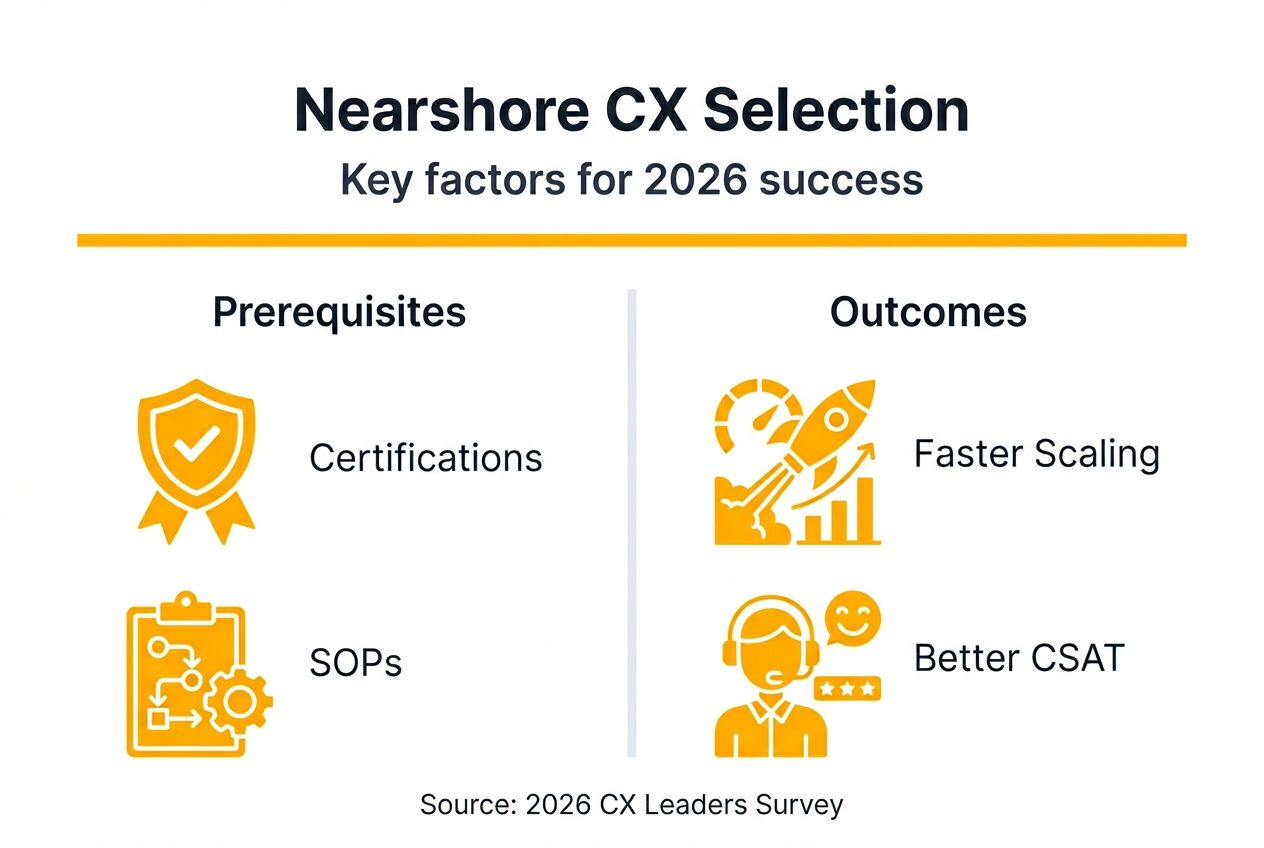
Before you evaluate vendors, establish these prerequisites to ensure you’re ready for a successful partnership:
- Compliance certifications: Healthcare organizations need HIPAA compliance. Legal firms require data security standards like SOC 2 Type II. Ecommerce companies must verify PCI DSS for payment processing. Without these certifications, you risk regulatory penalties and reputational damage.
- Documented SOPs and customer journey maps: Your internal processes must be clearly documented. Nearshore partners can’t replicate excellence if your playbook is vague or inconsistent.
- Cultural and language fit: Customers notice accents, communication styles, and empathy levels. Nearshore teams in Mexico, Colombia, or Costa Rica typically offer stronger cultural alignment with U.S. customers than offshore alternatives.
- Clear business goals and KPIs: Define what success looks like. Is it reducing churn by 20%? Improving first-call resolution by 15%? Vague objectives lead to misaligned partnerships.
Healthcare and legal sectors face heightened compliance scrutiny. A single data breach can trigger lawsuits and regulatory fines. Ecommerce businesses prioritize scalability during peak seasons like Black Friday or holiday shopping. Understanding your sector’s unique demands shapes every decision in the selection process.
Meeting these prerequisites positions you to evaluate nearshore CX providers with confidence. You’ll ask better questions, spot red flags faster, and negotiate contracts that protect your interests. For a deeper dive into what is nearshore outsourcing, explore how this model differs from traditional offshore arrangements.
Step-by-step nearshore CX partner selection process
Once prerequisites are in place, follow this structured six-step process to select a nearshore CX partner that aligns with your operational and compliance needs.
-
Define objectives and compliance requirements: Start by documenting your CX goals, budget constraints, and non-negotiable compliance standards. Healthcare organizations must specify HIPAA requirements upfront. Legal firms should outline confidentiality protocols and client communication standards. Ecommerce companies need to clarify seasonal scalability expectations and payment security needs. This step eliminates vendors who can’t meet your baseline requirements.
-
Audit vendor certifications and SOPs: Conduct compliance and certification audits to ensure vendor maturity and regulatory adherence. Request copies of ISO certifications, HIPAA attestations, SOC 2 reports, and PCI DSS compliance documentation. Review their documented SOPs for quality assurance, data handling, and crisis management. Vendors without transparent compliance frameworks should be disqualified immediately.
-
Assess cultural and language fit: Schedule live calls with prospective vendor teams. Listen for accent clarity, empathy in responses, and ability to handle nuanced customer scenarios. Request sample call recordings or chat transcripts. Cultural misalignment leads to customer frustration and higher churn rates, so this step is non-negotiable.
-
Set clear KPIs and SLA terms: Negotiate service-level agreements that specify measurable targets for CSAT scores, average handling time, first-call resolution rates, and quality assurance pass rates. Include penalties for underperformance and bonus structures for exceeding benchmarks. Vague KPIs create accountability gaps that harm your CX outcomes.
-
Pilot test with limited scope: Launch a 60 to 90-day pilot program with a subset of customer interactions. Monitor KPI performance daily and gather customer feedback weekly. This controlled test reveals operational issues before you commit to a full-scale rollout. Adjust processes, training, or even vendor selection based on pilot results.
-
Scale with governance and continuous improvement: Once the pilot validates partner performance, scale operations gradually. Implement monthly KPI reviews, quarterly business reviews, and continuous training cycles. Maintain oversight through regular audits and feedback loops to ensure sustained performance.
Pro Tip: Pilot programs are your safety net. They reveal hidden operational gaps, communication challenges, and cultural mismatches before you invest heavily. Treat pilots as discovery phases, not rubber stamps.
For additional guidance on nearshore BPO selection tips, explore strategies that top CX leaders use to vet vendors and negotiate favorable terms.
Common mistakes and troubleshooting in nearshore CX selection
Even experienced CX leaders make errors when selecting nearshore partners. Neglecting cultural fit and vague KPIs cause most nearshore CX failures. Here are the most frequent mistakes and how to avoid them:
- Skipping compliance audits: Some leaders accept vendor claims about HIPAA or SOC 2 compliance without verifying documentation. This oversight can lead to regulatory violations and costly fines. Always request third-party audit reports and validate certifications directly with issuing bodies.
- Ignoring cultural testing: Assuming that geographic proximity guarantees cultural alignment is a dangerous shortcut. Accents, communication styles, and empathy levels vary widely across Latin American countries. Conduct live call simulations and review sample interactions before committing.
- Setting vague KPIs: General goals like “improve customer satisfaction” don’t provide actionable targets. Specify measurable outcomes such as “increase CSAT from 78% to 85% within six months” or “reduce average handling time by 12% in Q2.” Vague KPIs make it impossible to hold vendors accountable.
- Over-relying on automation: Some vendors push heavy automation to reduce labor costs, but this approach often sacrifices empathy and personalized service. Balance automation for routine inquiries with human agents for complex or emotional customer interactions.
Troubleshooting common challenges:
- Low CSAT scores after launch: If satisfaction drops post-launch, audit call quality immediately. Review recordings for empathy gaps, script rigidity, or training deficiencies. Implement targeted coaching and adjust SOPs based on feedback.
- Compliance violations: If a vendor violates data handling protocols, escalate to leadership immediately and document the incident. Review your SLA for penalty clauses and consider switching vendors if violations persist.
- Scalability failures: If a vendor can’t ramp up staffing during peak periods, it signals weak operational infrastructure. Negotiate fixed ramp-up timelines in your SLA and include financial penalties for missed deadlines.
Pro Tip: Schedule monthly KPI reviews for the first six months of any nearshore partnership. Frequent check-ins catch issues early and allow for rapid course correction before problems compound.
For a comprehensive list of common nearshore CX mistakes, explore real-world case studies and lessons learned from CX leaders across healthcare, legal, and ecommerce sectors.
Measuring success and expected outcomes
Quantifying nearshore CX impact requires tracking specific metrics that reveal performance trends and ROI. Here are the key performance indicators that matter most:
- Customer Satisfaction Score (CSAT): Measures post-interaction satisfaction on a scale of 1 to 5 or 1 to 10. Target improvement of 15 to 30% within the first year.
- Churn rate: Tracks the percentage of customers who stop doing business with you. Effective nearshore CX can reduce churn by 20 to 25% within 6 to 12 months.
- First-Call Resolution (FCR): Measures the percentage of customer issues resolved on the first contact. Aim for FCR rates above 70% for simple inquiries and 50% for complex cases.
- Average Handling Time (AHT): Tracks the average duration of customer interactions. Reducing AHT by 10 to 15% improves efficiency without sacrificing quality.
- Quality Assurance Pass Rates: Evaluates adherence to scripts, compliance protocols, and empathy standards. Target QA pass rates above 90%.
- Retention and ROI: Calculate customer lifetime value (CLV) improvements and compare operational cost savings from nearshore labor rates versus onshore alternatives.
Realistic improvement targets vary by sector. Healthcare organizations typically see 20 to 30% CSAT increases due to improved appointment scheduling and patient support. Legal firms experience 15 to 25% churn reduction from better client intake and follow-up processes. Ecommerce businesses achieve 25 to 35% AHT reductions through streamlined order support and proactive issue resolution.
| Metric | Baseline Benchmark | Target Improvement | Measurement Frequency | Business Impact |
|---|---|---|---|---|
| CSAT | 70-75% | 85-90% | Weekly | Higher loyalty and referrals |
| Churn Rate | 15-20% | 10-12% | Monthly | Increased customer lifetime value |
| FCR | 60-65% | 75-80% | Daily | Reduced repeat contacts and costs |
| AHT | 8-10 minutes | 6-8 minutes | Daily | Lower operational costs |
| QA Pass Rate | 80-85% | 92-95% | Weekly | Consistent service quality |
Continuous monitoring is essential. Set up automated dashboards that display real-time KPI performance. Schedule weekly operational reviews with your nearshore partner to discuss trends, address anomalies, and refine processes. Monthly business reviews should include deeper analysis of customer feedback, call recordings, and strategic adjustments.
For detailed frameworks on measuring nearshore CX success, explore integration strategies and performance management best practices.
Operational scalability and performance management
Sustaining high-quality CX delivery requires scalable staffing models, agile operations, and continuous performance optimization. Here’s how to build scalability into your nearshore partnership:

Rapid team scaling: Effective nearshore partners can recruit, train, and deploy new agents within 2 to 4 weeks. This capability is critical during seasonal peaks, product launches, or unexpected demand spikes. Verify that vendors maintain a pipeline of pre-screened candidates and have documented onboarding processes that compress time to productivity.
Timezone proximity for real-time collaboration: Time zone alignment of nearshore teams enables real-time collaboration essential for agile CX operations and faster issue resolution compared to offshore. Operating within 1 to 3 hour differences allows for overlapping business hours, live escalations, and immediate feedback loops. This advantage becomes critical when resolving complex customer issues or coordinating with internal teams.
Continuous training and KPI iteration: Performance management doesn’t end after launch. Implement quarterly training refreshers on product updates, compliance changes, and soft skills development. Review KPIs every 90 days and adjust targets based on business evolution and market conditions. SLA governance should include escalation protocols, financial penalties for underperformance, and bonus incentives for exceeding benchmarks.
Crisis response and transparent communication: Operational disruptions happen. Natural disasters, political instability, or technology failures can impact nearshore operations. Prioritize partners with documented business continuity plans, backup data centers, and transparent communication protocols during crises.
Pro Tip: Request a crisis response simulation during vendor evaluation. See how partners handle unexpected disruptions and communicate with clients under pressure. This test reveals operational maturity and accountability.
| Factor | Onshore | Nearshore | Offshore |
|---|---|---|---|
| Scalability Speed | 4-8 weeks | 2-4 weeks | 6-12 weeks |
| Cost Savings | 0% (baseline) | 30-50% | 50-70% |
| Compliance Alignment | Excellent | Very Good | Moderate |
| Timezone Overlap | Full overlap | 1-3 hour difference | 8-12 hour difference |
| Cultural Fit | Excellent | Very Good | Variable |
| Real-Time Collaboration | Excellent | Very Good | Limited |
This comparison highlights nearshore CX as the optimal balance between cost savings, operational agility, and cultural alignment. Onshore options offer maximum control but lack cost efficiency. Offshore models provide the deepest savings but sacrifice real-time collaboration and compliance ease.
For strategies on nearshore CX scalability and optimization, explore process design frameworks and continuous improvement methodologies. Additionally, review nearshore CX operational models to understand different service structures and how they align with various business needs.
Explore Altiam CX’s nearshore solutions
If you’re ready to transform your customer experience with a trusted nearshore partner, Altiam CX offers tailored solutions designed for healthcare, legal, and ecommerce sectors. Our team combines compliance expertise, cultural alignment, and measurable performance frameworks to help you reduce churn, improve satisfaction, and scale operations efficiently.

Whether you need full-service nearshore customer experience outsourcing, specialized support for fast-growth tech CX solutions, or dedicated teams for law practice CX solutions, Altiam CX delivers disciplined execution and transparent performance tracking. Our clients typically see 20 to 30% improvements in customer satisfaction within six months and 25% reductions in churn within the first year. Explore how Altiam CX can help you achieve similar results.
Frequently asked questions about selecting nearshore CX partners
What are the critical compliance certifications to verify in nearshore CX providers?
Healthcare organizations must verify HIPAA compliance and BAA agreements. Legal firms should confirm SOC 2 Type II and data encryption standards. Ecommerce businesses need PCI DSS certification for payment processing. Always request third-party audit reports and validate certifications directly with issuing authorities.
How does cultural alignment impact customer experience quality?
Cultural misalignment leads to communication breakdowns, reduced empathy, and higher customer frustration. Nearshore teams in Latin America typically share similar time zones, cultural values, and communication styles with North American customers, resulting in smoother interactions and higher satisfaction scores compared to offshore alternatives.
What KPIs best demonstrate nearshore CX success?
Track CSAT, churn rate, first-call resolution, average handling time, and quality assurance pass rates. These metrics provide a comprehensive view of customer satisfaction, operational efficiency, and service quality. Establish baseline benchmarks before launch and measure improvements monthly.
How quickly can nearshore partners typically scale teams?
Mature nearshore providers can recruit, train, and deploy new agents within 2 to 4 weeks. This rapid scalability supports seasonal demand spikes, product launches, and unexpected growth phases. Verify that vendors maintain pre-screened candidate pipelines and documented onboarding processes.
What risks should be monitored in nearshore CX engagements?
Monitor compliance violations, cultural misalignment, scalability failures, and crisis response gaps. Schedule monthly KPI reviews for the first six months and quarterly business reviews thereafter. Maintain oversight through regular audits, call quality assessments, and transparent communication protocols to catch issues early.


