
TL;DR:
- Disciplined execution is essential to transform CX strategy into reliable, consistent customer experiences through governance and clear decision rights.
- Failure to align operating models causes fragmentation that leads to customer frustration and trust erosion, regardless of strategy quality.
Disciplined execution in customer experience (CX) is defined as the operational practice of converting strategy into consistent, repeatable service delivery through governance, clear decision rights, and coordinated workflows. The industry term for this practice is CX operational discipline, and it sits at the intersection of organizational design and frontline performance. Leading organizations have moved beyond experimentation toward proactive, predictive orchestration grounded in real-time operational decisions rather than pilots or campaigns. Frameworks such as RACI models, escalation paths, and cross-functional governance structures are the mechanisms that make this shift real. Without them, even the most thoughtful CX strategy produces inconsistent results and erodes customer trust.
Why disciplined execution matters more than strategy alone in CX
Consistent execution builds trust; strategy decks do not. The Business & Financial Times makes this point directly: CX failure is primarily an execution gap, not a strategy gap. Organizations invest heavily in journey mapping, persona development, and experience design, then wonder why customer satisfaction scores remain flat. The answer is almost always found in the space between the strategy document and the frontline interaction.
Reliability is the currency of customer trust. When a customer contacts support, they are not evaluating your vision statement. They are measuring whether the person who answers knows their history, resolves their issue, and follows through. Inconsistent service at any touchpoint resets that trust to zero, regardless of how strong the previous interaction was.
Clear ownership is the structural requirement that makes reliability possible. CX outcomes cannot be managed by advisory roles or cross-functional committees with no decision authority. Someone must own the end-to-end experience with the authority to act, not just report.
“Execution is where strategy meets reality. If you cannot execute consistently, your strategy is a hypothesis, not a plan.” — The Business & Financial Times
Day-to-day operational rigor is what translates strategy into actual customer behavior. This means:
- Defined workflows that specify who does what at every handoff
- Decision rights that tell teams what they can resolve without escalation
- Escalation paths that move unresolved issues to the right authority quickly
- Regular performance reviews that connect operational data to customer outcomes
How operating model fragmentation undermines CX execution
Fragmented operating models are the primary structural cause of inconsistent CX. CX Today identifies CX as fundamentally an operating model problem, not a technology or talent problem. When data lives in disconnected systems, teams operate in silos, and workflows lack shared visibility, customers experience the friction of that internal disorganization directly.
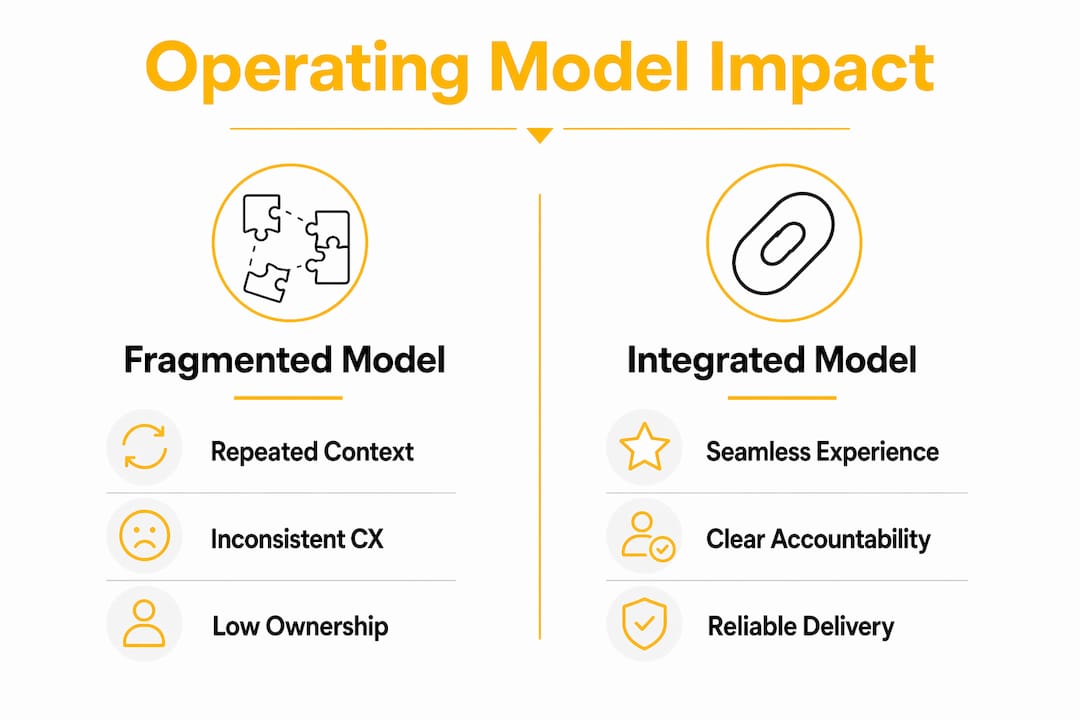
Consider a common scenario: a customer calls support after a failed online order. The support agent cannot see the fulfillment system. The fulfillment team cannot update the customer record. The customer repeats their story three times and receives three different answers. That breakdown did not happen because the strategy was wrong. It happened because the operating model was fragmented.
Fixing this requires deliberate redesign across four areas:
- Unified data access: Implement a shared CRM or customer data platform that gives every customer-facing team the same view of the customer’s history and current status.
- Cross-functional workflows: Map the handoffs between sales, service, fulfillment, and policy teams, then assign ownership at each transition point.
- Clear escalation paths: Define exactly when and how an issue moves from one team to another, with time limits and accountability checkpoints.
- Shared documentation standards: Create a single source of truth for policies, procedures, and customer commitments so frontline teams give consistent answers.
The contrast between fragmented and integrated operating models is significant:
| Operating model type | Customer impact | Organizational impact |
|---|---|---|
| Fragmented | Repeated context, inconsistent answers, low trust | Rework, blame cycles, high handle time |
| Integrated | Continuous context, consistent resolution, high trust | Efficiency, accountability, lower cost to serve |
Operating model redesign, not just new technology, is what closes the execution gap. Technology without redesigned workflows simply automates the existing dysfunction.
How governance and measurement sustain disciplined CX execution
CX governance structures transform metrics from passive data into decision-triggering insights. Customer Science draws a clear distinction between organizations that generate dashboards and organizations that use measurement to hold leaders accountable and trigger corrective action. The difference in CX outcomes between these two types is substantial.
Effective governance for CX execution includes three components:
- Decision rights with accountability: RACI models that assign not just responsibility but genuine authority. The person accountable for a CX outcome must have the power to change the inputs that drive it.
- Balanced measurement packs: Metrics that combine customer satisfaction scores, operational efficiency indicators, and control measures such as policy compliance and escalation rates. No single metric tells the full story.
- Cycle time standards: Defined maximum time from insight to approved initiative. When the gap between identifying a CX problem and funding a fix is measured in months, execution discipline breaks down.
Linking CX metrics to decision rights is the mechanism that changes outcomes at scale. Without this linkage, measurement is a reporting exercise rather than a management tool.
Pro Tip: Embedding CX checkpoints as formal funding gates in project approval processes, as recommended by the Agile Brand Guide, reduces late-stage redesign costs and enforces operational discipline from the start of every initiative rather than as an afterthought.

What is decision-driven CX orchestration?
Decision-driven CX orchestration is a framework that separates decisioning from delivery to maintain consistency across channels while adapting to live customer signals. CX Today outlines this as a five-step continuous loop that replaces static journey maps with a dynamic, real-time operating capability.
The five steps of the decision loop are:
- Observe: Capture real-time signals from customer interactions, system events, and behavioral data.
- Interpret: Analyze those signals against customer context, history, and defined business rules.
- Decide: Apply decision logic to determine the next best action for the customer and the organization.
- Coordinate: Trigger the appropriate response across the relevant channels and teams simultaneously.
- Learn: Feed outcomes back into the decision engine to improve future interpretations and decisions.
This framework prevents the inconsistent messaging that occurs when channel teams make independent decisions about the same customer. A customer who contacts you via chat, then calls support an hour later, should receive a coordinated response, not two separate conversations with no shared context.
| Framework element | Without orchestration | With orchestration |
|---|---|---|
| Channel coordination | Independent, siloed responses | Synchronized, context-aware responses |
| Decision speed | Reactive, manual escalation | Real-time, rule-driven action |
| Customer context | Reassembled at each touchpoint | Continuous and shared |
| Execution consistency | Variable by agent or channel | Standardized by decision logic |
Agentic customers increasingly value execution reliability over experience narrative. Eglobalis notes that machine-readable commitments, aligned APIs, and consistent policies are what build trust with both human customers and AI-driven agents interacting on their behalf. The implication is clear: execution quality is now a technical and organizational requirement, not just a service aspiration.
Practical strategies for embedding disciplined execution in CX
The most effective approach to operationalizing CX discipline combines structural authority, regular decision cadences, and formal governance checkpoints. These are not abstract principles. They are specific management practices that leaders can implement in the next quarter.
- Assign ownership at organizational seams. CX breakdowns occur most often at the transitions between sales and service, service and fulfillment, and policy and frontline teams. CMSWire advises that CX leaders must co-own these transitions with genuine decision-sharing authority, not just coordination responsibility.
- Position CX leadership close to strategic decisions. CX leaders who lack executive access cannot influence the upstream decisions that shape customer outcomes. Proximity to budget, product, and operations decisions is a structural requirement for execution authority.
- Establish regular decision cadences. Weekly or biweekly reviews that connect CX data to operational decisions prevent the accumulation of unresolved issues. These are not status meetings. They are decision meetings with defined outputs and owners.
- Set minimum evidence standards for CX initiatives. Require that proposed changes to customer-facing processes include data on current performance, projected impact, and measurement criteria. This prevents low-quality initiatives from consuming execution capacity.
- Use technology to make execution visible. Shared dashboards, real-time alerts, and automated escalation triggers give leaders the visibility needed to manage execution proactively rather than reactively.
Pro Tip: Review your CX measurement framework annually to confirm that every metric connects to a specific decision right and a named accountable leader. Metrics without owners are observations, not management tools.
Key takeaways
Disciplined execution in CX requires governance, clear decision rights, and integrated operating models working together to convert strategy into consistent, trust-building customer outcomes.
| Point | Details |
|---|---|
| Execution gaps cause CX failure | Most CX failures trace to operational breakdowns, not flawed strategy or insufficient technology. |
| Operating model integration is non-negotiable | Unified data access and cross-functional workflows eliminate the friction customers experience at handoffs. |
| Governance triggers action, not just reports | Decision rights linked to CX metrics are what convert measurement into improved outcomes. |
| Decision-driven orchestration enables real-time CX | The five-step observe-interpret-decide-coordinate-learn loop maintains consistency across all channels. |
| Ownership at seams determines execution quality | CX leaders must hold authority at organizational transitions, not just advisory influence. |
Why execution discipline is the real CX differentiator
I have spent years working alongside organizations that had genuinely strong CX strategies. Detailed journey maps, well-researched personas, executive sponsorship. And yet their customer satisfaction scores told a different story. The gap was never the strategy. It was always the execution.
What I have found consistently is that organizations treat execution as the natural consequence of having a good strategy. It is not. Execution is its own discipline, and it requires its own infrastructure. Governance structures, decision rights, escalation paths, and measurement frameworks are not administrative overhead. They are the operating system that makes CX strategy real.
The uncomfortable truth is that most organizations underinvest in execution infrastructure because it is less visible than strategy work. A new journey map is tangible. A revised RACI model is not. But the RACI model is what determines whether the journey map ever reaches the customer.
Leadership culture matters here as much as process design. Teams that see their leaders making decisions based on CX data, holding themselves accountable to customer outcomes, and treating cross-functional coordination as a priority will replicate that behavior. Teams that see CX treated as a project rather than a daily management discipline will treat it the same way.
My recommendation to any business leader reading this: stop asking whether your CX strategy is good enough, and start asking whether your execution infrastructure can deliver it. That is where the real work is.
— Daniela
How Altiamcx helps you execute CX with discipline

Altiamcx is built for organizations that are serious about turning CX strategy into consistent, measurable service delivery. As a nearshore CX and operational services partner, Altiamcx combines cultural alignment, governance frameworks, and performance measurement to close the gap between strategy and frontline execution. The results are concrete: one software platform improved productivity by 89% after migrating tech support to Altiamcx, driven by disciplined execution and structured operational oversight. If your organization is ready to move from CX aspiration to CX performance, explore how Altiamcx can help you build the CX operations that make it happen.
FAQ
What is the role of disciplined execution in CX?
Disciplined execution in CX is the practice of converting customer experience strategy into consistent, reliable service delivery through governance, defined decision rights, and coordinated operational workflows. Without it, even well-designed CX strategies produce inconsistent outcomes and erode customer trust.
Why do CX strategies fail without strong execution?
CX strategy failures are primarily execution gaps, not strategy gaps. Fragmented operating models, unclear ownership, and disconnected teams prevent strategy from reaching the customer in a consistent, reliable form.
How does operating model fragmentation affect customer experience?
Fragmented data systems and siloed teams force customers to repeat context at every touchpoint, producing inconsistent answers and low trust. Operating model redesign with unified data access and cross-functional workflows is the structural fix.
What is decision-driven CX orchestration?
Decision-driven CX orchestration is a five-step framework that observes customer signals, interprets context, decides on the next best action, coordinates the response across channels, and learns from outcomes to improve future decisions. It maintains consistency across all customer touchpoints in real time.
How do you measure execution effectiveness in CX?
Effective measurement combines customer satisfaction scores, operational efficiency metrics, and control indicators such as escalation rates and policy compliance. Linking these metrics to named decision rights and accountable leaders is what converts measurement into improved CX outcomes.