
TL;DR:
- A healthcare contact center manages patient interactions across multiple channels with a focus on outcomes and EHR integration. It must comply with HIPAA, staff licensed clinicians for clinical triage, and ensure seamless workflow integration to prevent care gaps. Altiamcx offers nearshore, bilingual, outcome-driven contact center solutions tailored for health systems and healthcare providers.
A healthcare contact center is a centralized, outcome-oriented engagement hub that manages patient and member interactions across phone, chat, SMS, and EHR-integrated workflows, staffed by trained agents following clinical and administrative protocols. For operations and CX leaders, the distinction from a generic call center matters immediately: a well-run healthcare contact center directly reduces no-shows, contains unnecessary ED visits, and drives measurable first-contact resolution against documented SLAs.
Three non-negotiables define the category:
- HIPAA compliance and a signed Business Associate Agreement (BAA) with every vendor
- EHR integration or tight API-level data exchange that keeps patient records accurate and actionable
- Outcome orientation, meaning agents close loops rather than just log calls
Becker’s Hospital Review frames this shift clearly: the contact center as front door to care is where fragmented channels create measurable gaps in patient access and activation.
Table of Contents
- What does a healthcare contact center actually do?
- How integration with clinical operations prevents fragmented care
- Compliance and governance requirements you should demand from vendors
- Which KPIs actually measure outcomes, not just call volume
- Why U.S. health systems choose nearshore outsourcing for contact center work
- How to choose a healthcare contact center partner
- How Altiamcx operates as a nearshore healthcare contact center partner
- Key Takeaways
- A practitioner’s note on what actually goes wrong
- Altiamcx is ready when you are
- Authoritative sources and further reading
What does a healthcare contact center actually do?
Healthcare contact centers split into two service models, and choosing the wrong one is a common procurement mistake.
Administrative-only model handles scheduling, insurance verification, billing inquiries, and message routing. Agents follow scripted workflows and do not require clinical licensure. This model fits high-volume appointment overflow, outbound reminder campaigns, and after-hours message dispatch.
Integrated clinical model adds licensed nurses for triage, care coordination, and after-hours clinical answering. Agents escalate to clinicians based on documented protocols, and every interaction feeds back into the patient record.
Core service lines across both models:
- Appointment scheduling and confirmation
- Insurance verification and eligibility checks
- IVR and omnichannel intake (phone, chat, SMS, web)
- Nurse triage and symptom assessment
- Care navigation and post-discharge follow-up
- Outbound reminders and no-show recovery
- Billing inquiry routing
Use case 1: A hospital system uses an integrated clinical model after hours. A patient calls with chest tightness; the licensed nurse triages, rules out emergency criteria, and books a same-day cardiology slot directly in the EMR.
Use case 2: A multispecialty clinic routes appointment overflow to an administrative team during peak hours, cutting hold times without adding headcount.
Pro Tip: Require licensed clinical staff only for calls that involve symptom assessment, medication questions, or clinical decision-making. Scripted administrative agents handle scheduling and billing at lower cost and with faster ramp time. Mixing the two without clear routing logic wastes both budget and clinical capacity.
How integration with clinical operations prevents fragmented care
True integration requires EMR or EHR access, or a tight, auditable API-level data exchange. Without it, agents work from stale information, duplicate records multiply, and care gaps widen.
A practical integration checklist:
- EHR scheduling write-back (agents book directly into the live schedule)
- Documented escalation protocols with defined clinical thresholds
- Audit trails for every patient interaction
- Secure messaging between agents and clinical staff
- Single source of truth for active care plans and follow-up tasks
- Role-based access controls limiting PHI exposure to relevant staff
Here is what a well-integrated workflow looks like in practice: a patient calls about worsening shortness of breath. The agent captures symptoms, routes to a licensed nurse via the escalation protocol, the nurse triages and books a pulmonology appointment with a write-back to the EHR, and a care navigator receives an automated follow-up task for a 48-hour check-in call. One interaction, three completed milestones, zero dropped handoffs.
Healthcare contact center software that centralizes patient data, automates workflows, and integrates with EHRs makes this possible at scale. Features like unified agent workspaces, intelligent routing, and real-time analytics are table stakes for any serious vendor.

Compliance and governance requirements you should demand from vendors
HIPAA compliance and clinical licensing are non-negotiable starting points, not differentiators. Every vendor you evaluate should clear these before any capability discussion begins.
Required compliance items:
- Signed HIPAA Business Associate Agreement (BAA)
- Data encryption at rest and in transit
- Role-based access controls and background checks for all clinical staff
- Documented QA and audit mechanisms with retrievable interaction logs
- Licensed nurses staffing all clinical triage lines, following documented clinical protocols
A vendor without a signed BAA cannot legally handle protected health information on your behalf. No BAA means no contract, regardless of price or capability claims. Treat it as a hard gate, not a negotiating point.
Trust signals to verify during procurement:
- Published SLA metrics with penalty clauses
- Security certifications (SOC 2 Type II is a strong baseline)
- Documented clinical governance framework
- Sample escalation scripts and QA scorecards available on request
Red flags that should stop the process:
- No BAA or reluctance to sign one
- No licensed nurses for triage lines
- Limited or non-retrievable audit logs
- No documented integration with any major EHR
- Inability to provide references from comparable health systems
For a detailed compliance contracting walkthrough, the HIPAA compliant outsourcing guide covers the key contractual and operational requirements healthcare administrators should verify.
Which KPIs actually measure outcomes, not just call volume
Volume metrics alone tell you how busy your contact center is, not whether it is helping patients. Operations leaders should track outcome and activation metrics alongside traditional efficiency figures.
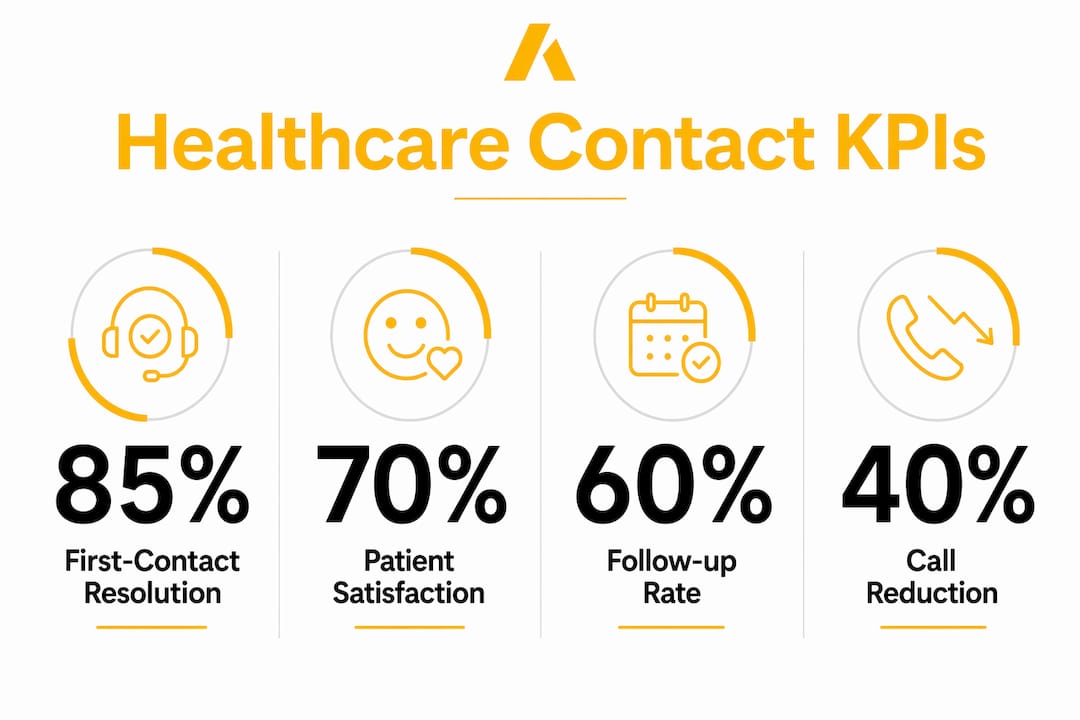
| Metric | Definition | Why It Matters |
|---|---|---|
| First-Contact Resolution (FCR) | Patient need resolved without a callback | Reduces recontacts and patient frustration |
| Appointment confirmation rate | Scheduled appointments confirmed before visit | Direct proxy for no-show reduction |
| Patient activation rate | Inbound calls converted to completed next steps | Measures care access and leakage prevention |
| Escalation containment rate | Clinical escalations resolved without ED referral | Tracks appropriate ED diversion |
| Average time-to-resolution | Time from first contact to closed care milestone | Identifies workflow bottlenecks |
| No-show rate change | Week-over-week shift in missed appointments | Quantifies outbound reminder program impact |
A patient activation approach converts inbound interactions into completed, in-network actions: scheduling directly into the EMR, resolving insurance barriers, and closing the loop with follow-up. That is the metric set that rolls up to executive reporting and justifies the contact center’s operational budget.
For practical strategies that connect these KPIs to patient satisfaction outcomes, the healthcare customer care guide offers a useful framework.
Why U.S. health systems choose nearshore outsourcing for contact center work
Nearshore outsourcing is chosen to scale bilingual staffing, reduce cost, and maintain overlapping time zones for live clinical coordination. For U.S. health systems serving Spanish-speaking populations, bilingual agent availability is often the deciding factor.
Key considerations when evaluating outsourced models:
- Seat-based pricing offers predictable costs but creates excess capacity during low-volume periods
- Consumption or outcomes-based pricing aligns operational expenses with actual patient demand, avoiding the inefficiency of idle seats
- Staffing flexibility lets health systems scale up for open enrollment or seasonal volume without permanent headcount commitments
- Bilingual and multilingual support addresses patient access gaps that monolingual in-house teams cannot cover cost-effectively
Common concerns about nearshore outsourcing include data privacy across borders, clinical licensing, and care continuity. These are addressable: HIPAA BAAs apply regardless of agent geography, clinical triage lines must be staffed by U.S.-licensed nurses (or licensed in the relevant jurisdiction), and documented escalation protocols maintain continuity when agents hand off to on-site clinical staff.
Pro Tip: Ask any nearshore candidate for documented health-system experience specifically. Generic BPO providers can handle volume; healthcare contact center work requires agents trained in clinical urgency, HIPAA handling, and EHR-adjacent workflows. The difference shows up in quality scores within the first 30 days of a pilot.
For a broader view of how outsourcing models map to healthcare operations, the types of healthcare outsourcing overview is a useful reference.
How to choose a healthcare contact center partner
Work through this sequence before signing anything: assess your needs → shortlist by capability → validate integration and governance → run a pilot → phase the rollout.
Must-validate checklist:
- Clinical credentials and licensing documentation for triage staff
- EHR integration examples with named systems (Epic, Cerner, Athenahealth)
- Sample SOPs and escalation scripts
- SLAs with defined KPI thresholds and penalty clauses
- Signed BAA and security certifications
- References from comparable health systems
- Pilot scope, success criteria, and exit terms
- Staffing model clarity (nearshore seats vs. fully managed service)
Questions to ask in procurement calls:
- Can you walk us through a live escalation workflow from symptom call to booked appointment?
- What QA scorecards do your clinical supervisors use, and can we see a sample?
- How do you handle EHR write-back failures or scheduling conflicts in real time?
Pricing model comparison: Seat-based contracts suit predictable, high-volume programs. Consumption-based pricing fits variable demand. Outcomes-based models align vendor incentives with your patient activation goals and are worth negotiating for integrated clinical programs.
A realistic implementation timeline runs: discovery and SOP alignment (weeks 1–3), EHR integration and agent training (weeks 4–8), pilot launch with defined success metrics (weeks 9–12), phased full rollout (months 4–6).
Standardizing your escalation workflow design before vendor selection pays dividends. A structured lead response management process provides a useful model for thinking through call-to-action and escalation logic before you write your RFP.
How Altiamcx operates as a nearshore healthcare contact center partner
Altiamcx provides nearshore CX and managed team-extension solutions built for health systems and healthcare-adjacent organizations. The service model combines bilingual agents, EHR-adjacent integrations, and documented clinical governance with the operational discipline that procurement and compliance teams require.
What Altiamcx delivers:
- Bilingual agent teams with healthcare-specific training and HIPAA compliance protocols
- BAA-ready contracting and documented security controls
- Measurable performance frameworks with SLA-backed KPIs
- Pilot-first onboarding that validates fit before full deployment
- Cultural alignment and overlapping time zones for real-time clinical coordination
- Scalable seat deployment for volume spikes without long-term headcount commitments
The nearshore team extension case study and the orthodontic services provider outcome illustrate the measurable CX improvements Altiamcx has delivered in healthcare and healthcare-adjacent settings. For a full picture of the healthcare CX operations model, the CX and operational support for health systems page covers service scope and engagement options.
Key Takeaways
A healthcare contact center drives patient outcomes when it combines EHR integration, licensed clinical governance, HIPAA-compliant operations, and outcome-oriented KPIs rather than volume metrics alone.
| Point | Details |
|---|---|
| Definition | A healthcare contact center manages patient interactions across channels with EHR integration and outcome-oriented workflows. |
| Model choice | Administrative-only models handle scheduling and billing; integrated clinical models add licensed nurse triage and care coordination. |
| Integration requirement | EHR write-back, audit trails, and escalation protocols are required to prevent fragmented care. |
| Compliance must-haves | A signed BAA, licensed triage staff, SOC 2 security controls, and retrievable audit logs are non-negotiable. |
| Altiamcx | Altiamcx delivers nearshore healthcare CX with bilingual agents, BAA-ready contracting, and pilot-first onboarding for health systems. |
A practitioner’s note on what actually goes wrong
The most common mistake operations leaders make is treating a healthcare contact center engagement as a staffing purchase rather than a workflow integration. Volume fills up fast. What takes longer to fix is the gap between an agent logging a call and a patient actually completing a care step. The centers that perform well are the ones where agents function as navigators: they own the outcome, not just the interaction. That requires documented escalation paths, EHR access, and QA that measures next-step completion, not just handle time. If a vendor cannot show you a QA scorecard that tracks patient activation alongside call efficiency, that is the real red flag, not their price.
Altiamcx is ready when you are
If you are evaluating nearshore partners for healthcare contact center work, Altiamcx offers a pilot-first engagement model that lets you validate performance against your own SLAs before committing to full deployment. The process starts with a scoping conversation, not a long procurement cycle.

Request a pilot scope or sample SOPs directly through the Altiamcx healthcare CX page. If you want to see measurable outcomes first, the nearshore team extension case study is a practical starting point.
Authoritative sources and further reading
- The end of the traditional contact center in healthcare — Becker’s Hospital Review — Strategic framing for outcomes-based contact center models; essential reading for ops leaders making the case internally.
- Healthcare Call Center Functions | TriageLogic — Detailed breakdown of administrative vs. clinical service lines and nurse triage governance requirements.
- Healthcare Contact Center Solutions | Talkdesk — Technical overview of EHR integration, unified agent workspaces, and analytics capabilities.
- Medical Contact Center | Sequence Health — Patient activation model and closed-loop scheduling approach for procurement reference.
- Call4Health | Medical Answering, Nurse Triage & Patient Access — Service line examples and governance requirements for after-hours clinical answering.
- HIPAA Compliant Outsourcing Guide | Altiamcx — Contracting and compliance checklist for healthcare administrators evaluating outsourced partners.
- Patient Support Outsourcing Services Comparison | Altiamcx — Comparative analysis of outsourcing service models for procurement teams.
- CX & Operational Support for Health Systems | Altiamcx — Altiamcx service scope, engagement model, and healthcare CX capabilities overview.