
A KYC operations workflow is the repeatable sequence a financial institution runs to collect customer information, verify identity, screen and score risk, decide, and keep records for as long as the relationship lasts. In the United States, the backbone is the Customer Identification Program (CIP) plus Customer Due Diligence (CDD). A workflow that works pairs automated checks with clearly owned manual review, exception handling and an audit trail that matches written policy.
This guide walks through each stage, shows how to route cases, lists the metrics worth tracking, and explains where staffing and operating model decisions make or break the process.
TL;DR
- A defensible KYC workflow has six working parts: intake, identity verification, screening, risk scoring and decision, exception handling, and ongoing monitoring with records.
- For U.S. banks, the CIP rule sets the minimum data and requires risk-based verification, written procedures and customer notice.
- Automation should clear the routine cases so trained reviewers can spend time on exceptions, escalations and customer follow-up.
- Written policy is not enough. Examiners look for practices that match it, with documented rationale on every decision.
- Staffing the review queue and customer follow-up is an operations decision. A managed nearshore team can absorb that volume while compliance keeps control of the decisions.
Table of Contents
- What a KYC operations workflow covers
- The six stages, in order
- Routing cases: auto-approve, review, reject
- Automate the routine, protect the judgment
- Metrics that show whether the workflow is working
- Where KYC workflows break down
- Our perspective: treat KYC as a service workflow with a compliance spine
- Staffing the workflow with a managed team
- How to start improving your workflow this quarter
- FAQ
- Sources
What a KYC operations workflow covers
Think of KYC as two layers. The first is the policy layer: what your institution has committed to in its written program. The second is the operations layer: the queues, handoffs, scripts, systems and people that carry out that policy thousands of times a month.
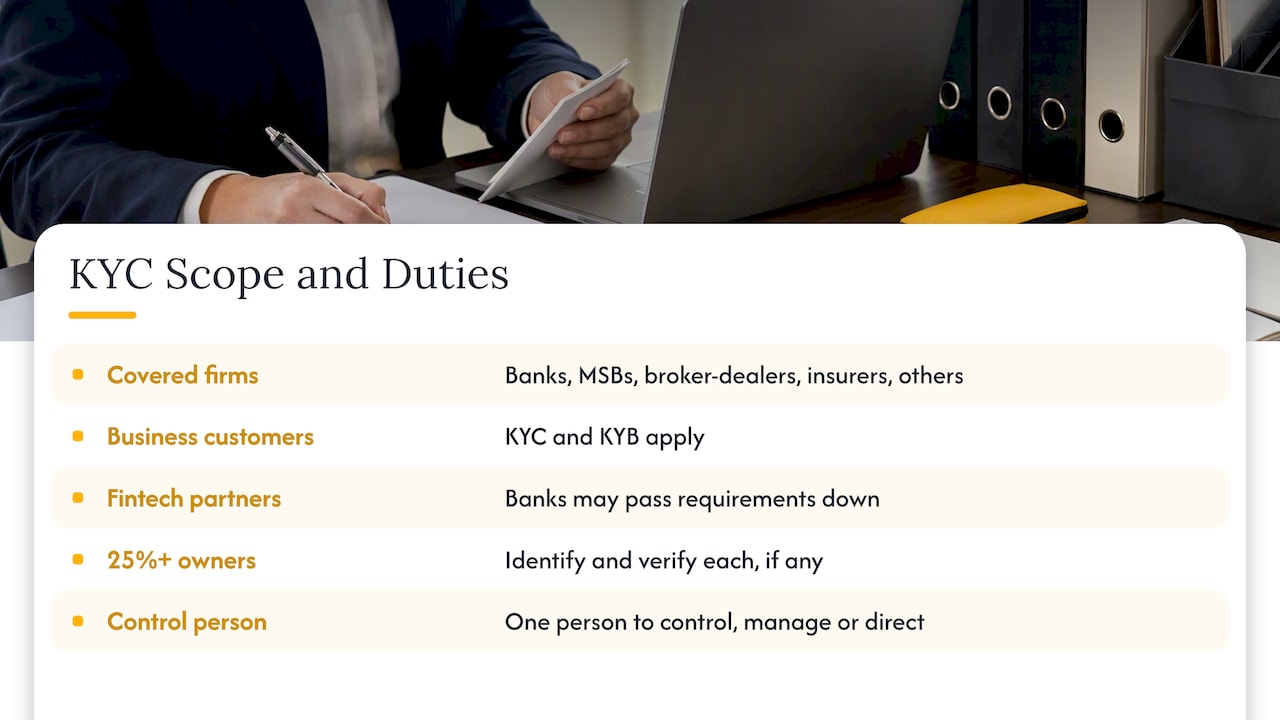
The rules apply broadly. Banks, money services businesses, securities broker-dealers, insurance companies and others must perform KYC and, for businesses, KYB on their customers, and banks may pass requirements down to fintech partners, according to Lithic’s operations guide. A bank required to have an anti-money laundering compliance program must implement a written CIP as part of that program.
For legal entity customers, the CDD Rule adds a beneficial ownership step. Institutions must identify and verify each individual who owns 25% or more of the entity, if any, and one individual with significant responsibility to control, manage or direct it, per FinCEN’s CDD FAQs. FinCEN’s intent is that entities identify the real, ultimate beneficial owners, not nominees or straw men. That one sentence has big operational consequences: your reviewers need a clear way to challenge an ownership chart that looks too tidy.
The six stages, in order
Most workflows follow the same arc. What separates a strong one is how clearly each stage defines inputs, owners, outputs and time limits. For a deeper practitioner view, see our six stages of KYC verification playbook.
Stage 1: Intake and information collection
Before a U.S. bank opens an account, the CIP requires it to obtain the customer’s name, an individual’s date of birth, an address and an identification number, subject to specified exceptions. The bank must also give notice describing its identification requirements before the account opens.
Operationally, that means:
- Ask for what the rule and your risk model require, and no more. Every extra field is a reason to abandon the application.
- Validate at the point of entry. Catch formatting errors, mismatched addresses and missing identifiers before a case ever reaches a person.
- Make the notice part of the flow, not an afterthought buried in terms.
Stage 2: Identity verification
The institution verifies identity using risk-based documentary methods, nondocumentary methods, or a combination. The choice depends on account type, how the account is opened, the information available, and the institution’s customer base and risk, as the CIP rule describes. The interagency guidance adds that banks must use risk-based procedures to verify identity to the extent reasonable and practicable.
In practice, design two or three verification paths rather than one. A low-risk individual opening a basic account through a mobile app needs a different path than a business applicant with layered ownership. Define in advance which results pass automatically, which trigger a retry, and which go to a reviewer.
Stage 3: Screening
Screening against sanctions, Politically Exposed Person (PEP) and adverse media lists is a core KYC component, and high-risk results are escalated to enhanced due diligence, according to GBG’s end-to-end guide. The FFIEC examination procedures also look for timely checking of new accounts against prescribed government lists, and for records of the identifying information, verification methods and results.
Two operational points matter most here. First, “timely” needs a number inside your own procedures. Second, name-match alerts are noisy, so reviewers need a documented standard for what counts as a true match and what rationale to record when they clear one.
Stage 4: Risk scoring and decision
Under the CDD Rule, institutions must develop risk-based procedures to understand the nature and purpose of customer relationships, build a risk profile and perform ongoing monitoring, as detailed in the FFIEC manual. The agencies also say a bank’s CIP should account for risks from account types, account-opening methods, available identifying information, and the bank’s size, location and customer base.
Turn that into a scorecard your team can apply consistently: customer type, product, geography, channel, ownership complexity, screening results. Then map score bands to three outcomes: approve, review, or reject or hold.
Stage 5: Exception handling and customer follow-up
This is where most workflows leak time. The cases that fail screening or arrive with bad data need a queue, an owner and a script. Operational teams can queue customers who fail screening, review them in dashboards, correct bad information, obtain missing information from customers, and mark them OK or reject them with a recorded reason.
If the bank cannot form a reasonable belief that it knows the customer’s true identity, its written CIP must say when not to open the account, the terms for account use while verification is attempted, when to close the account after failed attempts, and when to file a SAR. Those rules belong in reviewer playbooks, not only in the policy binder.
Stage 6: Records and ongoing monitoring
Centralize case data, verification results, decision rationales and reviewer notes in one audit trail, and set rescreening frequency by risk level with automatic triggers for changes, GBG recommends. Note what the regulator does and does not require: ongoing monitoring does not require continuous or periodic customer-information updates, but banks may set risk-based policies for periodic reviews. Your policy decides the cadence. Your operations must then keep to it.
Routing cases: auto-approve, review, reject
Routing is the heart of the workflow. Decision logic can send each case to auto-approval, manual review or rejection based on conditions you define. The design question is where to draw the lines.
| Route | Typical trigger | Owner | What gets recorded |
|---|---|---|---|
| Auto-approve | Clean verification, no screening hits, low-risk score | System | Inputs, checks run, score, timestamp |
| Standard manual review | Document quality issue, partial data match, minor screening alert | Frontline KYC reviewer | Findings, cure steps, decision rationale |
| Enhanced due diligence | High-risk score, PEP or adverse media, complex ownership | Senior analyst or compliance | Additional documents, source of funds notes, approver |
| Reject or hold | Failed verification after retries, confirmed sanctions match | Compliance | Reason code, customer communication, SAR assessment |
FFIEC examiners list red flags that justify manual review, including unexplained changes in business operation, account ownership changes and adverse results from media searches. Build those into your triggers so reviewers are not relying on memory.
One practical tip: the queue is a workflow in its own right. Assignments, due dates, checklists and audit logs matter as much as the verification vendor. Lightweight approval workflow tools for operations teams can help smaller teams route tasks and keep an audit log without enterprise software, though regulated decision systems should be validated against your own compliance requirements.
Automate the routine, protect the judgment
Automation is not the goal. Faster, consistent, explainable decisions are. Organizations can centralize case data, automate routine checks, and adapt onboarding flows to customer type, geography, risk score and verification results, which reduces friction and focuses review on complex cases, per GBG.
A few guardrails keep automation from weakening controls:
- Automate decisions you can explain. If a reviewer or examiner asks why a case passed, the system should show the inputs and the rule.
- Keep a human path for every automated rejection, so a legitimate customer with an unusual name or address is not lost.
- Test the rules regularly. Sample auto-approved cases and confirm they would have passed manual review.
- Watch the abandonment point. If applicants drop at a specific step, fix that step rather than loosening the control.
The FFIEC’s supervisory point is worth keeping on a sticky note: written policies alone are insufficient, and practices must correspond with them and align with the bank’s risk profile. A pass/fail identity check is not a defensible workflow by itself. The FFIEC procedures also expect documented procedures, list screening, recordkeeping, exception handling, customer notice, and oversight when third parties perform CIP tasks.
That last point matters if you outsource any step. Our guides on fraud operations outsourcing risks and board-level data security controls in BPO partnerships cover what oversight should look like.
Metrics that show whether the workflow is working
Regulators do not publish a single scorecard for KYC operations, so choose measures that map to the three questions every leader gets asked: Is it effective, efficient and compliant? A starting set:
Effectiveness
- Share of cases cleared automatically versus sent to review
- Reviewer decision overturn rate in quality sampling
- Share of cases re-opened after approval
Efficiency
- Time from application to decision, split by route
- Queue age: how many cases are older than your internal limit
- Touches per case, including customer follow-up contacts
- Application abandonment by step
Compliance
- Percentage of files with complete required data elements and recorded rationale
- Screening completed within your defined timeframe
- Periodic review completion against the schedule your policy sets
- Audit and exam findings, with time to remediation
Set targets from your own baseline and risk appetite instead of borrowing a benchmark from a vendor page. Review them by route and by customer segment, because an average hides the queue that is quietly failing.
EY’s guidance on KYC refresh also flags that programs should address data-quality consistency across business lines and assess data lineage and related controls. If two systems hold two different addresses for one customer, no metric will look healthy for long.
Where KYC workflows break down
Most failures come from operations, not from the rule text:
- Undefined ownership. CDD policies should define who has responsibility and authority to review and approve risk-profile changes and the standards for resolving insufficient or inaccurate information, per the FFIEC. If nobody owns the stuck case, it sits.
- Follow-up that depends on email goodwill. Customers who are asked for documents three different ways, by three different people, stop answering.
- Thin rationale. “Cleared” is not a rationale. Reviewers need a short, structured note.
- Seasonal volume with a fixed team. A launch, a promotion or a month-end spike can bury a queue within days.
- Training that stops after onboarding. Procedures change, and reviewers need quick refreshers tied to the changes.
The customer-facing side of these failures is as much a service problem as a compliance one. Our piece on what financial services CX compliance really means and our support workflow efficiency guide explain how the two disciplines meet.
Our perspective: treat KYC as a service workflow with a compliance spine
We see KYC through the lens of customer operations. The decision rules belong to your compliance team, and they should. But the work around those rules, such as answering applicants, chasing missing documents, scheduling follow-ups, documenting what happened and keeping queues moving, is a service operation. It succeeds or fails on consistency, training and clear handoffs.
That is why we push clients toward three habits. Write procedures so a trained reviewer can follow them without escalating every ambiguity. Measure queue age and follow-up quality as seriously as approval counts. And staff the exception queue as a standing function, not a stopgap. Mid-sized teams often hit a ceiling where hiring and training new reviewers in one location cannot keep up with demand. A nearshore, bilingual team working in U.S. time zones with your SOPs, your systems and your quality framework can extend capacity while your compliance leaders keep decision authority.
One caution we repeat to every financial services client: outsourcing does not outsource accountability. Define the scope of what the partner handles, test it, and keep oversight documented.
— Daniela
Staffing the workflow with a managed team
If your bottleneck is the human part of the process, such as exception queues, applicant follow-up and back-office documentation, Altiam CX provides nearshore customer experience, back-office operations and managed team extension, with bilingual agents and scalable team deployment. We run those teams against measurable performance frameworks so your leaders can see queue health, not just headcount. Explore our managed team extension and customer experience services to see how an engagement is structured.

For regulated environments, pair that capacity with a clear compliance monitoring routine. Our call center compliance monitoring playbook is a practical place to start, and the role of CX in financial services shows how onboarding experience affects retention.
How to start improving your workflow this quarter
- Map the current state. Trace ten real cases from application to decision and note every handoff and wait.
- Compare practice to policy. Where reviewers do something the written procedure does not say, fix the document or the habit.
- Define routes and triggers in a single table like the one above, with an owner for each.
- Pick five metrics, at least one each for effectiveness, efficiency and compliance, and baseline them.
- Fix the biggest queue first, usually exception follow-up, before buying new tooling.
- Schedule quality sampling of both automated and manual decisions.
FAQ
What is the difference between KYC and CIP?
KYC is the broad practice of knowing your customer. CIP is the specific U.S. regulatory program for banks requiring written procedures to collect and verify identifying information at account opening. CDD builds on it with risk profiling, beneficial ownership and ongoing monitoring.
Do U.S. banks have to refresh customer information on a fixed schedule?
Not by rule. The FFIEC states that ongoing monitoring does not require continuous or periodic customer-information updates, though banks may adopt risk-based policies for periodic reviews. Whatever cadence your policy sets, your operations must follow it and document it.
When should a case go to manual review?
Send a case to review when verification is partial, a screening alert needs judgment, or red flags appear, such as ownership changes, unexplained changes in business operation or adverse media results. High-risk cases should move on to enhanced due diligence with senior sign-off.
Can parts of a KYC workflow be outsourced?
Yes, but oversight must be documented. The FFIEC procedures expect oversight when third parties perform CIP tasks. Many institutions outsource applicant communication, follow-up and back-office handling while compliance retains decision authority.
What should a KYC audit trail include?
Record the identifying information collected, the documents and methods used to verify identity, the results, screening outcomes, the decision and rationale, and reviewer notes. Keep it in one place so an examiner can reconstruct any case.
Sources
- Fintech Guide to Building US KYC and KYB Operations, Lithic
- Section 1020.220, Customer Identification Program requirements for banks, Federal Reserve
- FAQs for CDD Final Rule, FinCEN
- Interagency Interpretive Guidance on Customer Identification, FinCEN
- FFIEC BSA/AML: Assessing Compliance with BSA Regulatory Requirements, Customer Due Diligence
- FFIEC BSA/AML: Customer Identification Program examination procedures
- FFIEC BSA/AML: Assessing the BSA/AML Compliance Program
- A complete guide to implementing an end to end KYC process, GBG
- Customer Onboarding and KYC Flows, Unmeshed
- Reassessing know your customer refresh, EY
- Approval workflows for operations teams, CentriOps