
Vendor compromise is enterprise compromise, and treating your BPO partner’s security as someone else’s problem is the single most expensive mistake in outsourcing. Leaders need four things now: verified vendor assurance (SOC 2 or ISO 27001 in scope), least-privilege access enforced at every seat, encryption with clearly assigned key ownership, and a tested incident-response playbook with real notification deadlines. This article gives you the checklists, contract language, and testing steps to put behind each one.
TL;DR:
- Ensure vendor contracts include real-time incident notification clauses, recent scope-specific SOC 2 or ISO 27001 attestations, and clear subcontractor disclosure to reduce blind spots.
- Implement strict identity and access controls, including role-based privileges, multi-factor authentication, and documented encryption key management for all vendor data interactions.
- Conduct quarterly tabletop exercises covering credential compromises, insider threats, and supply chain issues, with predefined roles and chain-of-custody procedures for effective breach response.
- Enforce physical security measures like badge access logs, clean-desk policies, and restricted visitor protocols to protect data and prevent unauthorized physical access.
- Use encrypted transfer channels, such as secure APIs with logging and mutual authentication, to prevent data breaches during transit between your organization and the outsourced provider.
Table of Contents
- Core Technical Controls Every BPO Engagement Must Enforce
- Vendor Due Diligence, Contracts, and Ongoing Assurance
- Compliance Frameworks and Certifications That Matter for BPOs
- Incident Response, Detection, and Tabletop Testing for Multi-Party Breaches
- Operationalizing Zero-Trust and Monitoring Across an Outsourced Environment
- People, Processes, and Insider-Risk Controls in BPOs
- Altiam CX Perspective: Operationalizing Governance With Measurable Outcomes
- Data Classification and Handling Policies Specific to BPO Environments
- Physical Security Controls at BPO Facilities
- Client Data Privacy and Consent Management in BPO
- Secure Data Transfer Methods Between Clients and BPO Providers
- The Compliance-First Playbook Business Leaders Actually Need
- Sources
Core Technical Controls Every BPO Engagement Must Enforce
Technical controls fail in outsourced environments not because the tools are weak, but because responsibility for them gets fuzzy the moment two organizations share infrastructure. Before any agent touches customer data, you need documented answers to who owns what.
Start with identity. Role-based access control should map to specific job functions, not broad departments, and privileged accounts need separate credentials with mandatory multi-factor authentication. Survey-based research on remote BPO operations found that firms reporting higher exposure to phishing and unauthorized access consistently had weaker MFA, firewall, and VPN coverage than better-prepared peers. That correlation alone justifies making MFA non-negotiable in any statement of work.
Beyond identity, four control areas need explicit documentation during procurement:
- Encryption everywhere: data at rest and in transit, with a written key-management matrix specifying whether the client or the provider holds root keys.
- Network segmentation: client workloads isolated from other tenants, with micro-segmentation limiting how far an intrusion can spread.
- Endpoint control: company-managed devices, mobile device management, and locked-down remote access rather than personal hardware.
- Verification, not assertion: architecture diagrams and configuration evidence reviewed during onboarding, not just a vendor’s word.
A BPO due diligence checklist built around these four areas turns procurement from a trust exercise into an audit.
Vendor Due Diligence, Contracts, and Ongoing Assurance
Google’s own threat intelligence team has tracked campaigns where attackers used stolen vendor credentials and legitimate support tooling to move laterally into client environments, which is why vendor risk can no longer be a once-a-year questionnaire. Analysis of these incidents shows that contracts routinely lack real-time incident-notification service level agreements and clear visibility into subcontractors, leaving enterprises blind until damage is already done.
Before signing anything, work through this sequence:
- Demand scope-appropriate attestations. A SOC 2 Type II report, ISO 27001 certificate, and a recent penetration-test summary should all name the specific systems that will touch your data, not the vendor’s business generally.
- Write short notification windows into the contract. Short notification windows that enable real-time incident reporting are essential; longer delays invite regulatory exposure you cannot control.
- Require forensic access rights and subcontractor disclosure. You need the ability to investigate, and you need to know who else touches your data.
- Set indemnification terms and cyber insurance minimums. Match the minimum to your actual data sensitivity, not a boilerplate figure.
- Reject vague evidence. A vendor that offers marketing language instead of dated reports and named auditors is a red flag, not a formality to work around.
Treating the relationship as a partnership rather than a transaction, as outlined in Format-3’s take on partner selection, tends to produce more candid disclosure during these negotiations than an adversarial procurement process does.
Compliance Frameworks and Certifications That Matter for BPOs
Not every certification answers the same question, and confusing them leads leaders to accept assurance that doesn’t actually cover their risk. PCI DSS governs environments that process, store, or transmit payment card data, and it applies only when card data is genuinely in scope. ISO/IEC 27001 certifies an information security management system, which matters when a provider handles broad categories of sensitive data across many clients. HIPAA applies specifically to protected health information, and healthcare organizations outsourcing clinical processes should review a HIPAA-compliant outsourcing guide before assuming general certifications cover them.
A SOC 2 Type II report deserves particular scrutiny. It covers a defined period, a defined scope, and often lists exceptions. AICPA’s own SOC reporting guidance explains the trust service criteria behind it, but a certificate alone tells you nothing about what was excluded.
Before accepting any attestation, verify:
- The report’s coverage period is recent, not two years stale.
- The scope names the systems and locations your data will actually touch.
- Exceptions are disclosed and explained, not buried.
- An independent audit has occurred separately from the vendor’s self-reported controls.
Incident Response, Detection, and Tabletop Testing for Multi-Party Breaches
A joint incident-response playbook only works if both sides rehearsed it before an actual breach forces improvisation. Define roles explicitly: who declares an incident, who has evidence-preservation authority, and what triggers the notification clock you negotiated in the contract.
Run tabletop exercises against realistic scenarios, not generic ones:
- Vendor credential compromise leading to lateral movement into client systems.
- Insider exfiltration by an agent with legitimate access.
- Supply-chain compromise through a subcontractor or shared tool.
Exercises that include service-continuity goals, not just detection speed, tend to expose the real coordination gaps between client and provider teams, according to PITON-Global’s analysis of BPO breach response. Contracts should preserve forensic access rights and a documented chain of custody for evidence, so an investigation doesn’t stall on legal ambiguity while data continues leaking.
Pro Tip: Schedule tabletop exercises quarterly for the first year of a new engagement, then semiannually once both teams have proven they can execute the playbook under pressure.
Operationalizing Zero-Trust and Monitoring Across an Outsourced Environment
Zero-trust sounds abstract until you apply it to the specific problem of identities crossing organizational lines. The practical starting point is short-lived credentials: session tokens that expire quickly, conditional access policies that check device posture and location, and contextual MFA that steps up when something looks unusual.
Legacy systems rarely support full micro-segmentation on day one, which is why many outsourced environments lean on SASE as a bridging layer while true segmentation gets rolled out around the highest-risk data domains first.
On monitoring, the goal is shared visibility without shared exposure. SIEM and SOAR integration should ingest vendor telemetry relevant to your systems, while excluding data that has nothing to do with your risk. Prioritize the rollout by data sensitivity: payment flows and health records first, general operational data last. A payments workflow handled by an agent with standing administrative access is a bigger open door than most leaders realize, and it’s usually the first thing worth closing.
People, Processes, and Insider-Risk Controls in BPOs
Technology controls mean little if the person with legitimate access decides to misuse it, or gets tricked into handing it over. Industry reporting on the outsourcing sector has flagged weak identity verification in helpdesk and contact-center roles as a recurring point of failure, pushing for stronger authentication and dedicated anti-vishing controls.
Build these controls into daily operations:
- Screen new hires where lawful, and re-screen periodically for roles with elevated access.
- Grant just-in-time, time-limited credentials instead of standing permissions, with fast revocation on role change or exit.
- Run simulated phishing and vishing drills regularly, with clear escalation rules for anything that feels like social engineering.
- Maintain a confidential whistleblower channel and a disciplinary framework that both sides of the engagement respect equally.
Cultural alignment between client and nearshore teams isn’t a soft benefit here. It’s what makes an agent comfortable flagging a suspicious request instead of quietly complying with it.
Altiam CX Perspective: Operationalizing Governance With Measurable Outcomes
Governance only matters if you can see it working. Altiamcx builds measurable performance frameworks into every engagement so operations leaders get evidence, not assurances, that controls hold under real conditions.
When evaluating any nearshore partner, request these artifacts directly:
- Current architecture diagrams showing where your data lives and moves.
- Scoped SOC 2 or ISO 27001 attestations naming your specific systems.
- A documented incident-response playbook with named roles.
- A recent penetration-test summary with remediation status.
| What to request | Why it matters |
|---|---|
| Architecture diagram | Confirms where data actually flows, not where policy says it should |
| Scoped attestation | Verifies certification covers your systems, not just the provider’s brand |
| IR playbook | Proves roles and timelines exist before an incident forces the question |
| Pen-test summary | Shows vulnerabilities were found and fixed, not just tested |
Altiam CX’s case studies on nearshore team extension show how disciplined execution and cultural alignment translate into fewer escalations and faster resolution, which is what risk reduction actually looks like day to day.
Data Classification and Handling Policies Specific to BPO Environments
Data classification in a BPO context has to reflect where information physically and digitally travels, not just what it’s labeled internally. A tiered system works best: restricted (payment data, health records, government identifiers), confidential (customer PII, contracts), and internal (operational metrics, non-sensitive communications). Each tier needs its own handling rules covering storage location, retention period, and who can export it.
The mistake most organizations make is writing a classification policy for their own walls and assuming it transfers cleanly to a vendor’s systems. It doesn’t, unless the contract specifies exactly how each tier gets handled once it leaves your infrastructure.
Practical handling rules should specify:
- Which data tiers can be stored on vendor-owned systems versus client-controlled environments only.
- Retention limits tied to each classification, with automatic deletion enforced technically, not just documented as policy.
- Export restrictions: restricted-tier data should never leave through email, personal cloud storage, or unmanaged devices.
- Labeling requirements at the point of intake, so an agent handling a support ticket knows immediately what tier they’re working with.
Review these policies whenever the scope of work changes. A back-office process that started with low-sensitivity data can quietly expand into handling restricted-tier information as a client relationship grows, and the classification policy needs to catch that shift before an audit does.
Physical Security Controls at BPO Facilities
Digital controls collapse quickly if the physical environment around them is loose. Facility security for outsourced operations should include badge-based access control with logged entry and exit, dedicated secure zones for teams handling restricted data, and camera coverage on all entry points and workstation areas.
Clean-desk policies matter more in a BPO setting than almost anywhere else, because dozens of agents may rotate through the same workstations across shifts. Printed material containing customer data should be prohibited outright or shredded immediately after use, and personal devices, including phones, should stay outside secure work areas entirely.
Visitor management deserves its own protocol: any non-employee entering a facility where client data is processed should be logged, escorted, and restricted from areas handling restricted-tier information. Ask any prospective partner how they handle this specifically, not generically. “We have security” is not an answer, but “badge access logs retained for 90 days, escorted visitor policy, no personal devices on the production floor” is.
Power redundancy and environmental controls round this out. A facility without backup power or fire suppression around its server rooms introduces an availability risk that sits alongside the confidentiality risk everyone focuses on first.
Client Data Privacy and Consent Management in BPO
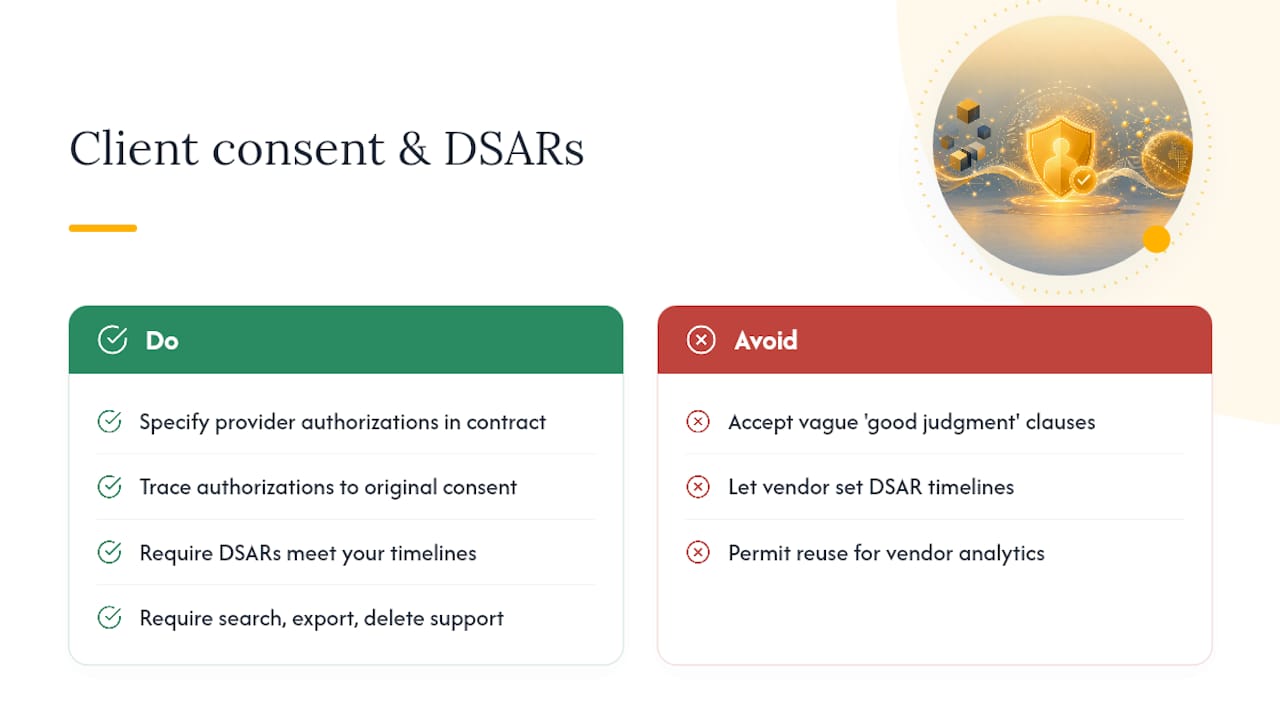
Consent management gets complicated the moment a third party enters the data chain, because the original consent a customer gave your organization may not explicitly cover a nearshore partner processing that same data. Contracts should specify exactly what a provider is authorized to do with client data, and that authorization needs to trace back to the consent your own customers originally gave.
Data subject rights add another layer. If a customer requests deletion or access to their data under a privacy framework, your BPO partner needs a documented process to fulfill that request within the same timeline you’re legally bound to, not on their own schedule. This means the provider’s systems need to support search, export, and deletion requests that touch your specific customer records, not just generic account management tools.
Purpose limitation matters just as much as consent itself. Data shared for customer support purposes shouldn’t be repurposed for the vendor’s own analytics or training data without separate authorization. Build this restriction into the contract explicitly, because “we’ll use good judgment” is not a clause a regulator will accept during an investigation.
Finally, map where consent obligations differ by customer geography. A vendor processing data for customers across multiple jurisdictions needs region-specific handling rules, and your contract should require the provider to flag which jurisdiction’s rules apply to which data before processing begins, not after a complaint arrives.
Secure Data Transfer Methods Between Clients and BPO Providers
Data in motion is where a surprising number of breaches actually start, often through methods that feel convenient rather than secure. Email attachments, unencrypted file transfer protocol, and shared consumer cloud drives should all be explicitly banned in any outsourcing contract, replaced by managed, encrypted transfer channels.
Secure file transfer protocol or managed API connections with mutual authentication give you an auditable trail of exactly what moved, when, and to whom. For ongoing operational data, a direct API integration with token-based authentication beats batch file transfers because it eliminates the window where a file sits exposed on an intermediate server.
For contact center environments specifically, virtual desktop infrastructure changes the security equation entirely. Rather than transferring data to an agent’s endpoint, a VDI setup for contact centers keeps customer data on client-controlled servers while the agent interacts with it through a controlled virtual session, meaning nothing sensitive ever lands on a local device that could be lost, stolen, or compromised.
Whatever transfer method you choose, require logging on every transaction: sender, recipient, timestamp, and file or record identifier. That log becomes essential evidence if a dispute or investigation ever asks “who had access to this data and when.”
The Compliance-First Playbook Business Leaders Actually Need
Most advice on outsourcing security still treats the vendor relationship as a procurement problem: get the certificate, sign the contract, move on. That’s backwards. The research on vendor-targeted campaigns makes clear that attackers see your BPO partner as the easiest door into your enterprise, precisely because it’s the door everyone stops watching after signing.
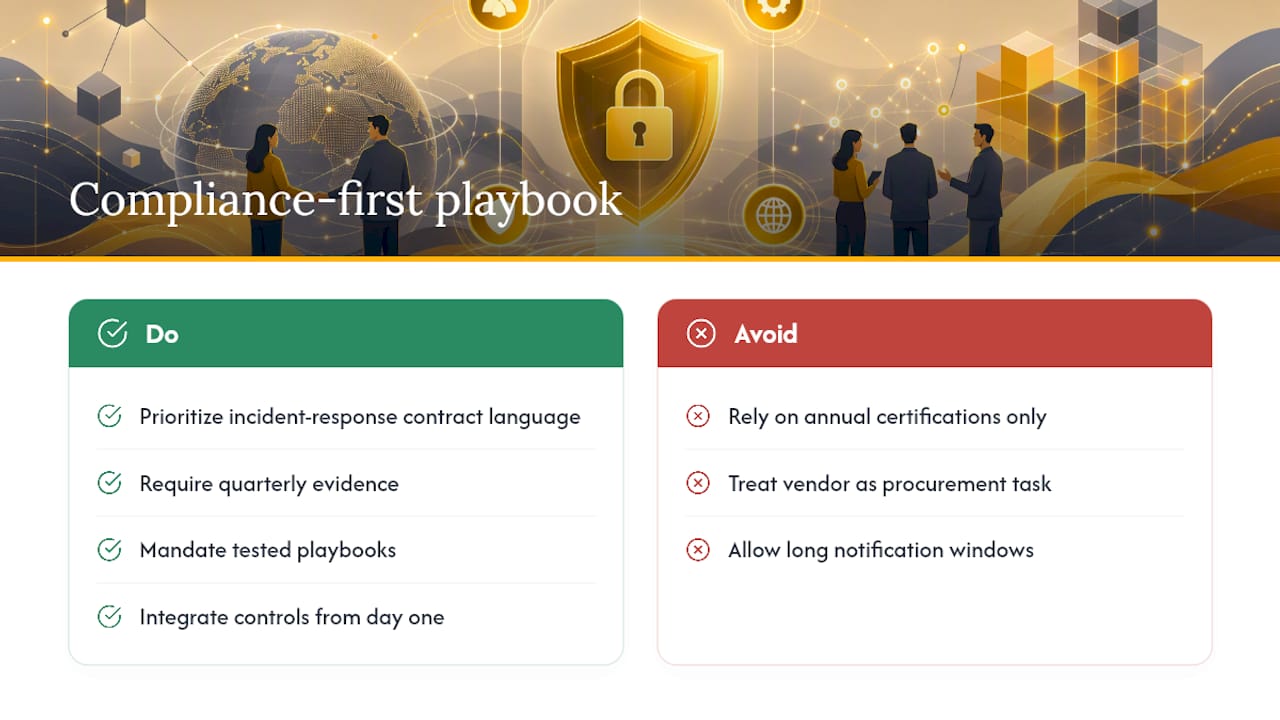
The conventional advice fails on cadence. Annual questionnaires and point-in-time certifications tell you almost nothing about the following eleven months. What actually reduces risk is continuous evidence: quarterly reporting, tested playbooks, and contract clauses that make notification delays expensive for the provider, not just inconvenient for you.
If you take one thing from this, prioritize the incident-response contract language first. Encryption and access controls matter enormously, but a breach happens eventually to almost everyone. What separates a contained incident from a headline crisis is whether your notification clock started at hour one or hour ninety.
— Daniela
These controls should be integrated into nearshore engagements from day one, paired with governance frameworks that operations leaders need to defend a vendor relationship to their own board. Case studies like the orthodontic services provider’s CX transformation and the software platform’s 89% productivity gain in tech support show what disciplined execution looks like when security and performance move together. If you’re evaluating a nearshore partner for customer experience, technical support, or back-office operations, visit Altiam CX to see how a compliance-first approach translates into measurable outcomes.
Sources
- Google warns of cyberattack targeting BPOs to steal corporate data — Outsource Accelerator (via CYBERSOL)
- PCI Security Standards Council
- ISO/IEC 27001 — Information security management