
A safe outsourcing transition plan is a phase-based roadmap that guarantees operational ownership, documented SOPs, an overlap period, explicit rollback triggers, and a 90-day validation window. Skip any one of those five elements and you are running an experiment, not a transition. Your first moves: open a risk register today, confirm your documentation baseline is real (not aspirational), and lock a parallel-run window before anyone touches production work.
TL;DR:
- Building in a parallel-run overlap of 30 to 90 days is essential to avoid service outages caused by rushed knowledge transfer.
- Lock and verify documentation, KPIs, role owners, and contractual milestones during pre-transition to prevent quality decline during cutover.
- Conduct staged knowledge transfer with acceptance gates at each phase, measuring readiness by KPIs and QA, not just calendar time.
- Have a detailed cutover day checklist including systems testing, staffed escalation contacts, and rollback procedures to reduce high-risk errors.
- Maintain a continuous improvement rhythm post-transition with regular KPI reviews, SOP updates, and staffing adjustments based on actual performance data.
Table of Contents
- What Are the Phases of an Outsourcing Transition Plan?
- What Should Be in a Pre-Transition Checklist?
- How Does Knowledge Transfer Work in Shadow, Assisted, and Independent Phases?
- What Goes on a Cutover Day Checklist?
- How Do You Validate a Steady State After Transition?
- What Are the Biggest Risks in an Outsourcing Transition?
- Who Should Own Governance During the Transition?
- What Mistakes Should Managers Avoid During Transition?
- How Can Outsourcing Transitions Be Approached?
- How Do You Train Teams on New Processes and Tools?
- How Do You Optimize Operations After Transition Closes?
- An Editorial Take: Transition Is a Rhythm, Not a Project
- How to Support a Lower-Risk Transition
- Sources
What Are the Phases of an Outsourcing Transition Plan?
Every credible outsourcing transition plan moves through four phases, and rushing any one of them is where most projects lose control.
- Pre-transition (2 to 6 weeks): documentation audit, KPI baselining, staffing and access setup.
- Knowledge transfer (4 to 8 weeks): shadow, assisted, and independent stages with acceptance gates between each.
- Cutover: the formal handover of operational ownership, backed by a rollback plan.
- Post-transition / hypercare (30 to 90 days): intensified monitoring until performance stabilizes at agreed KPI levels.
Simple, single-function transitions can close quickly. Complex, multi-market, regulated processes typically take longer. Nearly half of outsourcing transitions exceed their planned timeline by more than 30%, usually because teams compress knowledge transfer to hit a launch date. Building in a real overlap period, where incumbent and incoming teams run in parallel, is what prevents that slippage from becoming a service outage.
What Should Be in a Pre-Transition Checklist?
Everything that goes wrong during cutover traces back to something skipped during pre-transition planning. Before you schedule a single knowledge-transfer session, get four things locked.
- Catalog every document that keeps the process running. SOPs, runbooks, escalation trees, system access lists, and compliance requirements all need an owner and a version date, not just a folder somewhere on a shared drive.
- Set your KPI baseline before you hand anything over. CSAT, average handle time, SLA attainment, and QA scorecards need current numbers so you can measure the new team against something real, not a guess.
- Assign named owners for every role, including a transition manager, knowledge owners on the incumbent side, vendor leads, and an executive sponsor who can unblock decisions fast.
- Write contractual milestones into the transition schedule, including milestone credits and documented suspension rights, so both sides know what happens if a gate is missed.
Documenting processes before handoff, rather than during it, is what prevents quality decline and speeds onboarding once the new team takes live calls or tickets.
Pro Tip: Run a one-week documentation audit where the incumbent team walks a new hire through their own SOPs cold. Any step they have to explain out loud that isn’t written down is a gap you need to close before transfer begins.
How Does Knowledge Transfer Work in Shadow, Assisted, and Independent Phases?
Knowledge transfer is where transitions actually succeed or fail, and the three-stage structure exists precisely to catch gaps before they hit customers.
- Shadow phase (weeks 1 to 2): the incoming team observes live work, reviews recorded calls, and studies SOP templates without touching production systems.
- Assisted phase (weeks 3 to 5): the incoming team handles cases with the incumbent monitoring in real time, correcting errors before they reach customers.
- Independent phase (weeks 6 to 8): the incoming team runs solo with the incumbent on standby for escalations only, ideally with a capped number of consultations allowed before you flag the transfer as incomplete.
Each stage needs an acceptance gate, not a calendar date, before you move forward. That means passing defined test cases, clearing a QA calibration session against the incumbent’s scoring, and hitting a measured KPI threshold, not just “feeling ready.” Structuring transfer this way, instead of a single big-bang handover, cuts knowledge gaps by roughly 60% according to NASSCOM’s transition framework.
Pro Tip: Track how many times the independent-phase team reaches back to the incumbent for help. A rising trend, rather than a declining one, is your earliest warning that the knowledge transfer wasn’t as complete as the sign-off suggested.
What Goes on a Cutover Day Checklist?
Cutover is the single highest-risk day in the entire outsourcing implementation, and it should never rely on memory.
- Confirm final staffing against the approved roster, with named backups identified for every shift.
- Test every system access point the new team needs, from CRM logins to phone routing, hours before go-live, not during it.
- Verify call and ticket routing end to end with a live test transaction.
- Confirm who owns escalations by name, with a published contact tree everyone can see.
- Name who is authorized to trigger rollback, and what specific steps follow that decision (reverting routing, reactivating the incumbent, notifying stakeholders).
For the first 72 hours after go-live, run an incident command structure with a standby roster ready to step in, and shift to hourly or twice-daily reporting instead of your normal cadence. That intensified rhythm is what catches a problem on hour six instead of day three.
How Do You Validate a Steady State After Transition?
Hypercare is the 30 to 90 day window where you prove the transition actually worked, not just that it happened.
- 30 days: early KPI trend lines should be visible, even if not yet at target.
- 60 days: KPIs should be approaching baseline parity, with QA scores stabilizing.
- 90 days: KPIs should sit at or above the pre-transition baseline, sustained across at least two consecutive reporting cycles.
A standard 90-day monitoring plan includes daily dashboards, scheduled QA audits, coaching sessions tied to specific error patterns, and staffing flex to absorb volume spikes without service dips.
Only a minority of organizations enter a transition with a documented rollback plan, yet the ones that do measurably reduce disruption when problems surface. Hypercare monitoring is what turns that plan from a document into a working safety net.
Close the transition formally, and release any retained incumbent staff, only once you’ve hit two consecutive cycles at target. Closing early because the calendar says 90 days is up, rather than because the data says so, is how transitions quietly slide backward.
What Are the Biggest Risks in an Outsourcing Transition?
Every outsourcing transition plan needs a live risk register, not a one-time document filed away after kickoff. The recurring risks worth tracking:
- Key-person dependency, where one incumbent employee holds knowledge nobody else documented.
- Access provisioning delays, especially security and compliance approvals that take longer than IT estimates.
- Cultural or communication gaps between incumbent and incoming teams that slow escalation response.
- Underestimated parallel-run costs, which feel expensive until you compare them to the cost of an outage.
Define your rollback triggers before you need them: a specific KPI drop (say, SLA attainment falling below an agreed floor for 48 hours), a security incident, or a spike in escalations. The rollback procedure itself should be a stepwise document, not an improvised conversation. Budgeting 2 to 4 weeks of parallel operations for mid-complexity services costs real money, but it is consistently cheaper than the revenue and trust lost in a service gap.
Who Should Own Governance During the Transition?
A transition without clear decision rights turns every minor issue into an email chain. Set your RACI early: the transition manager is accountable for daily execution, the executive sponsor is accountable for budget and scope decisions, knowledge owners are responsible for transfer quality, and legal or procurement are consulted on any contractual trigger.
- Chair a daily standup during knowledge transfer and cutover; shift to weekly once hypercare stabilizes.
- Use a traffic-light dashboard (green, yellow, red) for executive reporting, so leadership sees status in seconds, not paragraphs.
- Keep legal and procurement in the loop on milestone credits and any suspension-rights clauses, since HR and commercial risk require early coordination between those teams, not a handoff after problems appear.
Pro Tip: Treat the incumbent vendor relationship as a partnership through the entire overlap period, not an adversarial handoff. A vendor who feels sidelined has far less incentive to flag a knowledge gap before it becomes your problem. That mindset shift, from transactional vendor to genuine partner, is worth reading in more depth in this piece on hiring partners instead of vendors.
What Mistakes Should Managers Avoid During Transition?
Most failed transitions trace back to a short list of avoidable errors.
- Don’t compress the knowledge-transfer timeline to hit an arbitrary launch date.
- Do confirm documentation is complete, not just filed, before shadow phase starts.
- Don’t launch without a KPI baseline; you can’t prove success against a number you never measured.
- Do budget parallel-run costs into the transition schedule from day one, not as a change request later.
- Do define rollback triggers in writing before cutover, with a named authority to invoke them.
Assign corrective owners immediately for any gap you find on this list. A documentation gap with no assigned owner by next week is a gap that will still be open at cutover.
How Can Outsourcing Transitions Be Approached?
Effective transitions are built around cultural alignment, disciplined execution, and measurable performance frameworks, the same three pillars this guide has walked through phase by phase. That means documented SOPs before shadow phase begins, KPI baselines set before day one, and hypercare monitoring that doesn’t end until performance holds for real, not just on paper.
This article was prepared with input from Daniela, whose background covers operational transition planning and CX governance across healthcare, legal, and ecommerce clients. For a look at outcomes rather than theory, see this nearshore team extension case study.
How Do You Train Teams on New Processes and Tools?
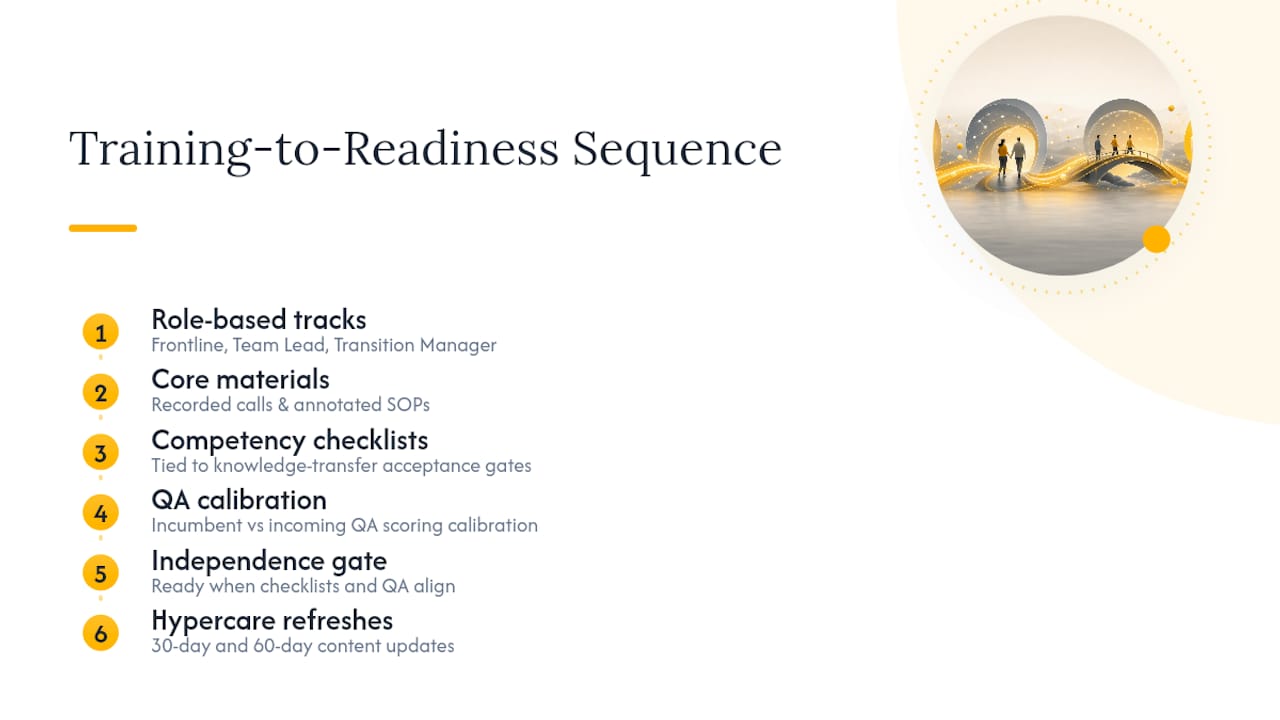
Training during an outsourcing transition is not a one-time orientation session. It needs to map directly to the knowledge-transfer gates you’ve already built, or it becomes disconnected busywork that doesn’t actually prepare anyone.
Start with role-based training tracks rather than one generic onboarding deck. A frontline agent needs deep tool proficiency (CRM navigation, ticketing macros, phone systems); a team lead needs escalation protocols and QA scoring calibration; a transition manager needs visibility into every dashboard feeding the KPI baseline. Building three separate tracks takes more upfront work than one shared deck, but it’s the difference between a team that can operate independently and one that keeps calling the incumbent for basics.
Use recorded call libraries and annotated SOP walkthroughs as your core training material, since they let new hires review real scenarios at their own pace instead of relying only on live shadowing sessions. Pair every training module with a competency checklist tied to the acceptance gates in your knowledge-transfer plan, so training completion and readiness to progress are measured by the same yardstick.
Run a calibration session between incumbent and incoming QA leads before independent phase starts. If their scoring differs by more than a small margin on the same set of sample interactions, your training hasn’t closed the gap yet, no matter how many sessions were logged. Refresh training content at the 30-day and 60-day hypercare checkpoints, since real production data almost always reveals edge cases the original SOPs missed.
How Do You Optimize Operations After Transition Closes?
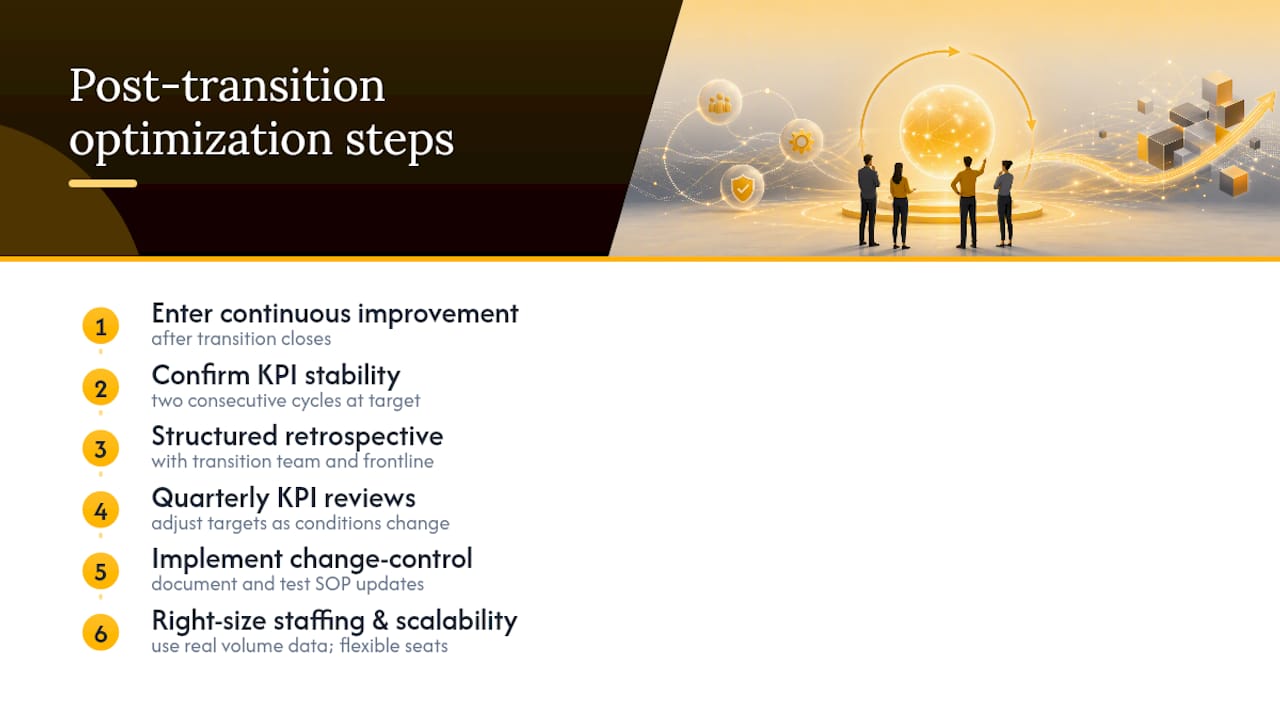
Closing the formal transition doesn’t mean the work is done. It means you’ve earned the right to shift from stabilization mode into continuous improvement mode.
Once you’ve hit two consecutive reporting cycles at target KPIs, schedule a structured retrospective with both the transition team and frontline staff. Ask specifically what SOPs needed correction during live operations, since those gaps are the ones your pre-transition documentation missed and should feed directly back into your process library. Set a recurring quarterly review cadence for KPI targets themselves. A baseline set during pre-transition planning reflects conditions at that moment, not necessarily what “good” should look like a year later as volume, complexity, or customer expectations shift.
Build a lightweight change-control process for any SOP update after hypercare ends, so improvements get documented and tested rather than becoming tribal knowledge held by whoever happened to solve the problem that week. This is also the point to revisit staffing models. Many transitions run slightly overstaffed through hypercare as a safety margin. Once performance is stable, right-sizing that roster based on real, sustained volume data usually produces meaningful cost efficiency without touching service quality. For teams working with a nearshore partner, this is often the window where scalability strategies around flexible seat counts pay off most, since demand patterns are now based on actual data instead of pre-transition estimates.
An Editorial Take: Transition Is a Rhythm, Not a Project
The biggest mistake I see in transition planning is treating it as a project with an end date, rather than the start of an operational rhythm. Projects wrap up. Customer experience operations don’t.
What actually works is daily async updates paired with strict KPI discipline, and a 30/60/90 review cadence that continues well past hypercare’s formal close. That rhythm beats micromanagement because it gives you visibility without making every team member feel watched, which erodes trust exactly when you need it most from a new team finding its footing.
If you’re managing your first transition, resist the urge to move every function at once. Pilot one, prove the model works end to end, then scale the pattern to everything else. It’s slower on paper. It’s far cheaper in practice.
— Daniela
How to Support a Lower-Risk Transition
If you’ve read this far, you already know the hard part of an outsourcing transition isn’t the concept. It’s the disciplined execution across documentation, knowledge transfer gates, and 90 days of hypercare monitoring, done correctly, the first time. Successful transitions rely on nearshore CX teams, technical support, back-office operations, and managed team extension, launched with KPI baselines set before day one and governed through the same phase-based structure this guide walks through.

One customer support platform working with Altiam CX saw productivity improve by 89% after migrating its tech support operation through a managed transition. For teams evaluating whether a phased, hypercare-backed launch fits their situation, the orthodontic services case study shows what that looks like in a regulated, patient-facing environment.
If you’re planning a transition and want a managed path with governance and reporting already built in, visit Altiam CX to review services and book a discovery call.
Sources
- IT Outsourcing Transition Plan: Step-by-Step Handover Guide | Opsio
- Transition to Outsourcing: How To Minimize Risk — SHRM
- The Complete Guide to Outsourcing in 2026 | Global Teams AI