
Federal law lets you record a phone call if one party consents, but that permission has limits. Around 10 to 12 states demand consent from everyone on the line, and getting this wrong exposes your business to civil damages and, in some states, criminal charges. The safest operational rule: if you cannot confirm where a caller is located, announce the recording every time.
TL;DR:
- Covering all-party consent states is essential because a caller in that jurisdiction may be physically present there, even if their number suggests otherwise.
- Federal law permits recording if one party consents, but stricter state laws take precedence, increasing exposure if not handled properly.
- Most violations, especially in high-volume industries, can lead to costly class actions and criminal penalties in states like California and Massachusetts.
- Implementing system-based disclosures with automatic logs and jurisdiction-aware configurations reduces legal risks better than relying on agent judgment.
- Regular legal reviews and using compliant outsourcing services can help stay current with evolving laws and prevent costly violations.
Table of Contents
- Call Recording Laws by State: The Quick Snapshot
- State-by-State Call Recording Consent Requirements
- The Federal Wiretap Act and Your Civil Liability
- Interstate Calls: Whose Law Actually Applies
- What Recording Without Consent Actually Costs You
- Building an Auditable Compliance Program
- Sample Scripts and the Settings That Actually Enforce Them
- How Altiam CX Turns Legal Requirements Into Daily Practice
- The Safest Posture for Any Multi-State Call Program
- Get Your Recording Program Audit-Ready With Altiam CX
- Where to Verify These Rules Yourself
- Sources
Call Recording Laws by State: The Quick Snapshot
The federal Wiretap Act sets the floor, but states build their own walls on top of it. Most of the country runs on one-party consent, meaning you can legally record a call as long as you, the recorder, know it’s happening, even if the other person has no idea. A smaller group of states requires every participant to agree first.
Here’s how the map breaks down:
- All-party consent states: California, Connecticut, Delaware, Florida, Illinois, Maryland, Massachusetts, Montana, Nevada, New Hampshire, Pennsylvania, and Washington are commonly listed among the strictest jurisdictions, per RecordingLaw’s state-by-state survey.
- One-party consent states: The remaining states, plus Washington, D.C., permit recording with just one participant’s knowledge.
- Hybrid or medium-dependent states: Oregon and Connecticut apply different rules depending on whether the conversation happens over the phone or in person, which trips up businesses that assume one rule covers every channel.
By the numbers: Legal surveys typically count about 9 to 12 states in the all-party camp, depending on how they classify borderline statutes, according to RecordingLaw. That range matters. If your call center handles customers nationwide, you’re statistically certain to touch a strict-consent state on any given day.
For a business fielding calls from unknown area codes, guessing wrong isn’t a rounding error. It’s a lawsuit waiting on the other end of the line. The conservative move is to treat every call as if it originated in an all-party state and disclose recording up front, regardless of where the number appears to be based.
State-by-State Call Recording Consent Requirements
Area codes lie. A customer with a New York number might be calling from a hotel room in Los Angeles. That’s exactly why compliance teams build their systems around the assumption that any call could involve a strict-consent participant. The table below organizes each state’s general rule for telephone call recording, along with the statutory anchor or authoritative note behind it.
| State | Consent Rule | Note / Statutory Reference |
|---|---|---|
| Alabama | One-party | Ala. Code § — |
| Alaska | One-party | Alaska Stat. § — |
| Arizona | One-party | Ariz. Rev. Stat. § — |
| Arkansas | One-party | Ark. Code § — |
| California | All-party | Cal. Penal Code § 632 covers “confidential communications” and allows civil damages |
| Colorado | One-party | Colo. Rev. Stat. § — |
| Connecticut | Hybrid | Phone calls generally require all-party consent for civil liability; in-person rules differ, per RecordingLaw |
| Delaware | All-party | Del. Code Ann. tit. 11, § — |
| Florida | All-party | Fla. Stat. § — |
| Georgia | One-party | Ga. Code § — |
| Hawaii | One-party (with nuance) | Haw. Rev. Stat. § —; some in-person contexts differ |
| Idaho | One-party | Idaho Code § — |
| Illinois | All-party | Ill. Comp. Stat. —, amended after prior version was struck down |
| Indiana | One-party | Ind. Code § — |
| Iowa | One-party | Iowa Code § — |
| Kansas | One-party | Kan. Stat. § — |
| Kentucky | One-party | Ky. Rev. Stat. § — |
| Louisiana | One-party | La. Rev. Stat. § — |
| Maine | One-party (with nuance) | Me. Rev. Stat. § —; some circumstances narrow the exception |
| Maryland | All-party | Md. Code, Cts. & Jud. Proc. § — |
| Massachusetts | All-party | Mass. Gen. Laws ch. —, § —, carries criminal exposure |
| Michigan | One-party (courts split on interpretation) | Mich. Comp. Laws § — |
| Minnesota | One-party | Minn. Stat. § — |
| Mississippi | One-party | Miss. Code § — |
| Missouri | One-party | Mo. Rev. Stat. § — |
| Montana | All-party | Mont. Code § —, requires notice/announcement |
| Nebraska | One-party | Neb. Rev. Stat. § 86-702 |
| Nevada | All-party (courts have applied it as such) | Nev. Rev. Stat. § 200.620 |
| New Hampshire | All-party | N.H. Rev. Stat. § 570-A:2 |
| New Jersey | One-party | N.J. Stat. § 2A:156A-4 |
| New Mexico | One-party | N.M. Stat. § 30-12-1 |
| New York | One-party | N.Y. Penal Law § 250.00 |
| North Carolina | One-party | N.C. Gen. Stat. § 15A-287 |
| North Dakota | One-party | N.D. Cent. Code § 12.1-15-02 |
| Ohio | One-party | Ohio Rev. Code § 2933.52 |
| Oklahoma | One-party | Okla. Stat. tit. 13 |
A few of these entries deserve extra attention. Illinois rewrote its eavesdropping statute after the state supreme court struck down the original all-party requirement as overly broad, and the revised law still lands in the all-party camp for most phone conversations. Vermont has no formal wiretap consent statute on the books; its rule comes from case law rather than a legislature-passed code, which makes it an outlier worth flagging for any compliance team building automated jurisdiction filters. Nevada’s statute reads like a one-party law on its face, but courts have applied it in a way that functions closer to all-party in practice, according to RecordingLaw’s survey.
If your organization operates a call center or sales floor that dials into more than a handful of these states, memorizing this table isn’t realistic for frontline staff. That’s a systems problem, not a training problem, and it’s exactly what the platform-configuration section below addresses.
The Federal Wiretap Act and Your Civil Liability
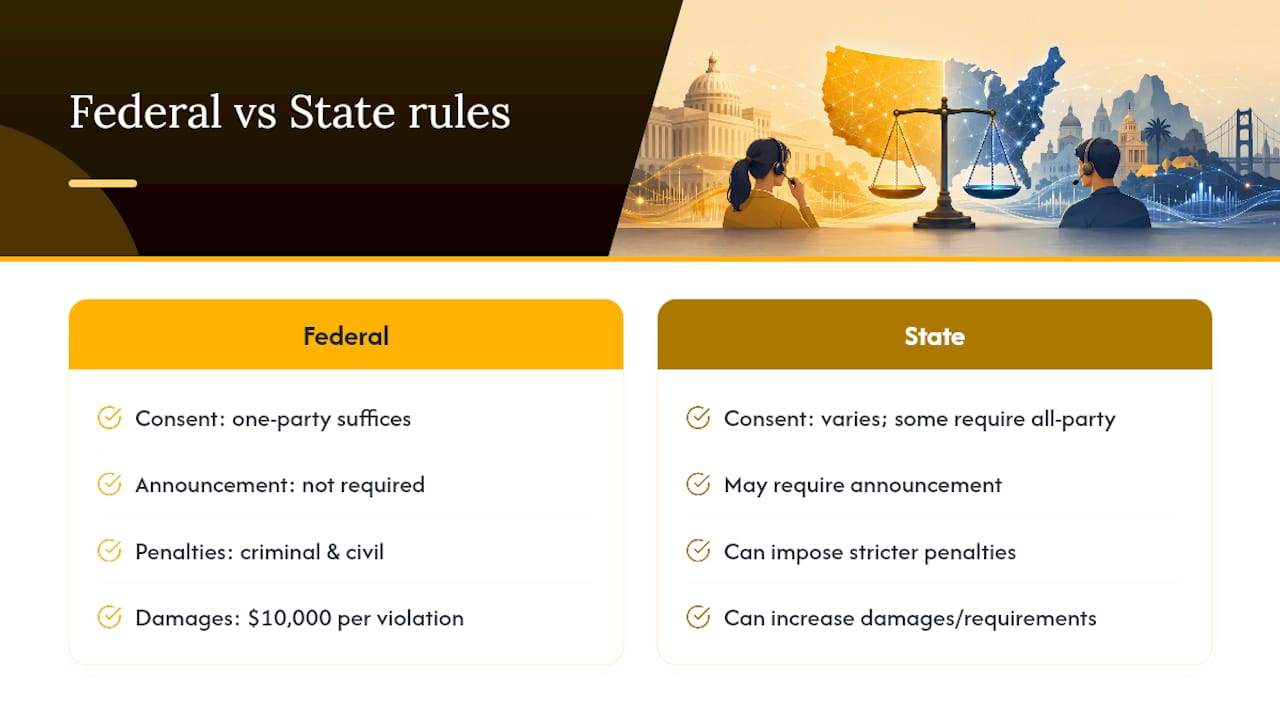
Federal law sets the baseline every state statute builds on top of. Under 18 U.S.C. § 2511(2)(d), it’s generally lawful to record a call as long as one party, meaning you, the business, consents to the recording. Nobody else on the line needs to agree, and you don’t need to announce anything, at least as far as federal law is concerned. States are free to raise that bar, and many do.
That permission has teeth on the enforcement side, too. Violating federal wiretap law doesn’t just expose you to a lawsuit; it can trigger criminal penalties.
Federal law provides a civil remedy for illegal recording: § 2520 sets a statutory damages floor of $10,000 or more per violation, and plaintiffs can recover whichever is greater, actual damages or that statutory minimum.
That’s not a hypothetical number. It comes directly from 18 U.S.C. § 2520, and it applies per violation, not per lawsuit. A company that records ten calls illegally under an interpretation a court later rejects isn’t looking at one $10,000 exposure. It’s looking at ten.
The practical takeaway for compliance teams: federal law is a floor, not a ceiling. It tells you the minimum protection you get for recording with one party’s consent. It says nothing about the states that demand more. When a state statute is stricter than the federal rule, and a dozen or so states are, that state’s law governs your risk exposure for calls touching its residents. Federal permission never overrides a stricter state requirement; it simply sets the national baseline everyone else builds on.
Interstate Calls: Whose Law Actually Applies
Call centers rarely deal with tidy, single-state scenarios. A sales rep in Georgia dials a prospect whose area code is Texas but who’s actually vacationing in California. Which law governs that call?
Courts and compliance guides generally point to the same practical answer: apply the stricter state’s rule. This approach traces back to cases like Kearney v. Salomon Smith Barney, where a California court held that California’s all-party consent law applied to a call even though the recording party was in Georgia, a one-party state, because the person being recorded was physically in California. The reasoning holds up across most interstate disputes: if either party is sitting in an all-party state when the call happens, treat the whole call as if that state’s law applies.
Three scenarios show how this plays out in practice:
- A support agent in Texas calls a customer in Illinois. Illinois requires all-party consent, so the agent must disclose recording and get some form of acknowledgment before proceeding.
- An outbound sales team in Florida cold-calls a lead whose area code is New York but who answers from a Massachusetts cell tower. Massachusetts is an all-party state with criminal exposure attached, so the safer assumption treats this as an all-party call regardless of what the caller ID suggests.
- A healthcare intake line based in Nevada receives an inbound call from a patient traveling internationally with a domestic number. Location can’t be verified reliably, so the default announcement plays regardless.
Caller location, not the location of your recording server or your call center’s home state, is what typically drives which law applies. When you can’t verify location with confidence, and most businesses can’t, the disclosure has to run every time.
What Recording Without Consent Actually Costs You
Legal risk stays abstract until you attach numbers to it. Once you do, the case for a compliant recording program writes itself.
On the federal side, violating the Wiretap Act can mean criminal exposure of several years in prison and fines, on top of the civil remedy under § 2520. That statute’s $10,000-per-violation floor, set by federal law, applies regardless of whether the plaintiff can prove actual financial harm. Multiply that by call volume, and small compliance gaps become expensive fast.
States layer their own penalties on top:
- California allows civil damages under Penal Code § 632, and courts there have shown a willingness to certify class actions when a business systematically records without disclosure.
- Massachusetts treats illegal recording as a criminal offense under its wiretap statute, not just a civil matter, which raises the stakes considerably for businesses operating there.
- Pennsylvania similarly carries criminal exposure under its wiretapping statute, in addition to any civil claims.
The exposure that catches businesses off guard: class actions. A single customer complaint rarely bankrupts a company. A class action alleging that your call center systematically recorded thousands of California residents without disclosure is a different order of problem entirely, and plaintiffs’ attorneys actively look for exactly this pattern in industries with high call volume, like collections, telemarketing, and customer service outsourcing.
Building an Auditable Compliance Program
Legal risk gets manageable once you turn it into a checklist. The businesses that stay out of trouble treat recording disclosure as a system, not a policy memo nobody reads.
- Standardize your announcement wording and placement. Whether the notice plays through an IVR prompt before a call connects or gets read by a live agent, it needs to be clear, audible, and impossible to miss. “This call may be recorded for quality purposes” works; burying it in fine print during a rushed greeting doesn’t.
- Log consent, not just the call. Every recorded call should generate a timestamped log showing when the disclosure played and confirming the other party continued the conversation afterward. Courts and compliance surveys treat that continuation as implied consent in many jurisdictions, according to Justia’s 50-state survey, but only if you can prove the notice actually ran.
- Set retention schedules before you need them, not after a subpoena arrives. Decide how long recordings live in storage, who can access them, and what triggers deletion. Encrypt recordings at rest and in transit, and restrict access to roles that genuinely need it.
- Layer in industry-specific rules. Healthcare organizations subject to HIPAA need to protect any protected health information captured in a recording. Businesses processing payments need to keep PCI DSS in mind; full card verification data should never sit unprotected inside a stored call recording. Financial services firms subject to FINRA oversight face their own recordkeeping obligations on top of state consent law.
- Put a review on the calendar. State legislatures amend these statutes more often than most businesses realize, Illinois being the clearest recent example. An annual legal review, paired with a compliance officer or outside counsel, keeps your disclosure language and retention policy current.
Pro Tip: Don’t rely on caller ID or area code to guess someone’s location. Treat every call as if the strictest applicable state law governs it, and let your announcement do the legal work automatically instead of asking agents to make judgment calls mid-conversation.
Sample Scripts and the Settings That Actually Enforce Them
Good policy language means nothing if your platform doesn’t enforce it. Here’s language your team can adapt, along with the settings worth checking before your next audit.
IVR announcement (before connection): “This call may be recorded for quality assurance and training purposes. By continuing, you agree to this recording.”
Live agent disclosure (if IVR isn’t in place): “Before we get started, I want to let you know this call is being recorded for quality purposes. Is that okay with you?”
Pre-scheduled outbound script: “Hi, this is [name] calling from [company]. This call is being recorded. Do you have a few minutes to talk?”
Beyond the script, your platform configuration determines whether that disclosure actually protects you:
- Enable “record on connect” rather than a delayed trigger, so no portion of the call happens before the notice plays.
- Configure selective recording scopes so sensitive workflows, like payment capture, pause or mask recording during that segment.
- Use geo-filters where your platform supports them, flagging calls tied to all-party states for stricter handling.
- Audit consent logs quarterly, not just when a complaint surfaces.
The mistakes that show up most often in real compliance reviews: no consent logs at all, treating every state the same instead of segmenting by jurisdiction, and storing unmasked card data inside recordings, a direct PCI DSS violation waiting to be discovered during an audit.
How Altiam CX Turns Legal Requirements Into Daily Practice
Knowing the law is one problem. Getting a distributed team of agents to apply it consistently, call after call, is a different one entirely. That gap is where most compliance programs actually fail, not in the policy document, but in the thousandth call of the day when an agent skips the disclosure because the script felt clunky or the customer sounded impatient.
Altiam CX approaches this as an operational build, not a legal memo. Announcements get standardized into the call flow itself, so disclosure isn’t left to an agent’s memory or discretion. Consent logging runs automatically alongside the recording, capturing the timestamp of the notice and whether the customer continued the call, the same evidence trail that courts look for when implied consent gets challenged.
QA sampling then checks that the disclosure actually played and that agents didn’t talk over it, rather than just checking that a recording exists. Training gets built around the specific jurisdictions a client’s call volume touches, and SLA design accounts for the extra seconds a proper disclosure adds to handle time, so compliance doesn’t quietly erode under pressure to hit call metrics. For clients in regulated fields like healthcare intake or legal client onboarding, this same framework extends into HIPAA-aware handling and documented audit trails ready for a compliance review on short notice.
The Safest Posture for Any Multi-State Call Program
If you run calls across more than one state and you can’t verify every caller’s location with certainty, default to all-party disclosure on every call. That’s not the cautious answer dressed up as advice. It’s the only posture that holds up when a customer answers from a state you didn’t expect.
The trade-off is real: a disclosure adds a few seconds to call handle time, and some businesses worry it makes conversations feel less personal. In practice, most customers barely register a brief, well-worded notice, and the alternative, guessing wrong on jurisdiction, carries a cost that dwarfs a few seconds of friction.
Where I’d push back on conventional guidance: too many compliance checklists treat this as a one-time legal review, then move on. State legislatures amend these statutes with some regularity, and courts reinterpret existing language, as Illinois and Nevada both demonstrate. If you operate in a regulated vertical, healthcare, legal services, or financial services, build a standing relationship with counsel, not a single sign-off. The law didn’t stop moving after your last audit, and neither should your review cycle.
— Daniela
Get Your Recording Program Audit-Ready With Altiam CX
Building compliant call recording workflows in-house means training agents, configuring platforms, maintaining consent logs, and staying current on state law changes, all while running your core business. Altiam CX is the alternative to building that infrastructure from scratch: our nearshore teams operate under documented recording workflows, jurisdiction-aware disclosure protocols, and audit-ready retention practices from day one, so you get compliant call handling without hiring and training an internal compliance function.

Clients in regulated fields see this play out directly. Our orthodontic services case study shows how a healthcare-adjacent provider improved customer experience while keeping documentation practices aligned with industry requirements. Law firms considering outsourced intake can review our legal intake outsourcing guide for how compliant client communication workflows get built into daily operations. And if SLA design and QA sampling around recorded calls is your current bottleneck, our call center SLA guide breaks down the rules ops leaders use to keep compliance and performance metrics aligned rather than in conflict.
Ready to see how a managed team extension handles this for your call volume specifically? Visit Altiam CX to talk through your current recording workflow and where a documented, audit-ready process could reduce your exposure.
Where to Verify These Rules Yourself
State recording laws change, and this article is a starting point, not a substitute for checking the current statute in your specific jurisdiction.
- 18 U.S.C. § 2511 and § 2520: the federal Wiretap Act’s consent rule and civil damages provision.
- FCC consumer guide on recording telephone conversations: federal guidance confirming states set their own rules.
- Justia’s 50-state survey on recording phone calls: a state-by-state legal breakdown with nuance on implied consent.
- Your state attorney general’s office: the authoritative source for any pending changes to your state’s statute.
Sources
- 18 U.S.C. § 2520 — Civil liability for willful violation of section 2511
- Recording telephone conversations (FCC consumer guide)
- Recording phone calls and conversations under the law: 50-state survey (Justia)