

Under Regulation E (12 CFR §1005.11), financial institutions must investigate a valid notice of error within 10 business days, correct confirmed errors within one business day, and report results within three. Extensions to 45 or 90 days are allowed only if the institution provisionally credits the consumer’s account. The rule protects consumers who report electronic fund transfer errors and binds every bank, credit union, and card issuer covered by the Electronic Fund Transfer Act.
TL;DR:
- Banks must investigate error notices within 10 business days and correct errors within one business day, with extensions possible if provisional credit is provided.
- Regulation E covers unauthorized transfers, incorrect amounts, and ATM or statement errors related to debit, ATM, ACH, and POS transactions, but excludes wire transfers and credit card transactions.
- Filing a dispute requires identifying the transaction, describing the error, providing contact details, and reporting promptly within 60 days of the relevant statement.
- Provisional credit must be issued within 10 business days for extensions, and institutions can withhold up to $50 under narrow conditions during the investigation.
- Proper documentation, standardized procedures, and timely evidence capture are essential for compliance and avoiding claim denials.
Table of Contents
- What Qualifies as a Reg E Error, and Which Transfers Are Covered?
- How Do You File a Reg E Dispute, and What Are the Deadlines?
- What Are a Bank’s Investigation Duties Under the 10, 45, and 90-Day Rules?
- How Does Provisional Credit Work, and When Can $50 Be Withheld?
- Why Do Reg E Disputes Get Denied, and How Can You Avoid That?
- How Do You Request Documents, Reassert a Denial, or File a CFPB Complaint?
- What Does the Reg E Dispute Timeline Look Like From Start to Finish?
- What Operational Practices Help Financial Institutions Stay Compliant?
- What Should Compliance Officers Prioritize First?
- How Can a Nearshore CX Partner Help Banks Scale Dispute Operations?
- Where Can You Read the Official Reg E Rules and Guidance?
- Sources
What Qualifies as a Reg E Error, and Which Transfers Are Covered?
Not every account complaint triggers the reg e dispute process. Regulation E recognizes seven specific error types, and a notice has to fit one of them before the clock starts running.
- An unauthorized electronic fund transfer
- Incorrect amount transferred to or from the account
- Omission of an EFT from a periodic statement
- A computational or bookkeeping error by the institution
- Failure to dispense the correct cash amount at an ATM
- An EFT that isn’t properly identified on a statement
- A consumer’s request for documentation or clarification about a specific transfer
Coverage extends to debit card purchases, ATM withdrawals, ACH transfers, and point-of-sale (POS) transactions tied to an asset account. It does not extend to wire transfers, credit card transactions, or most bill-payment checks issued through a bill-pay service, since those fall under different regulatory frameworks. There’s also a related but distinct category: remittance transfers to foreign recipients carry their own error-resolution rules under Subpart B of Regulation E, which overlap with but don’t duplicate the standard EFT process covered here.
How Do You File a Reg E Dispute, and What Are the Deadlines?
Filing a notice of error doesn’t require a formal letter. Regulation E permits oral or written notice, but what you say and when you say it determines how much protection you get.
- Identify the account and transaction. Include the account number, the date and dollar amount of the transfer, and the merchant or counterparty name if known.
- Describe the error clearly. State why you believe the transaction is wrong, not just that you don’t recognize it.
- Provide contact information so the institution can reach you during the investigation.
- Note the date you’re reporting it. This becomes the official start date of your notice of error.
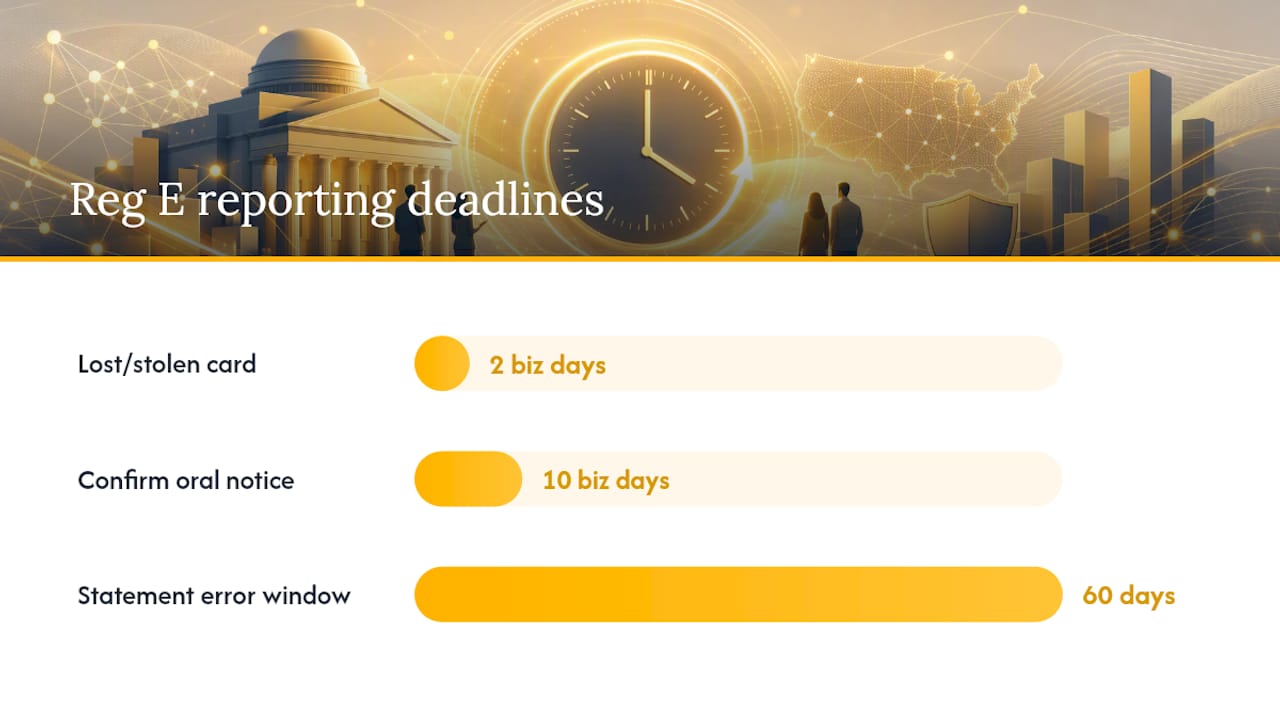
Timing changes your legal position. Under the Electronic Fund Transfers FAQs, consumer liability for unauthorized transfers is tied directly to how fast you report. Report a lost or stolen card within two business days and your exposure is capped at $50. Wait past 60 days from your statement date and you could be liable for the full loss on transfers after that window. The general rule for most other disputes is the 60-day statement rule: you have 60 days from when the statement containing the error was sent to give notice.
Institutions can ask you to confirm an oral notice in writing, but they must give you an address and a 10-business-day deadline to do so. Send it there, keep a copy, and note the date you mailed or submitted it.
Pro Tip: Always ask the representative who takes your oral notice for a case or reference number, and write down the date and time of the call. If your bank later claims it never received a timely notice, that reference number is your proof.
What Are a Bank’s Investigation Duties Under the 10, 45, and 90-Day Rules?
Once a valid notice of error lands, the institution’s clock starts immediately, not when paperwork arrives. Regulators have penalized banks for waiting on written confirmation before beginning work, since CFPB guidance makes clear that investigations must start promptly on oral notice alone.
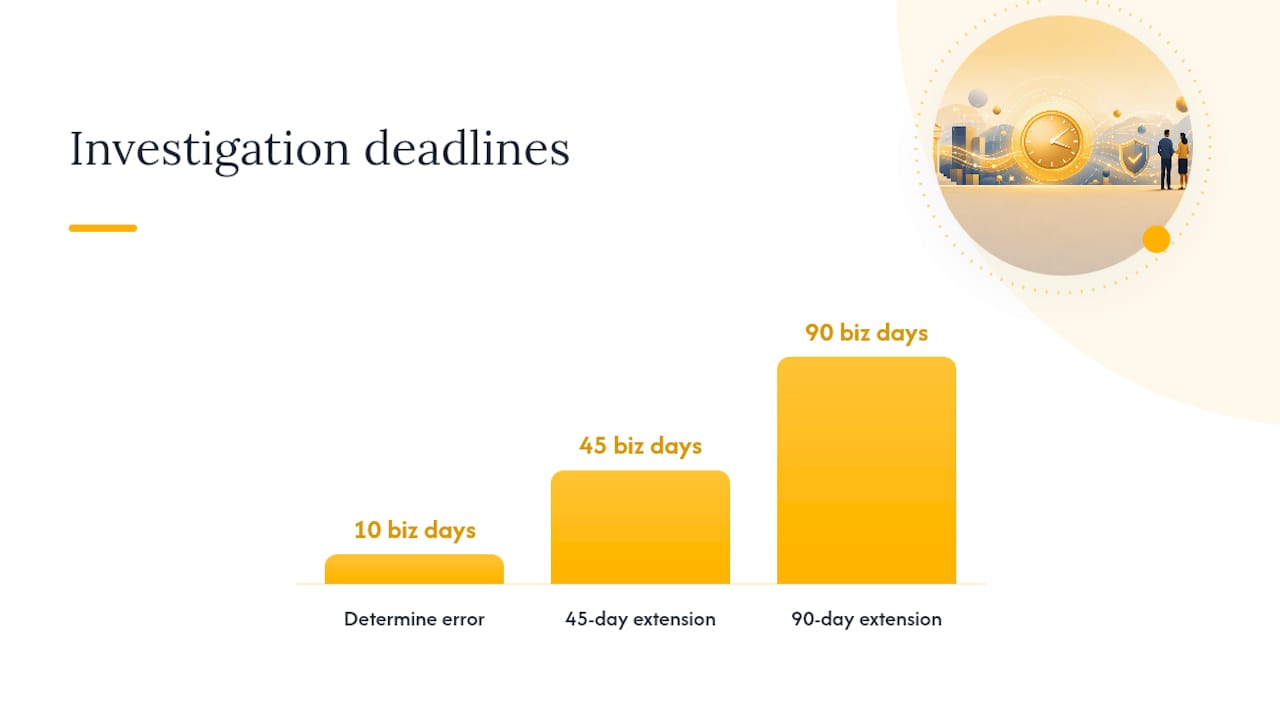
The baseline procedure under 12 CFR §1005.11 requires the institution to determine whether an error occurred within 10 business days of receiving the notice. If it needs more time, two extension paths exist:
- The 45-day extension is available if the institution provisionally credits the consumer’s account within the original 10-business-day window, notifies the consumer of the credit within two business days of issuing it, and gives the consumer full use of those funds while the investigation continues.
- The 90-day extension applies to specific categories: new accounts (open 30 days or less), point-of-sale transactions, and errors involving transfers initiated outside the United States. The institution still owes provisional credit within 10 business days for these cases.
Once a determination is made, the rule for resolving errors requires correction within one business day and written or oral notification of results within three business days of completing the investigation. “Reasonable investigation” isn’t a checkbox exercise. It means reviewing account history, transaction logs, merchant data, and the consumer’s own account of what happened, not just running an automated fraud filter and moving on.
Documentation matters as much as the decision itself. A file that shows what was reviewed, when, and by whom holds up far better under examiner scrutiny than a conclusion with no visible trail behind it.
How Does Provisional Credit Work, and When Can $50 Be Withheld?
Provisional credit puts disputed funds back in the consumer’s hands while the investigation runs. It’s not a final resolution. It’s a temporary bridge that keeps the consumer whole in case the bank later confirms an error occurred.
- The institution must credit the account within 10 business days of the notice if it invokes the 45 or 90-day extension.
- Consumers get full use of that provisional credit, including for purposes of calculating available balances and avoiding overdraft fees.
- An institution may withhold up to $50 of the provisional credit, but only under narrow conditions tied to the type of dispute and the consumer’s account relationship, and it must still credit the remainder.
- If the institution reverses the credit after determining no error occurred, it must notify the consumer in writing, including the date of the debit and the reason for the reversal.
Regulation E’s “honoring items” rule requires institutions to honor certain transactions drawn against reversed provisional credit for five business days after the debit, per Cornell Law’s text of §1005.11, protecting consumers from bounced payments they made in good faith.
Watch your statements closely in the days after a reversal. A debit that clears against a balance you thought was settled is one of the most common sources of confusion in this part of the process.
Why Do Reg E Disputes Get Denied, and How Can You Avoid That?
Most denials fall into one of two buckets: procedural and substantive. Knowing which one you’re up against changes how you respond.
Procedural denials happen when the notice itself falls short. Common triggers include reporting past the 60-day window, leaving out the transaction date or amount, or failing to send written confirmation after the institution properly requested it. These are avoidable with a complete, timely notice.
Substantive denials turn on the evidence. Institutions typically point to merchant receipts, signed authorization records, device or IP logs, or prior transaction patterns that resemble the disputed one. If your account has similar purchases at the same merchant, expect that pattern to come up during the investigation.
The CFPB has flagged a specific risk here: blanket or automated denials that don’t account for the consumer’s own narrative can constitute an unreasonable investigation. A bank that relies solely on a fraud score without weighing what the consumer actually reported is on shaky ground.
Before filing, gather:
- Screenshots or photos of the transaction as it appears in your account
- Any merchant correspondence, receipts, or order confirmations
- A timeline of when you noticed the error and who you contacted
- Names, dates, and reference numbers from any prior calls about the issue
Pro Tip: If you dispute a transaction, immediately request a copy of your account activity for that period. Banks sometimes update or annotate records during an investigation, and having your own snapshot from day one protects you if the versions don’t match later.
How Do You Request Documents, Reassert a Denial, or File a CFPB Complaint?
A denial isn’t necessarily the end of the road. Regulation E gives consumers specific rights to see the evidence behind a decision and to push back on it.
- Request the documents relied upon. If the institution finds no error occurred, §1005.11 requires it to notify you of your right to request the documents used in the investigation, and to provide copies on request.
- Reassert the error with new information. If you have evidence the institution didn’t consider, submitting it can reopen the case. Without new facts, the institution is generally relieved of further duty once it has fully complied with the investigation requirements.
- File a complaint with the CFPB if you believe the investigation was inadequate or the timeline was violated. Include your account details, a summary of the dispute, dates of every notice and response, and copies of any denial letters.
- Contact your state financial regulator as a parallel option, particularly for state-chartered institutions.
Expect a CFPB complaint to prompt a response from the institution, typically within 15 days, though full resolution timelines vary by case complexity.
What Does the Reg E Dispute Timeline Look Like From Start to Finish?
Here’s a practical sequence you can adapt for your own records, whether you’re a consumer tracking a claim or an FI staffer training new investigators.
- Day 0: Discover the error. Capture screenshots, statements, and receipts immediately.
- Day 0 to 2: Contact your institution. Give a clear, specific account of the transaction and error type. Note the reference number.
- Day 2 to 10: If asked, submit written confirmation to the address provided. Keep a copy and proof of submission.
- By Day 10: Institution must issue provisional credit if it’s invoking an extension, or complete its determination if not.
- Day 10 to 45 (or 90 for qualifying cases): Investigation continues. Provisional credit remains available for your use.
- At determination: Correction happens within one business day; you’re notified within three business days of completion.
- If denied: Request the documents relied upon and decide whether to reassert or escalate.
What Operational Practices Help Financial Institutions Stay Compliant?
A defensible Reg E program isn’t built during an active dispute. It’s built in the months before, through consistent process design that holds up under examiner review.
- Centralize case intake so every notice of error, whether it arrives by phone, chat, or branch visit, lands in one system with a consistent record format.
- Standardize evidence capture. Screenshots, system logs, and merchant data should follow the same checklist every time, regardless of which agent handles the call.
- Build QA checks that verify narrative review. According to ABA compliance guidance, documenting that an investigator actually considered the consumer’s account of events, not just transaction codes, significantly reduces supervisory findings.
- Design SLAs around the regulatory clock, not around internal convenience, so provisional credit decisions never slip past the 10-business-day mark.
- Train staff on edge cases like new accounts, POS transactions, and international transfers, where the 90-day extension applies but is frequently misapplied.
A well-documented financial services support workflow turns these steps into muscle memory rather than a scramble every time a dispute lands.
Pro Tip: Run quarterly mock investigations using real (anonymized) past disputes. It’s the fastest way to find gaps in your documentation standards before an examiner does.
What Should Compliance Officers Prioritize First?
Too many Reg E programs are built around speed to denial rather than speed to a defensible answer. That’s backwards. The CFPB’s own guidance on reasonable investigations makes clear that automated, narrative-blind decisions are exactly what draws supervisory attention, so the first investment should always be evidence capture and genuine consumer communication, not faster rejection.
Clear SOPs matter more than clever tools. A written procedure that tells every investigator exactly what “reasonable investigation” looks like for each of the seven error types closes more gaps than any new software purchase. Training and QA audits that check for narrative review, not just timeline compliance, are what actually reduce exposure.
There’s a real question of when to build this internally versus bring in managed support. If your institution handles disputes at a scale where staffing gaps create timeline risk, particularly around provisional credit deadlines, that’s the moment to look outside rather than stretch an already thin team thinner.
— Daniela
How Can a Nearshore CX Partner Help Banks Scale Dispute Operations?
Meeting the 10-business-day investigation clock gets harder when case volume spikes and your internal team is already stretched. That’s a critical gap that specialized dispute-handling teams, standardized documentation practices, and SLA-driven operations can address to keep provisional credit decisions inside the regulatory window even during volume surges.

Such teams can work as an extension of your existing compliance function, not a replacement for it. Your team keeps final determination authority and oversight; the partner’s teams handle intake, evidence capture, and case documentation using the standards your compliance officers set. That model has already shown results in adjacent support environments, including a nearshore team extension engagement that scaled operational capacity without sacrificing consistency. For financial institutions weighing whether to build additional in-house capacity or bring in support that’s ready to move faster, a conversation with Altiamcx is a reasonable next step. Ask about how a managed team extension could handle your next volume spike before it becomes a compliance risk.
Where Can You Read the Official Reg E Rules and Guidance?
- §1005.11 Procedures for Resolving Errors — the CFPB’s official regulatory text and commentary.
- 12 CFR §1005.11 (Cornell Law) — the full eCFR codified rule with subsections.
- Electronic Fund Transfers FAQs — CFPB interpretive guidance on liability and investigation standards.
- Reg E Error Resolution Flowchart — a visual industry summary of the notice, timeline, and credit process.
This article is general information, not a substitute for advice from a qualified lawyer. Consult a qualified legal professional about your own circumstances before acting on anything here.
Sources
- § 1005.11 Procedures for resolving errors.
- 12 CFR § 1005.11 — Procedures for resolving errors (Cornell Law)
- Electronic Fund Transfers FAQs | Consumer Financial Protection Bureau
- EFTA Reg E - ERROR RESOLUTION FLOW CHART


