
Measure your no-show rate before you touch anything else, then pair two-way automated confirmations with risk-targeted live outreach and structural fixes to booking lead time. Reminders alone move the needle modestly; adding a live phone call for your highest-risk bookings, backed by a randomized controlled trial, cut no-shows further and narrowed equity gaps. Start with a 30-day baseline measure segmented by appointment type and lead time, then build from there.
TL;DR:
- Implement risk-stratified live outreach for appointments flagged as high-risk, especially those booked more than 14 days in advance, to significantly reduce no-shows.
- Use two-way automated confirmations that allow patients to reschedule or cancel, with reminders sent at 72 hours, 24 hours, and on the day of the appointment, focusing on decision points.
- Shortening booking windows to same-week or next-day slots can halve no-shows, but should be balanced with capacity and patient access considerations.
- Address access barriers like transportation and fixed work hours with targeted solutions rather than blanket no-show fees, which often worsen disparities.
- Consider a nearshore team extension for large-scale risk stratification, live outreach, and waitlist management to efficiently scale no-show reduction efforts.
Table of Contents
- What Actually Cuts No-Show Rates? A 30 to 90 Day Action Plan
- Two-Way Confirmations: Building Reminders That Actually Work
- Does a Shorter Booking Window Reduce No-Shows?
- When Should You Use Live Outreach Instead of a Reminder?
- Making Rescheduling and Waitlists Frictionless
- Why Do Patients Miss Appointments? Addressing Access Barriers
- Building Your 90-Day Measurement and QI Plan
- Operationalizing at Scale: When to Extend Your Team
- What Practice Managers Get Wrong About No-Shows
- Let Altiam CX Run Your No-Show Reduction Playbook
- Selected Research and Practical Resources
- Sources
What Actually Cuts No-Show Rates? A 30 to 90 Day Action Plan
You don’t need a five-year transformation plan to move your no-show rate. You need a sequence, executed in order, with measurement at every step. Practices that treat this as a system problem, not a patient-blame problem, get sustained results according to quality improvement research on appointment systems.
Here’s the order that works, starting this week:
- Measure your baseline. Pull no-show rates by provider, appointment type, and lead time before changing anything. You cannot know what worked if you don’t know your starting point.
- Turn on two-way confirmations. Patients need to confirm or reschedule in a single tap, not just receive a broadcast text.
- Flag your highest-risk bookings. Identify the slice of appointments most likely to no-show and add a live call for that group only.
- Tighten your booking windows. Shorten advance scheduling where feasible, and re-confirm any appointment booked far out.
- Build a real waitlist. Automated backfill turns a cancellation into a filled slot instead of a lost hour.
- Check for access barriers. Transportation, work hours, and language gaps often explain more no-shows than “forgetfulness” ever will.
Each step compounds on the one before it. A confirmation system without a waitlist just tells you a slot is empty. A waitlist without risk stratification wastes staff time calling patients who were always going to show up. Sequence matters here as much as the tactics themselves.
Two-Way Confirmations: Building Reminders That Actually Work
The channel matters less than the design. A rapid systematic review found predictive text reminders reduce no-shows with high-certainty evidence, while predictive phone reminders and patient navigator calls “probably” reduce them with moderate certainty, according to a review of predictive-model interventions. The mistake most practices make isn’t picking the wrong channel. It’s building a one-way broadcast instead of a two-way workflow.
A confirmation that only lets a patient reply “yes” gives you false comfort. A confirmation that lets them reply “reschedule” or “cancel” gives you back a slot you can refill. That distinction is the entire point of the system.
Pro Tip: Never let a “confirmed” message be the end of the workflow. Build every reminder around a decision point, not a notification.
Practical cadence and structure:
- Send a first touch around 72 hours out, allowing time to backfill if the patient cancels.
- Follow with a 24-hour reminder that repeats the confirm/reschedule/cancel options.
- Add a morning-of message only for high-value or high-risk slots, not every appointment.
- Route older patients or complex-care cases to phone; route routine follow-ups to text.
- Log every response in the EHR and respect opt-out requests immediately.
- Avoid punitive phrasing (“missing this appointment may result in a fee”) in the reminder itself; save policy language for intake paperwork.
Meta-analyses generally show reminders produce a modest, single-digit-to-low-double-digit improvement in attendance, not a dramatic overhaul. Treat reminders as the floor of your strategy, not the ceiling.
Does a Shorter Booking Window Reduce No-Shows?
Yes, often significantly. The longer a patient waits between booking and the visit, the more life happens in between; a new job, a canceled ride, a symptom that resolved on its own. One practice-level case study documented in research on appointment-system redesign cut its no-show rate roughly in half simply by reducing forward booking time to a single day.
That’s not a universal fix. Specialists with long natural wait times can’t compress everyone into next-week slots. Here’s how to apply the principle without breaking access:
- Reserve a portion of same-week or short-window slots specifically for high-no-show-risk visit types.
- Re-confirm any appointment booked more than two weeks out with a dedicated touch closer to the date.
- Flag exemptions, caregivers coordinating multiple appointments, complex chronic-care patients, and log the reason rather than applying a blanket rule.
- Expect pushback from scheduling staff used to filling calendars far in advance; retrain around the new logic before rollout.
- Watch for supply-side strain if you shorten windows without adding capacity elsewhere.
The goal isn’t zero lead time. It’s matching lead time to actual attendance risk instead of defaulting to whatever the scheduling software allows.
When Should You Use Live Outreach Instead of a Reminder?
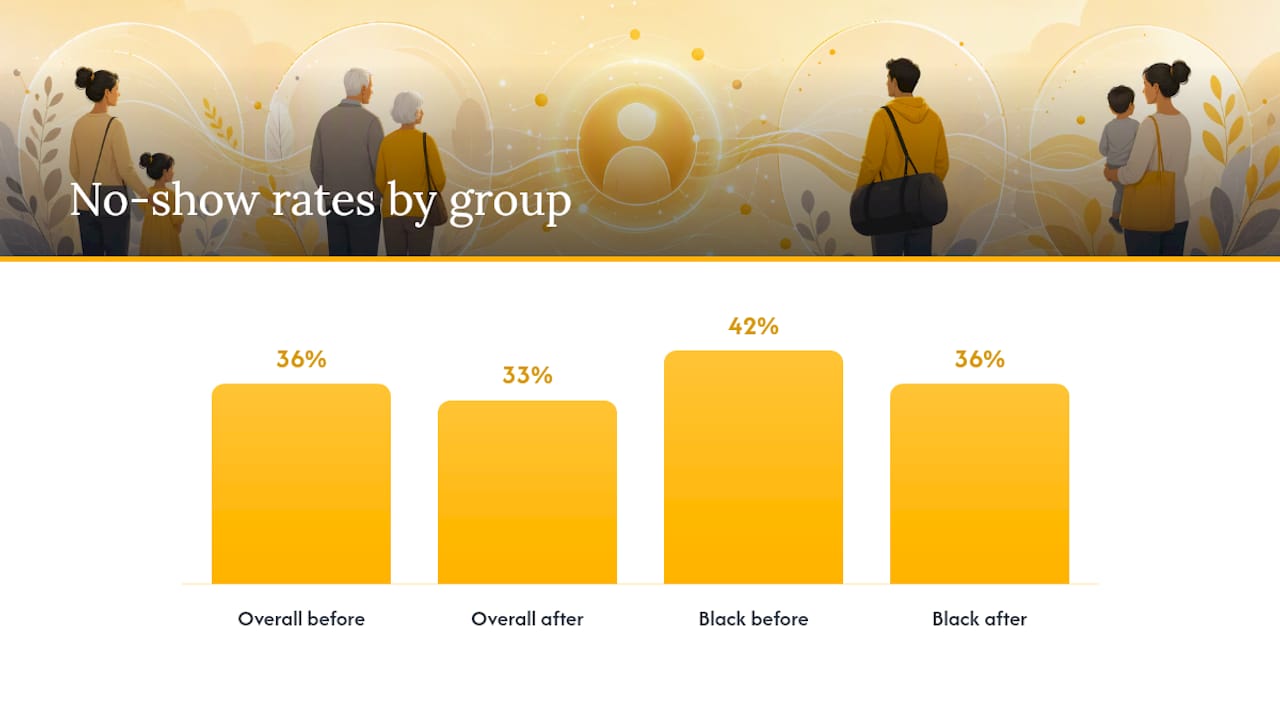
Reserve it for your highest-risk bookings. A 2023 randomized controlled quality improvement initiative added risk-stratified live phone outreach on top of standard automated reminders and dropped no-shows from 36% to 33% overall, with a sharper improvement for Black patients (42% to 36%), according to the trial’s published results. That’s not a marginal footnote. It’s evidence that targeted human effort closes equity gaps that blanket reminders don’t touch.
You don’t need a machine-learning model to triage. A simple rule set works:
- Flag any patient with a prior no-show in the past 12 months.
- Flag appointments booked more than 14 days out.
- Flag new patients, who no-show at higher rates than established ones.
- Flag specialties with historically high no-show rates, behavioral health is a common example.
- Route only the flagged group to a live call; leave everyone else on automated confirmations.
If you do adopt a predictive model later, validate it on your own patient population before trusting the risk scores, and monitor connection rate, reschedule conversion, and calibration across race and age groups rather than raw accuracy alone.
Pro Tip: Track “calls placed to slots recovered” as your core efficiency number. If it takes ten calls to save one visit, the model or the script needs work, not more calls.
Making Rescheduling and Waitlists Frictionless
A confirmation system that stops at “canceled” leaves money and access on the table. The real recovery happens in what fills that slot next. Operational research on backfill design suggests the practices that recover the most capacity treat cancellation and rebooking as one continuous motion, not two separate tasks handled by different staff.
Build it around these elements:
- One-tap rescheduling inside the same text thread the patient used to cancel, no phone tag required.
- A live waitlist that automatically texts the next eligible patient the moment a slot opens.
- A short response window (often 15 to 30 minutes) before the system moves to the next person on the list.
- Selective overbooking for appointment types with predictable no-show patterns, framed internally as capacity recovery, not a punitive scheduling trick.
- A weekly report on backfill fill rate and recovered visits, so you can see whether the waitlist is actually working or just sitting idle.
Track this separately from your raw no-show rate. A clinic can have a stubborn no-show rate and still recover most of that lost capacity if the backfill system is fast enough.
Why Do Patients Miss Appointments? Addressing Access Barriers
Not every missed appointment is a scheduling problem. Transportation, work hours, cost confusion, and language gaps drive a meaningful share of no-shows, and no reminder cadence fixes a patient who has no ride.

Telehealth helps here, but the evidence is mixed enough to warrant judgment rather than a blanket rollout. It works well for follow-ups, medication checks, and behavioral health visits where a physical exam isn’t required; it works poorly as a universal substitute for care that needs hands-on evaluation.
Practical interventions worth prioritizing:
- Transportation vouchers or rideshare partnerships for patients who repeatedly cite travel as the barrier.
- Evening or weekend slots for patients whose work hours conflict with your standard schedule.
- Interpreter access built into the booking flow, not added as an afterthought at check-in.
- Upfront cost estimates before the visit, since cost surprise drives avoidance as much as scheduling conflict does.
Resist the urge to solve this with a flat no-show fee. Small blanket fees rarely change behavior for patients facing real structural barriers, and they tend to fall hardest on the patients least able to absorb them, which can widen the same disparities targeted outreach is meant to close.
Building Your 90-Day Measurement and QI Plan
You cannot manage what you haven’t defined. Start with a clear formula: no-shows divided by scheduled appointments, segmented by provider, appointment type, and lead time, and track it weekly, not quarterly. Analysis of more than 3.5 million visits found that even a single no-show measurably reduces the odds a patient returns within 18 months, which makes this a retention metric as much as an operations one.
A realistic rollout looks like this:
- Days 1 to 30: Baseline discovery. Measure segmented no-show rates, identify your highest-risk appointment types, and audit your current reminder setup for one-way versus two-way design.
- Days 31 to 60: Targeted pilot. Launch risk-stratified live outreach on your flagged segment only, alongside two-way confirmations for everyone else. Track calls placed against slots recovered.
- Days 61 to 90: Automate and scale. Roll the working workflow into your scheduling system, add waitlist backfill, and expand to additional appointment types that showed strong pilot results.
Watch leading indicators weekly: confirmation response rate, reschedule conversion, and backfill fill percentage. Watch for unintended effects too. If shortening lead time pushes wait times up for a specific clinic or demographic, that’s a signal to adjust, not a reason to abandon the approach.
Operationalizing at Scale: When to Extend Your Team
Running risk-stratified live outreach for hundreds of appointments a week is a staffing problem before it’s a technology problem. Many practices reach a point where hiring, training, and scheduling an internal call team competes for time and budget better spent on clinical operations. That’s usually the moment a nearshore team extension model, handling live outreach, after-hours scheduling, and waitlist management, becomes worth evaluating, and a nearshore team extension works specifically in this kind of managed healthcare operations support.
If you’re evaluating a partner for this work, hold them to specific standards, not general promises:
- HIPAA-compliant handling of patient scheduling and health data at every touchpoint.
- Published performance SLAs covering connection rate and reschedule conversion, not just call volume.
- Cultural and language alignment with your patient population, especially for populations where a mismatch in tone or dialect affects trust.
- A measurement framework that reports the same metrics you’re already tracking internally, so results are comparable, not just claimed.
Pilot small before committing broadly. Run a defined cohort, perhaps one clinic or one appointment type, for 60 days with agreed metrics before expanding, and where possible, structure the contract around outcomes like reschedule conversion rather than raw hours logged. Our guide on healthcare contact center capabilities covers what live outreach infrastructure actually requires to run at this scale.
What Practice Managers Get Wrong About No-Shows
Most practices reach for a no-show fee before they’ve measured anything. That’s backwards, and it usually punishes patients facing real access barriers rather than the ones simply forgetting. Fees feel like control; they rarely change behavior, and they can quietly widen the equity gaps that targeted outreach is designed to close.
The uncomfortable truth is that blanket reminders make everyone feel like they’re doing something without doing much. Human outreach works, but only when it’s scarce, targeted, and measured. Spraying calls across your entire patient panel is a staffing cost, not a strategy.
If I ran a small-to-mid practice tomorrow, I’d do three things first: measure the baseline by lead time and appointment type, turn every reminder into a two-way workflow, and put a single staff member in charge of calling only the highest-risk bookings for 30 days. Everything else follows from what that pilot reveals.
— Daniela
Let Altiam CX Run Your No-Show Reduction Playbook
Building the workflow is one thing. Staffing it, seven days a week, with people trained to handle scheduling conversations with the right tone, is another challenge entirely. A nearshore team extension can be an alternative to hiring and training an internal call team for this exact problem: plugging directly into risk-stratified outreach, two-way confirmation follow-up, and waitlist management without the months of recruiting and onboarding a full internal unit.

Practices typically start with a defined pilot: one clinic or appointment type, a 60-day window, and shared metrics like connection rate and reschedule conversion agreed on upfront. From there, engagements scale into managed service contracts built around the outcomes that matter, not just headcount. Our patient support operations guide walks through how that kind of engagement typically starts.
See how this plays out in practice through our case study on operational impact, and reach out to scope a pilot cohort for your own no-show reduction plan.
Selected Research and Practical Resources
For deeper reading, start with the randomized controlled trial on risk-stratified outreach, the systematic review of predictive-model reminder interventions, and the practice-level QI case studies on appointment-system redesign. For scheduling workflow examples, see Clinic Ready’s implant complication management framework, which documents real confirm/cancel/reschedule design in practice.
Sources
- Reducing disparities in no show rates using predictive model-driven live appointment reminders for at-risk patients: a randomized controlled quality improvement initiative
- Systematic review of predictive model-based interventions on outpatient no-shows
- How no show appointments impact small practices | athenahealth


