Outsourcing fraud, AML or transaction-review work can raise operational risk, but it never transfers your accountability, as SR 23-4 makes clear. Your three immediate priorities are governance (inventory and risk-tier every outsourced function), targeted due diligence on critical providers, and audit-ready monitoring backed by audit rights, SLAs and an exit plan. We map each into a phased implementation plan below.
TL;DR:
- Critical providers should disclose staffing checks, privileged access controls, subcontractor changes, peak period quality samples, and references from regulated clients.
- Require contracts to permit onsite and remote audits of subcontractors, retrieve usable data on demand, and trigger remediation when quality thresholds fail.
- Limit reviewers to necessary case fields, log every action, separate alert review from payment release, and require second reviews for high risk decisions.
- Track false positive and false negative rates by language and region, because healthy averages can conceal weak performance in particular customer segments.
- Train outsourced reviewers with redacted real cases, regular calibration exercises, and confidential reporting channels, then verify completion and scores rather than attendance alone.
Table of Contents
- Which risks come with outsourcing fraud operations?
- What do regulators expect from your governance?
- How do you vet a fraud, AML or transaction-review provider?
- Which contract terms protect you when something goes wrong?
- What operational controls stop insider fraud at the provider?
- How do you monitor performance and stay audit-ready?
- What should you do in the first 30, 90 and 180 days?
- How do you train outsourced teams on fraud awareness?
- How do cultural and language differences affect fraud detection?
- What role do technology and automation play?
- What do real outsourcing failures and successes look like?
- What I have seen go right when teams rehearse the exit
- How can we help you manage outsourced operations with audit-ready controls?
- FAQ
- Sources
Which risks come with outsourcing fraud operations?
Start by sorting exposures into the categories your risk register already uses. Each one needs a named owner and a control, not a general worry.
- Operational risk: review errors, capacity gaps during volume spikes, and continuity failures when a provider site goes down. Fraud queues do not pause, so a missed backlog becomes losses within days.
- Compliance and legal risk: weak customer identification, missed suspicious activity escalations, and consumer protection failures that land on your institution, not the provider.
- Fraud at the provider: insider schemes, credential misuse, and staff who sell or leak customer data. A reviewer with decision authority and weak oversight is the classic loss mode.
- Reputational risk: a breach or mishandled case at the provider is reported under your name.
- Concentration and vendor lock-in: one provider holding your whole review function, or many regulated firms relying on a few providers, which the Joint Forum and BIS flag as a systemic concern.
- Subcontracting risk: your provider’s own vendors, often unseen, handling your data or queues.
Consider a redacted pattern practitioners describe. A provider quietly shifts overnight reviews to a subcontractor with lighter vetting. Nothing breaks visibly, but quality sampling drifts, and the first sign is a spike in chargebacks weeks later. The loss came from missing visibility, not from outsourcing itself.
Global supervisory guidance adds that outsourcing raises reputational, operational and legal risk profiles, so boards must fold it into the same framework as everything else. Our guide to critical function outsourcing helps you decide which activities belong in the top tier.
What do regulators expect from your governance?
The supervisory principle is plain: a third-party arrangement is an extension of your own risk environment. SR 23-4 tells firms to scale oversight to the activity’s risk, so a high-volume fraud-review function warrants tighter and more frequent monitoring than a facilities contract.
Examiners expect a written trail, not good intentions. The artifacts they look for:
- A complete inventory of third-party relationships, including subcontracting and foreign-based providers, as the Federal Reserve’s guidance letter describes
- Documented risk assessments for each relationship, refreshed on a schedule
- A board-approved policy and a named senior sponsor for each critical provider
- Evidence that oversight actually happened: meeting minutes, QA scorecards, remediation logs
The OCC’s guide for community banks recommends the same core: an inventory, risk assessments, ongoing monitoring and contingency planning. It also warns that third-party relationships can reduce your direct operational control while adding operational, compliance, financial and strategic risks.
Risk-tiering is where governance becomes practical. A fraud-review provider that touches customer data and makes or influences decisions belongs in your critical tier. That tier gets regular reviews, tested exit plans and independent testing. Lower tiers get lighter, less frequent checks.
Accountability does not move. Regulators maintain that the institution remains fully accountable for outsourced functions, so you must keep the ability to perform or transition the function in-house, per the FDIC third-party risk examination guidance.
The board’s job is to set risk appetite and demand evidence. Senior management’s job is to deliver that evidence in a form an examiner can read without a guided tour.
How do you vet a fraud, AML or transaction-review provider?
Treat selection as a control exercise, not a price comparison. Ask for proof on each item below, and score answers before any contract discussion. Our BPO due diligence checklist goes deeper for procurement teams.
- Technical capability. Look at the case management system, how rules and models are governed, how the provider integrates with your stack, and what telemetry you can see in real time.
- People controls. Ask about background checks, privileged access, shift and rotation policies, and how staff behavior is monitored. A provider that cannot describe its insider-threat program does not have one.
- Subcontracting transparency. Confirm you can prohibit or approve subvendors and require continuous reporting when they change.
- Financial and compliance proofs. Request fidelity bond or insurance evidence, SOC or ISO reports, and references from regulated clients.
- Operational evidence. Review sample QA results, redacted case samples and turnaround metrics across peak periods, not just average weeks.
- Security baseline. Check alignment with frameworks such as the CIS Controls and NIST Cybersecurity Framework for logging and data protection.
Run a reference call with a client of similar regulatory standing. Ask what went wrong early in the relationship, not what went well.
Pro Tip: Request a redacted sample of a real escalated case from start to finish. How a provider documents its own mistake tells you more than any slide deck.
For the board-facing side, see our article on board-level data security controls in BPO partnerships.
Which contract terms protect you when something goes wrong?
Contracts are where your oversight rights become enforceable. A policy you cannot enforce is a wish. Negotiate these before signature, because leverage disappears afterward.
- Audit and inspection rights: onsite and remote, including subcontractors, with no unreasonable notice requirements. Historic Federal Reserve supervisory letters have stressed audit rights and continuity planning for this reason.
- Data access and portability: your data stays yours, in usable formats, retrievable on demand.
- Subcontractor approval: no new subvendors touching your queues without written consent.
- Breach notification timelines: hours, not weeks, with defined content for the notice.
- SLA metrics for fraud operations: review throughput, quality sampling thresholds, false-positive and false-negative tracking, and remediation deadlines when sampling fails.
- Exit and transition mechanics: data escrow, current runbooks, knowledge-transfer timelines and scheduled exit-readiness drills. An exit plan you have never tested is a document, not a capability.
- Liability and insurance: clear indemnities, plus fidelity and fraud insurance coverage sized to the exposure.
The New York Fed’s outsourcing analysis names contractual and legal exposure from long or complex arrangements as a core challenge, alongside vendor selection, relationship monitoring and contingency planning. Short initial terms with renewal options can limit that exposure while the relationship proves itself.
Write the SLA so that missing a quality threshold triggers a defined remediation clock and, if uncured, escalating consequences. Vague “best efforts” language gives you nothing to enforce when sampling shows drift.
What operational controls stop insider fraud at the provider?
You cannot supervise every agent, so you demand controls that make abuse hard and visible. Verify them with evidence, not assurances.
- Least-privilege access: agents see only the fields their queue requires, with privileged accounts monitored and every action logged.
- Data minimization and masking: limit raw exports, encrypt in transit and at rest, and require pseudonymization where reviews can work without full identifiers.
- Segregation of duties: the people who review alerts are not the people who release payments or change decision rules.
- QA and peer review: a second reviewer on high-value or high-risk decisions, with scorecards you can inspect.
- Agent behavior monitoring: anomaly detection on handling patterns, surprise sample audits and periodic re-verification of staff identity and eligibility.
- Workforce integrity: background checks at hire and continuous monitoring afterward, with prompt removal of access when roles change.
Fraud practitioners put it bluntly: you outsourced the process, not the risk. The same materials warn that outsourcing creates “black boxes” unless the function is folded into internal audit and your fraud risk program.
A useful test: ask the provider to show you, today, who accessed a specific case last Tuesday and why. If the answer takes days, logging is not a control, it is an intention.
Pair these demands with periodic unannounced checks. Controls that exist only during announced audits tend to lapse in between.
How do you monitor performance and stay audit-ready?
Monitoring turns a one-time diligence exercise into a living program. Build it around indicators that show both performance and control health.
- KPIs tied to outcomes: review quality, throughput, false-positive rates, escalation accuracy and time to remediate findings.
- KRIs for control health: access-exception counts, subcontractor changes, staff turnover in sensitive queues, and your share of volume sitting with a single provider.
- Independent testing: sample re-reviews by your own team or a third party, SOC-type reports, penetration tests and periodic external audits.
- Evidence collection: logs, case samples, QA scorecards and documented remediation actions, stored so an examiner can trace a finding to its fix.
- AI and ML governance: drift detection, access to decision logs and oversight of black-box models. Approaches such as privacy-preserving AI agent audits show how oversight can work without exposing customer data.
Research on operational risk measurement shows how hard it is to quantify losses, which is why risk and control self-assessments and key risk indicators matter: they let you factor control effectiveness into your view of outsourced relationships. The FFIEC IT Handbook similarly ties outsourcing to operational risks such as fraud, error and service delivery, and expects written, risk-based requirements.
What should you do in the first 30, 90 and 180 days?
Sequence the work so the highest-exposure gaps close first.
- Immediately: inventory every outsourced fraud, AML and review function, assign risk tiers, and confirm audit rights and SLAs in current contracts.
- Early in the process: complete focused due diligence on critical providers and verify people controls: background checks, privileged access and subcontractor lists.
- As the program develops: stand up monitoring dashboards, run an independent QA re-review, and test exit readiness with a tabletop drill.
- As the program matures: strengthen continuous monitoring, schedule penetration and tabletop tests, and amend contracts where gaps surfaced.
Pro Tip: Book the exit drill on a calendar now. Teams that wait for a calm quarter never find one.
How do you train outsourced teams on fraud awareness?
A provider’s agents are your first line of defense, so training is a control, not an onboarding formality. Require that outsourced staff complete the same core fraud and AML awareness curriculum as your own reviewers, tailored to your products, typologies and escalation paths.
Good programs share a few traits. They start before agents touch live queues, with scenario-based exercises built from your own redacted cases. They repeat regularly, with refreshers whenever a new typology, product or policy change appears. And they test comprehension: quiz results and calibration sessions, where reviewers decide the same cases and compare outcomes, expose gaps that attendance records never will.
Insider risk belongs in the curriculum too. Agents should know what suspicious colleague behavior looks like, how to report it without fear, and what happens to anyone who misuses access. A confidential reporting channel that bypasses their own management is worth demanding in the contract.
Ask for training records as evidence: who completed what, when, and how they scored. Tie these to your KRIs, so a dip in calibration scores prompts a conversation before it becomes a loss. When your policies change, push updates through the provider within a defined number of days and verify receipt, not just distribution.
How do cultural and language differences affect fraud detection?
Fraud review is judgment work, and judgment depends on context. A reviewer who misses a cultural cue, a local naming convention or a phrase in a customer’s message can mark a genuine customer as suspicious, or let a scam pass.
Language gaps cause the quietest failures. Social engineering and romance or authorized-payment scams often hinge on tone and idiom in customer conversations. Reviewers working in a second language may catch the words and miss the pressure behind them. Match reviewers to the language and market of the cases they handle, and test fluency on real samples, not résumés.
Cultural alignment matters just as much. Differences in how agents challenge a supervisor, escalate doubt or admit an error affect how quickly problems surface. A team that never says “I am not sure” will bury uncertainty, and uncertainty is exactly what fraud queues need surfaced.
Practical steps help. Provide market-specific typology guides, including regional name formats, address conventions and common local scams. Run calibration sessions with your own experts. Track false-positive and false-negative rates by language and region, so a weakness in one segment does not hide inside a healthy average. Nearshore teams that share time zones and cultural familiarity with your customers can narrow these gaps, which is one reason many US organizations choose that model.
What role do technology and automation play?
Technology does not replace oversight, but it makes oversight cheaper and continuous. The strongest setups give you direct visibility into the provider’s work instead of relying on their reports.
Start with telemetry. Case management platforms should expose queue volumes, handling times, decision outcomes and access logs to you in near real time. Automated alerts on access anomalies, unusual decision patterns or sudden volume shifts catch problems between audits.
Automation also reduces human exposure. Rules and models can handle low-risk alerts, leaving people to judge the ambiguous ones, and masking tools can strip identifiers from review screens. Automated data loss prevention and export restrictions limit what any single agent can take.
The risk is opacity. Models that the provider tunes without your knowledge create drift you cannot see. Require change control for rules and models, access to decision logs, and periodic validation against your own samples. Ask who can alter thresholds, how changes are approved and how you would detect an unauthorized one.
Finally, anchor technical controls to recognized baselines. Frameworks such as the CIS Controls give you a shared vocabulary for logging, access and data protection, which makes provider assessments comparable across vendors and easier to explain to examiners.
What do real outsourcing failures and successes look like?
We do not have a verified public case with named parties to report, so we will describe patterns that practitioners and supervisors repeatedly raise, kept generic and redacted.
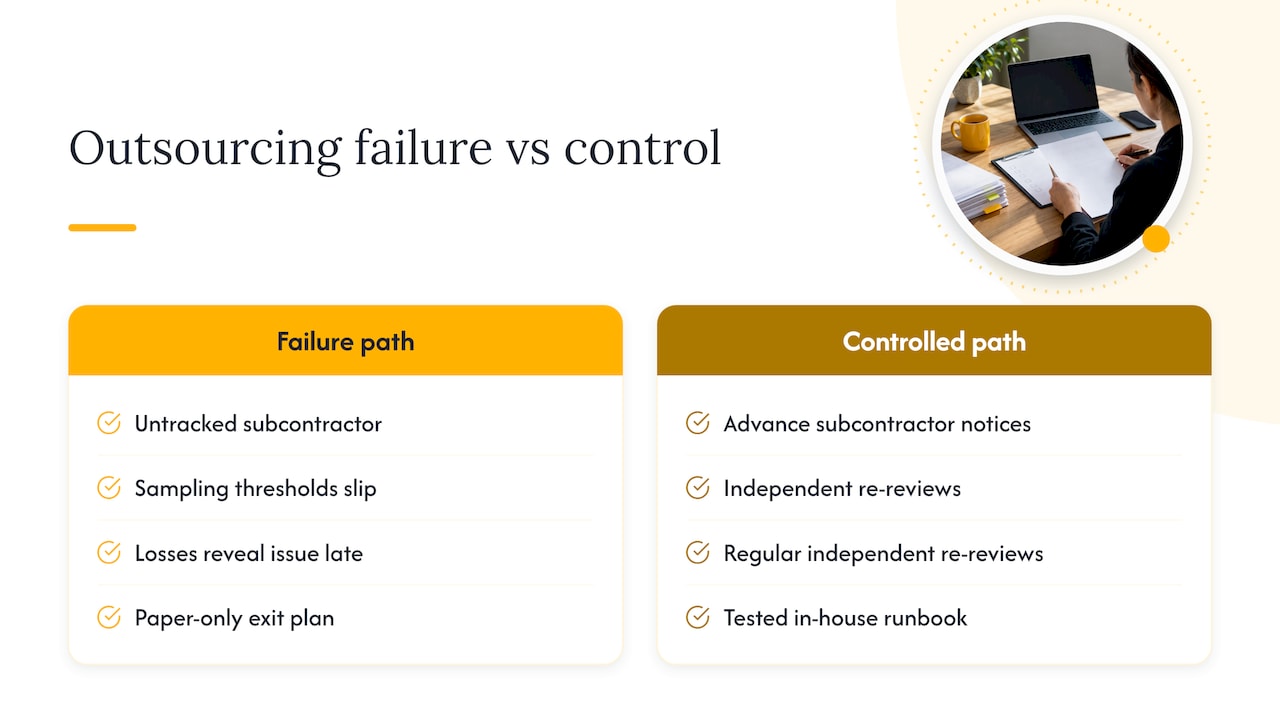
A common failure starts with a cost-driven transfer of a review queue. The contract grants audit rights on paper, but nobody exercises them. Over time the provider adds a subcontractor for overnight shifts, sampling thresholds slip, and the institution learns of the problem only when losses climb. The root causes are familiar: no active inventory of subcontractors, no independent re-review, and an exit plan that existed only as a document. This is what practitioners mean by a black box.
A common success looks quieter. The institution tiers the provider as critical, runs regular independent re-reviews, receives subcontractor change notices before they take effect, and holds a tested runbook for pulling the function back in-house. When a site disruption or staffing problem hits, the team shifts volume under a rehearsed plan instead of improvising. Nothing dramatic appears in the news, which is the point.
The difference between the two is rarely the provider’s brand or location. It is whether the buyer kept visibility, enforced the contract and practiced the transition. The OCC’s community bank guide emphasizes exactly this: contingency planning, including the ability to transition activities in-house, is part of the relationship from day one.
What I have seen go right when teams rehearse the exit
Most pitfalls are dull, not dramatic: a runbook nobody has opened, an audit right nobody has used. Teams that rehearse the transition tend to turn a provider outage into an inconvenience rather than a crisis. Do the drill before you need it. Our blog covers related controls in more depth.
— Daniela
How can we help you manage outsourced operations with audit-ready controls?
We provide a managed nearshore team extension. That structure can lower transition risk while keeping oversight in your hands. Review our services to see how they fit your fraud and review operations.

FAQ
Does outsourcing transfer liability to the provider?
No. Regulators maintain that the institution remains fully accountable for outsourced functions, so you must be able to perform or transition the work in-house, as the FDIC examination guidance explains. Contracts can allocate cost through indemnities, but they cannot shift your regulatory responsibility.
How often should you audit a fraud-operations provider?
Frequency follows risk. SR 23-4 calls for oversight scaled to the activity, so a critical, high-volume fraud-review function warrants more frequent monitoring than a low-risk vendor. Combine continuous KPI and KRI tracking with periodic independent testing and re-reviews.
What belongs in an exit plan?
A workable plan covers data escrow, current runbooks, knowledge-transfer timelines and who performs the work during transition. The OCC community bank guide recommends contingency planning that includes the ability to move activities in-house. Test it with a drill, since an untested plan is only a document.
What are warning signs of provider-side fraud or control failure?
Watch for unexplained access to cases outside an agent’s queue, sudden subcontractor changes, slipping quality samples and slow or incomplete answers to audit requests. Rising chargebacks or complaint patterns tied to one team also deserve attention. Practitioners warn that outsourcing creates black boxes when oversight is thin, so opacity itself is a signal.
Sources
- The Fed - SR 23-4: Interagency Guidance on Third-Party Relationships: Risk Management
- Third-Party Risk Management: A Guide for Community Banks
- Fdic