A cloud contact center can be secure when it has a clearly documented shared responsibility split, strong encryption paired with enforced identity and access management, and continuous telemetry feeding a security information and event management (SIEM) platform. The rest of this guide walks through how to verify each condition before you sign a contract.
TL;DR:
- Before signing, assign each control to the provider or your team, and require a current SOC 2 report, audit rights, and breach deadlines in writing.
- Require TLS for web and API traffic, SRTP for voice with TLS signaling, clear encryption key ownership, enforced MFA, and expiring agent access.
- Request sample management, API, and call logs before signing, then verify they feed your SIEM; access alone does not ensure usable monitoring.
- For healthcare deployments, require a BAA; verify recording location and retention, data residency, and support for customer access or deletion requests.
- Review each integration’s data flows and permissions, use narrowly scoped API keys, and repeat the review whenever a new connection is added.
Table of Contents
- What a cloud contact center is and why security scope shifts in the cloud
- Shared responsibility: roles, contract items, and customer-owned controls
- Technical controls to verify: encryption, IAM, and network security
- Operational controls and compliance: attestations and documentation to require
- Monitoring, telemetry, and incident response: what to request and test
- Multi-cloud and hybrid security challenges for CCaaS deployments
- Procurement-ready vendor selection checklist
- Data privacy considerations specific to cloud contact centers
- Security implications of third-party integrations and APIs
- Physical security for nearshore contact center operations
- Disaster recovery and business continuity for cloud contact centers
- Balancing security, cost, and operational realities in CCaaS selection
- FAQ
- Sources
What a cloud contact center is and why security scope shifts in the cloud
A cloud contact center, often called Contact Center as a Service (CCaaS), hosts voice, chat, and messaging channels alongside CRM integrations, analytics dashboards, and a set of platform APIs that connect everything together. None of it lives on your own servers. The provider runs the infrastructure; you configure how it is used.
That shift changes who owns which risks. In a traditional on-premises deployment, your IT team controlled the network, the hardware, and the software stack end to end. In a cloud deployment, the provider manages the underlying infrastructure and uptime, while you remain responsible for how identities are provisioned, how data is classified, and how integrations are configured. NIST SP 800-144 frames this as a need to extend your existing governance practices into the cloud rather than assume the provider has already covered them.
For buyers, this creates a few immediate implications:
- Contracts need explicit language defining which party owns which control, not vague assurances of “enterprise-grade security.”
- Audit rights should be negotiated up front, since you cannot verify what you cannot inspect.
- Every third-party integration (CRM, workforce management, analytics) needs its own access and data-flow review, since it extends the attack surface beyond the core platform.
Treating a CCaaS purchase as a software subscription rather than a security partnership is where most gaps start.
Shared responsibility: roles, contract items, and customer-owned controls
The shared responsibility model is an operational boundary, not a marketing slide. The provider typically secures the physical data centers, host infrastructure, and the core platform code. You retain responsibility for identity configuration, agent-level access, data classification, and how your teams actually use the tool day to day. The shared responsibility model still requires customers to maintain and document their own controls, including multi-factor authentication and role-based access, even on a well-secured platform.
Before signing, push for these contract items:
- A current SOC 2 report, not just an attestation.
- Written audit access or the right to request independent assessment results on a defined cadence.
- A commitment to SIEM or telemetry export in a usable format, not a locked-down dashboard.
- Defined breach notification timelines, stated in hours or days rather than “promptly.”
On your side of the line, a few operational tasks stay yours no matter how good the vendor is: enforcing MFA for every agent and admin account, applying role-based access control (RBAC) and least-privilege provisioning, classifying what data agents can see by sensitivity, and running a regular risk assessment against your own usage patterns. A board-level view of data security in BPO partnerships walks through how these customer-owned controls translate into governance decisions at the leadership level.
Pro Tip: Ask your vendor to map each control in their SOC 2 report to a clause in your contract. If they can’t, the report is decorative.
Technical controls to verify: encryption, IAM, and network security
Vendor claims are easy to make and hard to verify without specifics. Ask for the following, by name, and request documentation rather than a verbal confirmation.
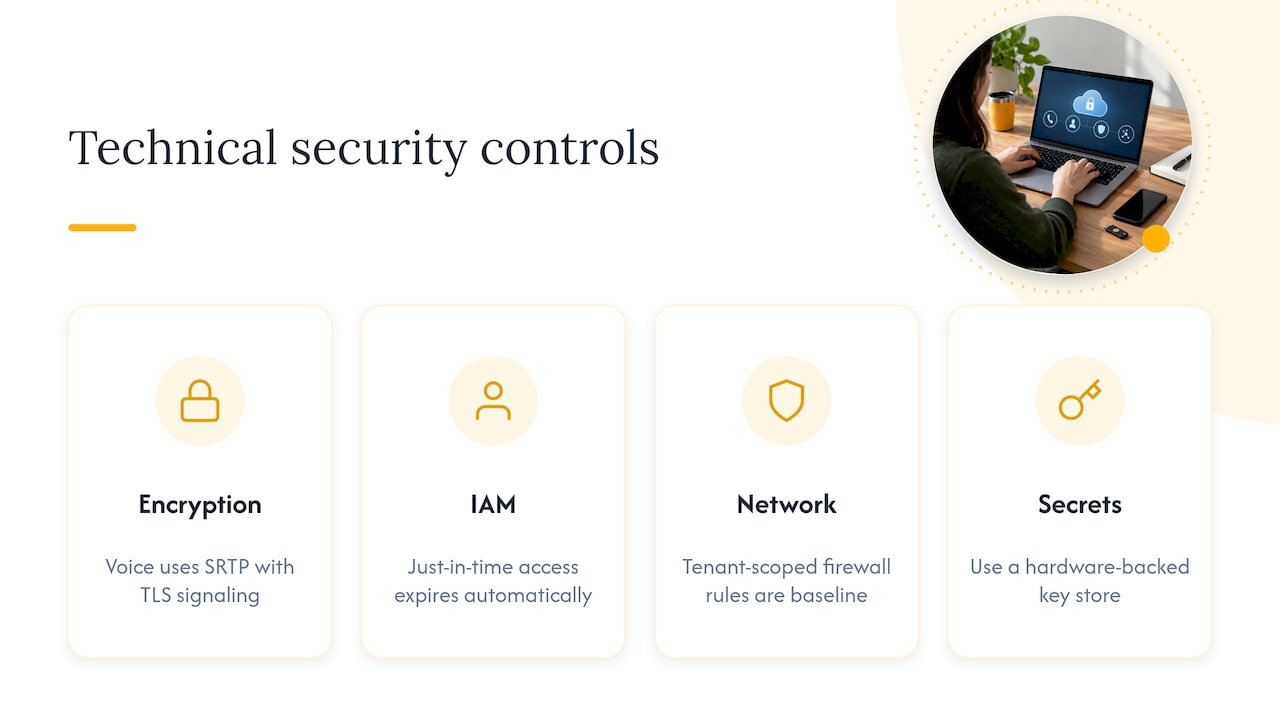
Encryption. Web and API traffic should run over TLS, voice traffic should use SRTP combined with TLS for signaling, and data at rest needs encryption with clear key management: either the provider’s managed key service or a customer-managed key (CMK) option. Ask who holds the keys and whether you can rotate or revoke them independently of the vendor.
Identity and access management. Enforced MFA should be non-negotiable, and single sign-on through your existing identity provider (IdP) should be supported, not bolted on. Look for role-based access control with just-in-time provisioning, so a temporary agent’s access expires automatically rather than lingering as a forgotten account.
Network and API security. Secure SIP termination, firewall rules scoped to your tenant, and tenant isolation patterns (so another customer’s misconfiguration cannot touch your data) are baseline expectations. AWS guidance on implementing security controls organizes this work into preventative, proactive, detective, and responsive layers, using tools like GuardDuty and Security Hub to automate detection across each layer.
Secrets and credential hygiene. Ask about rotation policies for API keys and service accounts, and whether secrets are stored in a hardware-backed key store rather than embedded in configuration files.
A defense-in-depth approach that pairs preventative, detective, and responsive controls with vendor log integration into a customer-owned SIEM is a core recommendation in current cloud security guidance for continuous monitoring across cloud environments.
Treat any vendor who cannot answer these questions in writing as a flag for further diligence, not a reason to walk away without asking twice.
Operational controls and compliance: attestations and documentation to require
Certifications matter less for the logo and more for what they force a vendor to document and repeat. Several attestations may be relevant in a CCaaS evaluation:
- SOC 2, which can provide evidence about whether controls operated as described.
- ISO/IEC 27001, which demonstrates a formal information security management system rather than ad hoc policies.
- HIPAA documentation, including a Business Associate Agreement (BAA), when protected health information may pass through the platform. Our healthcare contact center guide for operations leaders covers what HIPAA-aware vendor evaluation looks like in practice, and the HIPAA risk assessment checklist from theStartupMD offers a practical starting framework for healthcare SaaS and service evaluations.
Beyond the attestations themselves, ask for the supporting evidence: a recent penetration test summary (even a redacted version), a vulnerability scan cadence, and documentation of the vendor’s internal security program, including how often it gets reassessed by a third party.
On the contractual side, three items deserve specific language rather than general promises: incident notification timelines, forensic log retention periods long enough to support an investigation, and clear data retention and deletion terms once a contract ends. NIST SP 800-144 recommends verifying these provider assurances through independent assessment rather than taking a sales deck at face value, a habit worth building into every renewal cycle, not just the initial purchase.
Monitoring, telemetry, and incident response: what to request and test
Visibility is the difference between catching an issue in minutes and discovering it in a customer complaint. A secure CCaaS deployment depends on telemetry you can actually see, not telemetry the vendor promises exists somewhere on their side.
At minimum, request access to:
- Management plane logs showing configuration changes and admin actions.
- API activity logs covering every integration touching customer data.
- Call and session metadata, including timestamps, routing, and agent identifiers.
- Admin activity logs separate from standard agent activity.
Integration matters as much as access. Ask for sample log schemas before signing, not after, so your security team can confirm the format will actually feed your SIEM or SOAR platform without a custom parser. Our compliance monitoring playbook for U.S. call centers walks through what that integration work looks like once a contract is signed, including retention and access control settings worth locking down at setup.
Incident response expectations should be explicit, not assumed. Request a copy of the vendor’s documented IR plan, ask how often they run tabletop exercises, and confirm breach notification SLAs are written into the contract rather than described as “best effort.” Post-incident reports and remediation tracking should be a standard deliverable after any confirmed event, not something you have to request each time.
Pro Tip: Ask a prospective vendor to walk through a mock incident during the sales process. How they answer tells you more than any slide deck.
Multi-cloud and hybrid security challenges for CCaaS deployments
Many CCaaS platforms run on more than one underlying cloud provider, and larger organizations often pair a CCaaS tool with other cloud services in a hybrid architecture. That mix introduces friction that a single-cloud deployment does not have to solve.
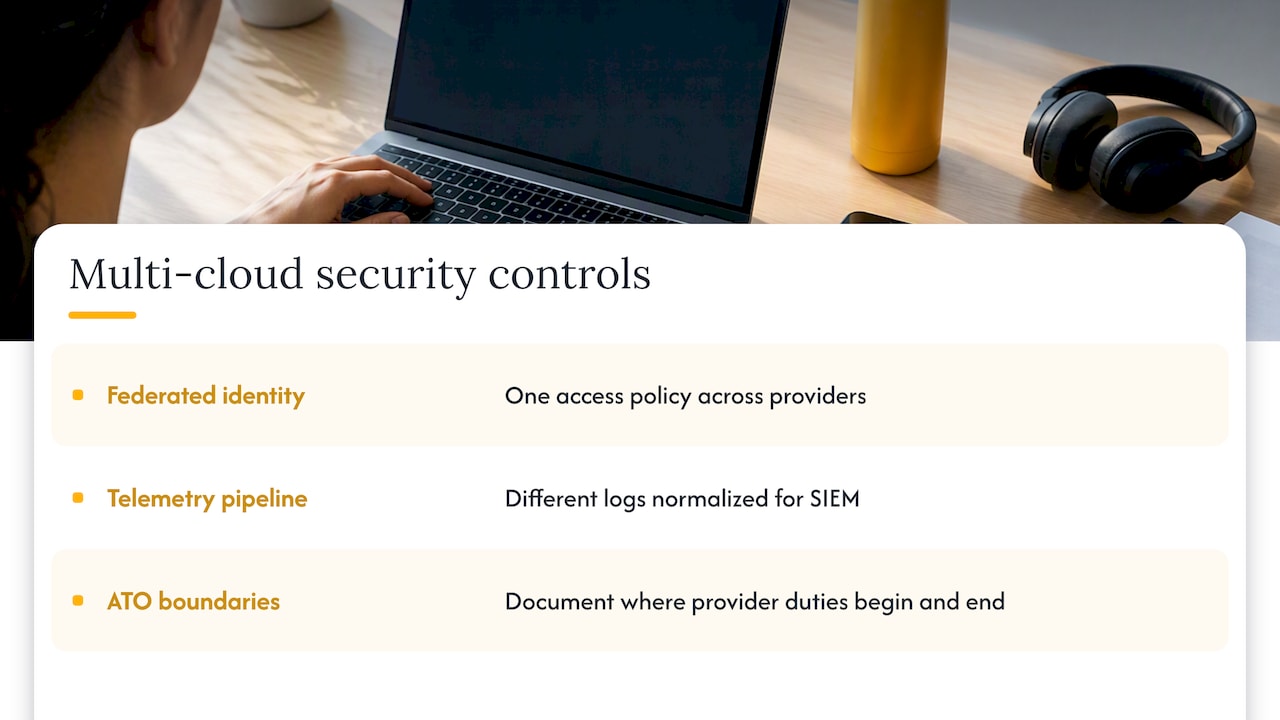
NIST IR 8613 identifies identity and access management, telemetry and logging, configuration management, data protection, and compliance as the primary challenge areas in multi-cloud architectures, largely because each provider structures these differently. Log formats vary, access models differ, and even cryptographic primitives and configuration baselines are not always consistent from one provider to the next, making uniform controls difficult to apply without extra work.
The practical fix is centralization rather than per-cloud management. A federated identity broker lets you enforce one access policy across providers instead of three separate ones. A normalized telemetry pipeline translates different log formats into a single schema before they reach your SIEM. And documented authorization-to-operate (ATO) boundaries make clear, in writing, where one provider’s responsibility ends and another’s begins, closing the gaps that attackers tend to find first.
Procurement-ready vendor selection checklist
Security claims deserve the same scrutiny as pricing claims. Use this sequence during RFPs, demos, and statement-of-work negotiations:
- Request a current SOC 2 report and review the reporting period.
- Ask for a recent penetration test summary, redacted if necessary.
- Confirm SIEM or log export capability and request a sample schema.
- Review the identity provider (IdP) integration guide for SSO and MFA support.
- Ask who holds encryption keys and whether customer-managed keys are available.
- Request the vendor’s documented incident response plan.
- Confirm breach notification SLAs in writing.
- Ask about third-party assessment cadence in addition to SOC 2 reporting.
- Review data retention and deletion terms for contract termination.
- Request details on employee background checks and remote agent access controls.
Claims should be testable, not just stated. Ask for redacted sample logs, a walk-through of a sample SIEM alert, or an excerpt from an actual incident response runbook rather than a summary slide. A live security walkthrough, scheduled separately from the sales demo, tends to surface gaps a polished pitch deck will not. SecurityScorecard’s guidance on vendor selection makes the same point: contractual security reports matter more than reputation alone when comparing providers.
Finally, confirm operational readiness beyond the platform itself: employee background check policies, remote agent device and network security requirements, and a documented cadence for vendor risk reassessment. A procurement-ready BPO due diligence checklist covers these operational questions in more depth for teams running a formal RFP process.
Pro Tip: Score each vendor response on a simple scale: documented and verifiable, documented but unverified, or undocumented. Undocumented answers are a negotiation point, not a disqualifier by themselves.
Data privacy considerations specific to cloud contact centers
Contact centers handle a concentrated stream of sensitive data: names, account numbers, payment details, and in healthcare or legal settings, protected health information or privileged case details. That concentration makes data privacy a distinct concern from general cloud security.
Start with data classification. Not every piece of information an agent sees needs the same protection level, and masking or redaction tools (hiding full card numbers during a call, for example) reduce exposure without slowing down service. Call recording and transcription features deserve particular attention: confirm where recordings are stored, how long they are retained, and whether they fall under the same encryption and access controls as live data.
Cross-border data flow is another frequent gap. If agents or servers sit in a different jurisdiction than your customers, confirm what data residency or transfer safeguards the platform supports. Consent and retention policies should align with the regulations your customers fall under, whether that is a sector-specific rule like HIPAA or a general privacy framework.
Finally, confirm your vendor supports data subject requests, meaning a customer’s right to request deletion or access to their own records, and that the process does not require a manual engineering request every time.
Security implications of third-party integrations and APIs
Every integration a CCaaS platform supports, whether a CRM, a workforce management tool, or an analytics dashboard, extends the attack surface beyond the core platform itself. A breach rarely happens at the center of a well-defended system; it happens at the edge, where a lesser-secured integration connects to it.
Each API connection should be reviewed for what data it can read or write, not just whether the integration “works.” Scoped API keys, meaning credentials limited to only the data and actions a specific integration needs, reduce the blast radius if one key is compromised. Ask whether the platform supports granular API permissions or only broad, all-or-nothing access tokens.
Review third-party app marketplaces with the same scrutiny you apply to the core platform. A CCaaS vendor may be well-secured while a popular add-on in their marketplace has weaker controls, and that gap becomes your risk the moment you install it. Request a list of data flows for every integration before go-live, and revisit that list whenever a new integration is added, since this is an area that tends to drift quietly over time without a scheduled review.
Physical security for nearshore contact center operations
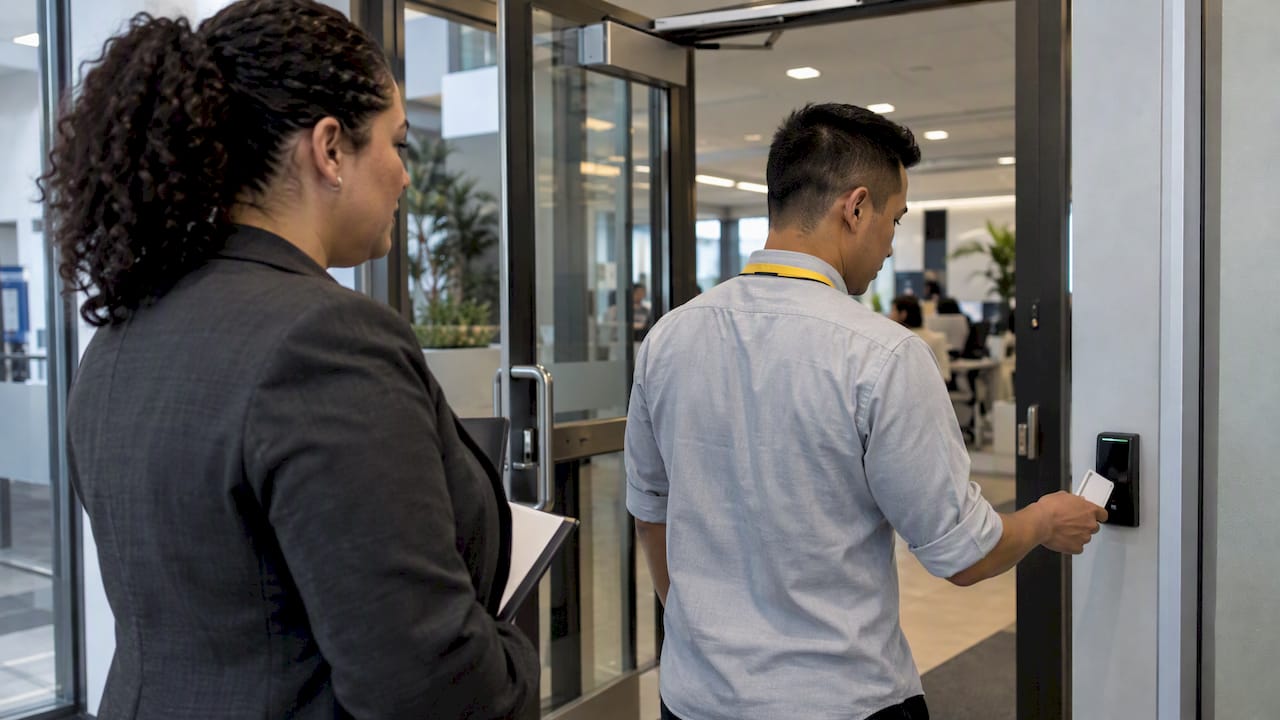
Cloud infrastructure security gets most of the attention, but nearshore contact center operations still involve physical locations where agents work, and that physical layer carries its own requirements. A secure facility should combine badge-controlled access, visitor logging, and camera coverage of workstation areas, especially where agents handle payment data or health information.
Workstation controls matter as much as building access. Clean desk policies, restrictions on personal devices at workstations, and disabled USB ports on agent machines reduce the risk of data walking out the door on a phone camera or a thumb drive. For remote or hybrid nearshore agents, physical security translates into device management: company-issued or managed devices, secured home network requirements, and screen privacy measures when agents handle sensitive calls outside a monitored facility.
Background checks for agents handling sensitive data are a baseline expectation, not an extra. A detailed remote agent security controls guide covers controls worth confirming before placing sensitive work with any nearshore team, whether agents work from a monitored facility or a secured home setup. Ask any nearshore partner how physical and device-level controls are documented and audited, since this is often the layer buyers forget to ask about until something goes wrong.
Disaster recovery and business continuity for cloud contact centers
A contact center that goes dark during a regional outage loses more than call volume. It loses customer trust at the exact moment customers are trying to reach someone. Disaster recovery (DR) and business continuity planning (BCP) for a CCaaS deployment need to go further than the generic uptime guarantee in a vendor’s marketing page.
Ask specifically about failover architecture: does the platform operate across multiple availability zones or regions, and how long does failover actually take in practice, not just in theory? Request the vendor’s documented recovery time objective (RTO) and recovery point objective (RPO), the maximum acceptable downtime and data loss window, respectively, and confirm these numbers are tested rather than estimated.
On your side, business continuity planning means having a documented fallback: an alternate channel (even a basic phone tree) if the primary platform goes down, and a clear internal communication plan for staff during an outage. Ask vendors how often they run DR tests and whether you receive a report afterward. A platform with a strong uptime history is reassuring, but a platform that can show you a recent, successful failover test is the one that has actually proven the plan works.
Balancing security, cost, and operational realities in CCaaS selection
Perfect security does not exist, and chasing it will stall a procurement cycle indefinitely. The more useful question is which controls are non-negotiable and which are reasonable trade-offs given cost and timeline. MFA, encryption, and SIEM integration belong in the non-negotiable column. A slightly longer SLA response window in exchange for a lower seat price is a legitimate trade-off, provided it is written down rather than assumed.
Vendor guarantees only work alongside your own governance: MFA enforcement, access reviews, and an annual risk assessment stay your job regardless of what the contract promises. Start with an internal risk assessment, shortlist vendors against the checklist in this guide, and schedule a technical validation call before signing anything.
— Daniela
FAQ
What is a cloud contact center?
A cloud contact center, or CCaaS, is a hosted platform that handles voice, chat, and messaging channels along with CRM integrations and analytics, without requiring on-premises hardware. The provider manages the underlying infrastructure while the customer configures access, integrations, and agent workflows.
What is Google Cloud contact center as a service?
Google Cloud offers contact center infrastructure and AI tools that integrate with broader security practices outlined in its security best practices catalog, which structures controls like IAM, key management, and logging into required and recommended implementation levels. Buyers evaluating this option should apply the same verification checklist used for any CCaaS vendor, including SOC 2 and audit access requests.
Who are the top cloud contact center providers?
Provider rankings shift frequently and depend on specific use cases like outbound sales, healthcare support, or omnichannel retail. Rather than relying on a fixed list, evaluate any provider against the shared responsibility, encryption, IAM, and telemetry criteria covered throughout this guide.
What are cloud security services?
Cloud security services are the tools and practices that protect cloud-hosted data and infrastructure, including identity and access management, encryption, network segmentation, and continuous monitoring. The Cloud Security Alliance maps these into domains like IAM, telemetry, and incident response, recommending Zero Trust principles and continuous verification rather than one-time setup.
How do I verify a vendor’s security claims before signing a contract?
Request documented evidence rather than verbal assurance: a current SOC 2 Type 2 report, a recent penetration test summary, and a sample SIEM log schema. Schedule a technical security walkthrough separate from the sales demo to confirm these controls work as described.
Sources
Consult these primary standards and provider guides when drafting your own vendor security requirements.
- NIST SP 800-144, Guidelines on Security and Privacy in Public Cloud Computing
- Cloudsecurityalliance
- AWS Prescriptive Guidance - Implementing security controls on AWS
- NIST IR 8613 ipd, Multi-Cloud Security Challenges: Understanding the Security and Compliance Implications of a Multi-Cloud Architecture