BPO SLA penalties are the contractual remedies, typically service credits, fee reductions, corrective action plans, or escalation to termination, that activate when a vendor misses an agreed performance threshold. Public guidance and filed contracts point to at-risk pools of around 5% to 15% of monthly spend, with penalties that escalate rather than jump straight to a maximum. The remedy only works when it is proportional and tied to a measurement method both sides accept.
TL;DR:
- Match remedies to the fee model: fixed price suits invoice credits, time and materials needs caps, and gain share can use its shared savings pool.
- At risk pools usually equal 5% to 15% of monthly spend, with 8% to 12% common; Ohio guidance illustrates escalating credits for repeat misses.
- Specify each KPI’s formula, authoritative data source, reporting cadence, and exclusions, such as planned maintenance and client delays, before signing to prevent disputes.
- Check the master agreement’s liability cap, require access to underlying records, and limit credits to KPIs that are critical to the business.
- When a metric is disputed, require evidence exchange and root cause analysis, then set a timed corrective plan and clear earn back conditions for recovery.
Table of Contents
- 1. Types of penalties and remedies when SLAs are missed
- 2. How penalties and service credits get calculated
- 3. Benchmark examples from public guidance and filed contracts
- 4. Measurement governance that keeps penalties enforceable
- 5. Contract clauses that determine whether credits have real value
- 6. How Altiam CX operationalizes SLA governance in practice
- 7. Why proportionate, escalated penalties protect the partnership
- How we help implement accountable SLAs
- FAQ
- Sources
1. Types of penalties and remedies when SLAs are missed
Not every missed metric deserves the same response, and the strongest contracts match the remedy to the severity and pattern of the breach. A single late report calls for a different response than a customer care queue that blows its answer-time target for three straight months.
The remedies that show up most often in outsourcing agreements include:
- Service credits: a reduction applied against a future invoice, calculated against the at-risk pool.
- Rebates or fee reductions: a direct discount on the period’s billing tied to the severity of the miss.
- Corrective action plans: a formal, time-bound plan requiring root-cause analysis and a fix.
- Step-in rights or escalation: our client gains oversight or direct involvement in the failing process.
- Termination for cause: reserved for repeated or severe breaches that corrective plans fail to resolve.
A one-off miss on a critical KPI typically triggers a credit and a corrective action plan, while persistent failures justify escalating credits or termination rights. The fee model matters too: fixed-price engagements lean on credits against a known invoice amount, time-and-materials contracts often need caps to prevent runaway deductions, and gain-share models can tie penalties to the shared savings pool instead of a separate credit mechanism. Choosing the wrong remedy for the fee structure is one of the more common drafting mistakes we see in contracts headed for renegotiation.
2. How penalties and service credits get calculated
The math behind service credits determines whether a penalty actually changes vendor behavior or just sits in the contract as a formality. Most frameworks start with an at-risk pool, a defined percentage of monthly fees that is available for credits if service levels slip.
- Set the pool size. Guidance from Pillsbury’s outsourcing practice points to a common range of 5% to 15% of monthly spend, with 8% to 12% appearing frequently in practice.
- Allocate the pool across KPIs. Weight critical measurements (system uptime, average handle time, first-call resolution) more heavily than informational ones.
- Build in escalation. A first miss might trigger discretionary review, a second miss a defined credit, and a third a larger one.
- Cap monthly exposure. Most agreements cap total monthly credits as a percentage of fees so one bad month does not threaten the vendor’s ability to keep delivering.
- Reallocate periodically. Revisit weighting as the engagement matures and priorities shift, since a KPI that mattered most at go-live may not carry the same weight a year later.
At-risk pools commonly run between 5% and 15% of monthly spend, with 8% to 12% cited as the typical range. That range gives enough financial weight to matter without threatening the vendor’s margin on the engagement. An illustrative escalation structure might leave the first miss to management discretion, apply a 10% credit on the second occurrence within a quarter, and move to 20% on the third, numbers drawn from Ohio’s contract performance guidance as an illustrative framework rather than a universal standard.
3. Benchmark examples from public guidance and filed contracts
Several public sources give operations leaders language and ranges to cite directly in negotiation, rather than relying on a vendor’s first draft.
- Ohio’s contract performance and SLA guidance illustrates gradual escalation, discretionary response on a first miss, moving to 10% and then 20% of a payment schedule for repeated failures, and recommends tailoring remedy types to the contract’s purpose.
- The FDIC’s guidance on managing technology providers recommends objective measurement, a balanced at-risk pool, and credit structures sized to matter without undermining the provider’s ability to deliver.
- A publicly filed outsourcing agreement separates “critical” measurements, which carry credit eligibility, from “key” measurements that are tracked for information only, a distinction worth copying into any new SLA schedule.
FDIC guidance recommends sizing service level credits to be meaningful without destroying supplier viability, a principle that should guide every number written into the penalty schedule. Treating every KPI as credit-eligible dilutes the pool and weakens the incentive on the metrics that actually matter to your customers.
4. Measurement governance that keeps penalties enforceable
A penalty clause is only as good as the measurement rules behind it, and vague metrics are the single most common reason SLA disputes drag on for months. The governance section of the contract should answer four questions before anyone signs: what is being measured, how, how often, and using whose data.
- Define the unit and formula. State exactly how a metric like average handle time or first-response time is calculated, down to the inclusions and exclusions.
- Name the authoritative data source. Specify which system of record governs when the vendor’s numbers and the client’s numbers disagree.
- Set the measurement interval and reporting cadence. Monthly reporting is standard for most customer care and back-office metrics.
- List exclusions explicitly. Planned maintenance windows, force majeure events, and client-caused delays should be written out rather than assumed.
Disputes should follow a defined path: evidence exchange, a root-cause analysis within an agreed window, a corrective action plan, and an earn-back provision that lets the vendor recover withheld credits once performance stabilizes. SEC-filed outsourcing agreements commonly include this root-cause-to-earn-back sequence, which keeps the relationship focused on recovery rather than a single punitive event. For more detail on avoiding the KPI selection mistakes that drive these disputes in the first place, see our call center SLA rules.
Pro Tip: Require the vendor’s monthly performance report to cite the same data source named in the contract, not a summary dashboard, so disputes never start with “whose numbers are right.”
5. Contract clauses that determine whether credits have real value
A generous-looking credit percentage means little if a limitation-of-liability clause elsewhere in the master agreement caps total damages below that amount. Before relying on any penalty structure, operations and procurement teams should check the clauses that interact with it.
- Review the limitation of liability first. A filed contract exhibit shows how damage caps can blunt a credit that looks substantial on paper.
- Draft earn-back language explicitly. Define the window and conditions under which a vendor recovers withheld fees after sustained performance improvement, following the pattern in filed outsourcing agreements.
- Tie corrective action to a timeline. Root-cause analysis within days, a written plan shortly after, and a defined remediation window keep the process from stalling.
- Negotiate fewer, higher-impact KPIs. A pool split across a dozen metrics dilutes every individual credit; five or six business-critical measures preserve financial weight, a point also raised in our KPI tiering guidance.
- Secure audit rights and reasonable evidence standards. Access to underlying records, not just summary dashboards, prevents disputes over whose data counts. Readers building out a broader KPI dashboard for this purpose may find this list of dashboardable business metrics useful for deciding which ones justify a credit attachment.
6. How Altiam CX operationalizes SLA governance in practice
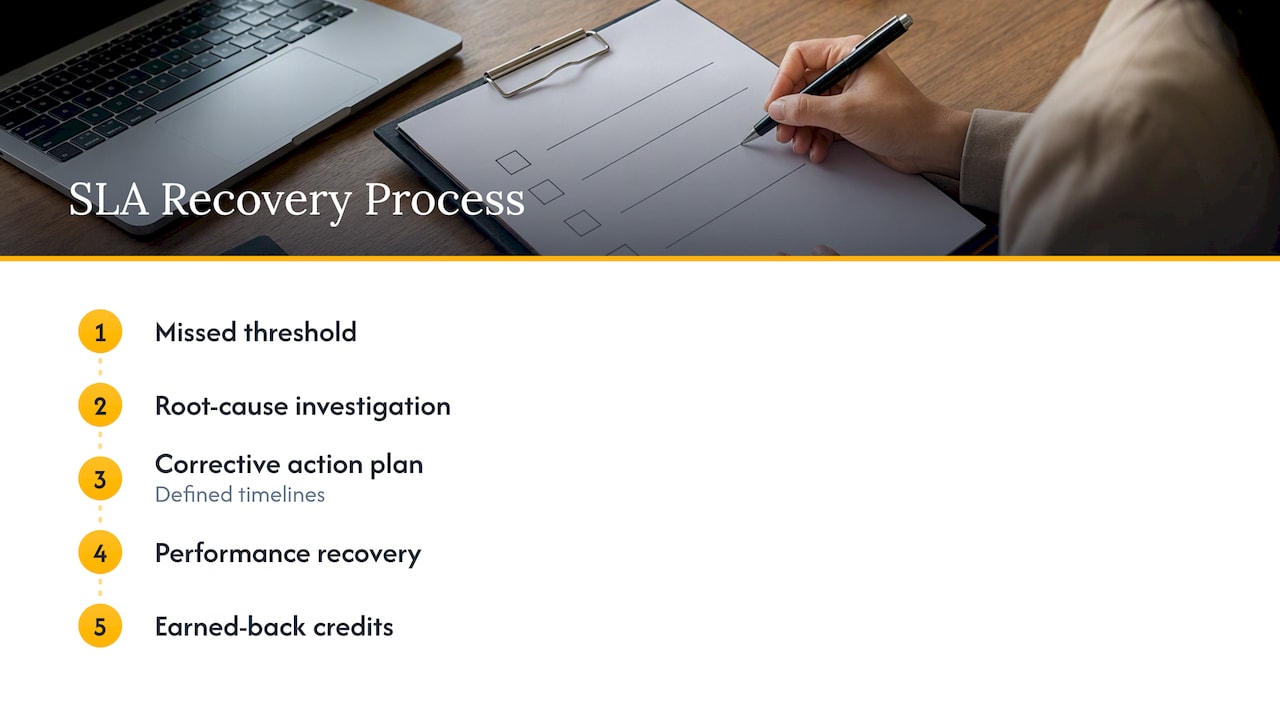
Governance only works when it is lived day to day, not filed away after signature. We run root-cause investigations on missed thresholds, document corrective action plans with defined timelines, and apply earn-back mechanics once performance recovers, mirroring best practices found in filed outsourcing agreements rather than treating a penalty as a one-time event.
That discipline matters most in nearshore team-extension models, where bilingual staff and scalable deployment only deliver value if performance stays measurable month over month. We built our reporting cadence around the same principle regulators and procurement guidance recommend: objective measurement, agreed data sources, and corrective steps that actually change outcomes.
7. Why proportionate, escalated penalties protect the partnership
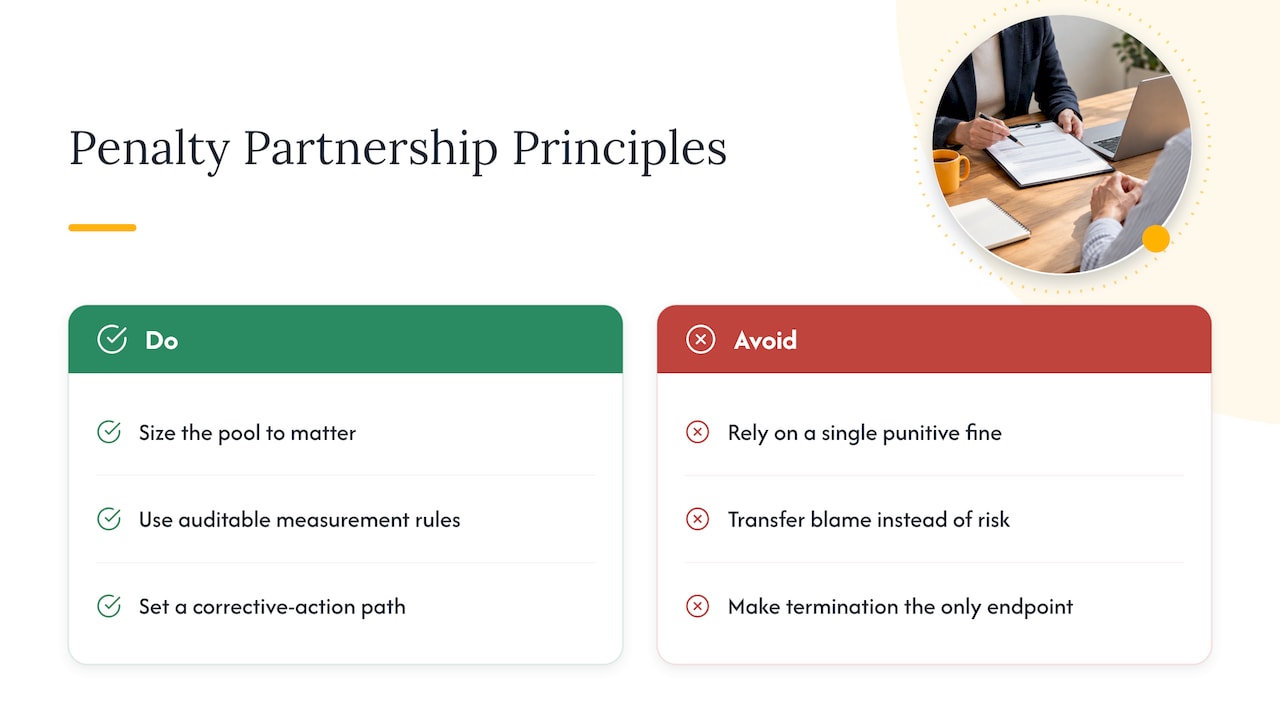
A single punitive fine rarely fixes an operational problem; it just moves the relationship into defense mode. Escalation paired with earn-back gives a vendor the incentive to invest in recovery instead of disputing the measurement.
Before accepting any penalty proposal, operations leaders should check for three things: a pool sized to matter without threatening viability, measurement rules both sides can audit, and a corrective-action path that leads somewhere other than termination. Penalties should transfer risk, not transfer blame.
— Daniela
How we help implement accountable SLAs

We build measurable accountability into every managed engagement rather than treating SLA language as paperwork. Through our Customer Experience and Managed Team Extension services, we set up at-risk pools, define measurement governance, and run the root-cause and earn-back cycle described above as part of day-to-day operations, not as a once-a-year compliance exercise.
- For regulated healthcare operations, our Managed Customer Support and Patient Support & SOP Management engagements build governance around compliance-sensitive metrics.
- For legal intake and back-office workflows, our Legal Intake & Inquiry Handling and Managed Legal Team Extension services apply the same measurement discipline to case communication and scheduling.
- Readers who want a closer look at outcomes can review our legal services back-office case study.
If you are drafting or renegotiating an SLA schedule, reach out through our services page to request a sample clause set or scope a pilot engagement with governed reporting built in from day one.
FAQ
What does SLA stand for in call centers?
SLA stands for service level agreement, the contractual document that sets measurable performance targets, such as average answer time or resolution rate, between a call center and its client. It typically defines the metric, the target, the measurement method, and the remedy if the target is missed.
What are the three types of SLA?
The three common types are customer-based (covering all services for one client), service-based (covering a specific service across clients), and multi-level, which layers corporate, customer, and service-specific commitments. BPO contracts most often use service-based or multi-level structures to separate critical metrics from informational ones.
What is SLA P1, P2, P3, P4?
P1 through P4 are priority levels used mainly in technical support and incident management, with P1 representing a critical, service-down issue requiring the fastest response and P4 representing a low-impact issue with a longer resolution window. Each priority level typically carries its own response and resolution time target within the SLA.
What to do if SLA is breached?
Start with the evidence exchange and root-cause analysis the contract requires, then move to the corrective action plan and apply whatever remedy the agreement specifies, whether a service credit, fee reduction, or escalation. Ohio’s contract performance guidance recommends starting with proportional remedies and reserving termination for repeated or severe failures.
Sources
These sources ground the ranges and clause language used throughout this guide:
- Tools to manage technology providers’ performance risk: Service Level Agreements — FDIC
- Ohio contract performance and SLA guidance (contract performance and service level agreements)
- SEC Exhibit: outsourcing agreement (example with measurement and earn-back language)
- Pillsbury law guidance on outsourcing SLAs and service level credits