Before you trust a single number on your SLA dashboard, confirm three things: the exact formula being used, the measurement window it’s calculated over, and who owns the metric operationally.
TL;DR:
- Verifying the exact formula, measurement window, and operational ownership of metrics is critical to confirm the SLA’s enforceability and accuracy.
- Using interval-level data for reporting helps detect operational issues that monthly aggregates might mask, especially during short-term performance dips.
- Building SLA targets based on historical data, forecasting models, and adjusting for seasonality ensures more realistic, achievable service levels.
- Improving response times relies heavily on forecasting accuracy, schedule adherence, and operational tactics like faster reforecasting and agent support tools.
- Differentiating between SLA and OLA helps identify whether breaches are external performance failures or internal process gaps needing resolution.
Table of Contents
- What Belongs in an Enforceable Call Center SLA?
- What Are the Core Call Center Performance Metrics?
- How Do You Negotiate Realistic SLA Targets?
- What Actually Moves Call Center Response Time?
- SLA vs OLA: What’s the Difference?
- What PCI Rules Apply to Call Center Payments?
- Quick Wins: Auditing Your SLA This Week
- Why Most SLA Failures Are Governance Failures, Not Staffing Failures
- A Managed Path to Consistent SLA Delivery
- Sources
What Belongs in an Enforceable Call Center SLA?
An SLA that can’t be verified is just marketing language dressed up as a contract. Enforceability comes from precision, not intention.
Start by separating three terms that get used interchangeably but mean different things. The SLA is the external commitment, the number your client or executive sponsor sees. The SLO (service level objective) is the internal target your operation runs against, often set slightly tighter than the SLA to build in a buffer. The SLI (service level indicator) is the raw-measured data, like actual answer times pulled from your ACD. Confuse these three and you’ll find yourself arguing over whose number is “real” during a breach dispute.
A defensible SLA document needs six components:
- Metric definition with an exact formula, not a description
- Measurement window (30 minute interval, daily, or monthly)
- Exclusions (holidays, force majeure, planned outages)
- Reporting cadence and format (who gets what data, how often)
- Penalty or credit mechanism tied to specific breach thresholds
- Named operational owner accountable for the metric
Measurement window choice matters more than most contracts acknowledge. A center that misses service level in three 30-minute intervals during a lunch rush but hits target for the rest of the day can still show a “compliant” monthly average. Interval-level aggregation catches operational pain that monthly rollups hide, which is exactly why reporting requirements should specify interval-level data rather than daily or monthly summaries alone.
What Are the Core Call Center Performance Metrics?
Every SLA rests on a handful of metrics, and getting the formulas exactly right prevents disputes later.
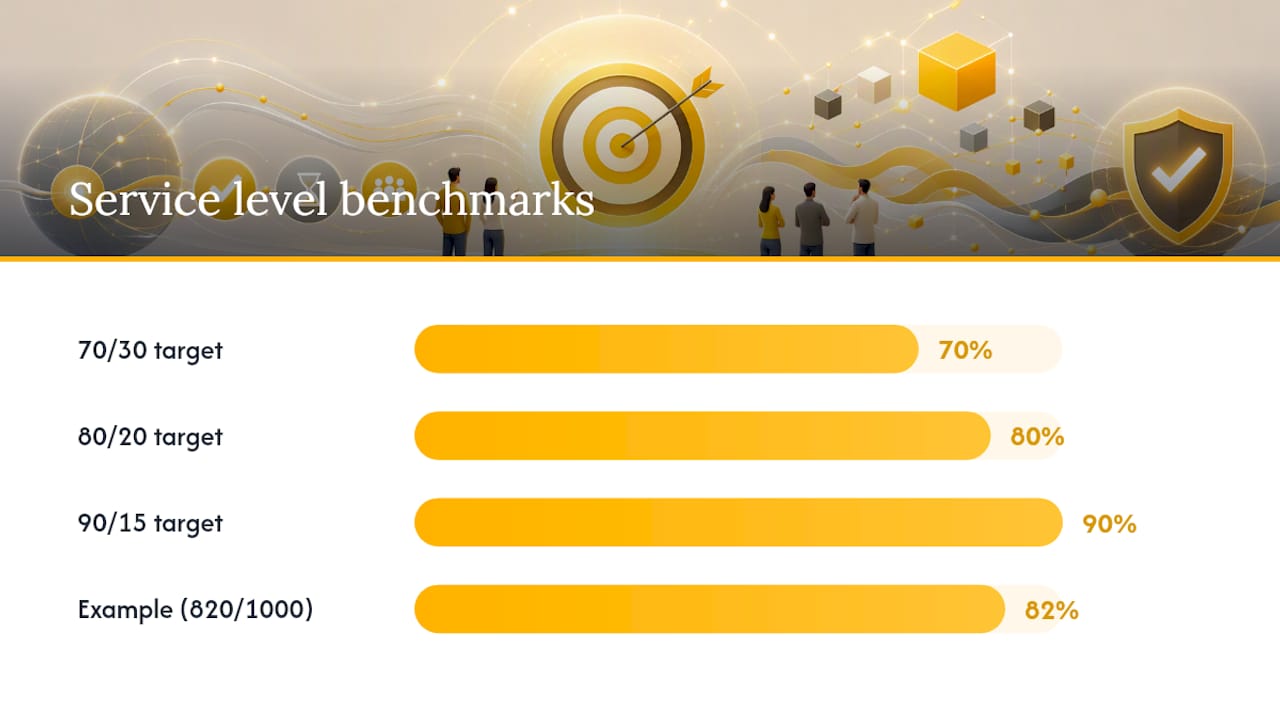
Service level is the percentage of calls answered within your threshold: (calls answered within X seconds ÷ total calls offered) × 100. If you answered 820 of 1,000 calls within 20 seconds, your service level is 82%. This is the metric behind the industry’s default 80/20 benchmark, though 70/30 and 90/15 targets are common depending on call urgency.
Pro Tip: Service level and Average Speed of Answer measure different things and both belong on your dashboard. Service level is a distribution (“what percent hit the threshold”), while ASA is a mean. Averages hide outliers. A center can post a strong ASA while a chunk of callers wait far longer than the threshold suggests.
Other core metrics:
- Average Handle Time (AHT): talk time + hold time + after call work, divided by calls handled
- First Call Resolution (FCR): calls resolved without follow up ÷ total calls, typically 70 to 79% industry wide, with top performers clearing 80%
- Abandonment rate: calls disconnected before answer ÷ total calls offered
- CSAT: post interaction survey score, usually a 1 to 5 scale converted to a percentage
FCR deserves special attention because it’s a leading indicator, not a lagging one. Each percentage point gained in FCR tends to lift CSAT alongside it, which makes it one of the few metrics worth over investing in. Set your targets by call type: billing disputes tolerate a slower answer than a medical intake line or a fraud alert queue.
How Do You Negotiate Realistic SLA Targets?
Many SLA breaches originate from targets set without sufficient data or realistic forecasting during agreement.
Build your proposal from data, not optimism.
- Pull 90 days of historical volume and AHT data, then run it through an Erlang C staffing model to calculate the agent count needed to hit your proposed service level at expected volume.
- Add a ramp clause covering the first 60 to 90 days of a new program, since hiring and training lag volume commitments.
- Specify seasonality adjustments in writing, particularly for retail, tax, or healthcare open enrollment spikes.
- Define reporting requirements explicitly: raw interval data, dashboard access, and a delivery deadline (many contracts specify daily summaries with weekly detail and a formal monthly report).
- Set penalty structure as tiered credits (a 2% miss costs less than a 10% miss) rather than a single cliff, and cap the at risk percentage of contract value.
Pro Tip: Never accept a penalty structure without a matching change control clause. If the client adds a new call type or triples volume mid-quarter, your SLA needs a documented mechanism to renegotiate the target, not just eat the miss. Accurate forecasting through tools like contact center forecasting methods makes this negotiation far easier to win, because you’re proposing a number backed by math instead of a guess.
Governance cadence closes the loop: monthly business reviews, a documented escalation path for repeat misses, and a 30 day notice period for any target change.
What Actually Moves Call Center Response Time?
Setting the target is the easy part. Hitting it consistently comes down to a handful of operational levers, and most centers are only pulling one or two of them.

Forecasting accuracy is the foundation. Conduct intraday reforecasting when actual call volumes deviate significantly from projections, allowing real-time adjustments to staffing and routing.
Schedule adherence is where forecasts die in practice. A center can build a perfect schedule and still miss service level if agents are running 12 minutes over their scheduled login time. Real time adherence alerts, paired with a documented escalation path for supervisors, catch this before it compounds across a shift.
Other high leverage fixes:
- Audit IVR menus quarterly; a confusing tree inflates handle time before an agent even answers
- Offer callbacks during volume spikes instead of forcing hold time, and give an honest ETA
- Equip agents with screen pops and a searchable knowledge base to cut AHT without cutting resolution quality
- Run interval-level post-mortems on missed intervals, not just monthly retrospectives
Pro Tip: A single intraday reforecast combined with a same-day adherence audit often recovers a missed service level interval before it drags down the monthly average. Waiting until the next planning cycle to react is how a bad Tuesday becomes a bad month. Workforce interventions along these lines are covered in more depth in workforce optimization case notes, and handle time specific tactics show up in customer care workflow improvements.
SLA vs OLA: What’s the Difference?
An SLA is the promise you make to a customer or business stakeholder. An OLA (operational level agreement) is the internal contract between teams that makes that promise deliverable. The distinction matters because SLA breaches trigger financial penalties, while OLA breaches point to internal process gaps that need fixing before they become customer facing.
Build OLAs after the SLA is signed, not before, mapping each SLA metric to an internal owner:
- Service level target → WFM team owns forecast accuracy and staffing plans
- AHT target → training team owns onboarding curriculum and knowledge base quality
- FCR target → escalation team owns tier 2 handoff speed and documentation
- Abandonment target → IT owns IVR uptime and routing logic
Each mapping should include an escalation path and a response time commitment. If a team consistently misses its OLA, that’s your root cause report before the customer ever sees a missed SLA.
What PCI Rules Apply to Call Center Payments?
If your call center takes phone payments, your SLA and your PCI compliance posture can work against each other unless you build them together from the start.
Pause and resume recording, where an agent manually stops and restarts call recording during card entry, has become an increasingly fragile compliance strategy. Under PCI DSS 4 guidance, this manual approach carries real audit risk because it depends on human timing rather than system architecture. DTMF masking, which strips card tone data from the recording and voice path entirely, is the more defensible fix. Done right, it can shift a center’s compliance burden from a full SAQ-D assessment down to a lighter SAQ-A, cutting both scope and audit cost significantly.
Before signing with any payment vendor, require:
- A current Attestation of Compliance (AoC), not an expired or self reported one
- An architecture diagram showing exactly where card data flows and where it’s masked
- Documented evidence of scope reduction, not just a vendor’s marketing claim
Budget real implementation time. Masking architecture, agent retraining, and a fallback manual process for system outages typically take a full quarter to deploy correctly, not a weekend.
Quick Wins: Auditing Your SLA This Week
You don’t need a full contract renegotiation to start improving your numbers this week.
Run through this in order: verify every metric formula against what’s actually contracted, confirm your measurement window matches what the client expects, map OLAs to each SLA metric, fix your top operational cause of misses, and lock in a reporting cadence in writing.
| Quick win | Time to implement | Impact |
|---|---|---|
| Real time dashboard alert | Days | Catches interval misses before they compound |
| One intraday reforecast | Same day | Corrects staffing mismatch mid-shift |
| Callback rollout for peak hours | 1 to 2 weeks | Cuts abandonment without adding headcount |
Why Most SLA Failures Are Governance Failures, Not Staffing Failures
The pattern I keep coming back to is this: when a call center SLA breaks down, everyone blames headcount first. Almost every root cause analysis I’ve seen actually traces back to two things, forecast error and unclear ownership.
Centers that hit their numbers consistently share a habit: they treat forecasting as a discipline that gets revisited daily, not a spreadsheet built once a quarter. They also know exactly who owns each metric before a miss happens, not after. Altiam CX’s work with clients on team extension programs reflects this pattern directly. The centers that struggle aren’t usually short on talent. They’re short on governance discipline and a forecast anyone trusts.
— Daniela
A Managed Path to Consistent SLA Delivery
Altiam CX supports organizations that need SLA delivery without building an entire workforce management function from scratch. We combine bilingual nearshore agents, disciplined forecasting, and measurable performance frameworks so your service level, AHT, and FCR targets are backed by real operational infrastructure, not a spreadsheet promise.

If your current SLA misses trace back to staffing gaps or inconsistent adherence, a managed team extension model closes that gap faster than a hiring cycle allows. Our orthodontic services case study shows how a specialized vertical improved customer experience metrics under a managed model, and our work in outsourced technical support shows the productivity gains possible when forecasting and adherence are handled by a dedicated partner. Reach out to talk through your current SLA targets and see whether a nearshore team extension fits your operation.
Sources
- Contact Center SLAs — What to Include and How to Set Them | HiveDesk
- Call Center SLAs: Metrics, Targets, and How to Set Them