
Compliance monitoring is the continuous program that proves every customer interaction, voice, chat, and email, met the law and your internal policy. It is not the same as quality assurance, though the two share tooling. Start this week by inventorying which regulations apply to each queue and pulling a baseline sample of historical calls. The Federal Trade Commission (FTC) and PCI Security Standards Council (PCI SSC) both publish the standards your scorecards need to reflect, and a partner builds monitoring programs against those exact frameworks.
TL;DR:
- Compliance monitoring programs must prioritize documented consent, data redaction, and identity verification for high-risk calls such as payment, health, or DNC-related interactions.
- Regular calibration of AI tools against human reviewers is essential to ensure detection accuracy before full deployment, reducing the mean time to remediation from weeks to days.
- Violations like delayed DNC list updates, storing unredacted card data, or lacking prior identity verification can lead to immediate enforcement actions, emphasizing rapid fixes.
- Vendors handling call infrastructure must have clear contractual compliance obligations, with regular checks to prevent third-party violations and mitigate liability.
- Training should target specific regulation requirements with real call examples, triggered by violation trends, and include transparent communication about monitoring technology to foster employee engagement.
Table of Contents
- What Compliance Monitoring Call Centers Actually Cover
- Key U.S. Laws and the Call-Level Checks That Prove You Follow Them
- Building an Audit Checklist and Scoring Model That Holds Up
- Sampling vs. 100 Percent AI-Driven Monitoring: Running the Pilot Safely
- Turning Flags Into Fixes: Workflow, Routing, and Coaching
- The Compliance Scorecard Leaders Actually Need
- Common Pitfalls That Turn Into Enforcement Actions
- Third-Party Vendor Management and Compliance Obligations
- Employee Training and Awareness Programs
- Keeping Up With Legal and Regulatory Changes
- What Actually Breaks Compliance Programs
- How Altiam CX Supports Compliance Monitoring Programs
- Primary Sources Worth Bookmarking
- Sources
- FAQ
What Compliance Monitoring Call Centers Actually Cover
Compliance monitoring call centers rely on isn’t a single checklist. It’s a stack of four layers that overlap on every interaction: the law, your disclosure scripts, how you handle data, and your own internal policy. Miss one layer and you can pass a quality audit while still carrying real legal exposure.
Channels behave differently under the same rules. A voice call requires real-time consent language and hold-time discipline; SMS and chat carry their own opt-in and record-keeping demands; email often gets treated as an afterthought and ends up the least monitored channel of the three.
Certain call types deserve automatic high-risk flags:
- Outbound sales or collections calls touching Do Not Call (DNC) lists
- Any call where a caller reads or enters a card number
- Calls involving protected health information (PHI) or identity verification
- Calls recorded in one-party consent states but routed through agents based in all-party consent states
Key U.S. Laws and the Call-Level Checks That Prove You Follow Them
Three regulatory frameworks generate the bulk of enforcement risk in call centers, and each one demands a specific, checkable action at the call level, not a general policy statement.
TCPA and DNC requirements. Every outbound call needs a documented consent record, a check against internal and national suppression lists, and a timestamp confirming the call fell within permitted calling hours for the recipient’s time zone. The FTC’s own enforcement record shows how costly gaps here get: a January 2024 settlement permanently banned a lead generator from making or assisting illegal outbound calls.
PCI DSS for voice payments. Card-carrying calls require pause-and-resume recording or real-time redaction so the card verification value (CVV) and full card number never land in a stored file, paired with role-based access limiting who can even reach that portion of a recording. The PCI SSC treats storage of sensitive authentication data as a direct violation, not a gray area.
HIPAA and PHI handling. Calls involving health information need a documented identity verification step before any detail is shared, adherence to the minimum-necessary-disclosure standard, and a full access log. HHS guidance ties violations to civil and criminal penalties depending on how the breach happened.
Building an Audit Checklist and Scoring Model That Holds Up
A checklist that treats a missed greeting the same as a missed DNC suppression check is a checklist that will fail you in front of a regulator. Weighting fixes that.
- Set compliance-critical items at 30 to 40 percent of the total score. These are the yes/no items: consent captured, card data redacted, identity verified, suppression list checked. There is no partial credit.
- Weight resolution accuracy at another substantial portion. Did the agent solve the actual problem, correctly, using approved information?
- Allocate the remainder for soft-skill and customer experience items. Tone, empathy, and clarity matter, but they should never outweigh a legal violation on the scorecard.
- Separate objective items from subjective ones on the form itself. A defensible audit structure keeps regulatory yes/no checks visually distinct from judgment-based scoring, so auditors can see the logic at a glance.
- Retain records on a schedule tied to your regulator, not your storage budget. Certain regulated firms keep recordings for multiple years with recent years immediately accessible, depending on their regulator’s requirements. Map your own retention window to your specific regulator and client contracts.
Weighting compliance items highest is the detail teams skip, and it’s the one that prevents a high CX score from masking real legal exposure.
Sampling vs. 100 Percent AI-Driven Monitoring: Running the Pilot Safely
Manual sampling of a small percentage of call volume was the industry standard for years, and it still leaves a blind spot: the violation that happens on the 96th call nobody reviews. Moving to full coverage closes that gap, but it needs a controlled rollout, not a flip of a switch.
Run the transition in shadow mode. For a limited period, let AI score calls across a few queues alongside your senior QA team, without acting on the AI’s flags yet. Pull a random sample of calls for dual scoring and compare results. Tune detection thresholds until objective compliance items achieve strong agreement between AI and your human reviewers, a benchmark contact center monitoring guidance treats as the calibration line before you trust automated flags in production.
Once you clear that threshold, the payoff shows up fast: mean time to remediation (MTTR) drops from weeks to days, you get a timestamped evidence trail for every flagged call, and coaching can scale across the floor instead of a sampled slice of it.
Pro Tip: Never let AI make the final call on subjective soft-skill items during the pilot. Route those to human reviewers even after the compliance-critical items clear calibration; augmenting human judgment works better than replacing it.
Turning Flags Into Fixes: Workflow, Routing, and Coaching
A flagged violation that sits in a dashboard for two weeks isn’t compliance monitoring. It’s documentation of a problem you didn’t fix in time.
- Set an SLA where critical violations reach a supervisor and the agent within 24 hours, with a written corrective action plan attached to the record.
- Define clear escalation rules for when an agent gets pulled from live calls pending review, not just coached after the fact.
- Feed real-time violations into your dialer’s suppression list immediately, so a DNC miss doesn’t repeat on the next call.
- Sync flagged interactions to CRM records automatically, so the compliance history travels with the customer account.
- Build a standing legal export process for any recording tied to a complaint or regulatory inquiry, ready before anyone asks for it.
The Compliance Scorecard Leaders Actually Need
Four metrics tell you whether the program is working, and none of them is “average handle time.”
Track your compliance score (the weighted result from your audit checklist), your rule violation rate (violations per hundred calls, broken out by regulation type), your authentication compliance rate (the percentage of PHI or payment calls where identity was verified before disclosure), and your MTTR on flagged violations.
Reporting cadence matters as much as the numbers. Send critical alerts to supervisors the same day. Roll weekly summaries up to operations leadership. Send a monthly trend report to the compliance and legal team, since that’s the audience regulators will eventually ask to see it. When a violation rate climbs in a specific queue or law category, that trend should drive next month’s training priorities directly, not sit in a report nobody revisits.
Common Pitfalls That Turn Into Enforcement Actions
A handful of recurring mistakes account for most of the compliance failures that turn into fines or class actions.
- Delayed DNC suppression. A number added to a suppression list on Friday but not synced to the dialer until Monday is three days of illegal calls.
- Captured card data in recordings. Any PAN or CVV sitting in a stored audio file is a PCI violation the moment it’s created, not just when someone finds it.
- Missing identity verification before PHI disclosure. Skipping this step even once, under time pressure, is the exact pattern HHS guidance treats as a reportable violation.
- Undisclosed employee monitoring technology. The National Labor Relations Board (NLRB) has signaled that surveillance tools like keystroke logging or screen recording can raise labor-law issues when employees aren’t told what’s being monitored and why.
Fixing most of these takes days, not quarters: sync suppression lists in real time, confirm redaction is active on every payment queue, and publish a plain-language notice covering what monitoring technology your team uses and why.
Third-Party Vendor Management and Compliance Obligations
Your compliance exposure doesn’t stop at your own agents. It extends to every vendor touching your calls, your dialing platform, your telephony provider, your outsourced overflow team, and each one carries its own risk profile.
The FTC’s enforcement record makes this concrete. In a January 2024 settlement, a telephony provider was permanently banned from supporting illegal telemarketing after its platform was used to facilitate violations by its clients. The provider wasn’t the one making the illegal calls. It was still held accountable for the infrastructure that enabled them.
That’s the standard to apply to your own vendor list. Every dialer, call recording platform, and outsourced team needs contractual language specifying who owns compliance for which control, how quickly they report an incident, and what audit access you retain. Ask for evidence, not assurances: proof of PCI attestation, documented consent-capture logic, and a real incident-response history.
Build vendor reviews into your existing operational rhythm rather than treating them as an annual formality. A quarterly check against a structured due-diligence checklist catches drift before it becomes a violation. If you’re evaluating a new outsourced partner for any critical support function, a governance checklist built for that decision should be part of the selection process, not something you draft after the contract is signed.
Employee Training and Awareness Programs
A scorecard only catches what agents already know is wrong. Training is what keeps the violation rate from climbing in the first place, and it needs to be specific to the regulations your queues actually touch, not a generic annual compliance video everyone clicks through.
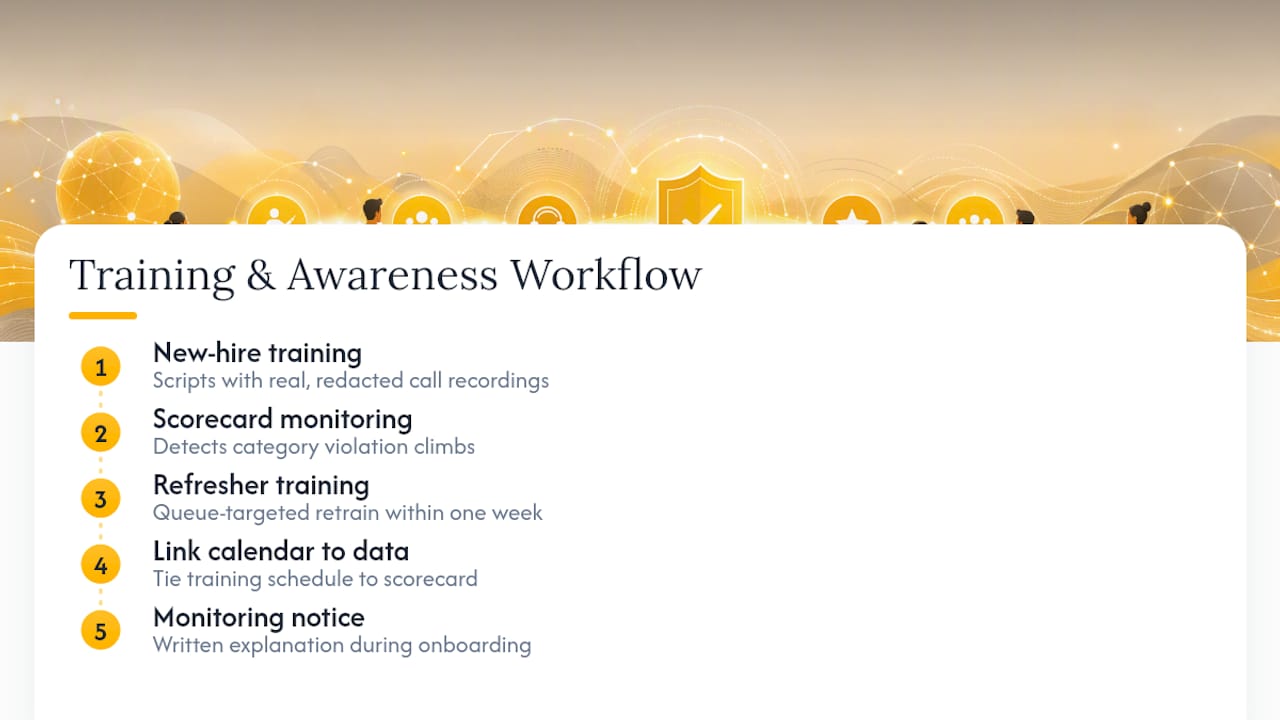
New-hire training should walk through the exact scripts required for consent capture, card data handling, and PHI disclosure, using real call recordings, redacted where necessary, rather than hypothetical scenarios. Agents retain script logic far better when they hear how it sounds in an actual customer interaction than when they read it off a slide.
Refresher training needs a trigger, not just a calendar date. When your violation rate climbs in a specific category, whether that’s suppression list misses or identity verification gaps, that queue gets targeted retraining within the week, not at the next scheduled quarterly session. Tie the training calendar directly to your compliance scorecard data described earlier, so the two systems reinforce each other instead of running on separate tracks.
Employees also need clear, upfront notice about monitoring technology itself. Beyond the legal exposure the NLRB has flagged around undisclosed surveillance, a workforce that understands why calls are monitored, and that the goal is coaching and legal protection rather than punishment, engages with feedback instead of resenting it. Put that explanation in writing during onboarding, not buried in an employee handbook nobody reads.
Keeping Up With Legal and Regulatory Changes
Compliance standards are not static, and a program built against last year’s rules develops gaps quietly. TCPA guidance gets refined through FTC enforcement actions and court rulings. PCI DSS moves through version updates. HIPAA guidance shifts as HHS issues new interpretive material. None of these changes announce themselves loudly enough to catch by accident.
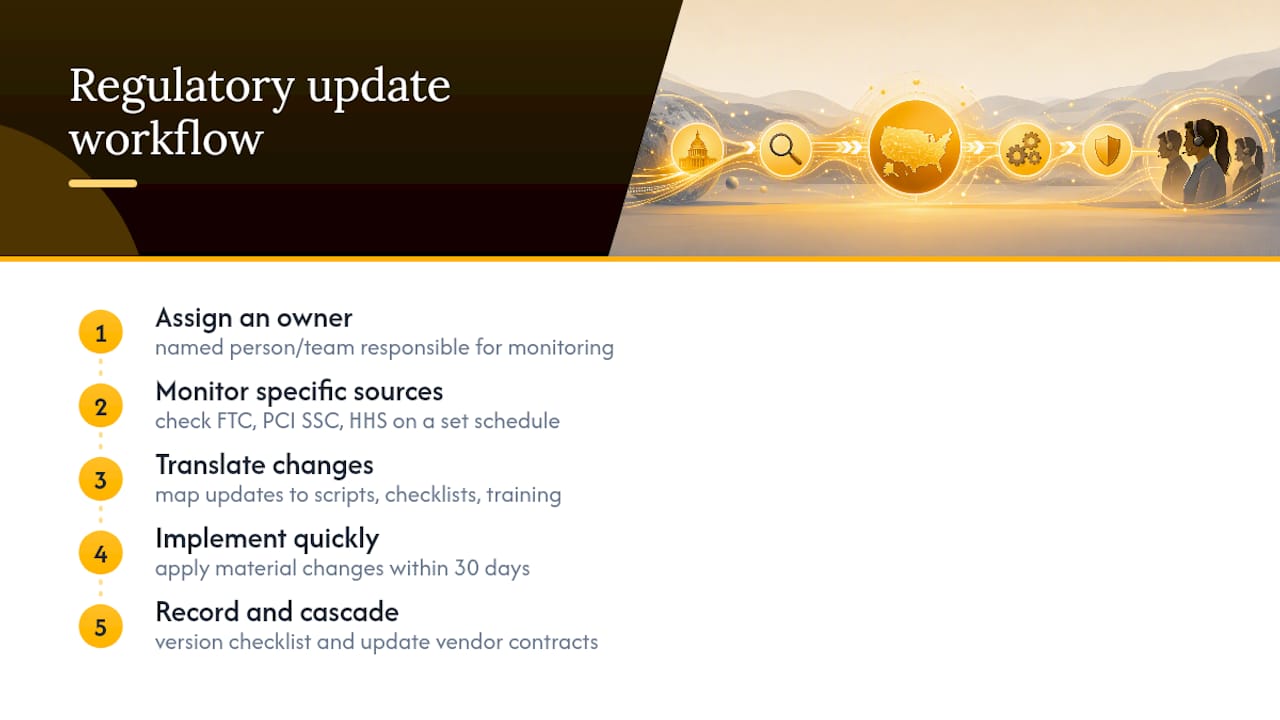
Assign regulatory monitoring to a specific person or team, not “compliance” as a vague department. That person’s job includes checking FTC press releases, PCI SSC bulletins, and HHS guidance updates on a set schedule, then translating any change into a specific update to your call scripts, your audit checklist weighting, or your training material within a defined window, ideally 30 days for anything materially affecting call handling.
Build a version history for your audit checklist itself. When a regulation shifts, you want a clear record showing exactly when your checklist changed to reflect it, since that record becomes evidence of good-faith compliance effort if you’re ever audited. A checklist that hasn’t changed in two years is itself a red flag to anyone reviewing your program.
Cross-reference changes against your vendor contracts too. A regulatory update that changes your obligations usually changes your vendors’ obligations as a subcontracted party, and that update needs to flow into their compliance requirements on the same timeline, not months later when someone notices the gap.
What Actually Breaks Compliance Programs
Most programs I’ve reviewed underinvest in the same place: the coaching loop after a violation flag, not the detection itself. Teams spend months tuning detection accuracy and weeks on remediation speed. Getting the threshold right matters too. Set it too sensitive and supervisors drown in false positives until they start ignoring alerts altogether. Set it too loose and you miss the violation that becomes a fine. One healthcare-adjacent program I reviewed cut its identity-verification miss rate by more than half in a single quarter, simply by moving that one checklist item to the top of the weighted scorecard.
— Daniela
How Altiam CX Supports Compliance Monitoring Programs
Building a compliance monitoring function from scratch means hiring QA specialists, building scorecards, training on TCPA and HIPAA nuance, and staying current on every regulatory shift, all before a single call gets reviewed. Managed teams trained on compliance-ready processes can provide a faster path for operations leaders, working against measurable performance frameworks instead of starting from a blank page.

A managed partner makes the most sense when your call volume is growing faster than your internal QA headcount, or when you’re entering a regulated vertical like healthcare or financial services without in-house compliance depth yet. Building in-house still works when your call types are narrow and stable enough that one dedicated QA lead can cover the ground. Altiam CX’s work with a software platform’s technical support operation shows the kind of productivity gain a structured, monitored team transition can produce. If your program needs evidence-ready monitoring without the twelve-month build cycle, request a compliance readiness review and see where your current setup stands.
Primary Sources Worth Bookmarking
Keep these on hand for audits and script reviews: the FTC’s enforcement actions show what triggers TCPA penalties, PCI SSC governs voice payment controls, and HHS HIPAA resources define PHI disclosure rules. State-specific consent requirements deserve their own review; see how call recording laws vary by state before finalizing your scripts.
This article is general information, not a substitute for advice from a qualified lawyer. Consult a qualified legal professional about your own circumstances before acting on anything here.
Sources
- FTC press release (January 2024)
- Call center audit checklist: compliance and scoring — LegalClarity
- Contact center monitoring best practices — TechTarget
- PCI Security Standards Council (PCI SSC) — resource hub
FAQ
What Is an Example of Compliance Monitoring?
A common example is reviewing a recorded outbound sales call to confirm the agent checked the number against the Do Not Call list, disclosed required terms, and stayed within permitted calling hours, then scoring that call against a weighted checklist.
What Is the 80/20 Rule in Call Centers?
In service-level contexts, a common target is answering most calls within a short timeframe. In compliance discussions, teams sometimes borrow this framing to mean most violations tend to cluster in a minority of call types, which is why high-risk queues like collections and payment calls deserve disproportionate review.
What Are the Key Compliance Checklists for Call Centers?
The core checklists cover TCPA and DNC consent capture, PCI DSS controls for any call touching payment data, and HIPAA identity verification for calls involving health information, each scored with compliance-critical items weighted at 30 to 40 percent of the total.
How Much Does Compliance Monitoring Cost?
Cost varies widely based on call volume, whether you build an in-house QA team or use AI-driven monitoring, and how many regulatory frameworks apply to your queues; a managed partner can offer a defined cost structure compared to building a QA function from scratch.