The most effective way to manage BPO attrition is to fix operation design: scheduling consistency, a structured first-90-day onboarding and ramp, supervisor quality, and compensation architecture, then confirm the gains with cohort retention tracking. Perks and one-off bonuses rarely move the needle on their own. We’ve seen the biggest gains come from treating retention as an operations problem, not a morale problem.
TL;DR:
- A study of 6,221 part time nursing assistants across 157 facilities found that consistent schedules lowered turnover, while high coworker variability raised it.
- Cohort tracking separates first 90 day losses, often tied to hiring or onboarding, from later departures linked to schedules, supervision, or career paths.
- Preboarding, a phased ramp, and peer coaching support new hires through onboarding and can reduce early departures.
- Perks and isolated raises rarely address attrition; transparent pay tied to skills and outcomes works better alongside visible career paths and flexible benefits.
- Pilot scheduling or onboarding changes against a control group; track first 90 day retention and require a 10% to 20% gain before wider rollout.
Table of Contents
- Why BPO Attrition Is Structurally Different
- Causes and Types of Attrition in BPOs
- Interventions That Reduce Attrition
- Interventions That Do Not Meaningfully Reduce Attrition
- Measuring Retention and the Cost Math That Justifies Investment
- Implementation Checklist: A 90-Day and Ongoing Plan for Operations Leaders
- Practitioner Perspective: How Altiam CX Approaches Attrition Management
- Author Perspective From Daniela
- How Altiam CX Can Help
- FAQ
- Sources
Why BPO Attrition Is Structurally Different
Attrition in a BPO is not the same animal as attrition in a software company or a manufacturing plant. Contact center and back-office roles are high-contact, frequently hourly, and tied to demand curves that shift by season, campaign, and time zone. That alone raises the baseline turnover rate before anything else goes wrong.
Two structural pressures make it worse. Scheduling volatility is the first: agents who cannot predict their hours or teammates week to week experience the job as unstable, even when pay is competitive. The second is a perceived ceiling on mobility. When a role looks like a dead end rather than a step toward something else, people leave the moment a better-paying or better-structured option appears.
This is why isolated perks underperform. A free lunch or a shout-out in a team chat does nothing to fix an unpredictable schedule or a supervisor who has no time to coach. The levers that actually move attrition are the ones baked into how the operation runs:
- Scheduling that limits coworker variability and avoids chronic under or over assignment
- Workload design that matches staffing to realistic forecast accuracy
- Supervisor capacity to coach rather than just monitor
- A visible, credible path beyond the entry-level seat
Operational design determines whether people see the job as sustainable. Everything else is secondary until that foundation is in place.
Causes and Types of Attrition in BPOs
Not all attrition is the same problem, and treating it as one undifferentiated number hides where the damage is coming from. Segmenting by type and cause is the first step toward a fix that actually targets the issue.
- Early attrition happens in the first 30 to 90 days and usually signals a hiring or onboarding mismatch rather than a pay problem.
- Voluntary attrition beyond the early window tends to trace back to schedule misfit, weak supervision, or a stalled career path.
- Involuntary attrition reflects performance or conduct issues, often rooted in inadequate training or unclear expectations set during ramp.
- Skill-related attrition shows up when agents are placed in roles that outpace their training, causing frustration on both sides.
- Demographic and tenure patterns reveal whether certain shifts, sites, or cohorts are losing people faster, which usually points to a local operational cause rather than a company-wide one.
The primary drivers repeat across almost every BPO: a hiring process that oversells the role, onboarding that rushes the ramp, scheduling that clashes with life outside work, supervisors stretched too thin to coach, burnout from sustained overtime, and pay structures that feel arbitrary or disconnected from performance.
Segmenting by cohort, role, and tenure turns a vague attrition percentage into a diagnosis. A site losing agents in week two has a different problem than one losing tenured agents at the 18-month mark, and the fix for each looks nothing alike.
Interventions That Reduce Attrition
Once attrition is segmented, the fixes that work are the ones that change the structure of the job rather than add something on top of it.
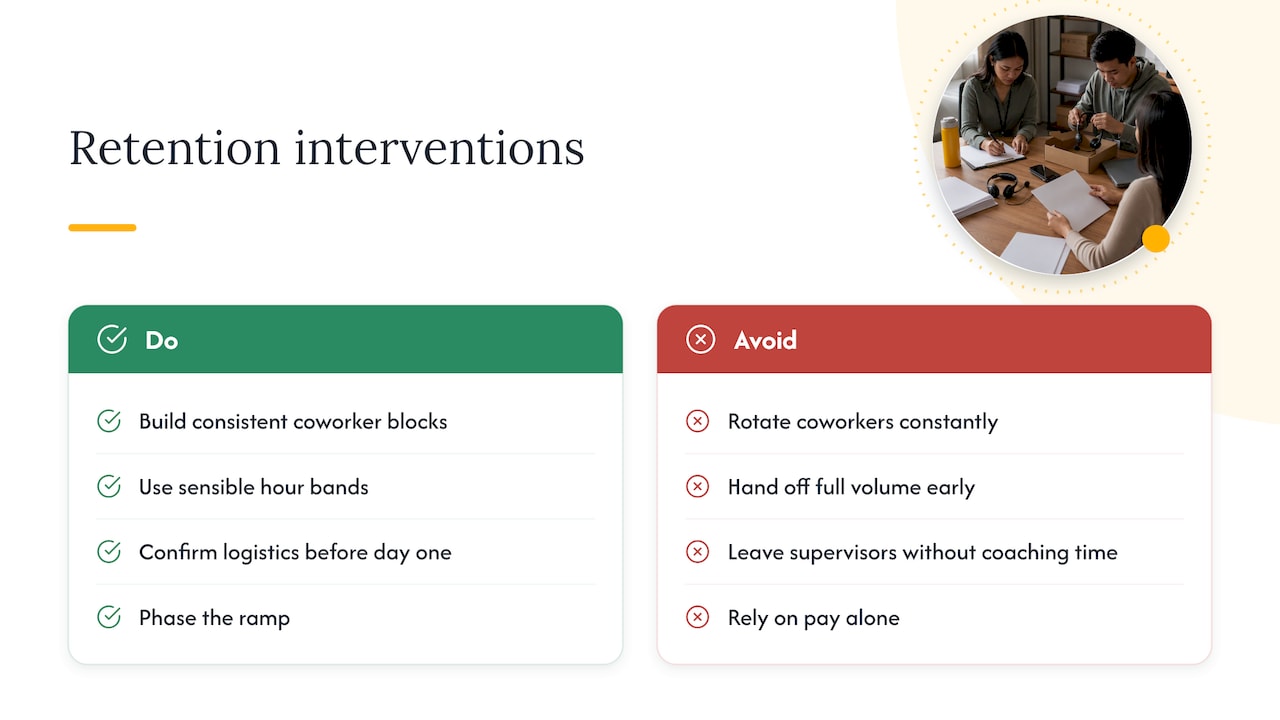
Scheduling design is the single most evidence-backed lever available. An empirical study of scheduling decisions using data from 6,221 part-time certified nursing assistants across 157 U.S. facilities over 26 months found that increasing hours initially reduces turnover up to a point, that high coworker variability increases turnover, and that scheduling consistency lowers it. The practical translation for a contact center: build consistent coworker blocks, use sensible hour bands instead of chronic under or over assignment, and avoid constantly rotating who sits next to whom. Our workforce management approach leans on exactly this kind of consistency to cut burnout while keeping forecast accuracy tight.
Onboarding and the first 90 days set the tone for everything that follows. Preboarding that confirms logistics before day one, a phased ramp instead of a full-volume handoff early in the onboarding period, and buddy coaching from a peer who survived the same ramp all reduce early attrition, as highlighted in service business onboarding best practices. We break this down further in our call center onboarding plan, which treats ramp as a measured process rather than a checklist.
Supervisor quality matters more than most retention plans admit. Selecting supervisors for coaching ability, not just tenure, and giving them a coaching cadence they can actually keep, changes how agents experience daily feedback. A supervisor managing 25 people with no protected coaching time cannot catch problems before they become resignations.
Compensation architecture beats one-time raises. Setting a competitive floor, tying incremental pay to skill and outcomes, and making incentive structures transparent gives agents a reason to stay for the next milestone rather than the next counteroffer. Forbes Human Resources Council guidance found that competitive pay matters, but retention holds up better when it’s paired with clear career growth, manager quality, and flexible benefits rather than pay alone.
Career pathways reduce the sense of a dead end. Dual tracks (supervisory and specialist), micro-promotions tied to measurable skill gains, and lateral moves into adjacent queues all signal that the job leads somewhere.
Engagement and wellbeing round out the list, but only when tied to structural follow-through. Stay interviews that feed into real schedule or workload changes, and benefits aligned to what the workforce actually needs, carry weight. Research on employee mobility barriers shows that the most valuable employees are also the ones most likely to leave, and that retention holds up better when organizations build layered barriers like development and internal career architecture rather than reacting with a counteroffer after the fact.
Pro Tip: Pilot one change at a time with a control group before scaling broadly, because scheduling and onboarding changes produce different effects and bundling them obscures the individual impact.
Interventions That Do Not Meaningfully Reduce Attrition
Some tactics feel productive but rarely change the underlying math. Knowing what to skip saves budget for what works.
- One-off perks like snack walls or casual-dress days create goodwill but don’t touch schedule unpredictability or career stagnation.
- Small, isolated pay bumps disconnected from a broader compensation redesign get absorbed quickly and leave the structural pay problem untouched.
- Engagement surveys launched without a visible action plan tend to erode trust further, since agents notice when feedback goes nowhere.
- Recognition programs that praise performance without changing workload, schedule, or advancement prospects read as hollow to the people living the job day to day.
Research synthesized across HR council guidance and practitioner sources consistently shows that one-off perks carry limited long-term impact when the structural problems underneath them stay the same. The pattern holds across industries: gestures without structural change buy a few weeks of goodwill, not retention.
Measuring Retention and the Cost Math That Justifies Investment
A retention initiative is only worth scaling if it moves measurable numbers, so the metrics matter as much as the intervention itself.
- Track cohort attrition rate by hire date, not a rolling average, so you can isolate whether a specific onboarding or scheduling change changed outcomes for the group that experienced it.
- Measure time-to-productivity, the span between hire date and when an agent hits target performance, since a faster ramp often predicts lower early attrition.
- Watch vacancy-days, the total days a seat sits unfilled, which ties directly into service quality and overtime costs for the remaining team.
- Calculate cost-per-hire, including recruiting, training hours, and supervisor time spent ramping a replacement.
Running cohort analysis means grouping agents by start week or start month and tracking their survival curve through the first 90 days specifically, since that window captures most of the preventable loss. The ACM scheduling study recommends small, controlled pilots with randomized scheduling or phased onboarding changes measured against a control group, with a success threshold such as a 10% to 20% improvement in first-90-day retention before a wider rollout.
The cost model itself is simple: add recruiting cost, training hours, and estimated lost productivity during ramp, then compare that total against the cost of the intervention. Overtime and labor cost structures published by the U.S. Department of Labor are a useful input when scheduling changes affect hours worked, since overtime rules shift the math on what a schedule redesign actually costs to run. Our breakdown of forecasting methods that hit tight accuracy bands is a useful companion when vacancy-days are the metric you’re trying to shrink.
Implementation Checklist: A 90-Day and Ongoing Plan for Operations Leaders
Sequencing matters more than enthusiasm. Here is an order that works for most contact center and back-office operations.
- Days 0 to 30: Fix preboarding logistics so new hires aren’t lost before day one, correct any obvious scheduling inconsistencies, start supervisor daily huddles, and capture baseline cohort metrics before changing anything else.
- Days 30 to 90: Roll out structured onboarding with a phased ramp, add a supervisor coaching cadence with protected time on the calendar, pilot a compensation or benefits adjustment with a control group, and begin tracking cohort retention against that baseline.
- Ongoing: Build visible career-pathing with milestones tied to skill, run recurring stay interviews that feed into real schedule or workload changes, and put governance in place so retention spend gets reviewed against the cost math each quarter.
- Assign owners clearly: operations leads own scheduling and forecasting, HR owns onboarding and compensation design, and site supervisors own daily coaching, with a monthly reporting cadence back to leadership.
Our 30/60/90 retention plan for managers walks through this same sequencing in more depth, including how to template a pilot before scaling it across sites.
Pro Tip: Treat the first pilot as a template, not a one-time fix: document what changed, what it cost, and what it moved, so the next site doesn’t start from zero.
Practitioner Perspective: How Altiam CX Approaches Attrition Management
Sequencing the same levers in the same order—scheduling consistency first, structured onboarding second, supervisor coaching third—is a way to approach managed team extensions effectively. Skipping the order tends to waste the budget spent on whatever comes later, because an agent who feels unstable in week one rarely sticks around long enough to benefit from a career path conversation in month six.
For regulated clients in healthcare CX operations and legal intake and case communication, we build cohort tracking into the pilot from day one rather than adding it after the fact. That means every new hiring group gets measured against its own baseline, not a network average that hides where the real losses are happening.
Retention is not a morale initiative. It’s an operations discipline that gets measured the same way forecast accuracy or service levels get measured.
Governance matters as much as the fixes themselves. We review retention spend against cost-per-hire and vacancy-days each quarter with clients, the same cadence we’d apply to any other operational metric. If you’re evaluating what a managed extension could look like for your own team, our nearshore CX services page is the place to start.
Author Perspective From Daniela
Attrition conversations in BPO leadership meetings default to pay too quickly. Pay matters, but it’s rarely the whole story, and treating it as the whole story means a leader never gets to the scheduling fix or the onboarding gap that’s actually driving people out the door. The levers that worked across every operation I’ve looked closely at are boring in the best sense: consistent schedules, a ramp that doesn’t rush people, supervisors who have time to coach. Run a first-90-day diagnostic before anything else. Measure the cohort, not the network average, and let the numbers tell you which lever to pull next.
— Daniela
How Altiam CX Can Help
If scheduling volatility, a rushed ramp, or thin supervisor coverage sound familiar, the managed team extension model can be designed around fixing those gaps before they show up as resignations. Rather than bolting a retention program onto an existing structure, we design the schedule, onboarding, and coaching cadence into the operation from the first hire.

For regulated industries like healthcare and legal services, we also bring operational playbooks built specifically for patient support and SOP management or legal intake and back-office support, so the retention fixes are designed around the compliance and communication standards your clients expect. If you want to see how a managed extension could run against your own cohort numbers, visit our services overview to start the conversation.
FAQ
How do you manage attrition in BPO?
Managing attrition well means fixing the operational design first: consistent scheduling, a structured first-90-day onboarding ramp, supervisor coaching capacity, and a transparent compensation structure. Measure results through cohort retention tracking rather than a network-wide average, since that’s the only way to confirm an intervention actually worked.
What does attrition mean in BPO?
Attrition in a BPO refers to the rate at which employees leave their roles, whether voluntarily, involuntarily, or during the early weeks of employment before they reach full productivity. It’s typically segmented by type, tenure, and cohort so leaders can identify which part of the operation is losing people and why.
What is the typical attrition rate in the BPO industry?
Attrition rates vary widely by site, role, and region, and no single figure applies across the industry. Leaders get a more useful picture by tracking their own cohort attrition rate over the first 90 days rather than comparing against an industry-wide number that may not reflect their specific operation.
What is a 20% attrition rate?
Whether that number is a concern depends on the cohort it’s measured against: a 20% rate concentrated in the first 90 days signals a hiring or onboarding problem, while the same rate spread evenly across tenure may reflect a different issue entirely.
Sources
- What gets your best employees to stay
- Scheduling decision impact on nurse-aide turnover (Manufacturing & Service Operations Management)
- 20 employee retention strategies that go beyond pay raises
- Usa