
Run a 90-day gated onboarding program with preboarding, a structured week one, nesting under a mentor, and measurable 30/60/90 KPI gates. Advancement happens only when an agent clears each gate, not because a calendar says it’s time. Built well, this structure shortens ramp time and lowers first-90-day attrition, giving you a repeatable system instead of a hope-and-pray hiring cycle.
TL;DR:
- Passing objective KPI gates at 30, 60, and 90 days is essential, including achieving team-average QA scores and stable CSAT by day 30.
- Preboarding should be completed five to seven days before start, including equipment shipping, system access testing, and sending welcome materials to prevent day-one ghosting.
- Day one focuses on equipment verification and culture orientation, with the first week structured around system checks, call etiquette, shadowing, role-playing, and a final sign-off.
- Mentors should be top performers with at least six months’ experience, with regular check-ins and a swap rule if pairing friction occurs during nesting.
- Leaders must enforce strict gate discipline, avoid rushing new hires into full autonomy before meeting KPIs, and tie onboarding success to retention and productivity metrics.
Table of Contents
- How does a 90-day onboarding framework reduce early attrition?
- Preboarding checklist: what to do the week before start
- What should day 1 and week 1 of onboarding include?
- What KPI gates should agents pass at 30, 60, and 90 days?
- How should mentor pairing and nesting cadence work?
- Which training modules actually shorten ramp time?
- What KPIs and failure modes should you track after launch?
- What should an implementation checklist include?
- What proof exists that this framework scales?
- What do managers actually get wrong under pressure?
- How Altiamcx helps you run this playbook at scale
- Primary sources and templates
- Sources
How does a 90-day onboarding framework reduce early attrition?
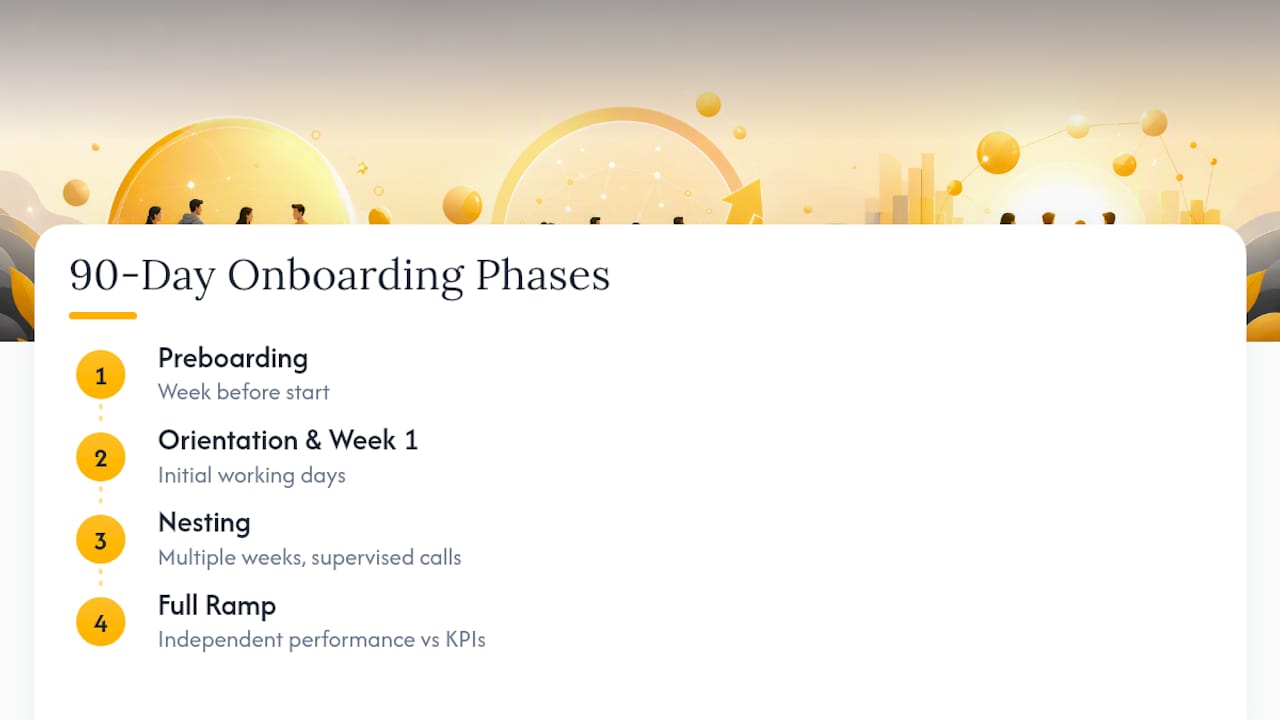
A 90-day onboarding framework works because it breaks a vague “get them trained” mandate into four distinct phases: preboarding, orientation and week one, nesting, and full ramp, each with its own timebox and exit criteria. Preboarding covers the week before start. Orientation and week one cover the initial working days following the start. Nesting typically spans multiple weeks of supervised live calls. Full ramp closes out the 90-day window with independent performance against standard KPIs.
Gates matter more than the calendar. Programs that require agents to pass objective checkpoints, rather than simply survive a set number of days, see more reliable performance once agents hit the floor. Success at 90 days looks specific: an agent hitting quality assurance (QA) targets independently, holding customer satisfaction (CSAT) scores at parity with the team average, and no longer needing a mentor for routine calls.
Preboarding checklist: what to do the week before start
Preboarding is where many no-shows and early exits get prevented before the first day even happens. It shifts a new hire’s mental state from “I accepted an offer” to “a team is actually waiting for me,” which cuts first-day ghosting more effectively than anything you can do once they arrive.
Run through this list five to seven days ahead of start:
- Ship equipment with tracking, and confirm delivery before end of week.
- Send a short welcome video from the direct manager, plus a mentor introduction email.
- Confirm calendar acceptance for orientation and week-one sessions.
- Provision and test all system access at least 48 hours before start to catch login failures early.
- Deliver a written day-one itinerary and a welcome packet covering dress code, parking or remote setup, and who to contact if something goes wrong.
Skip any one of these and you’re gambling on day one going smoothly.
What should day 1 and week 1 of onboarding include?
Day one should have no live calls. The entire day is equipment verification, login checks, and building basic comfort with the systems an agent will use for the next several years, not a rushed sprint to “get them talking to customers.”
A workable week-one sequence looks like this:
- Day 1: Equipment and login verification, culture orientation, meet the mentor and team.
- Day 2: Call etiquette and active listening foundations, first walkthrough of the QA rubric.
- Day 3: Product or service overview, shadowing live calls with the mentor (listen only).
- Day 4: Guided role-play using real call scenarios, trainer feedback on tone and pacing.
- Day 5: Trainer sign-off checkpoint, confirming the agent can navigate every required system without help.
If an agent can’t clear that day-five checkpoint, don’t push them into nesting. Hold them one more day. Rushing this step is how weak habits get baked in early.
What KPI gates should agents pass at 30, 60, and 90 days?
Objective thresholds, not manager gut feel, decide whether an agent advances or gets recycled through additional coaching.
Day-one show rate is your earliest warning signal. Track the percentage of accepted offers who actually show up on start day. A low show rate almost always traces back to a weak preboarding process rather than a hiring problem.
Nesting QA gate: during nesting, agents typically handle 8 to 12 supervised live calls per day with same-day QA review. A common gate: a rolling five-call QA average must hit roughly 80 to 85 percent before an agent moves to full independent load. Fall short, and the agent stays in nesting with a targeted coaching plan instead of moving forward on schedule.
KPI snapshot: Structured programs using nesting QA gates and defined mentor cadences show a measurable link between gate discipline and 90-day retention outcomes.
By day 30, target QA scores approaching team average, early CSAT stability, and first-call resolution (FCR) trending upward. By day 60, expect near-independent performance. By day 90, an agent should be indistinguishable from a tenured peer on core metrics. Missing a gate triggers a remediation plan, not a promotion by default.
How should mentor pairing and nesting cadence work?
Pull mentors from your top quartile of performers, and require a minimum tenure, usually six months or more, before someone qualifies to mentor. Cadence matters as much as mentor quality: daily 10-minute check-ins during week one, dropping to twice-weekly through weeks two to four, then weekly through months two and three.

Build in a swap rule at week two. If the pairing isn’t clicking, both sides need an easy, non-punitive way out. Run a short mentor pulse survey at that same checkpoint to catch friction early. And protect mentor hours with dedicated coaching time on the schedule. Unpaid, unprotected mentoring decays fast, usually by month two, and that decay quietly wrecks retention numbers months later.
Which training modules actually shorten ramp time?
Four competency areas cover the ground every new agent needs: soft skills (tone, empathy, active listening), product or process knowledge, technical and tools proficiency, and compliance.
Delivery format matters more than most training programs admit. Microlearning modules beat marathon classroom sessions for retention. Role-play with real call scenarios builds muscle memory. Reverse shadowing, where the trainee handles a call while the mentor listens, surfaces gaps faster than passive observation. Recorded-call self-scoring against the QA rubric builds self-awareness before a supervisor ever has to flag an issue.
Sequence these in order of cognitive load: soft skills and systems first, then product knowledge, then compliance layered in once basic call handling feels natural. Front-loading compliance details on day one is a common mistake that overwhelms new hires before they’ve built any confidence.
What KPIs and failure modes should you track after launch?
Track these consistently across every cohort:
- Day-one show rate — percentage of accepted offers who show up.
- Nesting QA average — rolling score against the QA rubric during supervised calls.
- 30/60/90-day retention — percentage still employed and performing at each checkpoint.
- Time-to-proficiency — days until an agent hits independent full-load performance, often extending toward six to seven months for full role mastery even after the 90-day gate closes.
Calculate training cost per successful agent by dividing total onboarding spend by the number who clear day 90 successfully, not by total hires. That distinction changes the number substantially when attrition is high.
The most common failures are avoidable: no preboarding leads to no-shows, fix it with the checklist above. No nesting means agents hit the floor unprepared, fix it by enforcing the QA gate. No exit gates mean weak agents get promoted anyway, fix it by making advancement conditional, not automatic.
What should an implementation checklist include?
Assign clear owners before launch: HR handles offer-to-start logistics, IT handles equipment and access provisioning, the training manager owns curriculum and gate decisions, and mentors own daily coaching cadence.
- Confirm system access tested 48 hours pre-start (IT).
- Lock trainer sign-off criteria for day five (training manager).
- Assign and brief mentors one week before the cohort starts (training manager).
Three fail-safes for week one: a backup trainer on standby if the lead trainer is out, a same-day escalation contact for any technical failure, and a floating mentor who can absorb a swap request without delay. Keep templates in your learning management system (LMS) so every cohort starts from the same baseline, detailed further in this team extension workflow guide.
What proof exists that this framework scales?
Altiamcx builds this exact 90-day gated structure into every managed nearshore engagement, because a documented process is the only thing that scales reliably across multiple client cohorts at once. One case study shows a technical support migration where structured onboarding and workflow discipline drove an 89% productivity improvement.
The internal playbook mirrors the gates described above: preboarding checklists, nesting QA thresholds, and mentor cadence rules. Details on scaling this across larger cohorts appear in Altiamcx’s onboarding steps for 2026, alongside handling-time gains covered in this customer care workflow breakdown.
What do managers actually get wrong under pressure?
Leadership pressure to fill seats fast is the number one reason gates get skipped, and it’s almost always a mistake. Present the plan to operations leadership around cost per successful agent, not cost per hire. That number makes the case on its own.
Three quick fixes for week one: confirm system access early, protect mentor hours on the calendar, and never let a trainer sign off an agent who can’t yet navigate the tools unassisted.
— Daniela
How Altiamcx helps you run this playbook at scale
Altiamcx is the practical route to running a 90-day gated onboarding program without building a training department from scratch. Instead of hiring, training, and managing an internal onboarding team, you get a nearshore partner that already runs preboarding checklists, nesting QA gates, and mentor cadence rules across live client cohorts.

The managed model plugs directly into the framework outlined above: agents move through preboarding, structured week-one foundations, nesting under a dedicated mentor, and 30/60/90 KPI checkpoints, with Altiamcx handling the day-to-day execution and reporting back on gate performance. The case study on tech support migration shows what that execution looks like in practice, with productivity climbing 89% after the transition. If your team is losing agents before day 90 and doesn’t have the bandwidth to fix onboarding internally, request a pilot conversation with Altiamcx and see how the gates apply to your specific call volume and role mix.
Primary sources and templates
- Employee Onboarding Process — phased stages, checklists
- Onboarding Checklist 2026 — KPI thresholds
- New Hire Checklist — systems access timing
- Onboarding Best Practices — retention drivers
Sources
- The employee onboarding process is key to laying the foundation of the employee-employer relationship
- Call Center Agent Onboarding Checklist 2026 | ViciStack Blog
- New Hire Onboarding Checklist and Guide
- Call Center Onboarding Best Practices: Improving Retention