
TL;DR:
- Critical function outsourcing involves contracting third parties for essential operations that directly impact a company’s compliance and financial health. Regulators require firms to maintain full accountability, thorough documentation, and tested exit strategies for these high-risk arrangements. Proper governance ensures ongoing oversight, secure vendor relationships, and readiness for potential disruptions.
Critical function outsourcing is the practice of contracting third parties to perform key business operations that are vital for a company’s continuous functioning and regulatory compliance. Unlike general outsourcing, this category covers functions whose failure would directly impair financial performance, service delivery, or legal standing. Regulators including the Financial Conduct Authority (FCA), the Prudential Regulation Authority (PRA), and the European Banking Authority (EBA) have built entire supervisory frameworks around it. The Digital Operational Resilience Act (DORA) now mandates specific controls for any financial institution that delegates these functions to external providers. If you lead an organization that relies on third parties for core operations, understanding this discipline is no longer optional.
What is critical function outsourcing, and why does it matter?
Critical function outsourcing is defined by regulators as the delegation of business activities that, if disrupted, would materially impair a firm’s ability to meet its obligations, maintain compliance, or deliver essential services. The FCA Handbook SYSC 8.1 defines criticality through granular impact analysis that considers operational continuity, compliance impact, and financial soundness. This is not a label applied by department name or IT category alone.
The importance of function outsourcing at this level goes beyond cost efficiency. When a bank outsources its core payment processing, or a healthcare organization delegates patient data management to a cloud provider, those arrangements carry regulatory weight. The Bank of England’s Supervisory Statement defines outsourcing broadly as any arrangement where a service provider performs business functions the firm would otherwise handle internally, whether directly or through sub-outsourcing, on an ongoing basis.
Average annual expenditure on cloud-based critical functions rose to €57 million in 2024 from €50.2 million in 2023 across major financial institutions. That growth reflects how deeply organizations now depend on external providers for their most sensitive operations. The financial and reputational consequences of mismanaging these relationships are severe.

How does critical function outsourcing differ from general outsourcing?
General outsourcing covers a wide range of business process outsourcing (BPO) arrangements, from payroll administration to marketing support. These functions matter, but their failure does not threaten the firm’s core operations or regulatory standing. Critical function outsourcing sits in a different category entirely, one defined by risk, accountability, and regulatory obligation.
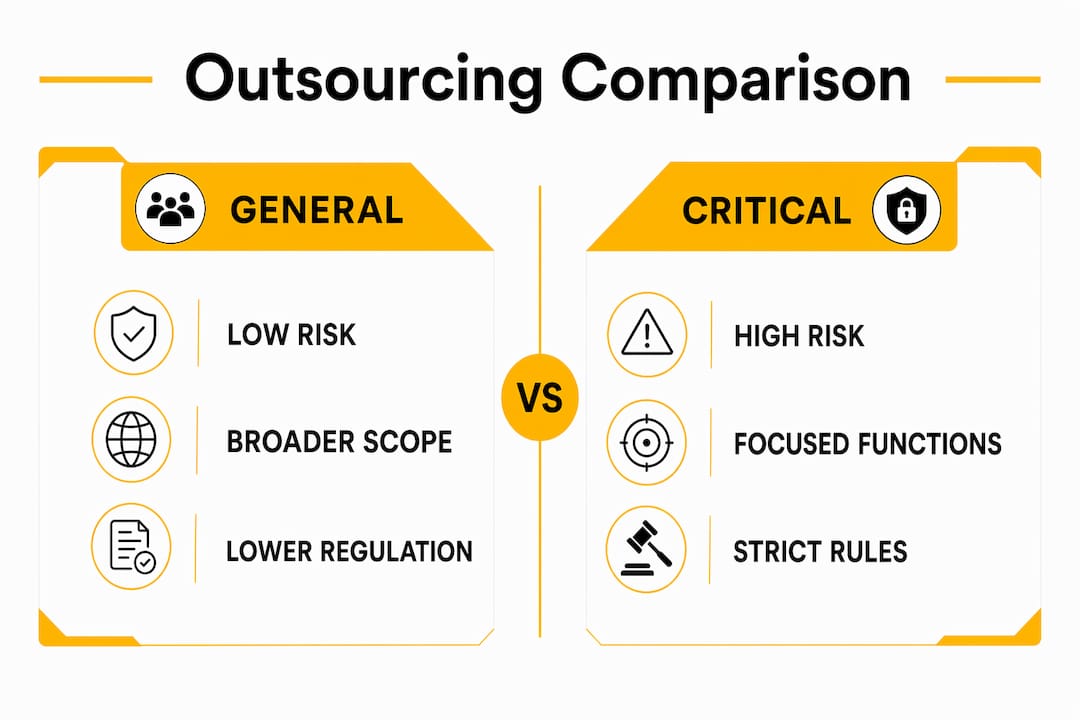
The table below captures the core distinctions:
| Factor | General outsourcing | Critical function outsourcing |
|---|---|---|
| Regulatory scrutiny | Low to moderate | High, with mandatory documentation |
| Accountability | Shared with vendor | Retained fully by the firm |
| Substitutability | Relatively easy | Often difficult or impossible |
| Exit strategy required | Recommended | Mandatory under DORA and PRA rules |
| Audit rights | Optional | Required, often annually |
A defining principle is that accountability cannot be delegated. The board and senior management remain legally responsible for every outsourced critical function, regardless of how capable the vendor is. This is not a technicality. Regulators have penalized firms that treated vendor contracts as a transfer of responsibility.
Key characteristics that distinguish critical functions include:
- Direct impact on the firm’s ability to serve customers or meet regulatory requirements
- High difficulty of substitution if the vendor fails
- Significant data sensitivity or system access involved
- Dependency on the vendor for ongoing operational continuity
Pro Tip: When assessing whether a function qualifies as critical, ask one question: if this vendor went offline tomorrow, could you maintain compliant operations within 24 hours? If the answer is no, treat it as critical.
Understanding why outsourcing drives growth requires separating routine delegation from high-stakes partnerships. The two demand very different governance models.
Which regulations govern critical function outsourcing?
DORA, the Digital Operational Resilience Act, is the most comprehensive regulatory framework governing critical function outsourcing for financial institutions operating in or with the European Union. It mandates multi-cloud strategies, backup plans, and clear contractual terms for any cloud-based critical outsourcing arrangement. DORA requires that financial institutions demonstrate operational resilience even if a cloud service provider fails abruptly.
In the United Kingdom, the PRA and FCA set parallel requirements through their supervisory statements. These rules require firms to maintain full responsibility and continuous monitoring for every outsourced critical function. The FCA’s SYSC 8.1 framework specifies that firms must document, test, and review outsourcing arrangements on a regular basis.
The key regulatory requirements across these frameworks include:
- Pre-contract due diligence. Firms must assess vendor financial stability, security certifications, and operational capacity before signing.
- Written agreements. Contracts must specify service levels, audit rights, data handling, and termination procedures.
- Ongoing monitoring. Firms must track vendor performance against agreed metrics throughout the contract term.
- Exit strategy documentation. Regulators require tested plans for transitioning away from a vendor, including data repatriation and knowledge transfer.
- Incident reporting. Material disruptions to critical outsourced functions must be reported to regulators within defined timeframes.
The principle of proportionality guides how firms apply these requirements. Not every outsourced activity demands the same level of scrutiny. Critical functions demand the highest levels of due diligence and contingency planning. Less critical functions receive proportionally lighter oversight.
Pro Tip: Map every outsourced function against a criticality matrix before your next regulatory review. Functions that touch customer data, payment systems, or compliance reporting almost always qualify as critical under DORA and PRA definitions.
What are the main risks of outsourcing critical functions?
Vendor dependency is the most significant risk in critical function outsourcing. 80% of critical IT contracts are concentrated among just 30 providers globally. That concentration means a single vendor failure can simultaneously affect dozens of regulated firms.
Substitutability has worsened over time. The share of critical outsourced functions that are difficult or impossible to substitute increased from 80% to 82% in major financial institutions, with 95% difficult to reintegrate in-house. That figure signals how deeply embedded these vendors become once a contract is live.
Common pitfalls business leaders must avoid include:
- Inadequate exit planning. Contracts signed without tested exit procedures leave firms exposed when vendors fail or relationships deteriorate.
- Insufficient personnel security. Vendor employees with system access must undergo background checks and sanctions screening. Skipping this step creates direct compliance exposure.
- Geopolitical blind spots. Vendors operating in politically unstable regions introduce risks that standard SLA monitoring does not capture.
- Cybersecurity gaps. Firms that do not verify vendor security certifications like ISO 27001 or SOC 2 Type II inherit the vendor’s vulnerabilities.
- Knowledge erosion. Over time, internal teams lose the expertise needed to manage or reintegrate critical functions, making vendor dependency permanent.
Pro Tip: Require vendors to provide annual evidence of ISO 27001 or SOC 2 Type II certification as a contract condition. This shifts the compliance burden to the vendor and gives you documented proof for regulators.
For firms managing tier two support outsourcing, these risks apply directly to technical escalation paths and system access controls.
How to outsource critical functions effectively
Effective implementation of critical function outsourcing starts before the contract is signed. Due diligence must cover the vendor’s financial health, operational track record, security posture, and regulatory standing. Audit rights should be written into every agreement, with annual access to verify security certifications and operational controls.
The table below summarizes a practical governance framework:
| Stage | Key action | Regulatory requirement |
|---|---|---|
| Pre-contract | Vendor screening and risk assessment | DORA Article 28, FCA SYSC 8.1 |
| Contract design | Define SLAs, audit rights, exit terms | PRA Supervisory Statement 2026 |
| Onboarding | Personnel security checks for vendor staff | DORA, Indicium AG guidelines |
| Ongoing oversight | Continuous monitoring and performance review | FCA, EBA guidelines |
| Exit readiness | Test exit strategy annually | DORA, Bank of England requirements |
Exit strategies deserve particular attention. Failure to establish documented exit strategies is the most common oversight in critical outsourcing contracts. A tested exit plan must specify how data will be repatriated, how knowledge will transfer, and how service continuity will be maintained during a provider transition.
Personnel security is equally non-negotiable. Vendor employees with system access must be subject to ongoing background screenings, sanctions list monitoring, and confidentiality obligations. These clauses are increasingly mandatory under updated regulations.
Business leaders who treat outsourcing as a strategic partnership rather than a transactional cost decision consistently achieve better compliance outcomes. The vendor relationship requires active governance, not passive contract management.
Pro Tip: Schedule a quarterly governance review with every critical vendor. Cover performance metrics, incident history, regulatory changes, and exit plan status. This single habit prevents most compliance surprises.
Key takeaways
Critical function outsourcing requires firms to retain full accountability, maintain tested exit strategies, and apply proportional oversight to every vendor relationship that touches core operations.
| Point | Details |
|---|---|
| Accountability stays with the firm | Boards remain legally responsible for outsourced critical functions regardless of vendor capability. |
| Regulations set the standard | DORA, PRA, and FCA frameworks mandate documentation, monitoring, and exit planning for critical arrangements. |
| Substitutability is a growing problem | 95% of critical outsourced functions are difficult to reintegrate in-house, making vendor selection permanent in practice. |
| Exit strategies are mandatory | Tested plans for data repatriation and knowledge transfer must exist before a contract is signed. |
| Personnel security cannot be skipped | Vendor staff with system access require ongoing background checks and sanctions screening under current regulations. |
The risk mindset shift that most leaders miss
The conversation around critical function outsourcing has matured significantly over the past several years. What I find most striking is how many business leaders still approach it as a procurement exercise rather than a governance discipline.
The regulatory frameworks, DORA in particular, are not bureaucratic obstacles. They reflect hard lessons from real operational failures where firms discovered, too late, that their vendor had become irreplaceable. The 95% reintegration difficulty figure is not an abstraction. It describes organizations that signed contracts without asking what happens when the relationship ends.
The detail I see overlooked most often is personnel security. Firms spend months negotiating SLAs and pricing, then skip the clause requiring background checks for vendor employees with system access. That gap is where real exposure lives. Regulators are increasingly focused on it, and audit findings in this area are rising.
My honest view is that the firms managing critical outsourcing well are the ones that treat their vendors as extensions of their own compliance program, not as external parties. They share audit findings, discuss regulatory changes proactively, and build relationships where the vendor understands the firm’s risk appetite. That kind of partnership does not happen through a contract alone. It requires deliberate, ongoing engagement from senior leadership.
— Daniela
How Altiamcx supports compliant critical function outsourcing
Altiamcx is a nearshore operational services partner built for organizations that need more than a vendor. It combines measurable performance frameworks, cultural alignment, and disciplined execution to help business leaders manage outsourced functions with confidence.

In one documented engagement, a software platform migrated its tech support to Altiamcx and achieved an 89% improvement in productivity. That result reflects what structured vendor governance and clear SLA accountability produce in practice. Altiamcx supports continuous performance monitoring, compliance-aligned onboarding, and back-office operations that meet the standards business leaders need when outsourcing functions that matter most.
FAQ
What is the definition of critical function outsourcing?
Critical function outsourcing is the delegation of business operations to a third party where failure would materially impair compliance, financial performance, or essential service delivery. Regulators including the FCA, PRA, and DORA frameworks define and govern these arrangements.
How do DORA and PRA regulate outsourced critical functions?
DORA requires financial institutions to maintain multi-cloud backup plans, documented exit strategies, and audit rights for critical outsourcing. The PRA and FCA add requirements for continuous monitoring and written agreements covering data handling and termination procedures.
Can a firm transfer accountability for a critical outsourced function to its vendor?
No. Accountability for outsourced critical functions always remains with the firm’s board and senior management. Regulators have penalized organizations that treated vendor contracts as a transfer of legal responsibility.
What makes a function qualify as critical under current regulations?
A function is critical if its disruption would impair the firm’s ability to serve customers, meet regulatory requirements, or maintain financial soundness. The FCA’s SYSC 8.1 framework requires granular impact analysis rather than relying on department labels alone.
What is the most common mistake in critical function outsourcing contracts?
Failure to establish documented and tested exit strategies is the most common oversight. Effective exit plans must cover data repatriation, knowledge transfer, and continuity of service during a provider transition, and must be in place before the contract is signed.