
Empathy is a measurable operational capability in retail service, not a soft skill. When applied as structured “empathy work” alongside AI-handled automation, it drives higher trust, conversion, and lifetime value. A global survey of nearly 12,000 consumers across 11 countries found that most companies fail to deliver the empathy customers expect, and that closing this gap raises both trust and employee morale.
Three practical implications for retail operations leaders:
- Prioritize empathy where agents can affect outcomes. Empathy yields the largest CSAT and conversion gains when the agent has real latitude to resolve the issue.
- Automate routine, low-emotion interactions. Free agent capacity for the complex, high-stakes cases where human judgment matters.
- Train agents in “empathy work.” Diagnose the customer’s need first, then choose the right empathic response — attentive, affective, or cognitive.
Altiamcx provides nearshore CX teams trained in this three-component model, with measurement frameworks designed to demonstrate ROI within a 6–12 week pilot. The exact pilot duration can vary, with retail CX pilots typically running for several weeks depending on audit scope and interaction volume.
Key Takeaways
Empathy in retail service is a measurable operational capability that increases CSAT, conversion, and loyalty when applied selectively through a structured three-component model alongside AI automation.
| Point | Details |
|---|---|
| Three-component model | Train agents in attentive, affective, and cognitive empathy — cognitive drives the largest gains. |
| CSAT evidence | Explicit emotional validation correlated with CSAT 3.94 vs. 3.52 across 35.1 million analyzed conversations. |
| Hybrid triage rule | Automate low-emotion routine queries; route high-stakes, emotional, or resolution-possible cases to human agents. |
| Measure with a pilot | Run a before/after pilot (typically 6–12 weeks depending on cohort size and volume) tracking CSAT, conversion, AOV, and first-contact resolution. |
| Altiamcx implementation | Altiamcx provides nearshore agents, empathy training, routing configuration, and pilot KPI reporting for retail teams. |
Table of Contents
- What does empathy in retail service actually mean?
- Why does empathy drive measurable business results?
- When should you use human empathy versus automation?
- How do you build empathy into retail service operations?
- How do you measure ROI from empathy investments?
- What mistakes undermine empathy programs?
- How a nearshore CX partner operationalizes empathy: an Altiamcx blueprint
- How do cultural differences affect empathy in retail settings?
- Why empathy is the most important skill for handling escalated interactions
- Why retail leaders are underestimating empathy’s strategic value in 2026
- Altiamcx helps retail teams scale empathy with measurable results
- Primary sources and further reading
- Sources
What does empathy in retail service actually mean?
The research distinguishes three distinct components, each trainable and measurable.
Attentive empathy is active listening: asking diagnostic questions, paraphrasing what the customer said, and signaling that you heard them before moving to resolution. It slows the interaction just enough to prevent misdiagnosis.
Affective empathy is emotional validation: a brief, genuine acknowledgment of frustration or disappointment. The key word is brief. A scripted “I’m so sorry you experienced that” repeated verbatim across every call is not affective empathy — it is a formula, and customers recognize it immediately.
Cognitive empathy is the highest-value component for retail: anticipating what the customer needs next, offering concrete options, and framing the resolution in terms of their goal rather than your policy. Research analyzing 289 stressful call-center interactions found that attentive and cognitive responses increased both satisfaction and efficiency, while affective phrases alone produced smaller gains.
The practical implication is “empathy work”: agents first diagnose which type of empathy the situation calls for, then enact it. Formulaic empathy fails because it skips the diagnosis step entirely.
- Invite signals: customer uses emotional language, pauses, or repeats the same complaint — empathy is needed.
- Disinvite signals: customer asks a direct transactional question, is in a hurry, or has already received an apology — move to resolution.
Pro Tip: Train agents to listen for the word “just” — “I just need to know if my order shipped.” That word signals the customer wants speed, not validation. Cognitive empathy (a clear answer plus a next step) is the right response.
Why does empathy drive measurable business results?
The business case is no longer theoretical. Level AI’s analysis of 35.1 million conversations found that explicit emotional validation correlated with an inferred CSAT score noticeably higher than in interactions without it. The lift is real but context-dependent: in domains where agents cannot change the outcome, such as healthcare, the gain was very small. Where agents have resolution latitude — retail returns, order modifications, loyalty exceptions — the gains are substantially larger.
Key figure: CSAT 3.94 vs. 3.52 in interactions with explicit emotional validation, across 35.1 million analyzed conversations.
Beyond satisfaction scores, the evidence points to several interconnected outcomes:
- Conversion and average order value (AOV): Survey-based research in fashion retail shows salesperson empathy positively affects shopping emotion and purchase intention, as supported by survey research, with direct implications for assisted selling and upsell conversations.
- Loyalty: Industry surveys link empathetic service to elevated loyalty metrics and document widespread customer frustration with automated systems that lack it.
- Employee retention: Teams where empathy is supported and modeled by management report higher morale. The HBR global survey notes that integrating empathy into operations raises morale alongside trust — a direct lever on retail’s chronic turnover problem.
When should you use human empathy versus automation?
The answer is a triage decision, not a philosophy. Retail CX experts consistently recommend a hybrid model: AI handles routine, high-volume, low-emotion queries and surfaces real-time context for agents, while humans handle complex, emotional, or resolution-possible cases.
A practical decision checklist for routing:
- Is the query transactional and low-stakes? (order status, store hours, return policy lookup) → Automate.
- Is the customer expressing frustration, distress, or repeated contact? → Route to a human agent.
- Does resolution require judgment, exceptions, or negotiation? → Human agent with AI-supplied context.
- Is the interaction a loyalty or retention moment? → Human agent, empathy-trained.
The human-AI balance in CX works best when AI removes friction on routine tasks so agents can concentrate entirely on the interactions where emotional connection changes the outcome. Customers want to be “known,” and digital tools that resolve small frictions are what make that possible at scale.
Pro Tip: Apply a simple escalation rule: if the interaction involves both high stakes for the customer AND an outcome the agent can actually change, escalate to a human. One condition alone is not enough.
How do you build empathy into retail service operations?
Implementation follows four phases. Each has a defined output.
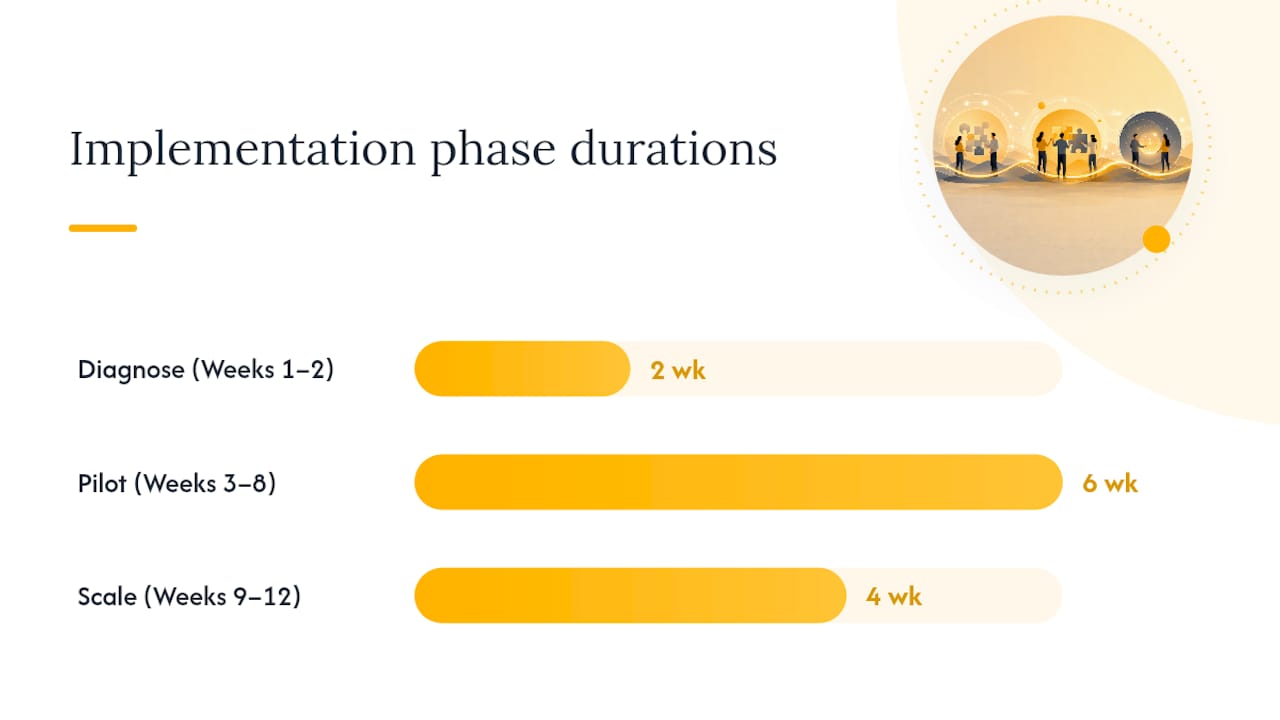
- Diagnose (Weeks 1–2). Audit current interactions using conversation analytics. Identify where empathy is absent, formulaic, or misapplied. Map agent skill gaps against the three-component model.
- Pilot (Weeks 3–8). Select a focused interaction type (returns, escalations, loyalty calls). Train a cohort of agents using active listening drills, cognitive-empathy problem-solving exercises, and role-play with scoring rubrics. Deploy scripting templates that embed decision rules rather than fixed phrases.
- Scale (Weeks 9–12). Expand to additional interaction types and agent cohorts. Introduce skill-based routing that matches psychologically primed customers with agents trained for their profile.
- Govern. Establish a quality review cadence, targeted coaching triggers, and escalation rules that prevent empathy from being applied where customers have signaled they don’t want it.
Key hiring and training elements:
- Behavioral interview prompts: Ask candidates to describe a time they changed their approach mid-conversation because they sensed the customer’s real need differed from the stated one.
- Role-play evaluation: Score on attentive (paraphrase accuracy), affective (appropriate brevity), and cognitive (options offered) dimensions separately.
- Scripting guidance: Write templates as decision trees, not scripts. “If customer expresses frustration → validate briefly → move to options” outperforms a fixed apology sentence every time.
Pro Tip: Protect agents from empathy fatigue by capping consecutive high-emotion interactions. Workforce optimization scheduling that alternates complex and routine queues reduces burnout without sacrificing coverage.
How do you measure ROI from empathy investments?
| KPI | Collection Method | Target Improvement |
|---|---|---|
| CSAT / NPS | Post-interaction survey | CSAT lift |
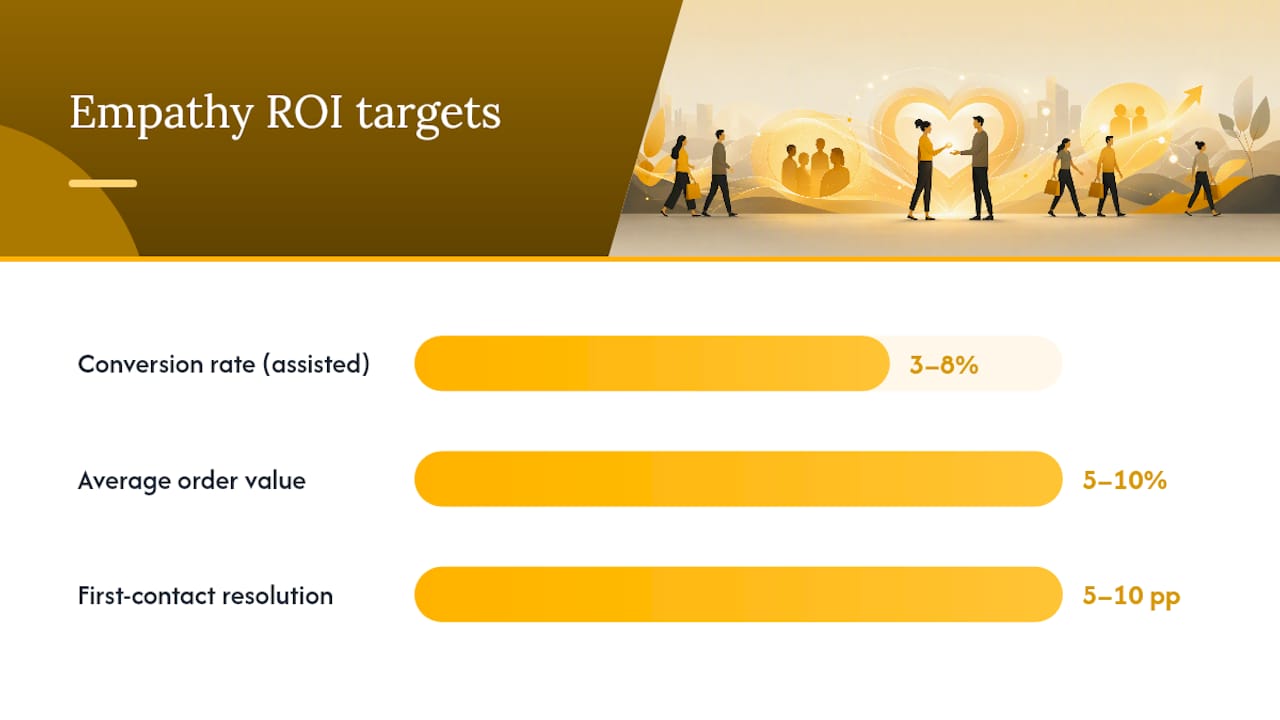
| Conversion rate (assisted) | CRM transaction data | +3–8% on empathy-trained cohort |
| Average order value | POS / ecommerce data | +5–10% on empathy-trained interactions |
| First-contact resolution | Ticket / call data | +5–10 percentage points |
| Agent retention (6-month) | HR data | Measurable reduction in turnover |
Testing methodology matters as much as the metrics. A staged before/after pilot on a defined interaction type gives a clean signal. Conversation analytics tools can detect explicit emotional validation in transcripts, letting you correlate empathy presence with CSAT outcomes directly.
A sample revenue calculation: if a 100-agent retail contact center handles 10,000 assisted interactions per month at a 15% conversion rate and $80 AOV, a 5% conversion lift from empathy training adds roughly 500 transactions and $40,000 in monthly revenue — before accounting for repeat purchase effects.
For a structured pilot approach, retail CX optimization frameworks provide the KPI scaffolding to run a 6–12 week test with clean before/after comparisons.
What mistakes undermine empathy programs?
Most empathy initiatives fail at the execution layer, not the strategy layer.
- Formulaic apologies. “I completely understand your frustration” delivered on every call destroys credibility faster than no empathy at all. Customers hear the script.
- Overuse where customers disinvite it. Applying affective empathy to a customer who wants a fast transactional answer wastes their time and signals poor listening.
- Misrouting trivial issues to human agents. This increases handle time and costs without delivering value. Automation should absorb these.
- No measurement. Without conversation analytics and KPI tracking, empathy training becomes a cost center with no visible return.
- Insufficient agent support. Empathy work is cognitively demanding. Without scheduling relief, coaching, and management modeling, agents burn out and empathy becomes performative.
Policies that convert service interactions into pure transactions can actively erode empathy — rigid scripts, penalty-based quality scoring, and handle-time pressure all work against the behaviors you are trying to build.
How a nearshore CX partner operationalizes empathy: an Altiamcx blueprint
A typical Altiamcx engagement for retail empathy implementation runs 12 weeks with defined deliverables at each stage.
- Weeks 1–2: Interaction audit, gap analysis, empathy playbook draft.
- Weeks 3–6: Agent training (active listening, cognitive-empathy modules, role-play scoring), routing rules configuration, conversation analytics dashboard setup.
- Weeks 7–10: Live pilot on selected interaction type, weekly KPI review, coaching adjustments.
- Weeks 11–12: Pilot KPI report, scale recommendation, governance SLA documentation.
Deliverables include:
- Empathy playbook with decision-tree scripting templates
- Training modules covering all three empathy components
- Routing rules and skill-based queue configuration
- Conversation analytics dashboard with emotional validation detection
- Pilot KPI report with ROI calculation
Altiamcx provides bilingual nearshore agents, workforce scaling, governance frameworks, and measurement infrastructure. This complements internal retail teams by adding trained capacity without the overhead of full-time hiring, and by bringing a measurement discipline that most internal programs lack.
How do cultural differences affect empathy in retail settings?
Empathy expression is not universal. In high-context cultures — common across Latin America and parts of Asia — customers expect relationship-building before resolution, and a direct transactional response can feel cold. In lower-context cultures, including much of the United States, customers often prefer efficiency with brief emotional acknowledgment rather than extended rapport-building.
For U.S. retailers with bilingual customer bases, this has direct operational implications. A Spanish-speaking customer from a Mexican background may interpret a brief, efficient response as dismissive, while the same customer’s English-speaking counterpart finds it respectful of their time. Nearshore agents with genuine cultural alignment — not just language fluency — navigate this distinction naturally. Training programs should include cultural calibration modules that teach agents to read these signals and adjust their empathy register accordingly.
Why empathy is the most important skill for handling escalated interactions
Escalated interactions are where empathy’s ROI is highest and where its absence does the most damage. A customer who has already contacted support once, received an inadequate resolution, and is now calling back is not looking for another apology. They want evidence that someone understands what went wrong and has the authority to fix it.
The sequence that works: acknowledge the history (“I can see this is your second contact about this”), validate the frustration briefly, then move immediately to a concrete resolution path. Cognitive empathy carries the weight here. Agents who can articulate the customer’s goal back to them — “What you need is the replacement shipped before Friday” — and then confirm they can make that happen convert escalations into loyalty moments. Those who default to affective phrases without resolution authority do the opposite.
High-touch service strategies consistently show that escalation handling is the single interaction type with the highest leverage on long-term retention. Getting it right requires both the right agent skill and the right routing — escalations should never land with a first-tier agent who lacks resolution authority.
Why retail leaders are underestimating empathy’s strategic value in 2026
The conventional wisdom treats empathy as a training topic — something you cover in onboarding and revisit when CSAT dips. That framing misses the point entirely.
Empathy is an operating-model design problem. It requires aligned policies, agent incentives, scripting, routing, and measurement to be sustainable. A retailer that trains agents in empathy but then scores them purely on handle time has built a contradiction into the system. The agents will default to speed, and the empathy training will fade within weeks.
The leaders who are getting this right in 2026 are treating empathy the same way they treat inventory accuracy or fulfillment SLAs: as a measurable operational output with defined inputs, clear owners, and regular review. The evidence supports the investment. The execution gap is where most programs fail, and closing it is a structural decision, not a training one.
Altiamcx helps retail teams scale empathy with measurable results
Retail teams that want to move from empathy as a concept to empathy as a measured operational output need more than a training workshop. Altiamcx delivers nearshore team extension with agents trained in the three-component empathy model, conversation analytics to track emotional validation in real interactions, and a governance framework that keeps the program accountable to KPIs.

The engagement model is built for retail CX leaders who need results within a defined timeline. A 6–12 week pilot covers interaction auditing, agent training, routing configuration, and a KPI report with a clear ROI calculation. The pilot length is dependent on the specific retail team’s size and needs, generally falling within a 6–12 week window. You get bilingual agents, workforce scalability, and a measurement infrastructure that most internal teams cannot build alone. Contact Altiamcx to scope a pilot for your team.
Primary sources and further reading
- Customers Expect Empathy. Here’s How to Deliver It. — HBR global survey of nearly 12,000 consumers; primary evidence for trust, morale, and the empathy gap.
- Customer satisfaction scores rise when agents express empathy — Level AI analysis of 35.1 million conversations; source for CSAT 3.94 vs. 3.52 and industry variance findings.
- Beyond efficiency: Why empathy wins in the age of AI customer service — Expert guidance on the hybrid AI + human model for retail CX.
- Loyalty in retail: balancing AI and empathy for lasting customer connections — Industry survey data on loyalty lifts and customer frustration with automation.
- Retail in 2023 and Beyond: ‘Empathy’ Holds the Key to Customer Retention — Practitioner analysis on the “show me that you know me” customer demand and digital friction reduction.
Sources
- Customers Expect Empathy. Here’s How to Deliver It.
- Customer satisfaction scores rise when agents express empathy
- Beyond efficiency: Why empathy wins in the age of AI customer service
- Loyalty in retail: balancing AI and empathy for lasting customer connections
- Retail in 2023 and Beyond: ‘Empathy’ Holds the Key to Customer Retention