Outsourcing eDiscovery moves the work, not the accountability. The main risks are confidentiality failures, weak supervision, lost defensibility, hidden subcontractors, runaway scope and billing disputes, and each one lands on the law firm or legal department, not on the vendor. Most of them can be priced, contracted and monitored before the first file is collected. This guide shows where they come from and which controls matter most.
TL;DR
- Outsourcing delegates execution, not judgment. Under the ABA’s framework, counsel still owes competence, supervision and confidentiality for work done by vendors and outsourced staff.
- The least visible risk is loss of defensibility: if processing logs, chain of custody and QC records are missing, you cannot explain your production when an opponent challenges it.
- Subcontractors and hosting layers are where many failures start. Diligence has to cover the whole service chain, and healthcare data adds HIPAA business associate duties.
- Scope creep and unclear billing units cause most commercial disputes. Use an assumptions register, change control and auditable usage reports.
- Match the provider to the need: a one-off matter, a standardized workflow, or an ongoing partnership each call for different controls.
Table of Contents
- Why outsourcing eDiscovery is still the right call for many teams
- The professional responsibility risk: you cannot outsource the duty
- Defensibility risk: the one that surfaces too late
- Security and privacy risk
- Healthcare data: nearshore or cloud does not remove HIPAA
- Subcontractor and service-chain risk
- Scope creep and billing risk
- Risk and control matrix
- How to vet a provider without relying on the demo
- Our perspective on delegating legal operations
- Where a managed legal team fits
- A practical pre-engagement checklist
- FAQ
- Sources
Why outsourcing eDiscovery is still the right call for many teams
Most firms and legal departments do not have the in-house technology or review capacity for large ESI volumes. The ABA notes that firms trying to keep case teams lean while handling the volume of ESI in litigation, regulatory actions and investigations are engaging e-discovery vendors and contract attorneys to fill the gap. That is a sound decision when it is managed as a controlled delegation.
The risks below are not arguments against outsourcing. They are the checklist that separates a defensible engagement from an expensive surprise.
The professional responsibility risk: you cannot outsource the duty
The ABA’s guidance on attorney use of vendors (August 2024) confirms that attorneys may retain vendors to manage documents, including ESI, for investigations or litigation. It also ties that permission to the Model Rules on competence (1.1), supervision (5.1 and 5.3) and confidentiality (1.6).
In practice, that means counsel should be able to show:
- Competent selection. You evaluated the vendor’s ability to safeguard client information, and you documented how.
- Real supervision. Outsourced nonlawyers and contract reviewers work under a protocol you defined, with escalation paths for hard responsiveness and privilege calls.
- Written confidentiality terms. Safeguards, protective-order compliance, incident notification and mitigation are in the contract, not in a sales deck.
- Conflict checks. The vendor and its reviewers have been screened for adverse-client exposure.
The ABA’s piece on direction and oversight of contract attorneys and e-discovery vendors points to a layered model: contractual safeguards, least-privilege access, multifactor authentication and logging, vendor monitoring, random quality-control review and substantive review of the final production. No certificate or software feature replaces that active oversight.
A related piece on ethical implications when outsourcing legal work is a useful read for the back-office side of the same question. If you are building a governance process around delegated work, this report on AI and governed workflows in legal practice is a helpful companion on counsel’s continuing duties.
Defensibility risk: the one that surfaces too late
A data breach is loud. Loss of defensibility is quiet, and it often costs more.
Before production, your provider must preserve the records that let you explain what happened: chain-of-custody documentation, processing parameters, exception logs, deduplication and threading decisions, reviewer instructions and QC results. The Sedona Conference guidance on selecting eDiscovery providers frames selection around exactly this kind of fit-and-risk assessment of the provider, the data and the project together.
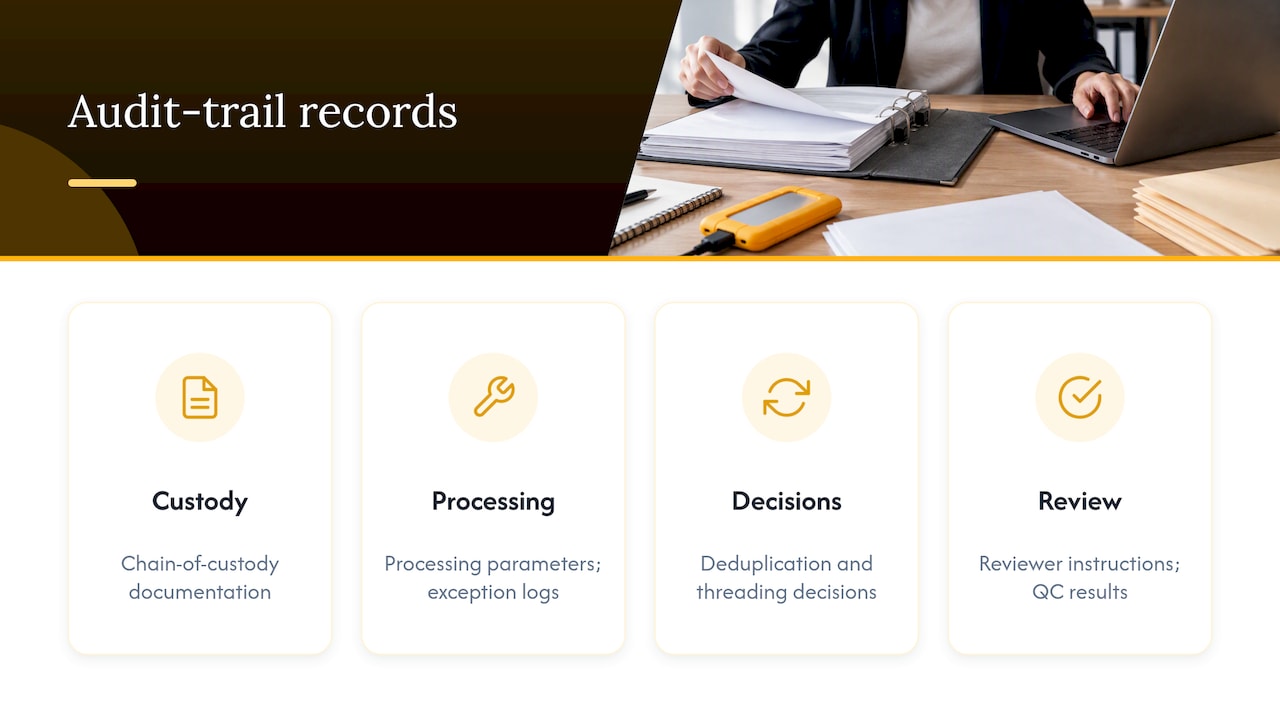
Why it matters: if an opponent challenges completeness or privilege, “the vendor handled it” is not an answer. You need the audit trail.
Preservation and sanctions exposure
Under Rule 37(e) of the Federal Rules of Civil Procedure, as summarized by the Federal Judicial Center, sanctions risk arises when ESI that should have been preserved is lost because reasonable steps were not taken and the information cannot be restored or replaced. The rule separates curative measures tied to prejudice from harsher remedies that require intent to deprive. Outcomes depend on the facts and the court.
The takeaway for outsourcing: an agreement with a provider cannot eliminate your own preservation duty. Put legal-hold handoffs, collection steps and deletion rules in writing, and confirm who holds the data at each stage.
Security and privacy risk
Federal agencies publish their own risk analyses for eDiscovery platforms, and they read like a vendor checklist. The Department of Justice’s privacy impact assessment for its Civil RelativityOne environment and the FDIC’s assessment of its eDiscovery and litigation support suite identify recurring risks: unauthorized access, over-collection, inaccurate data, unauthorized dissemination and third-party access.
The controls they describe are a sensible baseline to request from any provider:
- Data minimization, so you collect and host only what the matter needs
- Encryption in transit and at rest
- Case-specific repositories rather than shared pools
- Need-to-know permissions and multifactor authentication
- Activity logging and backups
- Security screening of the people who touch the data
The DOJ document cites TLS 1.2 or higher and AES-256 for its own environment. Those are agency-specific choices, not a universal legal standard, but they give you a concrete benchmark for your questions.
Healthcare data: nearshore or cloud does not remove HIPAA
If your matter involves protected health information, the risk compounds. HHS guidance on HIPAA and cloud computing says a cloud provider that handles ePHI is a business associate, even when it handles only encrypted ePHI. The covered entity or business associate must have a HIPAA-compliant business associate agreement in place, and encryption alone is not a blanket exemption. Safe-harbor treatment depends on meeting specified standards and protecting the decryption key.
Two more points to build into diligence:
- Breach clocks. A business associate must notify its customer of a breach of unsecured PHI without unreasonable delay and no later than 60 days after discovery, per the same HHS guidance. Your contract should set a much shorter operational window for incident notice, so you can meet your own obligations.
- Subcontractors. In a 2023 resolution agreement, HHS cited MedEvolve for failing to enter a BAA with a subcontractor. That is an enforcement example, not a penalty schedule, but it shows regulators look down the chain.
For a broader view of healthcare outsourcing controls, see our HIPAA compliant outsourcing guide for healthcare administrators.
Subcontractor and service-chain risk
A polished prime vendor can still depend on a hosting company, an offshore review shop or a lower-tier processor you never met. HHS’s cloud guidance makes the point for health data: a cloud host or subcontractor can carry its own business-associate obligations and can become the practical point of failure for ransomware, breach notification, access control or deletion.
Ask every provider for:
- A complete list of subcontractors and hosting locations
- Flow-down of your confidentiality, security and notification terms
- Your right to approve or object to changes in the chain
- Evidence of deletion or return of data at the end of the matter
- Notice of any ownership change at the provider
This also covers where data is stored and where it is accessed from. Some matters require U.S. hosting. A public-sector RFP examined by Sedona, from Delaware, specifically required secure U.S. hosting, robust encryption, regular backups, support during review, varied file-format processing and the ability to comply with HIPAA, FERPA and related privacy rules.
Scope creep and billing risk
Every eDiscovery budget rests on assumptions. The trouble starts when the assumptions are unwritten.
Scope usually grows through:
- New custodians added mid-matter
- Collaboration applications and chat data nobody scoped
- Nonstandard file types
- Foreign-language review
- Additional productions
- Revised privilege rules
- Longer hosting periods
A per-hour or per-gigabyte rate does not protect you from any of that. A written assumptions register and a change-control process tied to measurable volume, turnaround and quality thresholds does.
Billing units deserve the same scrutiny. A Delaware court opinion in a dispute between an e-discovery provider and a law firm involved factual disputes over how hosted data was measured and billed, and over subcontracted hosting companies. The lesson is operational, not legal: require an auditable unit definition, monthly usage reports, reconciliation rights and post-termination storage pricing.
Risk and control matrix
| Risk | What goes wrong | Control to put in the contract |
|---|---|---|
| Ethics and supervision | Unsupervised reviewers, missed conflicts | Review protocol, escalation path, conflict screening, QC sampling |
| Defensibility | No record of processing decisions | Audit trail, exception logs, QC results delivered at close |
| Preservation | ESI lost during handoff | Written hold and collection steps, chain-of-custody records |
| Security | Over-access, third-party exposure | Least privilege, MFA, logging, encryption, case-specific repositories |
| HIPAA | Missing BAA, slow breach notice | BAA at every tier, short incident-notice window, deletion evidence |
| Subcontractors | Hidden hosting or review layers | Disclosed list, flow-down terms, approval rights |
| Scope and billing | Unpriced assumptions, disputed data volumes | Assumptions register, change control, usage reports, exit pricing |
| Vendor quality | Strong sales team, thin delivery | References, audits, named staff, response-time commitments |
How to vet a provider without relying on the demo
Sedona’s guidance starts with the need: is it a new matter, a wish to standardize an existing workflow, or a decision to outsource the discovery process altogether? The answer changes what you test. A one-off project calls for speed and clear pricing. An ongoing partnership calls for governance, reporting and exit terms.
A defensible selection process goes beyond platform demonstrations. Test these areas:
- Conflicts and adverse-client exposure.
- Staffing and supervision. Who actually does the work, and who checks it?
- Physical and network security.
- Collection, processing and production capability, including the file formats you need.
- Support coverage during review windows.
- Hosting location, encryption and backups.
- Regulatory capability, such as HIPAA or FERPA where relevant.
- Pricing assumptions, in writing.
One trap is easy to miss. A knowledgeable and polished sales staff can sit in front of a thinner delivery team. Ask to meet the project manager and reviewers, call references from similar matters, and audit what you can. Fast, clear communication during live matters is a real quality signal, since delays create costly setbacks in litigation.
Our perspective on delegating legal operations
At Altiam CX, we work on the operational side of legal services: intake, client follow-ups, appointment coordination, back-office support and managed team extension for law practices. That vantage point shapes how we think about eDiscovery outsourcing.
The pattern we see is that risk grows where ownership is vague. When a legal team hands off work without a written protocol, a named supervisor and a reporting rhythm, quality drifts and nobody notices until a deadline. When the handoff has defined roles, measurable thresholds and regular review, nearshore and managed models can add capacity without adding exposure.
Three principles guide how we would approach any delegated legal workflow:
- Define the work before you hire for it. Standard operating procedures and QC criteria come first.
- Keep judgment with counsel. Delegate repeatable execution and keep privilege and responsiveness calls with attorneys.
- Measure what matters. Turnaround, accuracy and escalation rates beat vague promises of efficiency.
We do not position ourselves as an eDiscovery platform. Our role is the managed team and operational discipline around legal work, and we are clear about that line during scoping.
— Daniela
Where a managed legal team fits
Not every eDiscovery-adjacent task needs a specialized platform vendor. Matter intake, client communication, scheduling, document organization and back-office legal support are steady, process-driven functions that a dedicated nearshore team can run under your supervision. Pairing that team with your chosen platform provider can free attorneys and paralegals for the judgment-heavy work.
Our legal intake and back-office support offering covers legal intake and inquiry handling, client follow-ups and case communication, appointment scheduling, ongoing client support, managed legal team extension and back-office legal support. If you want to see how this looks in practice, review our legal services case study, or read more on litigation support outsourcing and the advantages of team extension for legal services.
A practical pre-engagement checklist
Before you sign with any provider, confirm that you can answer yes to each item:
- Have we documented why this provider fits this matter, and what alternatives we weighed?
- Does the contract include written confidentiality terms, incident notification and mitigation duties?
- Do we have the full list of subcontractors and hosting locations, with flow-down terms?
- Is there a BAA at every tier if health data is involved?
- Is there an assumptions register with change control and defined billing units?
- Will we receive processing logs, exception reports and QC results with each production?
- Is there a supervised, sampled QC process, and who on our side owns it?
- Are exit terms clear: data return, deletion evidence and post-termination storage pricing?
For teams evaluating delegation more broadly, our overview of why law firms outsource operations and the latest legal industry outsourcing trends add context on how teams structure these decisions.
If you are scoping a managed legal support team to work alongside your eDiscovery provider, start with our services overview and tell us which workflows you want to hand off.
FAQ
Does outsourcing eDiscovery shift liability to the vendor?
Not for your professional duties. The ABA framework keeps competence, supervision and confidentiality obligations with counsel, even when vendors or contract reviewers do the work. A contract can add indemnity and insurance, but it does not remove your own responsibility to select, instruct and oversee the provider.
What is the biggest eDiscovery outsourcing risk?
For many teams it is loss of defensibility rather than a breach. If chain-of-custody records, processing parameters and QC results are not preserved, you cannot explain a production when completeness or privilege is challenged. Security failures are serious too, but missing documentation often goes unnoticed until it is needed.
Does HIPAA apply if the provider only holds encrypted data?
Yes, in the HHS view. A provider that creates, receives, maintains or transmits ePHI is a business associate even if the data is encrypted and the provider lacks the key. You need a BAA, and encryption helps only if it meets the specified standards and the key is protected.
How do I prevent eDiscovery costs from growing out of control?
Write down the assumptions behind the quote: custodians, data sources, file types, languages, number of productions and hosting duration. Attach a change-control process and an auditable definition of how data volume is measured and billed. Ask for monthly usage reports and agree on post-termination storage pricing up front.
Should I use one vendor or several?
It depends on the need. Sedona’s guidance starts by asking whether you have a single matter, a workflow to standardize or a full outsourcing goal. A single provider simplifies accountability, while a split model can suit teams that separate platform work from operational support, as long as every party is covered by your confidentiality and security terms.
Sources
- ABA: Ethical Issues Related to Attorney Use of Vendors
- ABA: Considerations in Outsourcing: Direction and Oversight of Contract Attorneys and E-Discovery Vendors
- ABA: Ethical Implications When Outsourcing Legal Work
- The Sedona Conference: Guidance for the Selection of Electronic Discovery Providers
- Federal Judicial Center: Fed. R. Civ. P. 37
- DOJ: Privacy Impact Assessment for Civil RelativityOne
- FDIC: Privacy Impact Assessment for the eDiscovery and Litigation Support Suite
- HHS: Guidance on HIPAA and Cloud Computing
- HHS: MedEvolve Resolution Agreement and Corrective Action Plan
- Delaware Court opinion: Trust-Ed Solutions, LLC and Gilbert LLP e-discovery dispute