
KYC verification is the risk-based process that proves who a customer is at onboarding and feeds a customer risk profile used throughout AML monitoring. The lifecycle runs through six linked stages: identity collection (CIP), risk tiering (CDD), beneficial ownership checks for entities (KYB), sanctions and PEP screening, enhanced due diligence for flagged accounts, and ongoing monitoring with recordkeeping behind it. Simple digital checks often clear in minutes; complex corporate or high-risk files can take several business days, and monitoring never really stops after that.
TL;DR:
- Most onboarding failures stem from poor data capture during CIP, not from inadequate document verification or screening methods.
- Accurate risk profiling in CDD relies heavily on correct, complete, and timely data about occupation, transaction expectations, and ownership structures.
- The biggest operational improvement comes from front-loading data quality controls and routing screening hits to specialized analysts to reduce false positives and delays.
- Existing document checks do little to prevent large-scale fraud losses; the true challenge lies in building a comprehensive risk context early in the process.
- Continuous monitoring and event-driven re-verification, not fixed schedules, improve early detection of emerging risks and reduce operational costs over time.
Table of Contents
- What is the KYC verification process, step by step?
- Customer Identification Program: collecting and verifying identity data
- Customer Due Diligence: building the initial risk profile
- Beneficial ownership and KYB for business customers
- Sanctions, PEP, and adverse media screening
- Enhanced due diligence for high-risk and complex cases
- Ongoing monitoring and the shift to perpetual KYC
- Records, SAR filing, and staying exam-ready
- Documents, technology, and realistic timelines
- An operational perspective: cutting friction without cutting corners
- Where compliance teams get KYC wrong
- Sources
What is the KYC verification process, step by step?
The phrase “KYC verification process” gets thrown around loosely, but regulators and standards bodies treat it as a defined sequence, not a single check. Financial institutions build it around what FinCEN and the Bank Secrecy Act describe as a customer identification and due diligence program, and SWIFT’s own breakdown of the process names the same stages compliance teams already recognize: identity verification, due diligence, beneficial ownership discovery, sanctions screening, risk scoring, enhanced diligence where warranted, and ongoing monitoring.
Here’s the part operators often miss: KYC verification and identity verification are not synonyms. Identity verification confirms a document and a face match. KYC verification takes that confirmed identity and assigns it a risk posture, an expected behavior profile, and a monitoring cadence. The distinction matters because a program that stops at document checks isn’t KYC. It’s just the first rung of a taller ladder.
You’ll also hear “KYC vs AML” used as if they’re competing frameworks. They’re not. KYC verifies identity at onboarding, while AML covers the ongoing transaction monitoring and SAR filing that follows. Think of KYC as the intake exam and AML as the years of follow-up visits. One without the other leaves a program half built.
Customer Identification Program: collecting and verifying identity data
The Customer Identification Program, or CIP, is where the KYC verification steps actually begin. It’s the mandatory minimum under Bank Secrecy Act and FinCEN rules, and it’s where most onboarding friction gets created or eliminated.
For individual customers, a compliant CIP typically collects:
- Full legal name and date of birth
- Residential address (not a P.O. box)
- A government-issued identification number, such as a Social Security number or passport number
- One or more acceptable ID documents: driver’s license, passport, state ID, or in some programs a national ID card
Verification technique matters as much as the document list. Most institutions now layer several methods rather than trusting one:
- OCR and template matching to extract and validate data fields against known document layouts
- Chip or NFC reads on passports and newer driver’s licenses, which pull cryptographically signed data straight from the document’s embedded chip
- Issuing-authority checks, where available, to confirm a document number hasn’t been reported lost, stolen, or fraudulent
- Biometric liveness checks that compare a live selfie against the photo on the document and confirm the person isn’t a static image or deepfake
The operational trade-off is real. Every added verification layer reduces fraud risk but adds friction, and friction is what drives abandonment during onboarding. A well-designed capture flow front-loads the fields that feed downstream Customer Due Diligence, such as occupation and expected account activity, so the customer isn’t asked for the same information twice in two different screens. That single design choice does more for completion rates than most fraud teams give it credit for.
Pro Tip: Capture occupation and expected transaction volume during CIP, not during a later CDD form. Institutions that ask for this data twice see measurably higher onboarding drop-off, and the delay pushes risk scoring further down the pipeline than it needs to be.
Customer Due Diligence: building the initial risk profile
Customer Due Diligence takes the verified identity from CIP and turns it into a risk tier. This is the stage where a bank or fintech decides how closely to watch an account before a single transaction has occurred.
CDD draws on several inputs at once, and the interplay between them is what produces an accurate score:
- Customer type. An individual retail customer, a sole proprietor, and a multinational trading company carry structurally different risk profiles before you even look at behavior.
- Geography. Country of residence, country of citizenship, and country of incorporation all matter, particularly where a jurisdiction appears on sanctions or high-risk lists.
- Occupation and industry. Cash-intensive businesses, money service businesses, and certain high-risk professions warrant closer review than a salaried employee at a known employer.
- Product and transaction profile. A savings account and a correspondent banking relationship do not belong in the same review bucket.
- Source of funds. Where the money originates, and whether that origin is plausible given the customer’s stated profile, is often the single strongest predictor of future risk.
A workable operational rubric sorts customers into low, medium, and high tiers based on how many of these factors trip a threshold. A domestic retail customer with a conventional employer and modest expected balances lands in the low tier with standard periodic review. A customer with offshore ties, cash-heavy income, or a mismatch between stated occupation and expected transaction volume moves to medium, triggering a documented analyst review before approval. Anyone touching a sanctioned jurisdiction, holding a politically exposed position, or presenting an ownership structure that doesn’t reconcile cleanly moves straight to high risk and, in most programs, requires enhanced due diligence before the account opens.
The output of CDD isn’t a single pass/fail flag. It’s a decision code, a set of reviewer notes justifying the tier, a scheduled date for the next periodic review, and a data profile that transaction monitoring systems use to set alert thresholds. Weak data capture at this stage, particularly around occupation and expected activity, is one of the biggest drivers of false positives once transaction monitoring kicks in, because the system has nothing accurate to compare real behavior against.
Beneficial ownership and KYB for business customers
Verifying a legal entity is a different problem than verifying a person, and it’s where a surprising number of KYC programs fall apart. Know Your Business, or KYB, exists because a corporate customer is really a chain of ownership, and the actual risk sits with whoever ultimately controls the entity, not the entity’s name on a formation certificate.

Most US programs require beneficial ownership disclosure for any individual holding 25% or more equity in a legal entity customer, alongside at least one control person regardless of ownership percentage. That threshold comes from the same regulatory framework underpinning BSA obligations, and it’s worth treating as a floor rather than a ceiling. A customer holding exactly 24% ownership isn’t automatically low risk. It’s a number that should prompt judgment, not autopilot approval.
Documentation and verification steps typically include:
- Articles of incorporation or organization and any amendments
- Business registry extracts confirming the entity is active and in good standing
- Tax identification numbers (EIN in the US, or equivalent abroad)
- A signed beneficial ownership declaration identifying each qualifying owner and control person
- Government ID and CIP-level verification for every named beneficial owner, not just the entity itself
The escalation trigger is ownership opacity. Layered holding companies, trusts, or entities registered in jurisdictions with weak corporate transparency requirements should push the file into enhanced due diligence rather than a standard KYB pass. SWIFT’s KYC Registry illustrates one industry response to this burden: a centralized, standardized KYC data exchange that lets corporate customers avoid resubmitting the same ownership documentation to every bank they work with, cutting duplicated effort across institutions that would otherwise each run KYB from scratch.
Sanctions, PEP, and adverse media screening
Screening is where identity verification meets geopolitics, and it’s arguably the KYC compliance procedure most prone to operational error if the workflow isn’t tuned carefully.
Authoritative screening sources every compliance team should be checking against include OFAC’s Specially Designated Nationals list, the UN Consolidated Sanctions List, EU and UK sanctions lists, and commercial PEP and adverse media databases that aggregate global political exposure and negative news coverage. Re-screening on a recurring basis matters as much as the initial check, because sanctions lists change constantly and a customer who was clean at onboarding can appear on a list six months later without ever changing their own behavior.
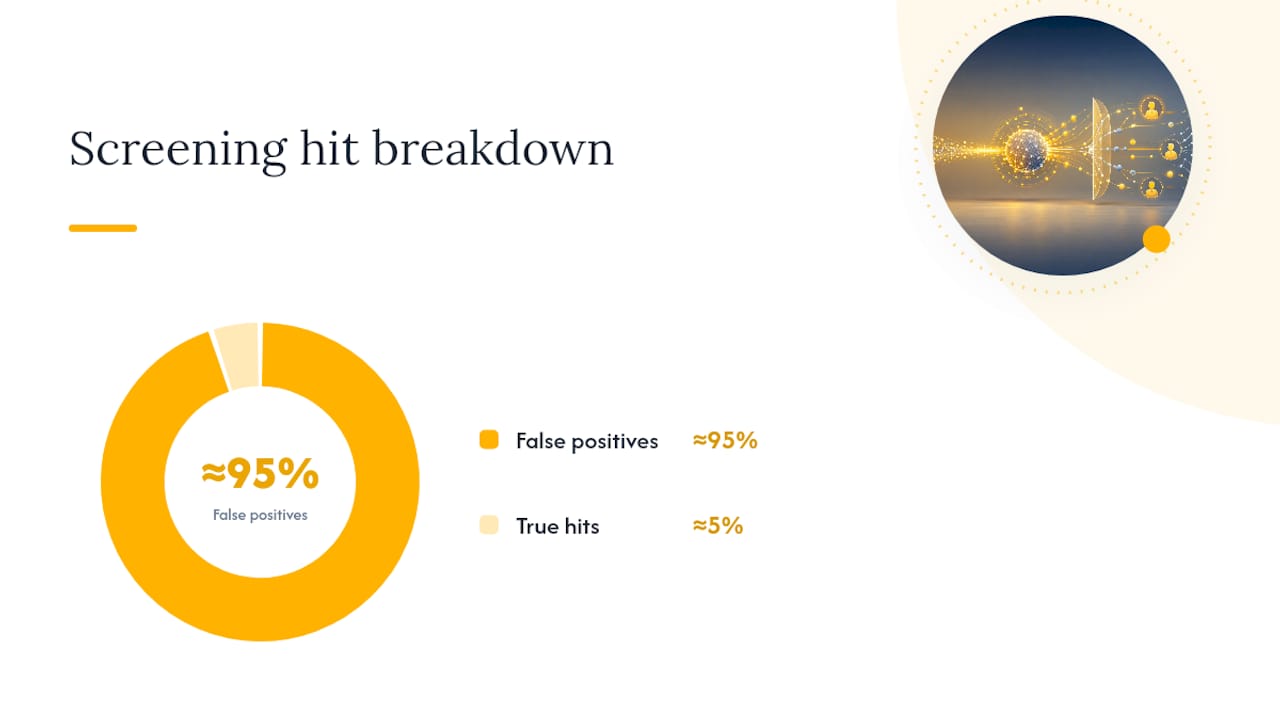
Matching is the hard part, not the list itself. Name variants, transliteration differences, common surnames, and partial matches generate a flood of false positives that can bury real hits if the triage process isn’t disciplined:
- Tier 1: auto-clear. Obvious non-matches, typically differing on date of birth or country combined with a common name, get cleared automatically by the matching engine.
- Tier 2: analyst review. Partial matches with some overlapping identifiers go to a trained analyst who checks supplementary identifiers before escalating or clearing.
- Tier 3: senior escalation. Confirmed or high-confidence matches against sanctions or PEP lists go to a compliance officer for a documented decision, often with account restriction pending resolution.
Pro Tip: If your false-positive rate sits above 95% of total screening hits, which is common with poorly tuned fuzzy-matching thresholds, invest in adjusting match sensitivity by name origin rather than applying one global threshold. A single algorithm tuned for English names will flood your queue with false hits on transliterated names from other scripts.
Enhanced due diligence for high-risk and complex cases
Enhanced due diligence, or EDD, is what standard CDD escalates to when a customer’s risk profile crosses a threshold that a routine review can’t adequately address. Regulatory guidance consistently frames EDD as a required layer of a risk-based approach, not an optional extra for the most cautious institutions.
Common triggers include:
- Politically exposed person status, whether foreign or domestic, and their immediate family members or close associates
- Complex or opaque ownership structures, particularly layered entities spanning multiple jurisdictions
- Unusually high transaction volumes relative to the customer’s stated profile or industry norms
- Operations in high-risk jurisdictions, including countries flagged by FATF for strategic deficiencies in their AML frameworks
- Prior suspicious activity flags from the same customer or a closely linked party
Once a file enters EDD, the evidence bar rises considerably. Analysts need documented source-of-funds and source-of-wealth verification, not just a stated occupation. That means pay stubs, tax filings, business financials, or asset sale records that plausibly explain the money involved. Adverse media searches widen beyond a basic name check to cover litigation history, regulatory sanctions, and negative press across multiple languages where relevant. Ownership mapping gets documented down to the individual level, with each layer of a corporate structure traced to a natural person.
Approval workflows should require sign-off from someone above the level that approved the original CDD tier, and every decision needs a written rationale that a regulator can follow years later without needing to interview the original analyst. That documentation discipline is what separates a defensible EDD program from one that collapses under a supervisory exam.
Ongoing monitoring and the shift to perpetual KYC
KYC verification doesn’t end at onboarding. It transitions into two parallel monitoring tracks that too many programs treat as one.
Transaction monitoring watches behavior. It flags activity that deviates from the customer’s expected profile, structuring patterns, or velocity that doesn’t match the stated business purpose. Identity and attribute monitoring watches the customer record itself. It catches address changes, ownership changes for business customers, new sanctions hits, and adverse media that surfaces after onboarding.
Review cadence should track risk tier rather than applying one blanket schedule:
- Low-risk retail customers: full review every 12 to 36 months, unless a triggering event accelerates it
- Medium-risk customers: annual review, with interim checks tied to transaction volume changes
- High-risk and EDD customers: review every 6 to 12 months, often with continuous automated monitoring layered on top
The industry is moving away from fixed periodic refresh cycles toward perpetual KYC, or pKYC, where a sanctions hit, an adverse media alert, or a significant behavioral anomaly automatically triggers a re-verification event rather than waiting for the calendar date. Event-driven refresh models tend to catch emerging risk faster than fixed-cycle reviews and reduce the operational cost of re-checking accounts that haven’t actually changed. Integrating real-time sanctions list updates and adverse media feeds directly into the monitoring system is what makes pKYC workable at scale rather than a manual scramble every time a list updates.
Records, SAR filing, and staying exam-ready
Every stage of the KYC verification process leaves a paper trail, and that trail is what an examiner actually reviews. The Bank Secrecy Act requires financial institutions to maintain KYC and AML programs and to report suspicious activity through Suspicious Activity Reports, with retention and documentation standards that FFIEC’s BSA/AML manual spells out for examiners in detail.
Recordkeeping practices worth building into any program:
- Retain identity verification records, CDD risk assessments, and screening results for at least five years after the account closes, matching standard BSA retention windows
- Keep granular audit trails showing who reviewed each file, what evidence they relied on, and when the decision was made, since exam windows often reach back years
- Log every screening hit and its resolution, not just the ones that escalated
A SAR filing follows a fairly linear path once suspicious activity is identified: an analyst documents the activity, a compliance officer reviews and approves the narrative, the filing goes to FinCEN within the required window, and the underlying evidence gets retained separately from the SAR itself since SARs carry strict confidentiality rules.
For exam readiness, keep a standing folder of sample files spanning each risk tier, documented senior approvals for every EDD escalation, and logs showing your screening system’s testing and tuning history. Examiners consistently ask for evidence that a program works in practice, not just that a policy document exists describing how it should.
Documents, technology, and realistic timelines
KYC requirements for documents vary by customer type, but a working checklist covers most cases compliance teams encounter.
For individuals: government-issued photo ID, proof of address dated within the last three months, and a Social Security number or equivalent tax ID. Acceptable alternatives include a passport in place of a driver’s license, or a utility bill in place of a bank statement for address proof.
For businesses: articles of incorporation, an EIN confirmation letter, a business license where applicable, and beneficial ownership declarations for every qualifying owner.
Technology choices largely come down to how much manual review a file’s risk tier justifies:
- Automated flows handle document OCR, biometric liveness, and basic sanctions screening for low-risk individual customers, often without any human touch until a discrepancy surfaces
- Manual review stays necessary for KYB files with layered ownership, EDD escalations, and any screening hit above the auto-clear threshold
- Hybrid integrations, where automation handles the first pass and routes exceptions to analysts, now dominate mid-market and enterprise onboarding stacks
Timelines follow the same split. A simple digital identity check for an individual customer can complete in minutes, while a complex corporate customer requiring EDD, ownership mapping, and source-of-wealth documentation realistically takes several business days. Building that timeline difference into customer-facing expectations upfront avoids a frustrated support call on day three of what the customer assumed was an instant process. Our scalable CX onboarding guidance covers how to communicate these delays without eroding trust in the process.
An operational perspective: cutting friction without cutting corners
Altiam CX works with organizations handling exactly this kind of high-volume, high-stakes onboarding, and a few operational patterns consistently separate teams that scale KYC well from teams that drown in their own backlog.
The biggest lever isn’t better screening software. It’s data quality checkpoints placed at the CIP stage, catching incomplete or inconsistent fields before they ever reach a risk analyst. A file with a mismatched occupation and account purpose costs far less to fix at intake than after it’s triggered three false-positive transaction alerts downstream.
Escalation queues matter just as much as the screening engine itself. Routing tier 2 and tier 3 screening hits to analysts with the right language and jurisdiction expertise, rather than a generalist queue, cuts resolution time noticeably. And tracking performance metrics like average time-to-clear by risk tier, not just overall throughput, exposes exactly where a program is bleeding time.
Programs that treat onboarding data quality as a compliance afterthought pay for it twice: once in false positives during monitoring, and again in the analyst hours spent explaining alerts that better intake would have prevented.
Our nearshore compliance framework guide walks through how these checkpoints fit into a broader operational model for compliance-heavy customer operations.
Where compliance teams get KYC wrong
The research behind this guide points to one uncomfortable conclusion: most KYC programs are document-verification programs wearing a compliance label. They excel at confirming a driver’s license is real and fail at building the risk context that makes the rest of the lifecycle work. That’s backwards. Identity verification is the easy 20%. Risk tiering, ownership mapping, and monitoring integration are the hard 80%, and they’re where fraud actually gets caught.
The conventional advice, tighten your document checks, add another verification vendor, misses that fraud losses climbed toward $125 billion in 2024 despite widespread document verification adoption. The gap isn’t in catching fake IDs. It’s in weak onboarding data feeding inaccurate risk profiles that monitoring systems can’t act on intelligently.
If you’re prioritizing one fix this year, it’s this: audit what your CIP form actually captures before you spend another dollar on screening software. Every dollar spent improving intake data quality returns more than a dollar spent tuning an algorithm working with bad inputs.
— Daniela