
Effective outsourced agent training is modular, practice-led, client-specific, and continuous, with a supervised nesting stage that bridges classroom learning and live calls. Depending on process complexity, managers should expect 4 to 8 weeks from preboarding to full competency. We built this playbook from what works in nearshore delivery at scale.
TL;DR:
- Full agent competency typically takes four to eight weeks, depending on process complexity and whether the training includes full nesting and assessments.
- Active learning methods like teach-backs and realistic role-plays significantly improve agents’ real-world performance compared to passive lecture-based training.
- Successful nesting relies on clear readiness gates, with gradual increase in volume and independence, and decisions based on combined test scores, QA, and mentor feedback.
- Continuous coaching, calibration, and career development are essential for maintaining skill levels and reducing attrition after initial training.
- Technology tools like LMS, searchable QRGs, and AI support must be paired with explicit training and change management to ensure effective deployment.
Table of Contents
- Phase-by-Phase Onboarding Timeline and Checklist
- Instructional Methods That Actually Change Behavior
- How to Structure Nesting and Set Safe Graduation Gates
- Sustaining Skill Through Coaching, Calibration, and Career Paths
- Using LMS, Knowledge Tools, and Agent-Assist AI Well
- Connecting Training Outcomes to Quality and Retention
- What Altiam CX Has Learned From Running This Playbook
- Why Most Training Programs Fail Before They Start
- How Altiam CX Delivers This Playbook for Your Team
- FAQ
- Sources
Phase-by-Phase Onboarding Timeline and Checklist
Outsourced agent training breaks down into distinct phases, each with its own goals and exit criteria. Skipping a phase, or rushing one to hit a launch date, is the most common reason new cohorts underperform once they go live.
- Preboarding (before day one): confirm systems access, hardware, and credentials; share role expectations, schedules, and a point of contact between the vendor’s trainers and the client’s operations team.
- Orientation and soft skills (1 to 2 days): run interactive sessions on tone, empathy, and de-escalation rather than slide-based lectures, since Contact Center Pipeline recommends one to two days of hands-on soft-skill practice before process content begins.
- Process and product training (2 to 3 weeks): teach systems, workflows, and product knowledge in modular blocks, each closed out with a knowledge check or a teach-back rather than a single end-of-course exam.
- Role-play and simulation: schedule graded scenarios that mirror real call types, scoring agents on accuracy, tone, and adherence to escalation paths before they touch a live queue.
- Supervised nesting: move agents into production under direct observation, with goals that increase week by week and support from trainers, quality analysts, and team leaders.
The timeline flexes with complexity: a straightforward order-status queue may need only the shorter end of the range, while regulated work in healthcare or legal intake justifies the longer end. ICMI’s guidance on outsourced training stresses defining upfront which elements the vendor owns, such as contact-center fundamentals and platform navigation, and which the client owns, such as brand voice, product depth, and escalation rules. That division prevents the gaps that show up later as rework.
Instructional Methods That Actually Change Behavior
Lecture-based training produces agents who can recite a policy but freeze when a customer deviates from the script. Active learning methods close that gap because they force agents to apply knowledge under conditions closer to a real call.
- Teach-backs: have agents explain a process in their own words immediately after learning it, surfacing gaps before they reach a customer.
- Scenario-based simulations: run graded role-plays built from real call types, including the awkward ones that scripts rarely cover.
- Microlearning blocks: break process training into short modules with a knowledge check at the end of each, which supports retention better than a single long session.
- Searchable quick-reference guides: build QRGs as living documents agents can search mid-call, not static PDFs filed away after week one.
Adult-learning research backs this approach: a synthesis of how people learn points to active participation, repeated practice, and ongoing self-assessment as the drivers of effective professional development, far more than passive content delivery. Class size and delivery format matter too. Remote cohorts tend to work best when kept small, since practical trainer experience points to median class sizes of six to seven people, with recorded-call dissection and gamified checks replacing the visual cues an in-person room provides naturally.
Pro Tip: Require every new hire to complete a one-minute teach-back on the day’s hardest topic before they leave class: “Explain this process as if I’m a customer who just called confused.”
How to Structure Nesting and Set Safe Graduation Gates
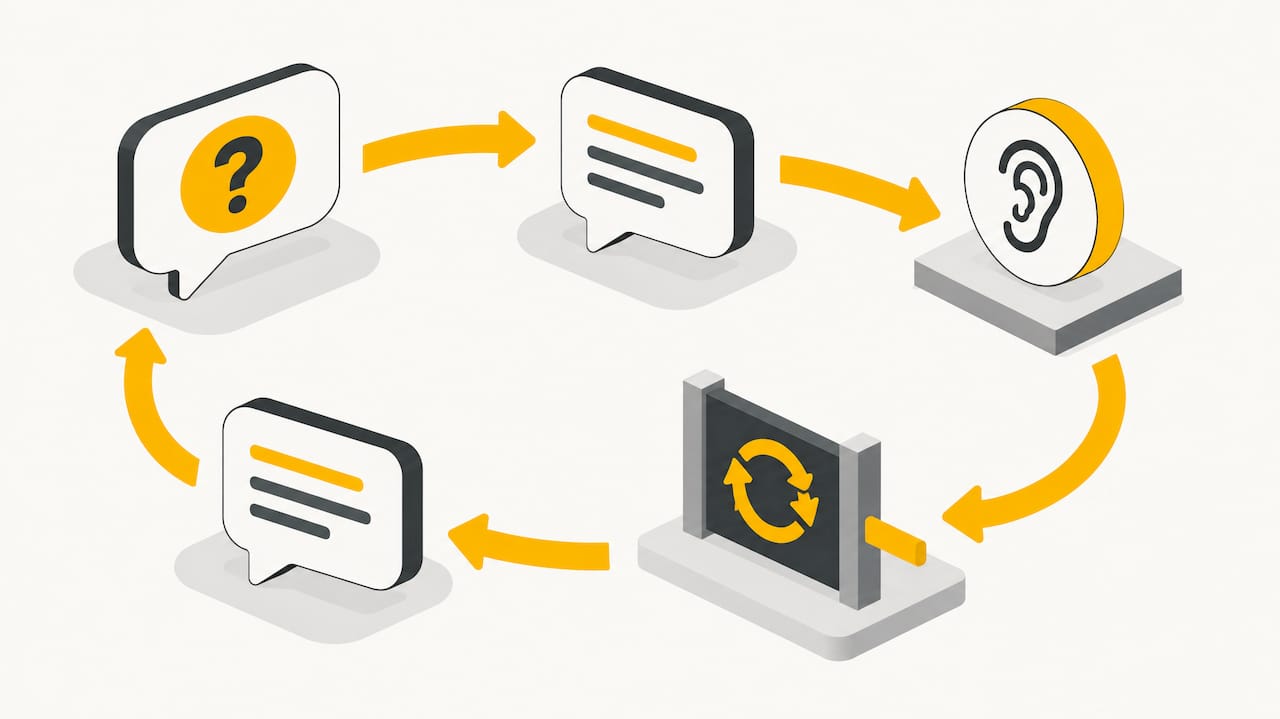
Nesting is where training either proves itself or quietly fails. Agents take live calls under direct supervision, with volume and independence increasing on a defined schedule rather than all at once.
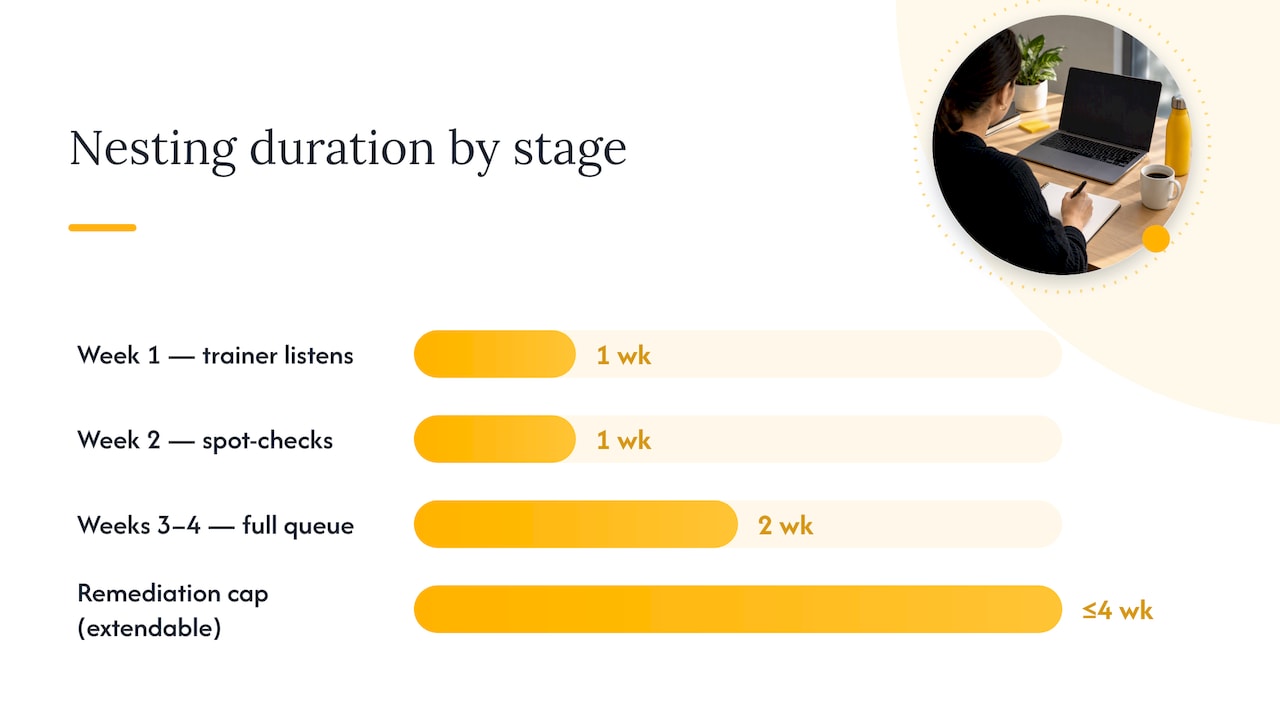
- Week one: agents handle a small share of calls with a trainer or buddy listening live, focused on process accuracy over speed.
- Week two: volume increases, support shifts from constant monitoring to spot-checks, and agents start handling more call types independently.
- Weeks three and four: agents approach full queue participation, with quality analysts reviewing a structured sample rather than every interaction.
Graduation out of nesting should depend on both numbers and judgment. Contact Center Pipeline’s guidance on hiring and training to retain recommends basing readiness decisions on test scores, QA scores, customer feedback, and mentor assessment together, not any single metric. A strong QA score paired with a mentor’s concern about judgment under pressure is a real signal, not noise to override.
When an agent fails a gate, the response should be remediation, not quiet promotion: extend nesting, pair with a stronger buddy, or repeat specific modules tied to the gap. Nesting can extend up to four weeks when needed, and trainers, QA, and operations leaders should coordinate daily during this window so issues get caught before they reach a customer, not after.
Sustaining Skill Through Coaching, Calibration, and Career Paths
Training does not end at go-live. The agents who stay sharp, and who stay employed, are the ones who keep practicing and keep getting feedback.
- Daily check-ins during nesting, shifting to weekly one-on-ones once agents are fully independent.
- Monthly upskilling sessions targeting new processes, product updates, or skills gaps that QA data reveals.
- QA calibration sessions where evaluators align on scoring so feedback stays consistent across the team.
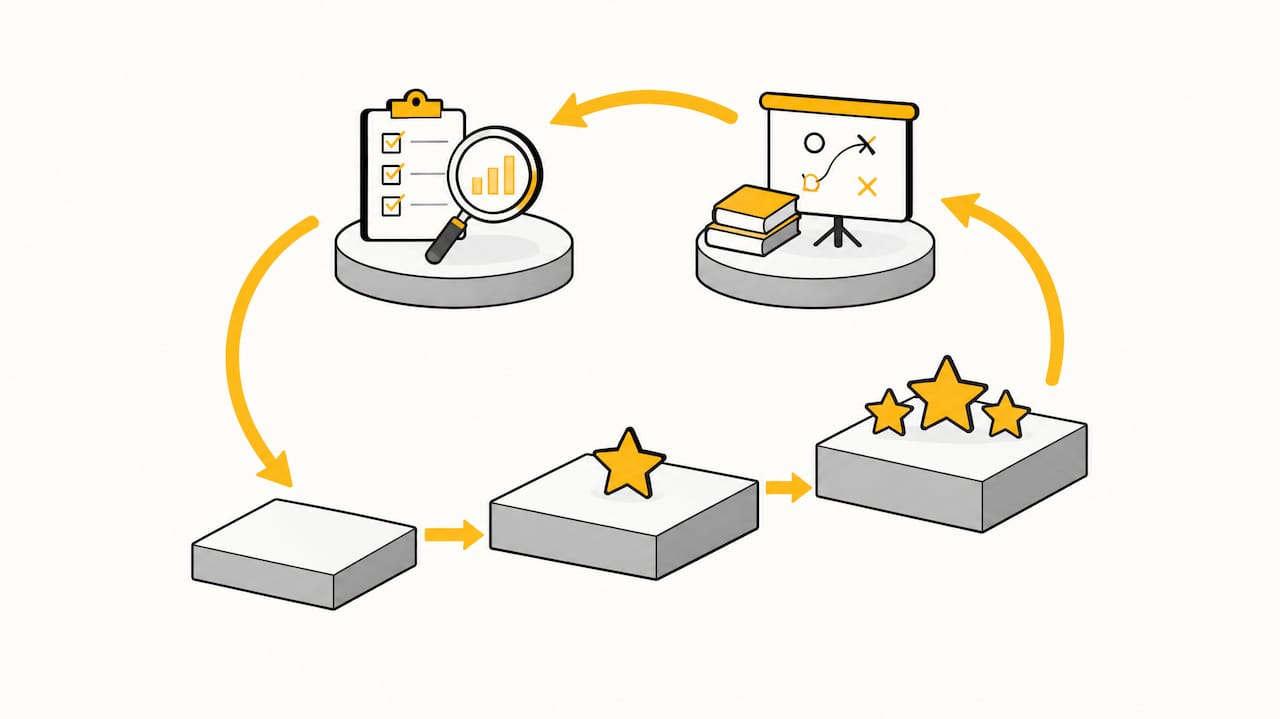
- Curriculum feedback loops that feed recurring QA misses back into training content, closing the gap between what the floor needs and what the classroom teaches.
When nesting repeats across cohort after cohort, the real problem is often attrition rather than curriculum. Contact Center Pipeline’s analysis of hiring and retention recommends correlating training metrics with turnover data to tell the two apart before redesigning a course that was never the issue.
Retention also responds to what happens after training: clear paths to senior agent or team lead roles, recognition tied to QA improvement, and visible investment in an agent’s growth all give people a reason to stay past the first rough weeks on the floor. Programs that treat training as a one-time event tend to see the same quality problems resurface every few months.
Using LMS, Knowledge Tools, and Agent-Assist AI Well
The right technology stack makes training stick after the classroom ends, but the tools only help when agents are explicitly taught to use them.
- Choose an LMS that supports modular content and built-in assessments, so knowledge checks happen inside the learning flow rather than as a separate afterthought.
- Build a knowledge base around searchable, task-specific articles rather than long policy documents, since agents need answers mid-call, not a manual to read later.
- Introduce agent-assist AI for real-time guidance and knowledge suggestions, but pair the rollout with training on when to trust a suggestion and when to override it.
- Set change management expectations before launch: agents need practice sessions with the new tool, not a one-line announcement in a shift huddle.
Quality teams that have deployed these tools report that AI functions best as augmentation layered onto solid training and quality processes, not as a substitute for either. The guardrail that matters most: measure whether AI-assisted calls improve QA scores and customer sentiment, not just handle time. A faster call that leaves a customer unresolved is not a win.
Connecting Training Outcomes to Quality and Retention
A training program is only as good as the evidence that it works, and that evidence needs to flow into a dashboard someone actually reviews.
- Track QA scores, voice-of-customer feedback, first-contact resolution, average handle time, and accuracy as the core set, reviewed by cohort so new hires can be compared fairly against tenured staff.
- Build a simple training-to-quality dashboard that shows each cohort’s scores against prior cohorts, making curriculum drift visible early.
- Test curriculum changes on a single cohort before rolling them out wide, comparing results against a cohort trained the old way.
- Separate curriculum problems from staffing problems by checking whether a quality dip tracks with a specific training change or with a spike in attrition and short-tenured agents.
This is also where the earlier point about attrition pays off: a dashboard that tracks training alongside turnover tells you whether to rewrite a module or rethink hiring criteria, instead of guessing.
What Altiam CX Has Learned From Running This Playbook
Running outsourced training across different industries teaches a simple lesson: the framework stays the same, but the details that make it work are specific to each client’s brand, product, and compliance requirements.
- Our nearshore agent training work focuses on pairing cultural alignment with the same modular, gated structure described above.
- Our onboarding plan built to cut attrition lays out a preboarding checklist and nesting exit criteria that managers can adapt directly.
- A 30/60/90 retention plan extends training logic past go-live into the months that determine whether a hire stays.
For managers piloting a similar structure with internal teams, a 30/60/90 onboarding template from Leaderly offers a useful starting framework for pairing early milestones with microlearning check-ins.
Why Most Training Programs Fail Before They Start
The conventional advice on outsourced training spends too much time on curriculum content and not enough on sequencing and gates. A detailed process manual does not fix an agent who was never tested on judgment under pressure, and a polished slide deck does not replace a mentor listening to a live call and flagging a tone problem the agent cannot hear in themselves.
The biggest gap we see is in ownership clarity. Vendors and clients often assume the other side will cover brand voice or escalation nuance, and that assumption surfaces three weeks into launch as inconsistent customer experience. Write down who owns what before training starts, not after the first wave of complaints.
If a manager can only fix one thing this quarter, it should be nesting discipline: real readiness gates, not a calendar date, deciding when an agent goes fully independent. Everything else, from QRGs to AI tools, works better once that foundation holds.
— Daniela
How Altiam CX Delivers This Playbook for Your Team
We run this exact model for clients who need outsourced teams trained fast without sacrificing quality: modular curriculum, supervised nesting with real readiness gates, and QA coaching that continues long after go-live. We pair cultural alignment with operational discipline to keep brand voice consistent across every agent we train.

- Faster time to competency through structured onboarding and staged nesting rather than one-size-fits-all training.
- Consistent brand voice maintained through client-specific curriculum built around your escalation rules and product depth.
- Continuous QA coaching that feeds floor insights back into training content instead of letting gaps repeat.
| What you get | How it shows up |
|---|---|
| Managed Team Extension | Scalable, trained agents added to your operation |
| Managed Customer Support | Healthcare-specific onboarding and SOP management |
| Legal Intake & Back-Office Support | Trained agents for intake, scheduling, and case communication |
If you are evaluating whether to build this internally or hand it to a partner, explore our customer experience and managed team extension services to see how the engagement works in practice.
FAQ
Is outsourcing a dying concept?
No. Outsourcing is shifting toward capability, digital tools, and customer experience rather than disappearing, according to Deloitte’s 2025 Global Business Services survey. Leaders are investing in specialized talent and technology-enabled roles, which raises the bar for training rather than removing the need for it.
What is the best training program for call center agents?
There is no single best program, but the most effective ones share a structure: modular classroom training, role-play and simulation, and a supervised nesting stage with clear readiness gates before full independence. Programs that skip nesting or rely only on lecture-style content tend to produce agents who struggle with real customer scenarios.
How do I become a better call center agent?
Practice handling varied, realistic scenarios rather than memorizing scripts, and ask for feedback on tone and judgment, not just accuracy. Agents who actively seek teach-back opportunities and coaching tend to close skill gaps faster than those who wait for a scheduled review.
How hard is it to become an agent?
Reaching baseline competency typically takes a few weeks of structured training, but becoming fully confident across varied call types takes longer because it depends on repeated practice and real customer interactions. Programs with a well-run nesting stage shorten that curve by catching gaps early instead of letting new agents struggle alone on the floor.
Sources
- Tips for Training Outsourced Agents — ICMI
- How to build an amazing onboarding experience — Contact Center Pipeline
- Deloitte 2025 Global Business Services survey — Deloitte