
Knowledge-Centered Support (KCS) is a methodology that treats knowledge capture as part of resolving a ticket, not a separate task done afterward. Support teams that adopt it typically see faster resolution times, higher first-contact resolution, and a knowledge base structured well enough to power AI and self-service reliably. The payoff shows up fastest in onboarding time and consistency across agents.
TL;DR:
- Achieving a reuse rate of 40 to 70 percent and a link rate of 60 to 80 percent are signs of a healthy KCS implementation.
- Low knowledge reuse combined with high linking indicates searchability issues rather than content gaps, requiring process improvements.
- A successful pilot should focus on a specific queue for 60 to 90 days and measure progress with clear reuse and resolution time goals.
- Continuous governance, coaching, and review are essential for maintaining KCS effectiveness, especially as AI integration increases reliance on structured knowledge.
- Support teams often need external help to sustain KCS practices long-term without overburdening internal management resources.
Table of Contents
- What Is KCS in Support, and Why Does the ‘v6’ Framing Matter?
- How Does the Solve Loop and Evolve Loop Actually Work?
- What Results Should You Expect, and How Do You Measure Them?
- How Do You Roll Out KCS From Pilot to Full Adoption?
- Who Owns KCS, and How Does Governance Stay Alive?
- What Tools and Integrations Actually Matter for KCS?
- What Does Running KCS Well Actually Look Like Day to Day?
- What Trips Up Most KCS Adoptions?
- KCS Is an Operating Model, Not a Project With an End Date
- Need Help Running KCS Without Pulling Focus From the Floor?
- Where to Go Deeper on KCS
- Sources
- FAQ
What Is KCS in Support, and Why Does the ‘v6’ Framing Matter?
KCS was built and is still maintained by the Consortium for Service Innovation, a nonprofit body that has governed the methodology since the 1990s. The Consortium sets the standard, certifies practitioners, and publishes the reference materials every serious implementation leans on.
The current version, KCS v6, renamed the framework “Knowledge-Centered Success.” That is not a marketing tweak. The Consortium made the change because KCS now creates value across the enterprise, not just inside the support queue, feeding self-service portals, product teams, and increasingly, AI agents. Structured, validated knowledge is what keeps a large language model from guessing, which is why KCS is described as foundational to AI readiness.
Core claims worth knowing going in:
- Knowledge gets captured at the moment of resolution, not written up later from memory.
- Reuse, not creation volume, is the metric that signals a healthy knowledge base.
- The same knowledge that helps a human agent also trains a chatbot or a self-service search.
How Does the Solve Loop and Evolve Loop Actually Work?
KCS runs on two connected loops. The Solve Loop happens on every ticket; the Evolve Loop happens periodically, and it uses what the Solve Loop produced to fix the system itself.
- Search first. The agent checks the knowledge base before doing anything else, not after getting stuck.
- Reuse or refine. If an article matches, they link it to the ticket and adjust it if the customer’s phrasing reveals a gap.
- Create if nothing exists. The agent drafts a short article in the moment, using the customer’s own words as the title.
- Flag for review. Anything uncertain gets marked instead of published as fact, which is the Flag It or Fix It practice in action.
The Evolve Loop is where managers and knowledge domain experts step back weekly or monthly, pull usage data, and ask what the reuse and link rates are actually telling them. Low reuse on a high-ticket topic usually means the article is buried, badly worded, or missing entirely.
Pro Tip: Track which articles get linked but never edited afterward. That is your strongest signal of an article that is already good. Copy its structure for new drafts instead of guessing at format.
What Results Should You Expect, and How Do You Measure Them?
Practitioners implementing KCS commonly report 30 to 50% faster resolution times and 20 to 40% improvement in first-contact resolution as the practice matures, alongside shorter onboarding for new agents who can lean on structured knowledge instead of tribal memory.
Those outcome metrics only move once the activity metrics are healthy. Watch these first:
- Reuse rate (percentage of tickets solved with an existing article): a mature program runs 40 to 70%.
- Link rate (percentage of tickets linked to any article, new or existing): healthy programs sit around 60 to 80%.
- Article creation rate: expect roughly one new article per several tickets during early adoption, tapering as coverage builds.
Low reuse with high link rates often means agents are creating duplicate articles instead of searching properly, a search or findability problem, not a content problem. Treat early numbers as a diagnostic, not a scorecard.
How Do You Roll Out KCS From Pilot to Full Adoption?
Start narrow. A tightly scoped pilot that proves reuse works is far easier to defend to skeptical agents than a company-wide mandate announced by email.
- Form a KCS Council with a sponsor, a coach, and two or three knowledge domain experts who will own quality decisions.
- Pick one queue or product line for the pilot. Run it 60 to 90 days, and define success as a specific reuse rate, not “better knowledge.”
- Adopt a simple template — PERC (Problem, Environment, Resolution, Cause) or basic Q&A format — so agents can capture an article in under two minutes.
- Enforce search-first behavior: no ticket closes without a documented search attempt.
- Train coaches, not just agents. KCS coaching is a distinct skill focused on article quality feedback, not ticket-handling feedback.
- Fold contribution into performance reviews once the pilot proves out, so knowledge work counts the same as ticket volume.
Before scaling past the pilot, confirm you can answer three questions: What was the reuse rate? Did resolution time move? Did agents resist, and why? If a link candidate on team scaling from Altiamcx’s own guidance on scaling support teams is useful here, this is the moment to revisit it before adding headcount, rather than after.
Who Owns KCS, and How Does Governance Stay Alive?
KCS assigns specific roles so quality does not depend on any one person remembering to check things.
- Candidate: a new agent still learning the knowledge base, reading and reusing but not yet publishing independently.
- Contributor: an agent authorized to create and edit articles during ticket resolution.
- Publisher: someone whose edits go live without a second review, earned through demonstrated judgment.
- Knowledge Domain Expert: the specialist the Council leans on for technically complex or high-risk content.
The Council schedules the Evolve Loop, reviews flagged articles, and decides when a Contributor is ready to become a Publisher. One governance trap worth naming: measuring contributors purely by article count invites padding with thin, low-value entries. Weight reuse and link data instead of raw creation numbers, and gaming the system stops being worth the effort.
What Tools and Integrations Actually Matter for KCS?
Vendor choice matters less than whether your stack supports three basics: search visibility, frictionless linking, and structured formatting.
- Knowledge base search should surface inside the ticketing interface itself, not a separate tab agents have to remember to open.
- Linking or creating an article should take one or two clicks from the ticket, not a context switch to another system.
- Templates should enforce structure (problem, environment, resolution, cause) so articles are consistent enough for both humans and AI to parse.
That last point matters more every quarter. Well-structured, validated knowledge is exactly what keeps automated responses accurate instead of confidently wrong, a concern Altiamcx has written about in clearing the fog around deploying AI for CX. If you’re piloting AI-assisted drafting, tools like AI conversational assistants can speed up first drafts, but route every AI-generated article through the same human review the Flag It or Fix It practice already requires.
Pro Tip: Before evaluating any new tool for KCS, ask whether it holds a Consortium KCS Verified or Aligned designation. That badge means the vendor built the workflow around the actual methodology, not a generic knowledge base bolted onto a support ticket.
What Does Running KCS Well Actually Look Like Day to Day?
The teams that sustain KCS past the pilot phase treat knowledge contribution as part of solving the ticket, not an add-on chore graded separately. That means coaching sessions review article quality alongside call quality, and performance conversations mention reuse rate the same way they mention average handle time.
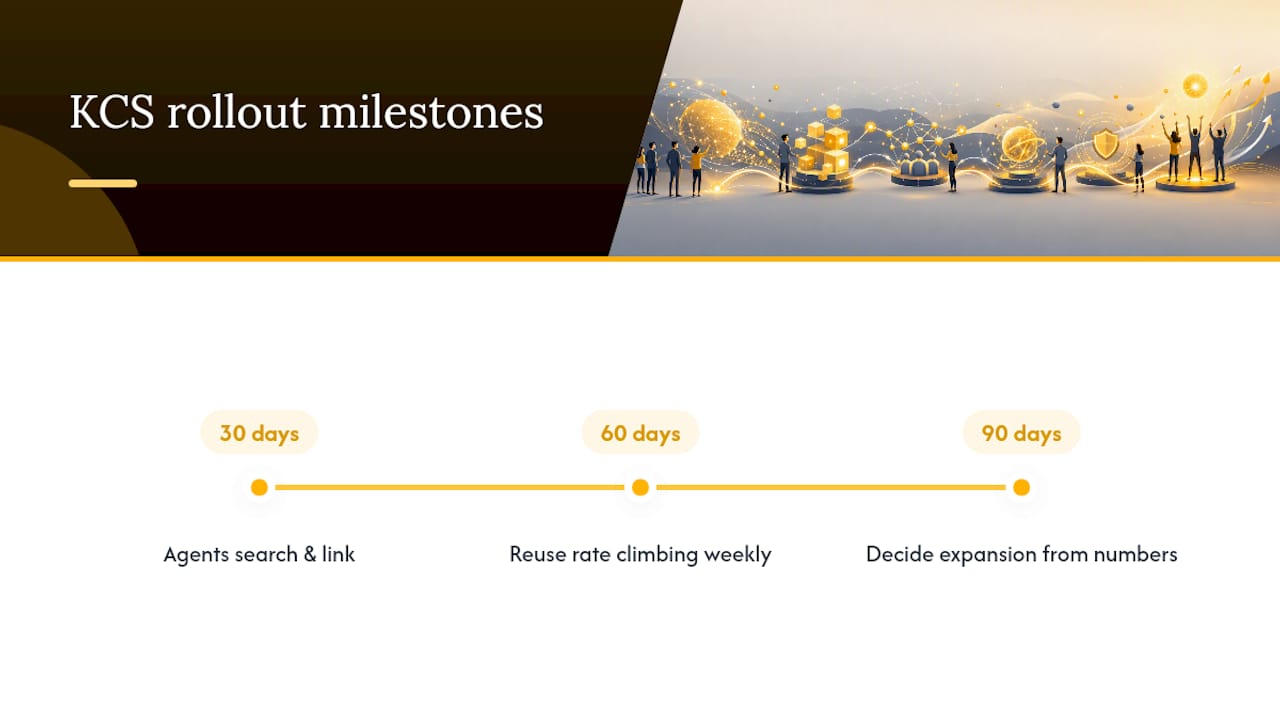
A practical 30/60/90 checklist: at 30 days, confirm every pilot agent can search and link without prompting. At 60 days, check whether reuse rate on the pilot queue is climbing week over week. At 90 days, decide whether to expand scope based on actual numbers, not enthusiasm.
What Trips Up Most KCS Adoptions?
Most failures trace back to three predictable spots.
- “This is extra work.” Fix it with two-minute templates and in-ticket editing, not a separate documentation step after the ticket closes.
- Stale articles nobody trusts. Enforce Flag It or Fix It at the agent level and schedule Evolve Loop reviews so nothing sits unchecked for months.
- Agents can’t find what exists. This is a search and UX problem more often than a content gap. Check search analytics before assuming you need more articles.
KCS Is an Operating Model, Not a Project With an End Date
The teams that get real value from KCS never treat it as something they “finish.” Governance, coaching, and Evolve Loop reviews have to run continuously, the same way ticket volume does, or the knowledge base quietly rots within two quarters. What makes this urgent right now is AI. Every self-service bot and automated response your organization builds is only as reliable as the knowledge feeding it. Waiting to fix your KCS practice until after the AI project launches gets the sequence backward. The next move for most teams isn’t a bigger rollout. It’s an honest governance audit of what you already have.
— Daniela
Need Help Running KCS Without Pulling Focus From the Floor?
Standing up a KCS Council, training coaches, and holding the line on quality reviews takes sustained attention most support leaders can’t spare on top of daily ticket volume. That’s the gap Altiamcx closes for organizations that want the operational discipline of KCS without diverting internal management time to build it themselves.

As a customer experience and operational services partner, Altiamcx provides customer care, technical assistance, back-office operations, and scalable team extension, staffed by teams trained to treat knowledge capture as part of the job, not an afterthought. These teams operate with cultural alignment and disciplined execution, supported by performance frameworks rather than good intentions. One case study reports a large productivity improvement following a migration of technical support to Altiam CX, illustrating outcomes possible with disciplined process work. If your team needs KCS coaching capacity or agents experienced in a knowledge-first workflow, you can explore nearshore team extension models and learn what a managed rollout might look like for your queue.
Where to Go Deeper on KCS
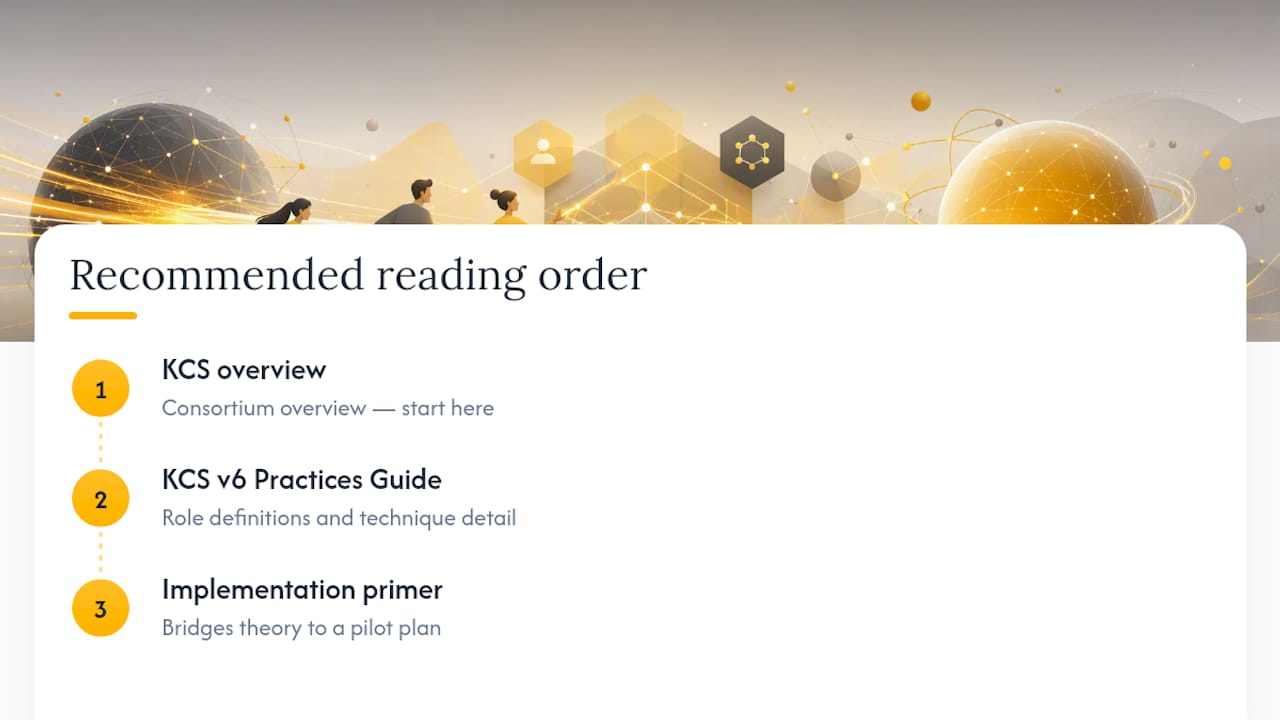
Read the Consortium’s own KCS overview first, then move into the KCS v6 Practices Guide for role definitions and technique detail. The implementation primer fills the gap between theory and a working pilot plan.
Sources
- Knowledge-Centered Success (KCS®) - Consortium for Service Innovation
- How to implement KCS in a support team (implementation primer)
- Knowledge-Centered Service (KCS): The complete guide for support teams (2026) | Corebee
FAQ
What Does KCS Stand For?
KCS stands for Knowledge-Centered Support, and under the current v6 framework, the Consortium now frames it as Knowledge-Centered Success to reflect its value beyond the support queue, including AI and self-service.
What Are KCS Practices?
KCS practices are the specific behaviors that make up the Solve Loop and Evolve Loop: searching before answering, capturing knowledge at the point of resolution, flagging or fixing inaccurate articles, and periodically reviewing usage data to improve content quality.
What Is a KCS Certification?
A KCS certification is a credential issued by the Consortium for Service Innovation, the sole certifying body for the methodology, and it also extends to a KCS Verified or Aligned designation for tools and services built around the practice.
How Long Does a KCS Pilot Take?
Most implementation guidance recommends a 60 to 90 day pilot scoped to a single queue or product line, with success measured by reuse rate rather than subjective feedback.
Can a Support Team Run KCS Without Outside Help?
Yes, but sustaining it requires ongoing coaching and governance capacity many teams don’t have spare, which is why some organizations bring in a managed partner like Altiamcx to run the coaching and staffing side while internal leaders own strategy.