TL;DR:
- A nearshore talent pool consists of skilled professionals in neighboring countries working within compatible time zones and cultures, enabling efficient team integration. It offers significant advantages over offshore and onshore models, including cost savings, faster project delivery, and better collaboration due to cultural and time zone alignment. Companies in tech, healthcare, and customer service benefit most by embedding nearshore staff as long-term team members to maximize quality, speed, and operational success.
A nearshore talent pool is defined as a group of skilled professionals located in geographically adjacent countries who work within compatible time zones and shared cultural frameworks, giving businesses direct access to qualified staff without the collaboration friction of traditional offshore models. For tech, healthcare, and customer service organizations, this staffing model has shifted from a cost-cutting tactic to a primary growth strategy. The industry term you will encounter most often is nearshore outsourcing, and understanding what it means in practice separates companies that scale efficiently from those that stall on hiring. Nearshore outsourcing advantages include time zone alignment, cultural fit, and access to deep regional talent markets that produce measurable results.
What is a nearshore talent pool and how does it work?
A nearshore talent pool consists of pre-vetted professionals in neighboring countries, typically within one to three time zones of your headquarters, who integrate directly into your operations. For U.S.-based companies, this means Latin American markets such as Colombia, Mexico, Argentina, and Brazil. For Western European firms, it means Poland, Romania, and Portugal. The model sits between onshore hiring (expensive, slow) and offshore outsourcing (cheap, but often misaligned).

What makes nearshore talent pools distinct is the combination of proximity and professional depth. Latin America produces over 2 million tech specialists across regional hubs, with a single nearshore partner capable of placing 15 to 20 engineers monthly. That is not a junior overflow pipeline. It is a mature, scalable workforce with Agile experience and B2/C1 English proficiency built in.
The practical mechanics are straightforward. A business defines its staffing needs, a nearshore partner sources and vets candidates from their regional talent network, and those professionals are embedded into the client’s workflows, tools, and communication channels. The result is a team extension, not a vendor relationship.
How nearshore compares to offshore and onshore hiring
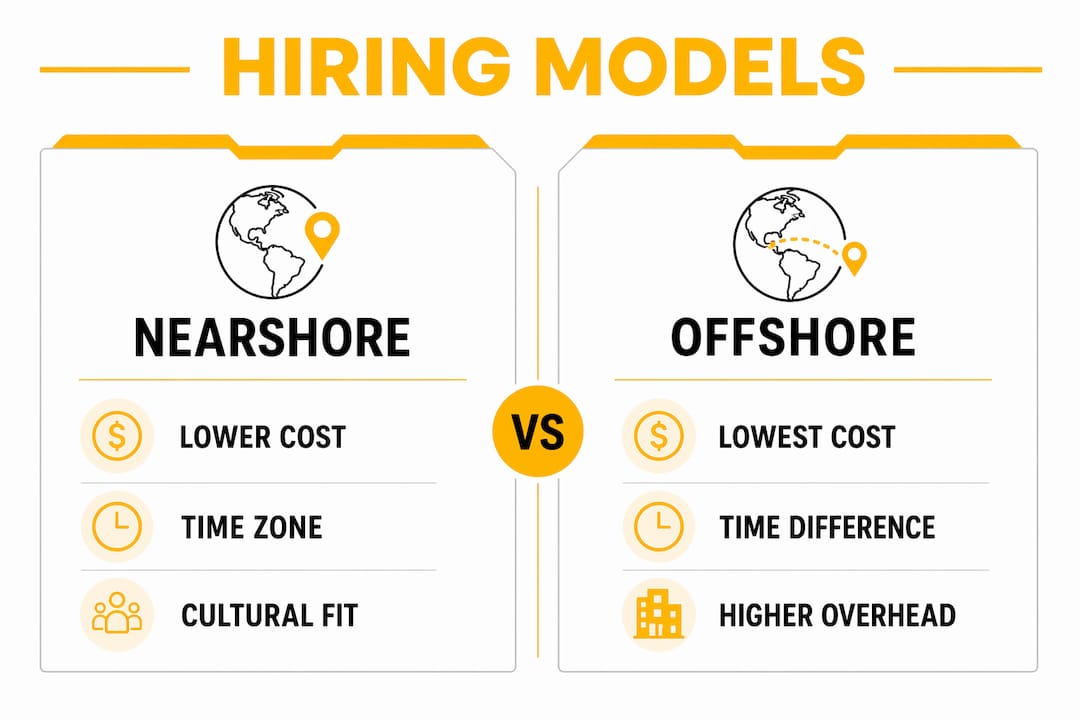
The differences between nearshore, offshore, and onshore models come down to four variables: cost, time zone overlap, cultural alignment, and talent quality. Each model makes a different trade-off across those four dimensions.
| Factor | Onshore | Nearshore | Offshore |
|---|---|---|---|
| Hourly cost (contact center) | $28–$48/hr | $8–$22/hr | $5–$15/hr |
| Time zone overlap | Full | Near-full (1–3 hrs difference) | Minimal (8–12 hrs difference) |
| Cultural alignment | High | High | Variable |
| English proficiency | Native | B2/C1 level | Variable |
Nearshore cost savings reach 30 to 50% compared to onshore, while projects complete 40% faster than offshore due to real-time collaboration. That speed advantage is not incidental. It comes directly from the ability to run synchronous standups, give same-day feedback, and resolve blockers without waiting for a 12-hour time zone gap to close.
The offshore model trades collaboration quality for lower rates. Colombian talent works EST/CST, Argentines operate one to two hours ahead, and real-time Slack responsiveness supports Agile workflows in ways that offshore teams structurally cannot. Cultural alignment also matters more than most hiring managers admit. Shared business norms, similar holiday calendars, and compatible communication styles reduce the invisible friction that kills project momentum.
Key distinctions at a glance:
- Nearshore vs. offshore: Nearshore wins on collaboration speed, cultural fit, and English fluency. Offshore wins only on base hourly rate.
- Nearshore vs. onshore: Nearshore delivers comparable talent quality at 30 to 50% lower cost with minimal time zone disruption.
- Misconception to correct: Nearshore is not a compromise between onshore and offshore. For most tech and CX roles, it is the superior model on a combined quality-cost-speed basis.
Which industries and roles benefit most from nearshore talent pools
Three sectors consistently extract the highest value from nearshore staffing solutions: technology, healthcare operations, and customer service. Each benefits for different reasons, but all three share a common requirement: teams that can communicate clearly, respond in real time, and operate within established professional frameworks.
Technology is the most mature nearshore use case. Poland has 430,000+ software developers ranked in the top six globally on HackerRank, and Romania’s ecosystem features low attrition and significant exposure to major international clients. In Latin America, the depth of talent in software engineering, cybersecurity, and data science has grown substantially, with universities producing tens of thousands of engineers annually who enter the workforce with Agile and DevOps fluency.
Customer service and BPO operations benefit from nearshore talent because multilingual contact centers in Latin America serve North American markets with native-level Spanish and strong English, covering both language needs simultaneously. The time zone alignment means agents work the same business hours as U.S. customers, eliminating the service gaps that plague offshore contact centers.
Healthcare presents a more nuanced case. Administrative and back-office healthcare roles, including medical billing, prior authorization, and patient scheduling, require staff who understand U.S. regulatory frameworks and can communicate without ambiguity. Nearshore professionals trained in HIPAA compliance and U.S. healthcare workflows fill these roles effectively, and the cultural proximity reduces the risk of miscommunication in sensitive contexts.
Pro Tip: When evaluating nearshore talent for healthcare or regulated industries, ask your partner specifically about compliance training, data handling certifications, and prior client exposure in your sector. Generic nearshore talent and sector-specialized talent are not the same product.
What are the operational advantages and cost impacts?
The financial case for nearshore staffing is direct. Contact center agents in Latin America cost $8 to $22 per hour versus $28 to $48 per hour onshore. That gap compounds quickly across a team of 20 or 50 people. But the more significant operational advantage is speed. Senior developer recruitment locally takes 6 to 12 weeks. A nearshore partner delivers vetted candidates within 72 hours. For a business trying to staff a product launch or scale a support team ahead of a seasonal peak, that difference is decisive.
Real-time collaboration through time zone alignment enables faster feedback loops and reduces costly rework compared to offshore models. A tech project that takes six months with an offshore team completes in three to four months nearshore, not because the talent works faster, but because decisions get made in hours instead of days.
The management overhead reduction is equally significant. Offshore teams often require dedicated project managers to bridge communication gaps, translate requirements, and manage asynchronous handoffs. Nearshore teams participate in live standups, respond in real time, and operate within the same tools and workflows as your core staff. That removes an entire layer of coordination cost.
42% of companies in 2026 now prioritize talent quality over hourly rates when choosing nearshore partners. This reflects a maturation in how businesses think about outsourcing ROI. Less rework, lower attrition, and faster delivery create financial returns that a lower hourly rate alone cannot match.
Pro Tip: Calculate your true cost-per-output, not just cost-per-hour, when comparing nearshore to onshore or offshore options. A $15/hr nearshore developer who ships clean code on schedule outperforms a $10/hr offshore developer who requires three rounds of revision.
How to build and manage a nearshore team for long-term success
Building a nearshore team that performs at the level of your internal staff requires a deliberate integration approach. The mechanics of sourcing and placing talent are the easy part. The harder work is cultural and operational alignment.
-
Define roles with precision. Vague job descriptions produce mismatched hires. Specify the tools, workflows, communication expectations, and performance metrics before you engage a nearshore partner. This is especially true for customer service and healthcare roles where context matters.
-
Onboard nearshore staff the same way you onboard internal hires. Give them access to your Slack channels, project management tools, documentation, and team meetings from day one. Failure to integrate nearshore staff into daily rhythms is the number one cause of low retention. Treat them as embedded team members, not external contractors.
-
Align on calendars and communication norms. Nearshore providers implement local compliance and align culturally sensitive calendars to optimize collaboration. Know which holidays your nearshore team observes and plan project milestones accordingly. This is a basic operational courtesy that most companies overlook until it causes a missed deadline.
-
Establish performance tracking from week one. Set clear KPIs, review them in regular one-on-ones, and give feedback in real time. Nearshore professionals perform best when they have visibility into how their work connects to business outcomes.
-
Invest in the relationship, not just the output. The shift from cost-driven to talent-driven nearshoring reflects more strategic workforce planning by CTOs focused on long-term value. Companies that treat nearshore staff as long-term team members see lower attrition, higher output quality, and stronger institutional knowledge retention over time. You can explore nearshore team integration frameworks that formalize this approach.
Key takeaways
Nearshore talent pools deliver the strongest staffing ROI when businesses treat them as embedded team extensions rather than transactional vendor relationships.
| Point | Details |
|---|---|
| Definition clarity | A nearshore talent pool is a vetted group of professionals in adjacent countries working within compatible time zones. |
| Cost and speed advantage | Nearshore staffing cuts costs 30 to 50% versus onshore and reduces project timelines by 40% versus offshore. |
| Top sectors | Tech, healthcare operations, and customer service extract the highest value from nearshore staffing models. |
| Integration is the differentiator | Embedding nearshore staff in daily tools and workflows is the primary driver of retention and output quality. |
| Talent quality is now the priority | In 2026, 42% of companies choose nearshore for talent access, not just cost reduction. |
Why the talent-first shift in nearshoring changes everything
I have watched the conversation around nearshore staffing change significantly over the past several years. When companies first approached nearshoring, the pitch was almost entirely about cost. Save 40% on labor. Reduce your burn rate. The framing was defensive, not strategic.
What I see now is different. The businesses getting the most from nearshore talent pools are not asking “how cheap can we go?” They are asking “where is the best talent we can actually work with?” That is a fundamentally different question, and it produces fundamentally different outcomes.
The companies that struggle with nearshore arrangements almost always make the same mistake: they treat the relationship as a transaction. They send requirements, receive deliverables, and wonder why quality is inconsistent and turnover is high. The companies that succeed do the opposite. They bring nearshore professionals into their planning meetings, give them context on business goals, and hold them to the same standards as their internal teams.
I also think the geographic conversation is underrated. Time zone alignment is not just a scheduling convenience. It changes the quality of collaboration in ways that are hard to quantify but impossible to ignore once you have experienced both models. A team that can resolve a critical issue in a 20-minute call beats one that exchanges emails across a 12-hour gap every time.
The nearshore model in 2026 is not a compromise. For most tech, CX, and healthcare operations, it is the most rational staffing decision available.
— Daniela
How Altiamcx helps businesses build high-performing nearshore teams
Altiamcx operates as a nearshore customer experience and operational services partner for organizations that need more than just bodies in seats. The focus is on cultural alignment, measurable performance, and team integration that holds up over time.

One software platform that migrated its tech support to Altiamcx saw an 89% productivity improvement after transitioning to a nearshore team extension model. An orthodontic services provider achieved measurable CX gains through nearshore talent solutions designed around their specific patient communication needs. These results come from treating nearshore professionals as core team members, not supplemental labor. If your organization is ready to explore what a nearshore team extension looks like in practice, Altiamcx has the frameworks and the talent network to make it work.
FAQ
What is a nearshore talent pool in simple terms?
A nearshore talent pool is a network of skilled professionals in nearby countries who work within compatible time zones and cultural settings, available for businesses to hire as team extensions. For U.S. companies, this typically means talent from Latin America.
How does nearshore outsourcing differ from offshore?
Nearshore outsourcing uses talent from adjacent countries with minimal time zone differences, enabling real-time collaboration. Offshore outsourcing uses talent from distant regions, often 8 to 12 time zones away, which creates communication delays and slower project cycles.
What are the main benefits of nearshore talent for tech companies?
Tech companies gain access to senior engineers with Agile and DevOps experience, vetted candidates placed within 72 hours, and project timelines that run 40% faster than offshore due to synchronous collaboration.
How do I find nearshore talent for my business?
The most direct path is partnering with a specialized nearshore staffing provider that maintains pre-vetted talent networks in target regions. Providers like Altiamcx source, screen, and integrate professionals into your existing workflows, reducing your time-to-hire from weeks to days.
What does nearshore staffing cost compared to onshore hiring?
Contact center agents in Latin America cost $8 to $22 per hour versus $28 to $48 per hour for onshore equivalents, representing a 30 to 50% cost reduction. Tech roles follow a similar pattern, with the added benefit of faster placement and lower attrition over time.