
TL;DR:
- Legal intake outsourcing involves delegating initial client contact, qualification, and scheduling to trained external teams. It improves lead response time, reduces costs, and allows firms to scale client intake efficiently while maintaining legal supervision and ethical compliance. A pilot program is recommended to measure performance and ensure proper governance before full implementation.
Legal intake outsourcing is the practice of delegating your firm’s first-contact, lead-qualification, conflict-checking, and appointment-setting workflows to an external, legal-trained team. For most growth-focused U.S. firms, it directly improves lead capture and attorney productivity. Firms that respond promptly to new leads are far more likely to make contact than those that respond later, and a dedicated outsourced specialist typically costs significantly less per month compared to an equivalent in-house hire.
Before you read further, here are three practical first steps:
- Audit your current volume. Count inbound calls, web form submissions, and chat leads per week, then identify how many go unanswered after hours.
- Shortlist your scope. Decide which tasks you want to hand off: first contact only, full qualification, conflict checks, scheduling, or all of the above.
- Run a short pilot. Commit to a 30–90 day trial with defined KPIs before signing a long-term contract.
Table of Contents
- What does legal intake outsourcing actually cover?
- What are the primary benefits of outsourcing intake?
- What are the real risks, and how do you mitigate them?
- How does an outsourced intake program run day-to-day?
- Practical do’s and don’ts when you outsource intake
- How much does outsourced intake cost, and what ROI should you expect?
- How do you evaluate and select a legal intake provider?
- Key Takeaways
- Why a pilot-first approach is the only responsible way to outsource intake
- Altiamcx supports your firm’s intake from day one
- Useful sources and further reading
What does legal intake outsourcing actually cover?
Legal intake is the structured process of capturing, qualifying, and onboarding new client matters. It spans everything from the moment a prospect first contacts your firm to the point where a qualified matter lands on an attorney’s desk. Outsourcing that process means an external team handles the operational steps, while your attorneys retain all legal judgment and decision-making authority.
The tasks a legal-trained outsourced team typically handles include:
- Phone and web chat coverage — answering inbound calls, live chat, and after-hours contact forms
- Lead qualification — applying your firm’s acceptance criteria to screen out matters outside your practice area
- Conflict screening — running preliminary conflict checks against your client database before any privileged information is shared
- Fact-gathering — collecting case-critical details using your firm’s intake script
- Document collection — requesting and routing initial documents to the right matter file
- Appointment scheduling — booking consultations directly into your calendar system
- Follow-up sequences — automated and agent-driven outreach to warm leads who did not convert on first contact
- CRM data entry — logging every interaction into Clio, Filevine, Lawmatics, or your practice management system
What stays with the firm is equally clear. Fee agreements, legal strategy, acceptance decisions, and any task requiring legal judgment remain with your attorneys and paralegals. Under ABA Model Rule 5.3, supervising attorneys are responsible for the conduct of non-lawyer staff, including outsourced intake agents. That supervisory duty never transfers to the vendor.
Statistic: Outsourced intake teams that go beyond message-taking to conduct real-time conflict checks and structured fact-gathering are what separate a legal client intake solution from a generic answering service.
What are the primary benefits of outsourcing intake?
The business case for outsourcing intake rests on four measurable levers: coverage, conversion, cost, and operational consistency.
Coverage and responsiveness are the most immediate gains. A notable share of legal consumers contact firms outside standard business hours, and after-hours leads that go unanswered are effectively lost. A 24/7 outsourced team captures those contacts without requiring your staff to work nights or weekends. The response speed matters here: the faster the response, the higher the contact rate, and the more matters reach your pipeline.
Conversion lift follows from structured follow-up. A well-run outsourced intake program uses documented SLAs and consistent follow-up sequences to increase retainer conversion compared to ad hoc internal processes. That range reflects the difference between a prospect who gets a callback three days later and one who receives a warm, scripted follow-up within the hour.
Cost and staffing advantages are straightforward when you compare monthly all-in costs. The typical monthly cost for an outsourced dedicated legal intake specialist is $1,500–$3,000, while a comparable in-house hire can cost $3,500–$6,000 or more when salary, benefits, and overhead are included. Beyond salary, you eliminate recruiting time, benefits overhead, and the productivity gap during onboarding.
Operational benefits round out the picture:
- Consistent conflict-check workflows reduce ethical exposure
- Standardized scripts produce cleaner CRM data for reporting and follow-up
- Predictable SLAs give you measurable performance targets instead of informal expectations
- Scalable team deployment lets you add capacity during high-volume periods without permanent headcount
Standardized intake processes from experienced providers deliver predictable outcomes and let firms scale client acquisition without adding internal overhead.
What are the real risks, and how do you mitigate them?
Outsourcing intake without the right guardrails creates problems that are harder to fix than the ones it solves. The risks are real, but each has a practical mitigation.
- Inconsistent intake quality. Agents who do not understand your practice area will misqualify leads. Mitigation: require legal-trained agents, provide firm-specific scripts, and run weekly QA call sampling.
- Poor alignment with your intake rules. Generic vendors apply generic criteria. Mitigation: document your acceptance criteria in writing and embed them in the agent’s decision tree before go-live.
- Ethical and conflict-check exposure. An intake agent who shares case details before running a conflict check creates bar-supervision risk. Mitigation: build conflict-check steps into the script workflow and require the vendor to escalate any flagged matter to a supervising attorney before proceeding.
- Data security gaps. Prospect and client data shared with a third party must be protected. Mitigation: require SOC 2 certification, HIPAA-compliant data handling where applicable, signed NDAs, and encryption at rest and in transit.
- CRM integration failures. Data entered in one system that does not sync to your practice management platform creates duplicate work and errors. Mitigation: test all integrations during the pilot phase before full deployment.
Pro Tip: Treat outsourcing without legal-trained staff as a red flag during vendor selection. If a provider cannot describe how their agents handle conflict checks or escalate ethically sensitive matters, they are an answering service, not a legal intake solution.
Some matters should stay in-house regardless of vendor quality. High-stakes criminal matters, cases involving vulnerable populations, and any intake where privileged information must be shared immediately are better handled by your own staff until a formal attorney-client relationship is established.

How does an outsourced intake program run day-to-day?
A well-designed outsourced intake program follows a repeatable sequence from first contact to scheduled consultation. Here is a sample operational flow:
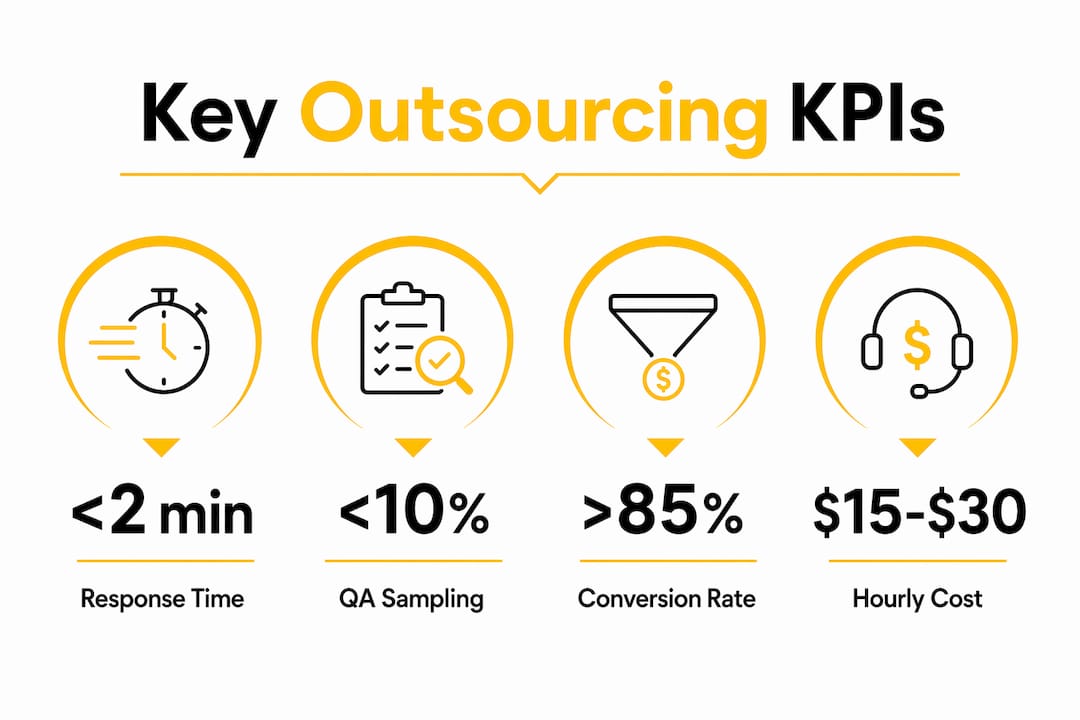
- First contact. A prospect calls, submits a web form, or initiates a live chat. The outsourced agent answers within your SLA window (typically under two minutes for live calls).
- Initial qualification. The agent applies your practice-area script to determine whether the matter fits your firm’s acceptance criteria.
- Conflict check. The agent queries your conflict database in real time. If a potential conflict surfaces, the matter escalates immediately to a supervising attorney or paralegal.
- Fact-gathering. For qualified matters, the agent collects case-critical details using your structured intake form.
- CRM entry. All data is logged into your practice management system (Clio, Filevine, or Lawmatics) with required fields completed.
- Scheduling. The agent books a consultation directly into your calendar via API or calendar sync.
- Follow-up. Prospects who do not convert on first contact enter an automated follow-up sequence with defined touchpoints and agent callbacks.
- Escalation. Any matter involving statutory deadlines, privileged disclosures, or red-flag client behavior triggers an immediate warm transfer or attorney callback request.
SLAs and KPIs to require from your provider
| KPI | Target benchmark | Why it matters |
|---|---|---|
| First response time (live call) | Under 2 minutes | Directly drives contact rate |
| After-hours contact rate | — | Captures leads otherwise lost |
| Qualified lead rate | Defined by your acceptance criteria | Measures script accuracy |
| Retainer conversion rate | Track monthly vs. baseline | Core ROI indicator |
| CRM data-completion rate | — | Downstream reporting quality |
| Conflict-check latency | Same session as first contact | Ethical compliance |
Common integrations include Clio Manage, Clio Grow, Filevine, and Lawmatics for matter and contact management, plus Google Calendar and Outlook for scheduling. Most enterprise-grade providers offer API connections or Zapier-style connectors for firms with custom stacks.
Practical do’s and don’ts when you outsource intake
Getting the governance right during onboarding separates firms that see measurable gains from those that cycle through vendors.

Do’s and don’ts at a glance
| Do | Don’t |
|---|---|
| Document intake scripts and decision rules before go-live | Hand off unsupervised judgment tasks to any external agent |
| Embed conflict-check steps directly in the agent workflow | Accept opaque reporting with no call-level data |
| Integrate CRM and calendar systems during the pilot phase | Skip a trial period to save time |
| Run weekly QA call sampling with a scoring rubric | Assume the vendor’s default script matches your firm’s criteria |
| Provide bilingual support if your client base requires it | Lock in a long-term contract before validating KPIs |
| Establish a clear escalation path to a supervising attorney | Treat the vendor as a set-and-forget solution |
Your onboarding checklist should cover: signed data processing and NDA agreements, test call batches before live deployment, CRM field mapping, calendar sync verification, bilingual capability confirmation if needed, and a defined dispute escalation path.
For governance after go-live, run weekly scorecard reviews for the first 90 days, sample at least 10% of calls for QA, update scripts whenever your practice areas or acceptance criteria change, and hold a monthly performance review with the vendor’s account manager.
Pro Tip: Require law firm intake governance documentation from any vendor before signing. A provider that cannot produce a sample script, a QA rubric, and a conflict-check workflow in the sales process will not produce them after you sign either.
How much does outsourced intake cost, and what ROI should you expect?
Pricing models vary by provider and scope. The four most common structures are:
| Pricing model | Typical range | Best fit |
|---|---|---|
| Per-seat hourly | $15–$30/hour per agent | Firms with predictable, defined coverage windows |
| Per-minute | — | Lower-volume firms testing coverage gaps |
| Per-qualified lead | — | Performance-focused arrangements |
| Managed monthly fee | $1,500–$3,000/month | Firms wanting predictable costs and full coverage |
Primary cost drivers include coverage hours (24/7 versus business hours only), qualification complexity (simple screening versus multi-step fact-gathering), conflict-check integration requirements, bilingual capability, and CRM integration depth.
ROI estimation formula: (Incremental retained cases per month × average matter value) minus monthly outsourcing cost = net monthly return.
A worked example: if outsourcing captures 5 additional retained matters per month that would otherwise have been lost to slow response or after-hours gaps, and your average matter value is $3,000, that is $15,000 in incremental revenue against a $2,000 monthly outsourcing fee. The math holds even at conservative conversion assumptions.
For context, legal process outsourcing increases efficiency by shifting recurring tasks to external providers while freeing internal counsel to focus on core legal work. Intake is one of the highest-ROI tasks to shift because it is both high-volume and directly tied to revenue.
How do you evaluate and select a legal intake provider?
Vendor selection is where most firms either protect themselves or create future problems. Use this sequence:
- Screen for security and compliance first. Require SOC 2 Type II certification, HIPAA-compliant data handling where your matters involve health information, encryption at rest and in transit, and a signed data processing agreement before any other conversation.
- Verify legal intake experience. Ask for evidence that agents receive legal-specific training, not generic call-center training. High-quality outsourced intake teams are legal-trained and protocol-driven on conflict checks. Ask how they handle escalation of ethically sensitive matters.
- Confirm technical fit. Verify native integrations or API support for your practice management system. Check calendar sync, data export ownership terms, and whether you retain full ownership of all intake data.
- Review commercial terms carefully. Insist on a 30–90 day pilot with no long-term commitment, defined SLA credits for missed targets, transparent onboarding fees, and a clear termination clause with data return provisions.
- Run a structured pilot. Measure against your pre-defined KPIs (see the SLA table above) for the full pilot period before committing to a longer engagement.
Altiamcx brings nearshore CX expertise, bilingual agents, and disciplined performance frameworks to legal intake. Firms working with Altiamcx benefit from team-extension models that keep your firm in control of legal judgment while the outsourced team handles the operational intake sequence. Nearshore talent sourcing, including bilingual CX talent pools, supports firms with Spanish-speaking client bases or multilingual coverage requirements.
Pro Tip: During the pilot, ask the vendor to provide raw call recordings alongside their QA scores. If their scores and your independent assessment diverge consistently, the QA process is not calibrated to your standards.
Key Takeaways
Legal intake outsourcing delivers measurable gains in lead capture, conversion, and cost efficiency when implemented with proper governance, legal-trained agents, and documented SLAs.
| Point | Details |
|---|---|
| Define scope before you outsource | Map which tasks transfer (calls, qualification, scheduling) and which stay in-house (legal judgment, fee agreements). |
| Speed drives contact rate | Responding to a new lead within five minutes materially increases the likelihood of making contact and converting the matter. |
| Cost advantage is significant | Outsourced legal intake typically costs $1,500–$3,000 per month, while an equivalent in-house hire runs $3,500–$6,000+ per month. |
| Governance prevents ethical risk | Embed conflict-check steps, QA sampling, and attorney escalation paths before go-live, per ABA Model Rule 5.3 supervisory duties. |
| Altiamcx as your intake partner | Altiamcx provides nearshore legal intake teams with bilingual capability, CRM integration, and defined SLA frameworks for U.S. law firms. |
Why a pilot-first approach is the only responsible way to outsource intake
The firms that get the most from outsourced intake are not the ones that move fastest. They are the ones that move deliberately. A 30–90 day pilot with defined KPIs, weekly QA reviews, and a clear escalation path is not a hedge against commitment. It is the mechanism that produces the data you need to negotiate better long-term terms and to catch misalignment before it becomes a bar-supervision problem.
What gets underestimated in most discussions of legal intake outsourcing is the ethical dimension. ABA Model Rule 1.6 on confidentiality applies the moment a prospect shares case details, even before a formal engagement. That means your intake vendor is handling confidential information from the first call. Firms that treat this as a procurement decision rather than a compliance decision are the ones that end up with bar complaints.
The hybrid model, where internal oversight combines with outsourced operational execution, consistently outperforms both fully in-house and fully hands-off outsourced approaches. Altiamcx’s nearshore model is built around exactly that structure: measurable performance frameworks, cultural alignment, and disciplined execution that your firm can audit at any point. The legal outsourcing trends moving through U.S. firms in 2026 confirm this direction. The question is not whether to outsource intake. It is whether you build the governance to make it work.
Altiamcx supports your firm’s intake from day one
Firms that need faster lead response, better after-hours coverage, and cleaner CRM data without adding permanent headcount have a direct path forward with Altiamcx. As a nearshore CX and operational services partner, Altiamcx deploys legal-trained intake teams with bilingual capability, structured conflict-check workflows, and native integrations with Clio, Filevine, and Lawmatics.

The engagement model is built for law firms that want control without the overhead: defined SLAs, weekly performance reporting, and a 30–90 day pilot structure so you validate results before any long-term commitment. Altiamcx’s operational track record in nearshore team extension shows what disciplined execution looks like in practice. If you are ready to see what a structured intake pilot would look like for your firm, contact Altiamcx to define your pilot scope, SLAs, and success criteria.
Useful sources and further reading
The following sources informed the research and claims in this guide. Each is worth reading directly for the depth it adds to specific sections.
Clio — “A Guide to Legal Process Outsourcing for Law Firms” Covers how standardized intake processes from experienced providers deliver predictable outcomes and let firms scale client acquisition without adding internal overhead. Useful for understanding the operational case for outsourcing recurring legal tasks. Read the Clio guide
LegalIntaker — “Why Law Firms Are Outsourcing Legal Intake Services” The primary source for the five-minute response rule, the 20–35% conversion uplift from structured follow-up, the monthly cost comparison between outsourced and in-house intake, and the after-hours contact behavior data cited throughout this article. Read the LegalIntaker guide
Sirion — “What Is Legal Intake? Its Importance and Process Explained” Defines legal intake as the structured process of capturing, qualifying, and onboarding new client matters, and explains how intake data quality affects downstream case management and resource allocation. Read the Sirion explainer
Vida AI Agent OS — “Outsource Legal Intake: Complete Guide for Law Firms” Practitioner-level guidance on the operational steps of outsourced intake, including the warning against treating intake as message-taking only and the requirement for real-time conflict checks and structured fact-gathering. Read the Vida guide
Wolters Kluwer — “Legal Process Outsourcing vs Insourcing” Explains how LPO increases efficiency by shifting recurring tasks to external providers, and supports the recommendation for hybrid models that combine internal oversight with outsourced operational execution. Read the Wolters Kluwer analysis
American Bar Association — Model Rule 5.3 (Responsibilities Regarding Nonlawyer Assistants) The governing ethical rule for supervising attorneys when non-lawyer staff, including outsourced intake agents, handle client-facing tasks. Essential reading before any outsourcing engagement. Read ABA Model Rule 5.3
This article provides general information about legal intake outsourcing practices and is not legal or professional advice. Confirm current bar rules, confidentiality requirements, and compliance obligations with qualified legal counsel or your state bar association for your specific situation.