A seasonal staffing plan is a written forecast of how many people you need, in which roles, in which weeks, and how you will recruit, train, schedule and release or retain them. The plan that works starts with demand by interval, not with a headcount guess. It sets hiring and training dates backward from your peak, assigns compliance duties before anyone starts, and names a fallback when the forecast is wrong.
It is October 21, 2026. If your peak is this holiday season, you are already late for in-house recruiting, but not for a managed team or an overflow model. This guide covers both: the plan you would build with a full runway, and the plan you build when the runway is short.
TL;DR
- Forecast by week first, then by day and interval for the peak weeks. Convert volume to agents using handle time, shrinkage and a service-level target.
- Work backward from peak: recruit 3 to 6 months out when you can, and finish training before the first surge week, not during it.
- Seasonal staff are covered by wage and overtime rules, and staffing-agency or outsourced workers still fall under your safety and data obligations.
- Keep a core team for judgment-heavy work and add flexible capacity for volume. A managed nearshore team can fill that layer when your hiring window has closed.
- Retain your best seasonal people. It cuts the cost of starting from zero next year.
Table of Contents
- What a seasonal staffing plan should include
- Start with the demand forecast
- Build the hiring timeline backward from peak
- Choose your supply mix
- Train for the work, not for the calendar
- Compliance: what you cannot hand off
- Seasonal staffing by industry
- Our perspective: plan the work, then choose the people
- Where Altiam CX fits
- Measure, review and retain
- FAQ
- Sources
What a seasonal staffing plan should include
Google’s “people also ask” box asks what a staffing plan should include. For a seasonal one, we keep it to eight components:
- Planning horizon and roles. The start and end dates of the season, and each role you need: frontline agents, tier-2 support, schedulers, back-office processors, team leads, QA.
- Demand forecast. Volume by week, then by day and interval for the busiest weeks.
- Supply plan. Which demand is covered by your core team, overtime, seasonal hires, a staffing agency or a managed outsourced team.
- Hiring timeline. Posting, screening, offer and start dates, with a buffer for no-shows.
- Training and onboarding. Curriculum, nesting or shadowing period, and who signs off that an agent is ready.
- Schedule and coverage rules. Shift patterns, breaks, overtime limits and escalation paths.
- Compliance and data access. Wage rules, safety training, and any regulated data the role touches.
- Exit or retention decisions. Who you will offer permanent roles, who you release, and how you keep a pool warm for next year.
A one-page version of this, with an owner and a date for each line, beats a forty-slide deck nobody opens.
Start with the demand forecast
Every weak seasonal plan we see fails at the same step: it starts from last year’s headcount. Headcount is an output. Demand is the input.
Build the forecast in two layers
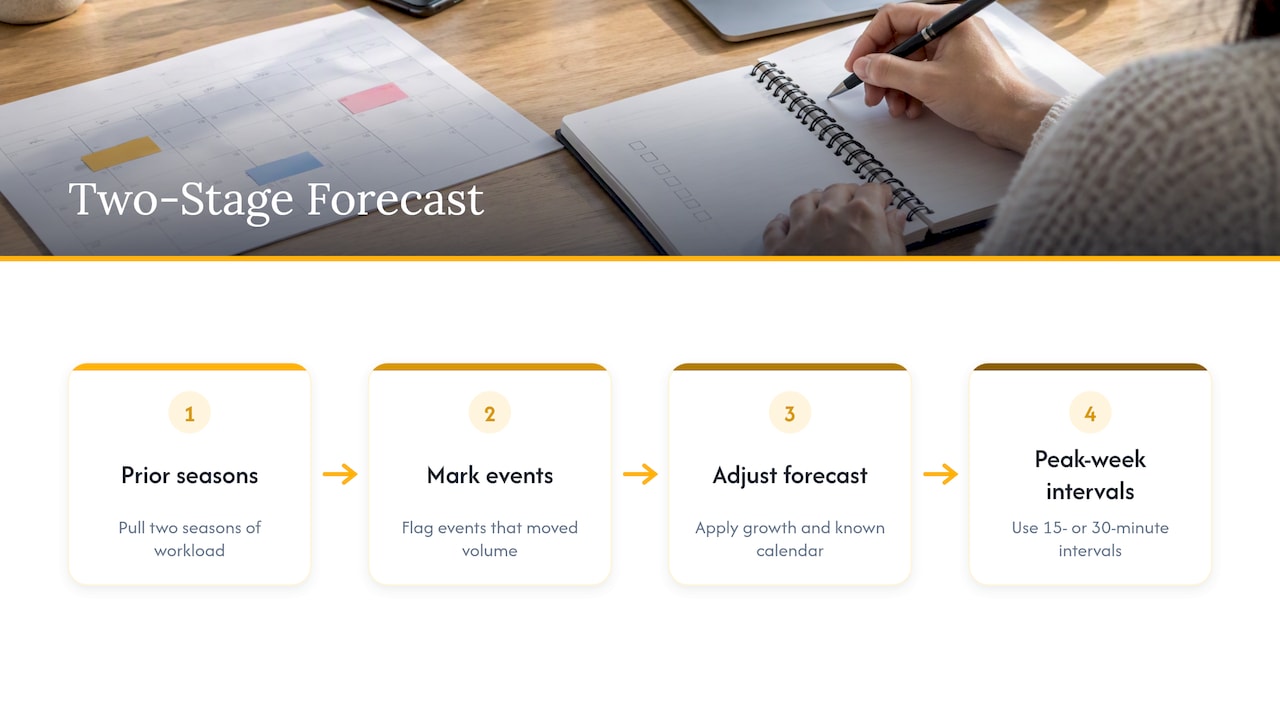
Layer one: weekly volume. Pull at least two prior seasons of contacts, orders, claims, appointments or cases, whichever drives your workload. Mark the events that moved volume: promotions, product launches, carrier delays, open-enrollment windows, tax deadlines, court calendars. Then apply this year’s growth assumption and the known calendar.
Layer two: interval volume. For peak weeks, break the day into 15 or 30 minute intervals. Contact centers staff to the interval, not to the day, because a quiet morning does not offset a slammed afternoon. We lay out this method in our guide to interval-based, two-stage contact center staffing forecasts.
Convert volume to agents
A simple version:
- Workload hours = forecast contacts × average handle time
- Required agents = workload hours ÷ productive hours per agent per week
- Productive hours = scheduled hours minus shrinkage (breaks, training, meetings, absence)
A worked example: 12,000 contacts in a week at an average handle time of 8 minutes is 1,600 workload hours’ worth of… no, 96,000 minutes, which is 1,600 hours. Divide by 28 productive hours per agent (a 40-hour schedule after roughly 30% shrinkage) and you need about 57 agents before adding a service-level cushion. That figure is illustrative, so replace each input with your own data.
Plan for forecast error
The forecast will be wrong somewhere. Decide in advance how you will absorb a 20% overrun: overtime, a pre-approved flexible pool, or an overflow partner who can start within days. Our rule is to never let a single source of capacity carry the whole risk.
Check the macro signal, but trust your own data
Public hiring numbers show how volatile seasonal demand is. Challenger, Gray & Christmas reports that retailers added 461,500 jobs in the fourth quarter of 2025, the smallest seasonal gain since 2008, and predicts a smaller number again for this fourth quarter. The Bureau of Labor Statistics reports that retailers added 492,000 employees in the 2024 to 2025 holiday buildup and kept 29,000 of them afterward, compared with an average of 605,000 added in 2018 to 2021 buildups.
What this tells you: peers are hiring cautiously, and seasonal pools are tighter than the old averages suggest. It does not tell you your volume. Your order, claim or appointment history does.
Build the hiring timeline backward from peak
Start with the date your volume first exceeds what the core team can handle. Subtract training time, then recruiting time.
| Step | Typical lead before first surge week | Notes |
|---|---|---|
| Forecast and budget approved | 4 to 6 months | Sets role counts and cost ceiling |
| Recruiting opens | 3 to 6 months | Industry guidance often cites this window for planning |
| Offers out | 8 to 10 weeks | Over-hire to cover no-shows |
| Training starts | 4 to 6 weeks | Longer for regulated work |
| Nesting or supervised live work | 1 to 2 weeks | Calls or cases with a coach nearby |
| Production ready | Before the surge starts | Not on the first surge day |
The lead times are our planning defaults, not legal or industry standards. Adjust them for role complexity. A tier-1 order-status agent ramps faster than a patient-access agent who must handle scheduling, insurance questions and protected health information.
For ecommerce teams working to a Q4 calendar, we have mapped the exact rhythm in recruit in September, train by October.
If you are past the window
If you are reading this in late October with a November peak, the in-house route gets hard. Recruiting, background checks and a proper training cycle rarely fit in two weeks. Realistic options:
- Extend hours for your best existing agents within overtime rules and budget.
- Narrow the scope of seasonal roles to the top five contact reasons, with scripted workflows.
- Move low-complexity work (order status, appointment confirmations, document intake) to an overflow team.
- Add a managed team that arrives already trained on your processes, rather than recruiting from scratch.
Choose your supply mix
Most organizations combine several sources. The question is which work goes where.
| Option | Best for | Watch out for |
|---|---|---|
| Core team overtime | Short spikes, judgment-heavy work | Burnout, overtime cost, attrition after the season |
| Direct seasonal hires | Predictable local roles, brand-specific work | Recruiting time, onboarding load on your managers |
| Staffing agency temps | Quick fills for simple tasks | Variable quality, shared compliance duties |
| Managed outsourced or nearshore team | Repeatable volume, bilingual coverage, multi-season programs | Needs a clear scope, SOPs and a data-protection contract |
No option is right everywhere. A law firm that gets a surge of intake calls after a major event has a different mix than a retailer with predictable November volume.
Why nearshore fits seasonal work
Nearshore teams in Latin America work in time zones that overlap U.S. business hours, which matters when your customers expect a live answer at 4 p.m. Eastern. Bilingual agents help when your customer base includes Spanish speakers. And because a managed team is built and trained by the provider, you are not rebuilding recruiting and onboarding every autumn.
Train for the work, not for the calendar
Seasonal staff most often fail at the connection between generic training and your specific rules. A good program has four parts:
- Product and policy basics. Returns windows, escalation rules, eligibility criteria, what the agent may and may not promise.
- Systems. CRM, ticketing, scheduling and telephony practice in a sandbox before live work.
- Tone and judgment. Call listening, role-play and calibrated QA scoring.
- Escalation. Who to ask, how fast, and what happens when nobody answers.
Set an exit test. Nobody goes live unscored. Then monitor the first two weeks closely: QA sampling at a higher rate, daily huddles, and a Slack or Teams channel where new agents can ask quickly.
Compliance: what you cannot hand off
This is the section most seasonal plans skip, and the one that creates the most exposure.
Wages and overtime
Seasonal and part-time workers are not a separate legal class for pay. Under the Fair Labor Standards Act, covered nonexempt employees must receive at least the federal minimum wage of $7.25 per hour, and overtime at not less than one and one-half times the regular rate for hours over 40 in a workweek. Federal law does not require overtime merely because work falls on a weekend or holiday. States and cities often set higher minimums or extra rules, so check where your people work. The Department of Labor’s seasonal employment page is a good starting reference. For classification questions, talk to your employment counsel.
Safety training for agency or outsourced workers
Using a staffing agency does not move your safety duties to the agency. OSHA states that the agency and the host employer share responsibility for training temporary workers, that training must happen before work begins, and that it must be in a language and vocabulary the worker understands. OSHA’s temporary worker guidance explains the host employer role. The practical step: write down in your contract who trains on what, and make sure site-specific and task-specific training is on your side of the ledger.
For office-based CX work the hazards differ from a warehouse floor, but the principle is the same. Ergonomics, emergency procedures and any site-specific rules still need to be delivered to everyone who works for you.
Protected health information and financial data
If your seasonal roles touch patient data, the vendor is a business associate. HHS explains that a written business associate contract must set the permitted uses and disclosures of protected health information and require appropriate safeguards. An HHS OIG review of Medicaid agencies found that offshore outsourcing rules vary, and noted that only fifteen of fifty-six agencies had state-specific requirements on offshore administrative work. Whichever location you choose, put the agreement in place before the first agent gets system access.
Our deeper guides cover this ground: HIPAA-compliant outsourcing for healthcare administrators, board-level data security controls in BPO partnerships, and, for financial teams, outsourcing GLBA work while keeping the 30 day deadline.

Seasonal staffing by industry
Ecommerce and retail
Volume is date-driven: Black Friday, Cyber Monday, shipping cutoffs, returns in January. Plan the surge on the front end (order status, delivery questions) and the tail (returns). Staff the tail, too. Many teams release people the week after Christmas and then get buried in returns.
Healthcare
Healthcare surges follow open enrollment, flu season, elective-procedure calendars and billing cycles. Seasonal agents here need more than headcount: patient scheduling, benefits explanations and portal help. CMS has highlighted digital health education and telehealth as part of improving access, which is a reason to include portal and telehealth walkthroughs in training. See our guides on healthcare contact centers and streamlining patient support.
Legal
Law practices see intake surges tied to events, filing deadlines and advertising campaigns. Missed calls are missed matters. A seasonal plan here covers intake, follow-ups, scheduling and back-office document handling, with strict confidentiality rules.
Financial services
Tax season, year-end statements and rate changes create predictable peaks. Agents who handle personal financial data need security training and access controls on day one.
Our perspective: plan the work, then choose the people
We run nearshore customer experience, technical support, back-office and managed team extension programs, and the same pattern repeats. Teams that struggle in peak season did not lack effort. They lacked a clear picture of which work was repeatable and which was not.
Our view has three parts. First, separate the work. Anything repeatable and documented, such as intake, scheduling, status inquiries, follow-up, and standard back-office processing, can sit with a managed team. Anything that needs deep judgment or a brand-sensitive relationship stays with your core people, who are freed up to do it well.
Second, treat seasonal capacity as a bridge to a standing model. Seasonal hiring pays off when it feeds the next season. A managed team that stays with you through the year, scaling up and down, avoids the annual reset of recruiting and training. That is the idea behind our managed team extension: capacity that is yours in practice, trained on your SOPs, aligned to your culture and your customers’ language.
Third, measure. Agree service-level, quality and response-time targets before the season, review them weekly, and make decisions from interval data rather than gut feel. Cost efficiency follows from fewer abandoned contacts and less rework, not from the lowest hourly rate.
— Daniela
Where Altiam CX fits
If your hiring window is closing or you want a model that does not restart every year, we can help. Our customer experience and managed team extension services provide bilingual agents and scalable teams from Latin America, working in U.S.-aligned hours. Healthcare organizations can look at our managed customer support and patient support programs, and law practices at our legal intake and client follow-up services. Pricing is scoped to your engagement, so talk to us with your forecast in hand.
Measure, review and retain
Track these weekly during the season:
- Service level and average speed of answer
- Abandon rate
- First-contact resolution
- QA score for new versus tenured agents
- Schedule adherence and shrinkage against plan
- Cost per contact or per case
After the season, run a review within 30 days. Compare forecast to actual by week, note where overtime or overflow was used, and record what training gaps appeared.
Then decide who to keep. Retention is a pipeline: the BLS figures above show retailers retaining a small share of seasonal hires, but the ones who stay arrive already trained. Offer your top performers permanent or recurring roles, and keep a list of the rest to contact early next year.
FAQ
What should a staffing plan include?
A seasonal staffing plan should include the planning horizon, roles, a demand forecast, the supply mix, a hiring timeline, training and onboarding, scheduling rules, compliance duties and a retention decision. Assign an owner and a date to each item. Review it weekly during the season.
How long can an employee be considered seasonal?
There is no single federal definition that fits every situation. Seasonal status depends on the nature of the work and the law that applies, such as tax, benefits or state rules. Ask your employment counsel before you rely on a duration, and see the Department of Labor’s seasonal employment page for background.
Can you give an example of a seasonal employee?
A retail customer support agent hired in October to answer order and delivery questions through the holidays is a typical case. So is a legal intake coordinator added for a filing deadline surge, or a scheduling agent added for a healthcare enrollment window. In each case the role has a defined start and end, or a defined review point.
Can you provide an example of a staffing plan?
A simple one: forecast 12,000 weekly contacts in peak weeks, convert to about 57 productive agents using handle time and shrinkage, and list who covers them. For example, 35 core agents, 12 seasonal hires and 10 from a managed team. Add recruiting dates, a four-week training block and a weekly review. Use your own numbers.
Sources
- Challenger, Gray & Christmas: 2026 Holiday Hiring Outlook
- BLS: Trends in retail trade holiday employment buildups and layoffs
- U.S. Department of Labor: Wages and the Fair Labor Standards Act
- U.S. Department of Labor: Seasonal Employment / Part-Time Information
- OSHA: Safety and Health Training for temporary workers
- OSHA: Protecting Temporary Workers
- HHS: Business Associate Contracts
- HHS OIG: Offshore Outsourcing of Administrative Functions by State Medicaid Agencies
- CMS: Addressing rural health inequities in Medicare