
An outsourcing pilot program is a time-boxed, controlled launch of a vendor on a real slice of your work. It exists to answer one question before you sign a long contract: can this team deliver your quality, on your systems, at your volume? Most pilots run 30 to 90 days, use live production work, and end with a scale, fix or stop decision against targets agreed on day one.
That sounds simple. In practice, many pilots prove very little. They run on hand-picked tickets, with a vendor’s best agents, against vague goals. Everyone declares success, and the problems surface in month four of the full contract. This guide shows how to design a pilot that tells you the truth, whether you are outsourcing customer support, technical assistance or back-office work.
TL;DR
- Treat the pilot as a stress test on real, messy volume, not a demo on clean samples.
- Run 30 to 90 days, depending on how complex and high-touch the work is, and keep scope narrow enough to measure.
- Write the scorecard and the scale-or-stop gates before launch, with named owners on both sides.
- In regulated work such as financial services or healthcare, finish due diligence and contract terms before the first live interaction.
- Decide in advance what happens at the end: scale, extend with fixes, or exit cleanly.
Table of Contents
- What a pilot is for, and what it is not
- Choose the right scope
- How long should an outsourcing pilot run?
- Build the pilot in five steps
- What to measure
- Regulated work: do the risk homework first
- Common mistakes that make pilots meaningless
- Our perspective: what a pilot should prove about nearshore delivery
- Where Altiam CX fits
- Pilot readiness checklist
- FAQ
- Sources
What a pilot is for, and what it is not
A pilot is a risk-reduction tool. It is not a free trial of a vendor’s sales deck and not a proof that outsourcing is a good idea in the abstract. The UK government’s guidance on testing and piloting services makes the distinction well: a pilot’s main job is to iron out operational and logistical issues. It also treats a pilot that misses its targets as a chance to refine or change course, not as a verdict on the whole business case, provided the controlled environment captured data that informs the next decision.
That framing changes how you design it. A good pilot should be able to fail informatively. If every possible result leads to “proceed,” you have built a ceremony, not a test.
A pilot should answer four things:
- Can the team do the work? Quality, accuracy and customer satisfaction on your actual case types.
- Can the team do it inside your environment? CRM, telephony, ticketing, knowledge base, security controls.
- Can the two organizations work together? Escalation speed, reporting rhythm, how quickly feedback turns into changed behavior.
- Is the economic case real? Cost per resolved contact or per completed task, compared with your current baseline.
If your pilot cannot produce a clear answer on each, widen the design or narrow your claims.
Choose the right scope
Scope is the first place pilots go wrong. Too broad, and you cannot attribute results. Too narrow or too easy, and results will not hold at scale.
Pick a work stream with a clear boundary. Good candidates include one queue, one channel, one product line, one appointment-scheduling workflow or one back-office process with defined inputs and outputs. Avoid carving out only the easiest tickets. The vendor will look great, and you will learn nothing about the hard ones.
Keep it big enough to measure. You need enough volume per week that a few bad interactions do not swing the numbers. A scorecard built on 40 contacts is an anecdote.
Avoid starting with your most critical, least documented process. Start with something meaningful but recoverable. If your first candidate is a regulated or highly sensitive function, add controls rather than skipping the pilot. The critical support function outsourcing checklist covers what to settle before moving that kind of work.
Use real volume, including the messy parts
Practitioners who write about pilot design keep returning to the same point: a pilot should be a stress test, not a demo. That means live production work, with real complexity and the gaps in your knowledge base left in. One suggested tactic is to push volume about 25% above baseline for a stretch, to see how agents and systems behave under pressure.
This matters because the most revealing test of a vendor is ambiguity: a case where the right answer is not written down. How a team escalates, asks questions and documents the gap tells you more than a perfect score on scripted scenarios.
How long should an outsourcing pilot run?
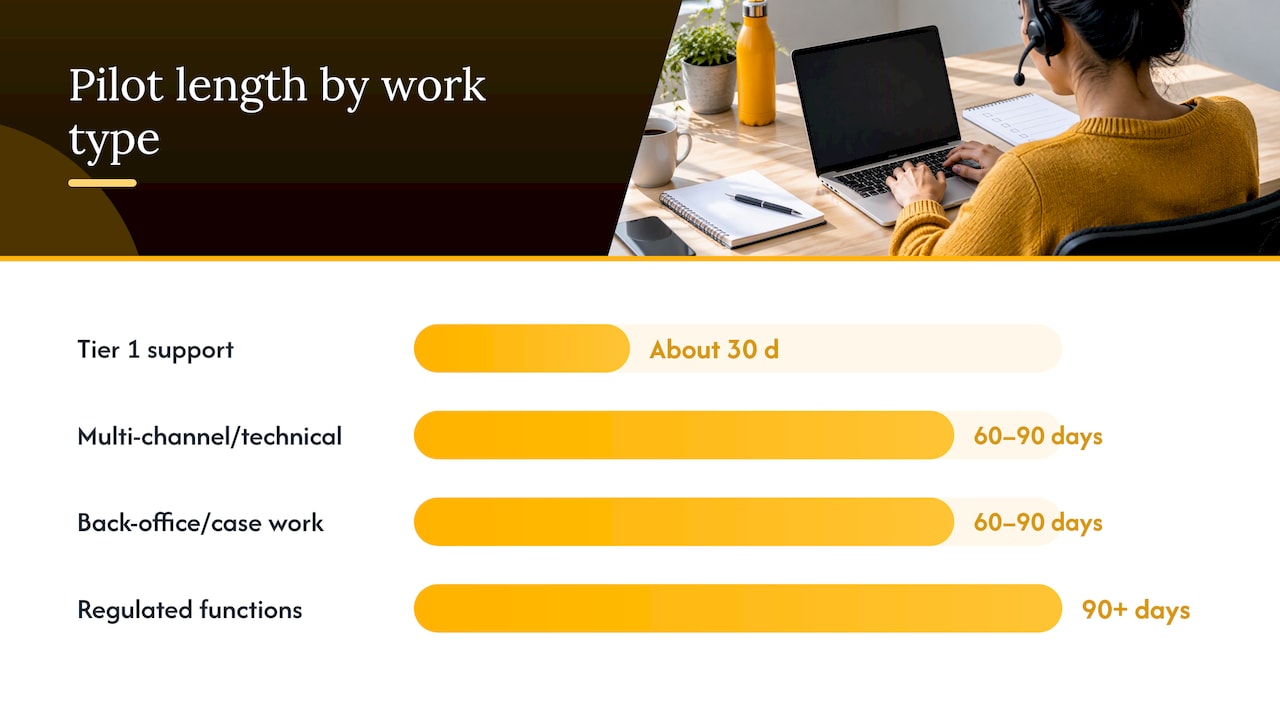
The common range is 30 to 90 days in total, which includes planning and setup, not just live operation. Short pilots, around 30 days, suit focused, lower-risk processes. A 90-day structure, often split into planning, setup and live pilot phases of about 30 days each, is more typical for complex, high-touch work.
Here is a practical way to match duration to the work:
| Work type | Typical pilot length | What drives it |
|---|---|---|
| Single-channel tier 1 support, stable scripts | About 30 days | Fast onboarding, high volume, simple metrics |
| Multi-channel support or technical assistance | 60 to 90 days | Training depth, tool access, escalation paths |
| Back-office or case-based work | 60 to 90 days | Longer cycle times, quality sampling, rework rates |
| Regulated or sensitive functions | 90 days or more | Due diligence, contract terms, compliance review |
These are planning ranges, not rules. Count backward from the decision date you need, and make sure the live window is long enough to include at least one full business cycle for your work: month-end, a promotion, a billing run, a seasonal peak.
If you want a detailed template for a shorter window, our guide to running a 4 to 8 week co-sourcing customer support pilot lays out the cadence week by week.
Build the pilot in five steps
1. Set objectives and a baseline
Before anything starts, record your current numbers on the chosen scope: first-contact resolution, average handle time, quality score, CSAT, backlog, cost per contact. Without a baseline, you will be arguing about improvement from memory.
State two or three objectives in plain terms. “Match in-house quality at lower cost per resolved contact” is testable. “Improve customer experience” is not.
2. Write the scorecard and the gates
Every metric needs a definition, a data source, a target and an owner. Then define gates: the thresholds that decide what happens next.
- Scale: targets met on quality and service levels for a set number of consecutive weeks.
- Extend and fix: targets missed in identifiable, correctable areas, with a dated remediation plan.
- Stop: quality or compliance misses that persist after the fix window.
Healthcare founders face the same discipline when they run hospital pilots, and the thinking carries over. This piece on evidence stages and gates for pilots is a useful frame for setting objectives, performance measures and readiness checks before you commit more.
3. Prepare the environment
This is where timelines slip. Provision system access, security approvals, call recording and QA tooling, and make sure your documentation is in a state a new team can actually use. A short list:
- Named project lead and team leads on both sides
- Access to CRM, ticketing, telephony and knowledge base
- Current SOPs, escalation matrix and tone-of-voice guidelines
- Training plan with sign-off criteria before agents go live
- Reporting calendar: daily during launch, weekly after
4. Launch with a parallel run
A big-bang cutover is the riskiest way to start. A common recommendation among CX outsourcing practitioners is a parallel period of roughly two to four weeks, where your internal team and the vendor handle the same scope and you compare results directly. It adds short-term cost. It also exposes process gaps while your in-house experts are still close to the work.
Our four-phase outsourcing transition plan explains how to sequence knowledge transfer so a pilot does not become an accidental service outage.
5. Review, decide, document
Hold a formal review at the end, not a casual check-in. Walk through the scorecard against each gate, list the process fixes discovered, and record what you would change before scaling. Even if you stop, the documentation you created (SOPs, knowledge gaps, escalation rules) remains valuable.
What to measure
Pick metrics that reflect both customer outcomes and operational discipline. A balanced scorecard usually includes:
| Area | Example metrics |
|---|---|
| Quality | QA score on a calibrated rubric, error and rework rate, compliance adherence |
| Customer outcome | CSAT, first-contact resolution, complaint rate |
| Speed | Response time, handle time, backlog age |
| Reliability | Schedule adherence, attendance, service-level attainment |
| Learning | Time to proficiency, knowledge-base gaps found and closed |
| Economics | Cost per resolved contact or completed task vs. baseline |
Two cautions. First, calibrate quality scoring jointly in week one, so both sides grade the same interaction the same way. Second, watch trends, not only averages. A team that starts at 85% and climbs steadily tells a different story from one that starts at 95% and slides.
Regulated work: do the risk homework first
For financial institutions, a pilot is not an exemption from third-party risk management. The interagency guidance in OCC Bulletin 2023-17 calls for risk management that matches the risk and complexity of the relationship. In practice that means due diligence, contract provisions, ongoing oversight and contingency planning, and a clear split of responsibilities for customer complaint handling. Your compliance and legal teams should confirm what applies to your institution and to the specific function you plan to move.
The practical consequence: build due diligence and contract terms into the pilot timeline, so the first live customer interaction does not come before they are finished. Two related guides go deeper: complaint management outsourcing and fraud operations outsourcing risks.
Healthcare and legal pilots carry their own confidentiality obligations. Involve your privacy or compliance counsel before scoping work that touches patient or client information, and agree on data-handling terms before access is granted.
Common mistakes that make pilots meaningless
- Cherry-picked scope. Easy tickets produce flattering, useless results.
- No baseline. You cannot show improvement without a starting point.
- Vendor’s A-team. Ask who staffs the pilot and who staffs the contract. They should be the same profile.
- Moving goalposts. Targets changed midstream make the final decision political.
- No decision date. Pilots drift into “extended pilots” that are really unmanaged contracts.
- Ignoring the internal side. Slow approvals, missing access and stale documentation on your end distort results. Track them as well.
Our perspective: what a pilot should prove about nearshore delivery
We approach every pilot as the first chapter of a working relationship, not a sales hurdle. Altiam CX is a nearshore customer experience and operational services partner, and the things we think a good pilot should surface are the same things that make nearshore delivery valuable or not: cultural alignment with your customers, bilingual quality, disciplined execution and measurable performance.

So we encourage clients to test exactly those. Put bilingual interactions in scope and score them. Include the awkward, ambiguous cases. Look at how quickly the team turns feedback into changed behavior, because that speed is a better predictor of long-term performance than any week-one score. Judge us by a scorecard you wrote, not one we proposed alone.
We also think pilots should end with a decision rather than a drift. If the data says scale, we want to scale on a plan you trust. If it says fix first, we want the fixes named and dated. A pilot that exposes a gap in your own SOPs has still earned its cost.
— Daniela
Where Altiam CX fits
If you are planning a pilot in customer support, technical assistance, back-office operations or managed team extension, we can help you scope it, set the scorecard and run it with a dedicated nearshore team. Healthcare operations teams can see how we approach managed customer support and patient support with SOP management. Law practices can review our legal intake, client follow-up and back-office support offering. For everything else, start with our customer experience and managed team extension services.
Pilot readiness checklist
Before you start the clock, confirm each of these:
- Scope is defined, bounded and representative of real work
- Baseline metrics are recorded
- Scorecard, targets and scale, fix and stop gates are written and agreed
- Owners are named on both sides, with a weekly governance rhythm
- System access, security review and training sign-off are scheduled
- Compliance, privacy and contract terms are cleared for the function
- A parallel run or equivalent comparison is planned
- A decision date is set, with the people who will make the decision
FAQ
How long should an outsourcing pilot program last?
Most run 30 to 90 days in total. A focused, lower-risk process can be tested in about 30 days, while complex or high-touch operations usually need around 90 days once planning and setup are counted. Choose the length so the live window covers a full business cycle for your work.
Should a pilot be paid?
Usually yes, because you are using a dedicated team on real work, and a paid engagement keeps both sides committed to the scorecard. Terms vary by provider and scope, so agree on billing, ramp-up costs and exit terms in writing before launch.
What is a good pilot size?
Big enough that weekly metrics are statistically meaningful and representative of real work, but small enough to manage closely. One queue, one channel or one defined process is a common starting point. Include harder cases, not only routine ones.
What happens if the pilot fails?
A missed target is information. Review whether the causes were process gaps, training, tooling or the vendor’s fit, then choose to extend with a fix plan or exit. Government sourcing guidance treats a pilot as a tool for refining or pivoting, so the documentation you gather still helps your next decision.
Do regulated industries need extra steps?
Yes. Financial institutions should align with interagency third-party risk guidance, and healthcare and legal teams should clear data-handling terms with their compliance or privacy counsel. Finish due diligence and contract provisions before live work begins.
Sources
- Outsourcing Pilot Design: What It Should Actually Prove
- Testing and Piloting Services, UK government guidance note
- Third-Party Relationships: Interagency Guidance on Risk Management, OCC Bulletin 2023-17
- Scale Hospital Pilots: Evidence Stages and Four Gates for Founders